Is Truth the standard for preaching in your church?
And is honesty concerning Christ a measure of your hospitality and love of other believers?
Walking in Truth and Love
Now that you are separated to holiness by the risen Jesus Christ,who must a saint believe?
NOT every Rabbi — not every Bishop, any Priest or supposed Prophet; not every emotional pastor or passing spirit-led performance; not the powerful preacher of visionary change.
Many would mislead you.
TheElder of Ephesus and nearby church gatherings of saints in first century Asia Minor had already heard of or encountered many false teachers and their heretical teachings concerning the Lord Jesus Christ.
At the time of his final epistle (most likely in the A.D. 90’s), John is the only remaining Apostle. John’s Apostolic authority is unquestionable, as is the Elder’s dedication in witness of the Way, the Truth and the Life of Christ.
Jesus said to him [the Apostle Thomas],
“I am the way, and the truth, and the life. No one comes to the Father except through me.
John 14:6 ESV
John’s witness of the Truth of Christ Jesus becomes immediately evident in this — the Apostle’s final letter.
III John
The elder
πρεσβύτερος - presbyteros - elder
to the beloved Gaius, whom I love in truth.
Beloved, I pray that in all respects you may prosper and be in good health, just as your soul prospers. For I rejoiced greatly when brothers came and bore witness to your truth, that is, how you are walking in truth.
3 John 1:2-3 NKJV
Γάϊος – Gaius
The Elder receives a letter from his dear friend [agapētos] Gaius responding positively that indeed John hopes to visit these believers personally soon after his response arrives.
Gaius is a common Greek name and he could be:
a Macedonian delegate from Derbe who earlier had accompanied Paul to Jerusalem [Acts 20:4] or
a Corinthian, one of two men baptized by Paul and/or
later, Paul’s host (the Elder or Bishop of Thessalonica) [Acts 18:7]
or possibly yet another Gaius with this common name
Referring to those Gaius leads in his local church John rejoices:
I have no greater joy than these things that I hear of my children walking in the truth.
3 John 1:4 – Darby Translation
Friendship Worthy of God
The Apostles Peter, Paul and others had been executed for their faith some twenty years ago in Rome. Many more Christians were constantly martyred in since then throughout the Empire.
The recipient of the Elder’s final epistle recognizes the witness of his hospitality to these evangelists — many who might soon die in witness to the gospel of the risen Lord Jesus Christ.
Now (sometime around the year of our Lord 90-95), John commends the faithful boldness of his dear (and probably long-time) friend Gaius.
Beloved, it is a faithful thing you do in all your efforts for these brothers, strangers as they are, who testified to your love before the church.You will do well to send them on their journey in a manner worthy of God.
3 John 1:5-7 ESV
The Elder is essentially putting his Apostolic seal of approval on the witness of these beloved, specific evangelists (missionaries).
Therefore we ought to support people like these, that we may be fellow workers for the truth.
3 John 1:8
DO NOT MISS the lasting long relationship of more than twenty years between the Elder John and Elders of other churches throughout the Roman Empire.
I have written something to the church…
.. but Diotrephes, who loves to have the preeminence among them, does not receive us.
3 John 1:9 NKJV
This is why, if I come, I will remind him of the works he is doing, slandering us with malicious words.
And he is not satisfied with that!
He not only refuses to welcome fellow believers, but he even stops those who want to do so and expels them from the church.
3 Epistle of John 1:10 CSB
The Elder has an enemy opposed to Apostolic doctrine and authority.
True saints of Christ will recognize such evil gate-keepers of false faith as an antichrist! And John intends to correct their growing heresy in person with his beloved true Christian friend Gaius.
Yield to Good but Not Evil
Here the Apostle measures this heretical behavior of Diotrephes, who stands against the true gospel of Christ. John advises his faithful friend with this Apostolic standard:
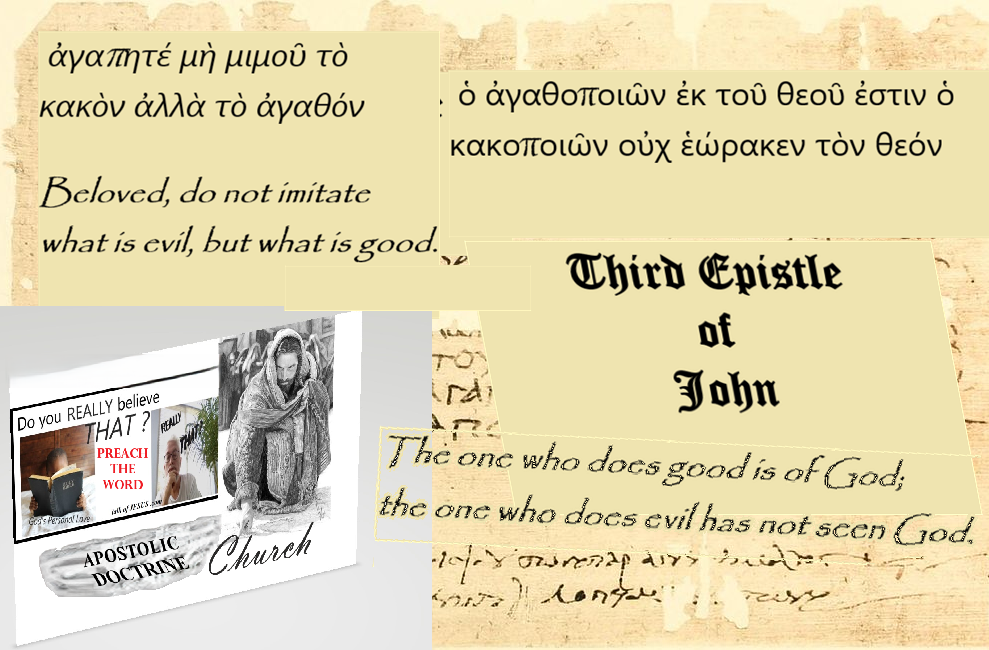
Beloved [agapētos] follow not that which is evil [kakos ], but that which is good.
3 John 1:11a KJV
Before we go forward with John's Apostolic rule, let's make certain that WE the saints of the Church understand both GOOD and EVIL.
κακός, κακῇ, κακόν, the Sept. for רָע (from Homer down), bad (A. V. (almost uniformly) evil);
(morally, i. e.) of a mode of thinking, feeling, acting; base, wrong, wicked: of persons,
universally, of a bad nature; not such as it ought to be.
John applies this to this wicked gate-keeper of his hometown church, comparing his own standard of judging who belongs in the Church and who does not to the true hospitality of of the Truth of Christ as the Shepherd of flocks, with the Apostles of Jesus as true witness of the Gospel and teachings of our Lord.
A previous warning concurrently in circulation
Although the later canon of Scripture places Revelation after this epistle (and that of Jude), some historical scholarship suggests that the Apocalypse of John may have been written prior to this brief letter — the Elder’s third epistle. Perhaps you might recognize a type of Diotrephes in the message to the angel of Ephesus:
“I know your works, your labor, your patience, and that you cannot bear those who are evil. And you have tested those who say they are apostles and are not, and have found them liars;
“and you have persevered and have patience, and have labored for My name’s sake [that of the risen Lord Jesus Christ] and have not become weary.
a primary word; “good” (in any sense, often as noun):—benefit, good(-s, things), well.
This comparison between evil and good by the Lord Jesus calls believers to faithfulness imitating God our Father in heaven.
“If you then, being evil, know how to give good gifts to your children, how much more will your Father who is in heaven give good things to those who ask Him!
Gospel of Matthew 7:11 NKJV
John in his gospel also quotes Jesus concerning good.
For as the Father has life in himself, so he has granted the Son also to have life in himself. And he has given him authority to execute judgment, because he is the Son of Man.
Do not marvel at this, for an hour is coming when all who are in the tombs will hear his voiceand come out,
those who have done good to the resurrection of life,
and those who have done evil [φαῦλος phaûlos, “foul” or “flawy”, i.e. (figuratively) wicked:—evil]
to the resurrection of judgment.
Gospel of John 5:26-29 ESV, with a definition of evil
Deciding between Friends
John writes to a mutual brother faithful to the Lord Jesus and the teaching of the Apostles. But how does the Elder (and Apostle) advise his dear friend to lead?
Short answer: enroll a second brother in the Lord known to be true to the truth of the Gospel.
Demetrius is well spoken of by everyone—and even by the truth itself. We also speak well of him, and you know that our testimony is true.
3 John 1:12 NIV
John writes briefly with all the Authorithy of Apostolic leading of the Church. He enlists allies grounded in truth. And most of all John emphasizes that he and others must confront this controversy in person (lest it get out of hand at the leading of this wicked so-called christian).
I have much to write you, but I do not want to do so with pen and ink. I hope to see you soon, and we will talk face to face.
The beloved Elder closes his final Apostolic Epistle with a seemingly common word of distant greeting; but it is indeed a peace that we do not understand and practice too little as the saints saved by the risen Christ Jesus.
is between individuals, i.e. harmony, concord; the Messiah’s peace, the way that leads to peace (salvation); the tranquil state of a soul assured of its salvation through Christ, and so fearing nothing from God and content with its earthly lot, of whatsoever sort that is; the blessed state of devout and upright men after death — as well as: a state of national tranquillity; exemption from the rage and havoc of war
Do the saints of your church struggle with this?
The Ephesians, to whom John writes did!
And the Elder adds a call to reciprocal love as well:
Our friends [Philos] salute you.
Most certainly John would recall the words of Jesus from more than sixty years ago — again and again in correspondence as well as personal encounters with his fellow believers…
Greater love hath no man than this, that a man lay down his life for his friends.G5384 Ye are my friends,G5384 if ye do whatsoever I command you.
Gospel of John 15:13-14 KJV
.. I have called you friends;G5384 for all things that I have heard of my Father I have made known unto you.
Gospel of John 15:15b – the words of JESUS to His Apostles
These things I command you, that ye love one another.
John 15:17
Philos, friend, obeys Christ’s commands of love and truth. Our salutation to each other is that of love and peace.
Greet the friends by name. Again, a mutual and personal greeting between beloved friends, this translation of ‘greet’ using the same Greek word as ‘salute.’
Certainly those receiving the Elder’s third epistle looked forward to Johns upcoming personal visit, God-willing. From the Apostle’s very lips they will receive the truth of Christ and follow The Way prescribed by John and the Apostles of JESUS.
Would your church welcome the Elder IF the Apostle John and his friends were coming to challenge an errant teacher or preacher of your local gathering?
It was a tragic punishment of the Jews to be exiled, it would become a tragic consequence for a church which would later abandon truth for control in a medieval world.
He who saw this has testified so that you also may believe. His testimony is true, and he knows he is telling the truth.
I have no greater joy than this: to hear that my children are walking in truth.
Gospel of John 19:35; Third Epistle of John 1:4 CSB
From familiar Scripture as a young man near Jesus,
or an old man on Patmos;
or do you see a faithful man following Jesus on an extraordinary journey lasting many years?
INTRODUCTION to JOHN’s Apostolic Faith
late A.D. 20’s at the Jordan river near Bethany
John was there again with two of his disciples. When he saw Jesus walking by, he said, “Look, the Lamb of God!” And when the two disciples heard him say this, they followed Jesus.
Jesus turned and saw them following.
“What do you want?”
“Rabbi”
“where are You staying?”
“Come and see,”
So they went and saw where He was staying, and spent that day with Him.
Gospel of John 1:35-39 excerpt, BSB
James and his young brother John were not sleeping when the Messiah of Israel came to their Rabbi, John the Baptist.
In fact, these two sons of Zebedee had sought the savior of Israel, and then found and followed John the Baptist (who many Jews believed could be the one).
Then they would join the Master of whom John spoke, and follow Him when the Lord sought His own disciples from their own little fishing village far removed from Jerusalem.
Introduction to Jesus’ Disciple John
John is a familiar and beloved Disciple of Jesus, well-known to Christians and unbelievers alike through the Gospels, as well as numerous illustrations and paintings often commissioned by the Roman or OrthodoxChurch many centuries later.
~ in the year of our Lord 30
He and others likely didn't have a visible halo over their heads. And art such as DaVinci's, 'The Last Supper,' — with young John clinging to Jesus, which illustrates John's actual devotion — shows a long table and chairs never used in upper rooms of the A.D. first century.
A.D. 30’s – A.D. 50’s
Perhaps Christians will recall that prior to His crucifixion, JESUS sent the Twelve out to some cities to proclaim the Gospel.
And some may recall that the APOSTLE John was with Peter when both Apostles had been sent to preach in the Temple after Pentecost (~A.D. 30), were witnessed to work miracles.
“How is it that each of us can hear them in our own native language?
Followers of Jesus Christ in these last days will generally picture the Apostle Jesus loved as he began his faithful path of life in the early years of John’s life (when he was only in his twenties).
Even in Acts of the Apostles, our early focus turns from Peter (and John, somewhat) primarily to Paul.
Although John’s Gospel details key witness of the Lord Jesus Christ prior to the Lord’s death, resurrection and ascension, the Apostle wrote his Gospel for the Church many years later, around the year of our Lord (A.D.) 85 – fifty some years after Pentecost.
~ A.D. 50 – ~ A.D. 100
The Apostle John wrote his final letters near the end of the A.D. First Century!
Written between a mid-first century Council in Jerusalem and his own natural death near the end of the A.D. First Century, the Epistles of John reveal a familiar festering of indignancy between Jerusalem’s Jews and occupying Roman legions.
Christians were caught in a new light leading them to dangerous intersections of worldly clashes affecting the lives of Jews, Romans, Greeks and every saint seeking Christ.
Pictured: A.D. 70 burning of the Temple in Jerusalem by the occupying Roman army.
Writing to the Jews, the saints and the Romans
The saints of the Church witnessed Apostolic faith in a Roman governed world with diminished Jewish influence throughout Syria, Asia, and Europe (including Rome) — and even in Rome’ s local Herodian tetrarchies which included Galilee and Judea, with the city of Jerusalem.
The Apostle John wrote to saints who came to Christ from all of these varied backgrounds — saints and their Elders new to the Gospel, in need of sound teaching and vulnerable to temptations of false teaching.
Introduction to John’s Epistles
In order to further understand a turbulent historic setting for this SERIES on the final LETTERS of JOHN, we will first take a brief look at the first century Church and also look ahead to John’s other well-quoted book, Revelation.
FINALLY — with God’s help and that of theologians more studied than me —I hope to tie it all together by studying the two briefest letters in the New Testament: the Epistles of Second John and Third John.
COMMMENT with your QUESTIONS and observations about the THREE Letters of John at anytime. Your input may be important to our understanding of John's letters.
NEXT: Reintroducing John, the man, disciple, Apostle and Elder
God and Christ became incarnate in order to restore Their personal relationship with sinful man.
Roger@TallkofJesus.com
God and Apostles, Disciples of men
Our purpose in introducing Paul’s final epistle to a pastor is:
1. to reintroduce you to the Apostle Paul and
2. to reacquaint you with Timothy, a disciple of Paul who served him in varying roles,
BOTH whom we’ve met in Acts of the Apostles and other epistles.
Let us begin with God
(says the teacher to his class).
God — YHWH the LORD — Is One.
One in Being. One in Essence. One in Substance.
There IS no other god.
God IS the Creator of all things and of all mankind.
He had a relationship in the beginning of time — before which He Exists and after which He Exists — the LORD’s relationships are perfectly personal.
God IS: Father, Son — Jesus Christ, and the Holy Spirit.
Christ, Apostles and Disciples
The Apostle Paul writes to Timothy in his first epistle:
This is a faithful saying and worthy of all acceptance, that Christ Jesus came into the world to save sinners, of whom I am chief.
First letter of the Apostle Paul to Timothy
Jesus, the incarnate Son of God the Father, taught the Gospel with all perfection to men for three years.
The Twelve Disciples (which included neither Paul nor Timothy) followed the Lord, ate and slept with Jesus — they all knew the incarnate Son of God personally.
Consider the interpersonal relationships connecting each of these roles as defined by Scripture and what the Lord Jesus, our Teacher, instructs:
Disciple (follower), Master (teacher), Servant (slave) and Lord
The Disciples Matthew, John and Peter were all present with the incarnate Christ Jesus personally when the Lord said this:
The disciple is not above his master, nor the servant above his lord.
Gospel of Matthew 24:14 – Jesus’ to The Twelve Disciples; Instructions for Service & meaning of discipleship – KJV
The Twelve followed JESUS for three years, discipleship at its most personal.
Furthermore, many others would follow JESUS’s teachings as ‘Christians’ chosen by God for the Way of eternal life.
Apostles to the Jews and Gentiles
Of course from the beginning Jesus knew that Judas would betray Him and that a disciple Mathias would be chosen to replace the betrayer of Christ as a twelfth Apostle to the Jews.
Christ had taught and trained the Twelve how they would become Apostles — primarily, but not exclusively, to their fellow Jews —after His death, resurrection and ascension.
Simon Peter, a servant and an apostle of Jesus Christ, to them that have obtained like precious faith with us through the righteousness of God and our Saviour Jesus Christ:
2 Peter 1:1 KJV
Paul also refers to himself as an Apostle, greeting his disciples (followers) in his first epistle and this final letter.
Paul, an apostle of Jesus Christ by the will of God, according to the promise of life which is in Christ Jesus,
To Timothy, my dearly beloved son:
2 Timothy 1:1-2a KJV
So who are apostles?
Apostolos – a delegate, messenger, one sent forth with orders
specifically applied to the twelve apostles of Christ
in a broader sense applied to other eminent Christian teachers
– of Barnabas of Timothy and Silvanus
Apostles are ‘sent out’ by Christ.
As in the case of the Twelve and the Apostle Paul, the Lord himself instructed them Personally — that is, the Person of Jesus sent these Apostles out into the world personally.
Other apostles continued to be ‘sent out into all the world’ by the Holy Spirit after Jesus’ ascension, as Luke records for us of the day of Pentecost in ACTS 1.
As we learned from Acts of the Apostles that after the AD 49 Council in Jerusalem, Peter, Paul, John and all others were sent out ‘first to the Jews,’ but also into gentile areas of the Roman Empire (mostly Hellenist or Greek provinces) to include ALL as follows of Christ as part of each local church.
Jesus is Lord
Note that Jesus Christ refers to the Father as Lord (Kyrios in their common Greek language of the Roman Empire) with an authority and meaning no different than the original Hebrew scripture (Yahweh).
“Teacher, which is the great commandment in the Law?”
And He said to him,
“‘YOU SHALL LOVE THE LORD YOUR GOD WITH ALL YOUR HEART, AND WITH ALL YOUR SOUL, AND WITH ALL YOUR MIND.’
Matthew 22:36-37 LSB
Saul, a Jew of Jews, sent out by a Master crucified and risen!
About five years after the Jews of Jerusalem had crucified Jesus, a young disciple of Gamaliel witnessed the stoning of a follower of The Way.
They went on stoning Stephen as he was calling out and saying, “Lord Jesus, receive my spirit!” Then falling on his knees, he cried out with a loud voice, “Lord, do not hold this sin against them!” And having said this, he fell asleep.
Acts of the Apostles 7:59-60 LSB
Stephen, even in his dying breath, called JESUS, “Lord” – twice.
And this young disciple of the rabbi Gamaliel had witnessed it personally.
Saul of Tarsus would become an apostle of the Sanhedrin specifically sent out to continue persecuting Christians.
But then, as we know, Christ appeared to Saul and instructed this new and unwilling (at first) Apostle to go to the Gentiles.
Paul frequently writes that He is a slave (doulos) of JESUS or God(or of the gospel). The Lord Jesus himself points to the service required of this most personal relationship.
Many translations prefer servant to slave, but it is the same Greek word: doulos.
The disciple is not above his master, nor the servant above his lord.
The Apostle Paul describes himself in another pastoral epistle written about the same time as his two letters to Timothy:
Paul, a servantG1401of God, and an apostle of Jesus Christ, according to the faith of God’s elect, and the acknowledging of the truth which is after godliness;
Epistle of Paul to Titus 1:1
Timothy – Paul enlists a disciple of The Way
Now Paul also arrived at Derbe and at Lystra.
And behold, a disciple was there, named Timothy,
the son of a Jewish woman who was a believer,
but his father was a Greek,
Acts of the Apostles 16:1
During Paul’s second missionary journey, which had begun inland through the mountains northwest of Tarsus in rural Galatia. While visiting churches established by Barnabas and him on a first missionary journey, the Apostle meets a young Timothy — a Greek, because of his father, but brought up as a Christ-follower by his mother(a Jew, as Paul had been) and Timothy’s grandmother.
A brief introduction of Timothy (Τιμόθεος – Timotheos)
Timothy joined Paul and Silas on mission, staying behind at Berea for a time with Silas. Paul, later commands the two by the Spirit to join him in Athens from where the trio proceed to Macedonia.
Paul then ‘sent into Macedonia two of them that ministered unto him, Timotheus and Erastus; but he himself stayed in Asia for a season.
Acts 19:22 KJV
We observe how personal all of the mentoring relations of the Apostle remain to Paul as Luke records those with the Apostle when once again the Jews laid wait to capture and kill him.
Paul was accompanied by Sopater son of Pyrrhus from Berea,
We will mention more of Timothy's crucial later pastoral roles later in this epistle.
Timothy wrote other epistles with Paul :
It is important for us to note that these Pastoral Epistles make known the Spirit-directed teaching of the Apostle Paul we must study, rather than focus on any pastors or saints to whom Paul writes, such as Timothy.