Tag: beloved

  • 3 John – When Truth Prevails Among Friends

    3 John – When Truth Prevails Among Friends

    Is Truth the standard for preaching in your church?

    And is honesty concerning Christ a measure of your hospitality and love of other believers?


    Walking in Truth and Love

    Now that you are separated to holiness by the risen Jesus Christ, who must a saint believe?

    NOT every Rabbi — not every Bishop, any Priest or supposed Prophet; not every emotional pastor or passing spirit-led performance; not the powerful preacher of visionary change.

    Many would mislead you.

    map of Ephesus near the churches where John was an Elder "an epistle from John - Elder to the Churches 1 John 2 john 3 John

    The Elder of Ephesus and nearby church gatherings of saints in first century Asia Minor had already heard of or encountered many false teachers and their heretical teachings concerning the Lord Jesus Christ.

    At the time of his final epistle (most likely in the A.D. 90’s), John is the only remaining Apostle. John’s Apostolic authority is unquestionable, as is the Elder’s dedication in witness of the Way, the Truth and the Life of Christ.

    Jesus said to him [the Apostle Thomas],

    “I am the way, and the truth, and the life. No one comes to the Father except through me.

    John 14:6 ESV

    John’s witness of the Truth of Christ Jesus becomes immediately evident in this — the Apostle’s final letter.

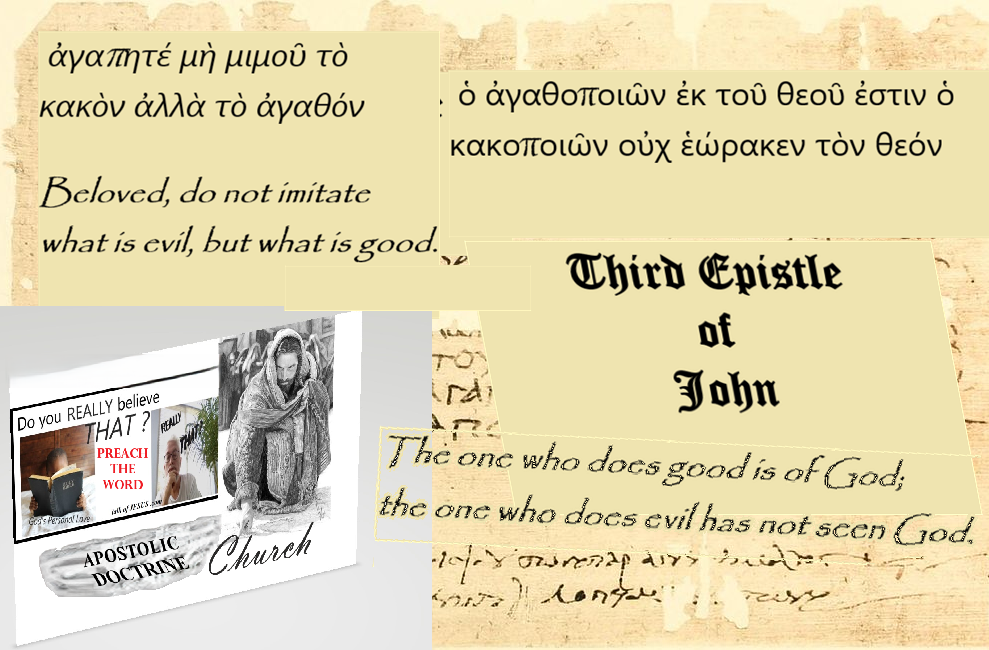
    Third Epistle of John Do you really believe that? The one who does good is of God; the one who does evil has not seen God.

    III John

    The elder

    πρεσβύτερος - presbyteros - elder

    to the beloved Gaius, whom I love in truth.

    Beloved, I pray that in all respects you may prosper and be in good health, just as your soul prospers. For I rejoiced greatly when brothers came and bore witness to your truth, that is, how you are walking in truth.

    3 John 1:2-3 NKJV


    Γάϊος – Gaius

    The Elder receives a letter from his dear friend [agapētos] Gaius responding positively that indeed John hopes to visit these believers personally soon after his response arrives.

    Gaius is a common Greek name and he could be:

    • a Macedonian delegate from Derbe who earlier had accompanied Paul to Jerusalem [Acts 20:4] or
    • a Corinthian, one of two men baptized by Paul and/or
    • later, Paul’s host (the Elder or Bishop of Thessalonica) [Acts 18:7]
    • or possibly yet another Gaius with this common name
    Referring to those Gaius leads in his local church John rejoices: 

    I have no greater joy than these things that I hear of my children walking in the truth.

    3 John 1:4 – Darby Translation


    Friendship Worthy of God

    The Apostles Peter, Paul and others had been executed for their faith some twenty years ago in Rome. Many more Christians were constantly martyred in since then throughout the Empire.

    The recipient of the Elder’s final epistle recognizes the witness of his hospitality to these evangelists — many who might soon die in witness to the gospel of the risen Lord Jesus Christ.

    Now (sometime around the year of our Lord 90-95), John commends the faithful boldness of his dear (and probably long-time) friend Gaius.

    Beloved, it is a faithful thing you do in all your efforts for these brothers, strangers as they are, who testified to your love before the church.You will do well to send them on their journey in a manner worthy of God.

    3 John 1:5-7 ESV

    The Elder is essentially putting his Apostolic seal of approval on the witness of these beloved, specific evangelists (missionaries).

    Therefore we ought to support people like these, that we may be fellow workers for the truth.

    3 John 1:8

    DO NOT MISS the lasting long relationship of more than twenty years between the Elder John and Elders of other churches throughout the Roman Empire.


    Followers of Christ must always expect an attack against Scripture. Church doctrine is a line in the sand. - How will a leader or council of leaders choose what the Church will teach?

    I have written something to the church

    .. but Diotrephes, who loves to have the preeminence among them, does not receive us.

    3 John 1:9 NKJV

    This is why, if I come, I will remind him of the works he is doing, slandering us with malicious words.

    And he is not satisfied with that!

    He not only refuses to welcome fellow believers, but he even stops those who want to do so and expels them from the church.

    3 Epistle of John 1:10 CSB


    The Elder has an enemy opposed to Apostolic doctrine and authority.

    True saints of Christ will recognize such evil gate-keepers of false faith as an antichrist! And John intends to correct their growing heresy in person with his beloved true Christian friend Gaius.

    Yield to Good but Not Evil

    Here the Apostle measures this heretical behavior of Diotrephes, who stands against the true gospel of Christ. John advises his faithful friend with this Apostolic standard:


    Beloved [agapētos] follow not that which is evil [kakos ], but that which is good.

    3 John 1:11a KJV

    Before we go forward with John's Apostolic rule, let's make certain that WE the saints of the Church understand both GOOD and EVIL. 

    Many versions of 3 John v.11 read:

    do not imitate what is evil

    Strong’s G2556 – kakos

    κακός, κακῇ, κακόν, the Sept. for רָע (from Homer down), bad (A. V. (almost uniformly) evil);

    (morally, i. e.) of a mode of thinking, feeling, acting; base, wrong, wicked: of persons,

    universally, of a bad nature; not such as it ought to be.

    John applies this to this wicked gate-keeper of his hometown church, comparing his own standard of judging who belongs in the Church and who does not to the true hospitality of of the Truth of Christ as the Shepherd of flocks, with the Apostles of Jesus as true witness of the Gospel and teachings of our Lord.


    A previous warning concurrently in circulation

    Although the later canon of Scripture places Revelation after this epistle (and that of Jude), some historical scholarship suggests that the Apocalypse of John may have been written prior to this brief letter — the Elder’s third epistle. Perhaps you might recognize a type of Diotrephes in the message to the angel of Ephesus:

    “I know your works, your labor, your patience, and that you cannot bear those who are evil. And you have tested those who say they are apostles and are not, and have found them liars;

    “and you have persevered and have patience, and have labored for My name’s sake [that of the risen Lord Jesus Christ] and have not become weary.

    The Revelation of Jesus Christ to John 2:2-3 NKJV

    but imitate good

    ἀγαθός – Strong’s G18 – agathos

    a primary word; “good” (in any sense, often as noun):—benefit, good(-s, things), well.


    This comparison between evil and good by the Lord Jesus calls believers to faithfulness imitating God our Father in heaven.

    “If you then, being evil, know how to give good gifts to your children, how much more will your Father who is in heaven give good things to those who ask Him!

    Gospel of Matthew 7:11 NKJV

    John in his gospel also quotes Jesus concerning good.

    For as the Father has life in himself, so he has granted the Son also to have life in himself. And he has given him authority to execute judgment, because he is the Son of Man.

    Do not marvel at this, for an hour is coming when all who are in the tombs will hear his voice and come out,

    those who have done good to the resurrection of life,

    and those who have done evil [φαῦλος phaûlos, “foul” or “flawy”, i.e. (figuratively) wicked:—evil]

    to the resurrection of judgment.


    Gospel of John 5:26-29 ESV, with a definition of evil


    Deciding between Friends

    John writes to a mutual brother faithful to the Lord Jesus and the teaching of the Apostles. But how does the Elder (and Apostle) advise his dear friend to lead?

    Short answer: enroll a second brother in the Lord known to be true to the truth of the Gospel.

    Demetrius is well spoken of by everyone—and even by the truth itself. We also speak well of him, and you know that our testimony is true.

    3 John 1:12 NIV

    John writes briefly with all the Authorithy of Apostolic leading of the Church. He enlists allies grounded in truth. And most of all John emphasizes that he and others must confront this controversy in person (lest it get out of hand at the leading of this wicked so-called christian).

    I have much to write you, but I do not want to do so with pen and ink. I hope to see you soon, and we will talk face to face.

    3 John 1:13-14a NIV


    εἰρήνη – eirēnēPeace

    The beloved Elder closes his final Apostolic Epistle with a seemingly common word of distant greeting; but it is indeed a peace that we do not understand and practice too little as the saints saved by the risen Christ Jesus.

    εἰρήνῃ σοί ἀσπάζονταί σε, οἵ φίλοι ἀσπάζου τούς φίλους κατ᾽ ὄνομα

    • Peace be to thee.
    • Our friends salute thee.
    • Greet the friends by name.

    3 John closing salutation – King James Version

    From Strong’s G1515 – eirēnē, PEACE

    is between individuals, i.e. harmony, concord; the Messiah’s peace, the way that leads to peace (salvation); the tranquil state of a soul assured of its salvation through Christ, and so fearing nothing from God and content with its earthly lot, of whatsoever sort that is; the blessed state of devout and upright men after death — as well as: a state of national tranquillity; exemption from the rage and havoc of war

    Do the saints of your church struggle with this?

    The Ephesians, to whom John writes did!


    And the Elder adds a call to reciprocal love as well:

    Our friends [Philos] salute you.

    Most certainly John would recall the words of Jesus from more than sixty years ago — again and again in correspondence as well as personal encounters with his fellow believers…

    Greater love hath no man than this, that a man lay down his life for his friends. G5384 Ye are my friends, G5384 if ye do whatsoever I command you.


    Gospel of John 15:13-14 KJV

    .. I have called you friends; G5384  for all things that I have heard of my Father I have made known unto you.

    Gospel of John 15:15b – the words of JESUS to His Apostles

    These things I command you, that ye love one another.

    John 15:17

    Philos, friend, obeys Christ’s commands of love and truth. Our salutation to each other is that of love and peace.


    Greet the friends by name. Again, a mutual and personal greeting between beloved friends, this translation of ‘greet’ using the same Greek word as ‘salute.’

    Certainly those receiving the Elder’s third epistle looked forward to Johns upcoming personal visit, God-willing. From the Apostle’s very lips they will receive the truth of Christ and follow The Way prescribed by John and the Apostles of JESUS.


    Apostles' Creed - TalkofJESUS.com Doctrine

    Would your church welcome the Elder IF the Apostle John and his friends were coming to challenge an errant teacher or preacher of your local gathering?


    What has happened to the TRUTH

    among worshippers of God?

    Each one betrays his friend;

    no one tells the truth.

    They have taught their tongues to speak lies;

    they wear themselves out doing wrong.

    Jeremiah 9:5 CSB

    It was a tragic punishment of the Jews to be exiled, it would become a tragic consequence for a church which would later abandon truth for control in a medieval world.

    He who saw this has testified so that you also may believe. His testimony is true, and he knows he is telling the truth.


    I have no greater joy than this: to hear that my children are walking in truth.

    Gospel of John 19:35; Third Epistle of John 1:4 CSB

    APOSTOLIC FAITH 2 Peter 2 Timothy from Paul 2 John & 3 John

    Comment on Scripture – Share the Gospel

    Talk of JESUS . com

  • II Timothy i beloved son of Paul

    II Timothy i beloved son of Paul

    a second epistle of the Apostle Paul from Rome: to Timothy

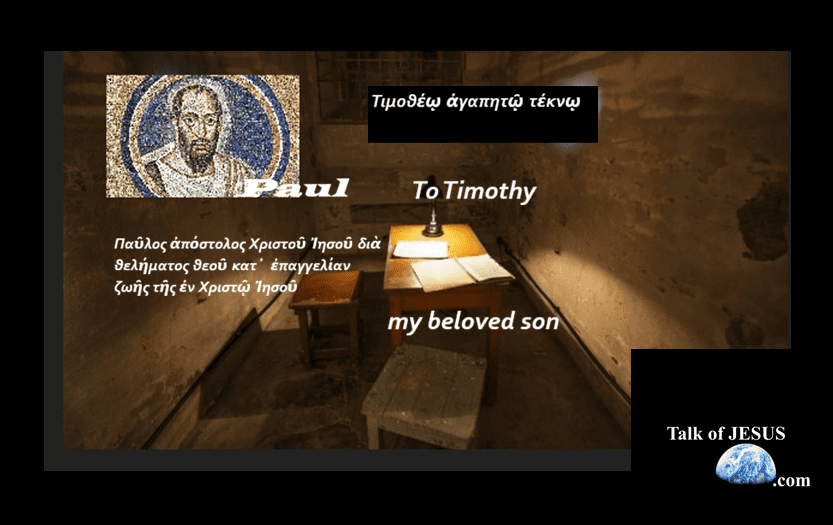
    Τιμοθέῳ ἀγαπητῷ τέκνῳ

    χάρις ἔλεος εἰρήνη ἀπὸ θεοῦ πατρὸς καὶ Χριστοῦ Ἰησοῦ τοῦ κυρίου ἡμῶν

    To Timothy, my dearly beloved son:

    Grace, mercy, and peace, from God the Father and Christ Jesus our Lord.

    2 Timothy 1:2 KJV


    Timothy, beloved son of an Apostle

    Paul is about to send Timothy out as his continued Apostolic voice to a next generation of faithful believers.

    Last Will and Testament of Simon Peter - Talk of Jesus

    “Dearly BELOVED..”

    Do any recognize the greeting of such intimately connected believers so joined in Christ Jesus? 

    This is how Paulos, a Jew of Cilicia, addresses his Galatian gentile protege Timotheus


    Greek by heritage of his father (apparently deceased or absent) and raised Jewish by the faith of his Grandmother Lois and convert mother, Eunice (as we detailed in our Introduction)


    as his SON, a beloved and chosen adoptive son — not just an exceptional student and faithful follower.

    τέκνον – teknon – child or son

    • Strong’s G5043 – teknon – “a child” (akin to tikto, “to beget, bear”), is used in both the natural and the figurative senses. In contrast to huios, “son” (see below), it gives prominence to the fact of birth, whereas huios stresses the dignity and character of the relationship. Figuratively, teknon is used of “children” of
    • (a) God, Jhn 1:12;
    • (b) light, Eph 5:8;
    • (c) obedience, 1Pe 1:14;
    • (d) a promise, Rom 9:8; Gal 4:28;
    • (e) the Devil, 1Jo 3:10;
    • (f) wrath, Eph 2:3;
    • (g) cursing, 2Pe 2:14;
    • (h) spiritual relationship, 2Ti 2:1; Phm 1:10.
      • (2X from the Pastoral Epistles of Paul)
    • See DAUGHTER, SON.

    Vine’s Expository Dictionary of New Testament Words

    As mentioned in our introduction to Timothy, the Apostle Paul has adopted this young man of Galatia and mentored him along with others as trusted servants, sons and companions in his apostolic mission to the Gentiles.


    Historical Context:

    2 Timothy was likely written around AD 67, during Paul’s second imprisonment in Rome, shortly before his martyrdom. This period was marked by intense persecution of Christians under Emperor Nero. Paul, aware of his impending death, writes with a sense of urgency and finality.

    Audience and Purpose:

    Paul’s second letter to Timothy, left in Ephesus to oversee the church, guides both him and the broader Christian community. It encourages church leaders and believers in the face of persecution. Paul urges Timothy to protect the gospel, endure hardships, and teach sound doctrine.

    source: BibleHub.org

    As to the role of Timothy to the Church, we might in a later era address this esteemed son of the Apostle to the Gentiles as Bishop Timothy of Ephesus,

    The Apostle Paul most likely sent his first letter to the Corinthians from Ephesus

    or possibly Arch-Bishop Timotheus of Asia.

    the Apostle Paul begins his 3rd missionary journey by land traveling from Antioch Syria to Ephesus in Asia Minor

    But regardless of Timothy’s personal importance to Paul as a fellow servant of Christ and the Gospel, you can see from the definition of son above that his spiritual relationship to the Apostle and Christ’s Church stand foremost to any role of administrative authority (which he had, as did the Apostle Paul) or imaginative royal-like religious title.

    But on taking leave of them he said, “I will return to you if God wills,” and he set sail from Ephesus. Conclusion of the second missionary journey of Paul from Acts 18
    and he set sail from Ephesus.

    From Personal Sonship to Apostolic Responsibility for the Gospel

    In the fifteen or so years since Timothy as a young man had first followed and served Paul, he has proven himself faithful, and a capable pastor (or shepherd trusted with local flocks of followers of The Way, loyal to Paul and true to the Gospel of Jesus Christ.

    Hence I remind you to rekindle the gift of God that is within you through the laying on of my hands;

    2 Timothy 1:6 RSV

    “.. rekindle the gift of God that is within you..” – the word Paul uses here in this introduction of his pastoral epistle is: anazōpyreō

    – stir up that by which the fire is kindled anew or lighted up, a pair of bellows);

    Don’t you love Paul’s imagery of a fire of holiness, perhaps neglected and cooling to Christ as its last embers of your faith — REKINDLING through the Holy Spirit (received by the Apostle’s laying on of hands)?

    Of course you know Paul’s word for ‘the gift of God’ – the charisma of Theos.

    Paul reminds by building up in the power of the faith already well-known in and to Timothy: 

    for God did not give us a spirit of timidity

    that is, fearfulness of cowardice 

    but a spirit of power and love and self-control.

    THREE gifts of the Spirit required of pastors and the faithful of the flock of every church.

    • dynamis – strength power and ability
    • agapē – (not just any love, but agapē love) – affection, benevolence, good will, charity, love for the brothers and sisters of the church
    • sōphronismos – The KJV translates as sound mind (1x).
      • (this you may not know and in this the saints so often find ourselves lacking)
      • an admonishing or calling to soundness of mind, to moderation and self-control

    Power in the Spirit, Agape Love and a yielding of the mind to God

    Several missionary stops of the apostle Paul before going to Rome - Acts of the Apostles

    Paul could have easily been forgotten in his prison cell in Rome, even more distant in Europe across the Aegean — than Derbe and Antioch from Ephesus, all in Asia where Timothy remains pastoring the church.

    Therefore, be not ashamed

    So the Apostle writes:

    Do not be ashamed then of testifying to our Lord, nor of me his prisoner, but share in suffering for the gospel in the power of God, who saved us and called us with a holy calling,

    not in virtue of our works but in virtue of his own purpose and the grace which he gave us in Christ Jesus ages ago, and now has manifested through the appearing of our Savior Christ Jesus, who abolished death and brought life and immortality to light through the gospel.

    2 Timothy 1:8-10 RSV


    The faithful and unfaithful to Paul and Apostolic faith

    Paul is about to begin an important point and reason for this second epistle (which we will study more next time), but here he lists some remembered for their works. 
    Coasts of Asia Minor along the Aegean Sea

    This you know, that all those in Asia have turned away from me,

    among whom are Phygellus and Hermogenes.


    The Lord grant mercy to the household of Onesiphorus, for he often refreshed me, and was not ashamed of my chain;

    Circus Maximus - Rome and model of surrounding city of Rome

    but when he arrived in Rome, he sought me out very zealously and found me.

    The Lord grant to him that he may find mercy from the Lord in that Day—and you know very well how many ways he ministered to me at Ephesus.

    2 Timothy 1:15-18 NKJV


    NEXT: For this Gospel I was appointed


    Comment on Scripture – Share the Gospel


  • Members in Christ’s body the Church

    Members in Christ’s body the Church

    And when he had given thanks, he brake it, and said, Take, eat: this is my body, which is broken for you: this do in remembrance of me.

    1 Corinthians 12:11 KJV – Paul quoting the Lord Jesus

    Paul now draws a picture of the human body in order that members of the body of believers might see our own part in the larger Church in Corinth and all places where the saints gather in Christ’s Name.

    Previously, when we departed from here in the Apostle’s instructions to the Corinthians, Paul instructs:


    And there are differences of administrations, but the same Lord.

    1 Corinthians 12:5 KJV

    One Body, many Members, different spiritual Gifts

    Now to each is given the manifestation of the Spirit, for the common profiting.

    1 Corinthians 12:7 BLB

    The first implication of this: EACH member of the body of your church and mine will show (manifest) some fruit of the Spirit.

    But one and the same Spirit works all these things, distributing to each one individually just as He wills.

    1 Corinthians 12:11 LSB

    Who belongs as members?

    IF someone in your church does not yet manifest any fruit of the Spirit, is it possible that the Lord has not given them the Spirit OR made these a part of His Body - a member of His Church? 

    Are even the best spiritualities of faithful jews and religious adherents of Islam connected to the body of our Lord Christ Jesus?

    Do the best of Hindus Buddhists and other pagan worshipers not oppose Christ?

    Yet some are drawn by the Spirit.

    The Body of Christ

    For just as the body is one, and has many members, and all the members of the body being many are one body, so also is Christ.

    1 Corinthians 12:12 Berean Standard Bible

    Jews and Gentiles

    map of the Aegean ~200 BC Corinth in the Achean League 
between Alexander the Great and Julius Caesar
    What is the overriding context of this epistle Paul writes to a church on the Achaian peninsula of Greece ? 

    The Apostle to the Gentiles (Hellenists or Greek or Roman) -- seeks to heal long-standing differences in this large Roman city of Corinth situated in the philosophic and cultural center of ancient Europe.
    • To one there is given through the Spirit a message of wisdom – v.8 (quite Hellenist)
    • to another faith.. to another gifts of healing v.9 (the One God of the Jews and ignored signs of the Messiah)

    For by one Spirit we were all baptized into one body—whether Jews or Greeks, whether slaves or free—and have all been made to drink into one Spirit.

    1 Corinthians 12:13 NKJV

    Invisible fruit pictured in the body

    brain and connection to the body

    For the body does not consist of one part, but of many. 1 Corinthians 12:14 BSB

    If the foot should say, “Because I am not a hand, I do not belong to the body,” that would not make it any less a part of the body?

    And if the ear should say, “Because I am not an eye, I do not belong to the body,” that would not make it any less a part of the body.

    • If the whole body were an eye, where would the sense of hearing be?
      • (Now think of the body of Christ, the church.)
    • If the whole body were an ear, where would the sense of smell be?
    Laughable! Hyperbole, yet logical.

    But now hath God set the members

    (And the Spirit of God has distributed your spiritual gifts.)

    But now hath God set the members every one of them in the body, as it hath pleased him.

    How strange a body would be if it had only one part!

    1 Corinthians 12:18 KJV and 12:19 NLT

    Do you get both the seriousness and Paul's practical ridicule of members di-vi-ded by spiritualities God granted to others? 
    The Apostle to the gentiles continues his illustration: 
    • The eye cannot say to the hand, “I do not need you.”
    • Nor can the head say to the feet, “I do not need you.”

    Here is Paul’s appeal to draw near to your members divided by opinions concerning spiritual gifts and an order of regulating the body (so to speak).


    On the contrary, the parts of the body that seem to be weaker are indispensable, and the parts we consider less honorable, we treat with greater honor. And our unpresentable parts are treated with special modesty, whereas our presentable parts have no such need.

    But God has composed the body and has given greater honor to the parts that lacked it, so that there should be no division in the body, but that its members should have mutual concern for one another.

    If one part suffers, every part suffers with it; if one part is honored, every part rejoices with it.

    1 Corinthians 12:22-26 BSB


    Appointment of the Greater Gifts

    The Apostle sent out to the Corinthians, Achaeans, Greeks, Romans and displaced Jews suggests an order of importance in the A.D. first century church. Yet Paul has just instructed the saints that it is the Spirit which places us in our place in the Church -- and that spiritual GIFTS are not ours to choose. 

    27 Now you are the body of Christ, and each of you is a member of it. And in the church God has appointed

    1. first of all apostles,
    2. second prophets,
    3. third teachers,
    4. then workers of miracles,
    5. and those with gifts of healing, helping, administration, and various tongues.

    A local (Corinthian) understanding of roles and spiritual gifts

    Acts Apostolos - Acts 1 of the Apostles begins a 28 chapter account of the chronicles of Christ's Apostles - a history of Christ's Church
    Acts of the Apostles 1-28

    1. ἀπόστολος – apostolos
    2. προφήτης – prophētēs
    3. διδάσκαλος – didaskalos
    4. δύναμις – dynamis
    5. χάρισμαcharisma 

    Apostles, Prophets and Teachers

    ἀπόστολοι (apostoloi)
    Noun – Nominative Masculine Plural
    Strong’s 652: From apostello; a delegate; specially, an ambassador of the Gospel; officially a commissioner of Christ.

    Am I not an apostle? G652 am I not free? have I not seen Jesus Christ our Lord? are not ye my work in the Lord? If I be not an apostle G652 unto others, yet doubtless I am to you: for the seal of mine apostleship are ye in the Lord.


    1 Corinthians 12:1-2


    1 Corinthians 12:28 – And God has set…

    You’ve just studied the list.

    So what does the Apostle Paul (#1 on the authoritative list) ask as he further questions the Corinthian saints of differing opinions about their own roles in the local church?


    1 Corinthians 12:29-30

    • Are all apostles? (#1)
    • Are all prophets? (#2)
    • Are all teachers? (#3)
    • Do all work miracles? (#4)
    • Do all have gifts of healing?
    • Do all speak in tongues?
    • Do all interpret?
      • (these 3 grouped in #5)

    SO WHERE DO I FIT IN?

    and Who is in charge of who, here in our local gathering of saints in Corinth?

    Perhaps in the hearing of Paul’s first letter being read to the Corinthian Church these saints might have wondered what the APOSTLE would prescribe next as a solution to OUR divisions.

    12:31 ζηλοῦτε δὲ τὰ χαρίσματα τὰ κρείττονα Καὶ ἔτι καθ᾽ ὑπερβολὴν ὁδὸν ὑμῖν δείκνυμι

    But covet earnestly the best gifts: – 31a KJV

    Now eagerly desire the greater gifts. – 31a NIV

    But earnestly desire the higher gifts.- 31a RSV


    But now let me show you a way of life that is best of all.

    1 Corinthians 12:31 b – NLT


    NEXT – Paul’s connection of GIFTS

    Beloved fellow saint, you may know where the Apostle proceeds in his much-quoted list from 1 Corinthians 14.

    Perhaps with love in mind you may have a COMMENT here on what the Apostle Paul has instructed us so far.

    Comment on Scripture – Share the Gospel