Is Truth the standard for preaching in your church?
And is honesty concerning Christ a measure of your hospitality and love of other believers?
Walking in Truth and Love
Now that you are separated to holiness by the risen Jesus Christ,who must a saint believe?
NOT every Rabbi — not every Bishop, any Priest or supposed Prophet; not every emotional pastor or passing spirit-led performance; not the powerful preacher of visionary change.
Many would mislead you.
TheElder of Ephesus and nearby church gatherings of saints in first century Asia Minor had already heard of or encountered many false teachers and their heretical teachings concerning the Lord Jesus Christ.
At the time of his final epistle (most likely in the A.D. 90’s), John is the only remaining Apostle. John’s Apostolic authority is unquestionable, as is the Elder’s dedication in witness of the Way, the Truth and the Life of Christ.
Jesus said to him [the Apostle Thomas],
“I am the way, and the truth, and the life. No one comes to the Father except through me.
John 14:6 ESV
John’s witness of the Truth of Christ Jesus becomes immediately evident in this — the Apostle’s final letter.
III John
The elder
πρεσβύτερος - presbyteros - elder
to the beloved Gaius, whom I love in truth.
Beloved, I pray that in all respects you may prosper and be in good health, just as your soul prospers. For I rejoiced greatly when brothers came and bore witness to your truth, that is, how you are walking in truth.
3 John 1:2-3 NKJV
Γάϊος – Gaius
The Elder receives a letter from his dear friend [agapētos] Gaius responding positively that indeed John hopes to visit these believers personally soon after his response arrives.
Gaius is a common Greek name and he could be:
a Macedonian delegate from Derbe who earlier had accompanied Paul to Jerusalem [Acts 20:4] or
a Corinthian, one of two men baptized by Paul and/or
later, Paul’s host (the Elder or Bishop of Thessalonica) [Acts 18:7]
or possibly yet another Gaius with this common name
Referring to those Gaius leads in his local church John rejoices:
I have no greater joy than these things that I hear of my children walking in the truth.
3 John 1:4 – Darby Translation
Friendship Worthy of God
The Apostles Peter, Paul and others had been executed for their faith some twenty years ago in Rome. Many more Christians were constantly martyred in since then throughout the Empire.
The recipient of the Elder’s final epistle recognizes the witness of his hospitality to these evangelists — many who might soon die in witness to the gospel of the risen Lord Jesus Christ.
Now (sometime around the year of our Lord 90-95), John commends the faithful boldness of his dear (and probably long-time) friend Gaius.
Beloved, it is a faithful thing you do in all your efforts for these brothers, strangers as they are, who testified to your love before the church.You will do well to send them on their journey in a manner worthy of God.
3 John 1:5-7 ESV
The Elder is essentially putting his Apostolic seal of approval on the witness of these beloved, specific evangelists (missionaries).
Therefore we ought to support people like these, that we may be fellow workers for the truth.
3 John 1:8
DO NOT MISS the lasting long relationship of more than twenty years between the Elder John and Elders of other churches throughout the Roman Empire.
I have written something to the church…
.. but Diotrephes, who loves to have the preeminence among them, does not receive us.
3 John 1:9 NKJV
This is why, if I come, I will remind him of the works he is doing, slandering us with malicious words.
And he is not satisfied with that!
He not only refuses to welcome fellow believers, but he even stops those who want to do so and expels them from the church.
3 Epistle of John 1:10 CSB
The Elder has an enemy opposed to Apostolic doctrine and authority.
True saints of Christ will recognize such evil gate-keepers of false faith as an antichrist! And John intends to correct their growing heresy in person with his beloved true Christian friend Gaius.
Yield to Good but Not Evil
Here the Apostle measures this heretical behavior of Diotrephes, who stands against the true gospel of Christ. John advises his faithful friend with this Apostolic standard:
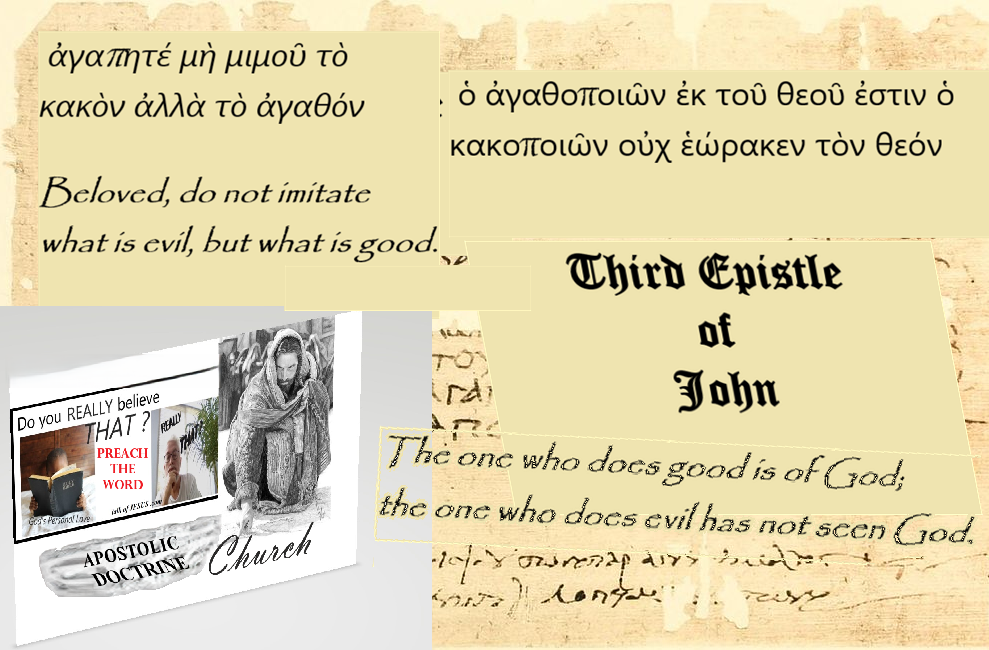
Beloved [agapētos] follow not that which is evil [kakos ], but that which is good.
3 John 1:11a KJV
Before we go forward with John's Apostolic rule, let's make certain that WE the saints of the Church understand both GOOD and EVIL.
κακός, κακῇ, κακόν, the Sept. for רָע (from Homer down), bad (A. V. (almost uniformly) evil);
(morally, i. e.) of a mode of thinking, feeling, acting; base, wrong, wicked: of persons,
universally, of a bad nature; not such as it ought to be.
John applies this to this wicked gate-keeper of his hometown church, comparing his own standard of judging who belongs in the Church and who does not to the true hospitality of of the Truth of Christ as the Shepherd of flocks, with the Apostles of Jesus as true witness of the Gospel and teachings of our Lord.
A previous warning concurrently in circulation
Although the later canon of Scripture places Revelation after this epistle (and that of Jude), some historical scholarship suggests that the Apocalypse of John may have been written prior to this brief letter — the Elder’s third epistle. Perhaps you might recognize a type of Diotrephes in the message to the angel of Ephesus:
“I know your works, your labor, your patience, and that you cannot bear those who are evil. And you have tested those who say they are apostles and are not, and have found them liars;
“and you have persevered and have patience, and have labored for My name’s sake [that of the risen Lord Jesus Christ] and have not become weary.
a primary word; “good” (in any sense, often as noun):—benefit, good(-s, things), well.
This comparison between evil and good by the Lord Jesus calls believers to faithfulness imitating God our Father in heaven.
“If you then, being evil, know how to give good gifts to your children, how much more will your Father who is in heaven give good things to those who ask Him!
Gospel of Matthew 7:11 NKJV
John in his gospel also quotes Jesus concerning good.
For as the Father has life in himself, so he has granted the Son also to have life in himself. And he has given him authority to execute judgment, because he is the Son of Man.
Do not marvel at this, for an hour is coming when all who are in the tombs will hear his voiceand come out,
those who have done good to the resurrection of life,
and those who have done evil [φαῦλος phaûlos, “foul” or “flawy”, i.e. (figuratively) wicked:—evil]
to the resurrection of judgment.
Gospel of John 5:26-29 ESV, with a definition of evil
Deciding between Friends
John writes to a mutual brother faithful to the Lord Jesus and the teaching of the Apostles. But how does the Elder (and Apostle) advise his dear friend to lead?
Short answer: enroll a second brother in the Lord known to be true to the truth of the Gospel.
Demetrius is well spoken of by everyone—and even by the truth itself. We also speak well of him, and you know that our testimony is true.
3 John 1:12 NIV
John writes briefly with all the Authorithy of Apostolic leading of the Church. He enlists allies grounded in truth. And most of all John emphasizes that he and others must confront this controversy in person (lest it get out of hand at the leading of this wicked so-called christian).
I have much to write you, but I do not want to do so with pen and ink. I hope to see you soon, and we will talk face to face.
The beloved Elder closes his final Apostolic Epistle with a seemingly common word of distant greeting; but it is indeed a peace that we do not understand and practice too little as the saints saved by the risen Christ Jesus.
is between individuals, i.e. harmony, concord; the Messiah’s peace, the way that leads to peace (salvation); the tranquil state of a soul assured of its salvation through Christ, and so fearing nothing from God and content with its earthly lot, of whatsoever sort that is; the blessed state of devout and upright men after death — as well as: a state of national tranquillity; exemption from the rage and havoc of war
Do the saints of your church struggle with this?
The Ephesians, to whom John writes did!
And the Elder adds a call to reciprocal love as well:
Our friends [Philos] salute you.
Most certainly John would recall the words of Jesus from more than sixty years ago — again and again in correspondence as well as personal encounters with his fellow believers…
Greater love hath no man than this, that a man lay down his life for his friends.G5384 Ye are my friends,G5384 if ye do whatsoever I command you.
Gospel of John 15:13-14 KJV
.. I have called you friends;G5384 for all things that I have heard of my Father I have made known unto you.
Gospel of John 15:15b – the words of JESUS to His Apostles
These things I command you, that ye love one another.
John 15:17
Philos, friend, obeys Christ’s commands of love and truth. Our salutation to each other is that of love and peace.
Greet the friends by name. Again, a mutual and personal greeting between beloved friends, this translation of ‘greet’ using the same Greek word as ‘salute.’
Certainly those receiving the Elder’s third epistle looked forward to Johns upcoming personal visit, God-willing. From the Apostle’s very lips they will receive the truth of Christ and follow The Way prescribed by John and the Apostles of JESUS.
Would your church welcome the Elder IF the Apostle John and his friends were coming to challenge an errant teacher or preacher of your local gathering?
It was a tragic punishment of the Jews to be exiled, it would become a tragic consequence for a church which would later abandon truth for control in a medieval world.
He who saw this has testified so that you also may believe. His testimony is true, and he knows he is telling the truth.
I have no greater joy than this: to hear that my children are walking in truth.
Gospel of John 19:35; Third Epistle of John 1:4 CSB
Today we are going to READ the New Testament’s shortest letter. It is written by the beloved Apostle John near the end of the first century A.D.
Once you have read it, we will then take a look at WHY the Elder wrote it and how to heed John’s warnings to those joined to Christ’s Church.
2 John
The ELDER,
unto the elect lady and her children, whom I love in the truth; and not I only, but also all they that have known the truth; for the truth’s sake, which dwelleth in us, and shall be with us for ever.
Grace be with you, mercy, and peace, from God the Father, and from the Lord Jesus Christ, the Son of the Father, in truth and love.
I rejoiced greatly that I found of thy children walking in truth, as we have received a commandment from the Father. And now I beseech thee, lady, not as though I wrote a new commandment unto thee, but that which we had from the beginning, that we love one another. And this is love, that we walk after his commandments.
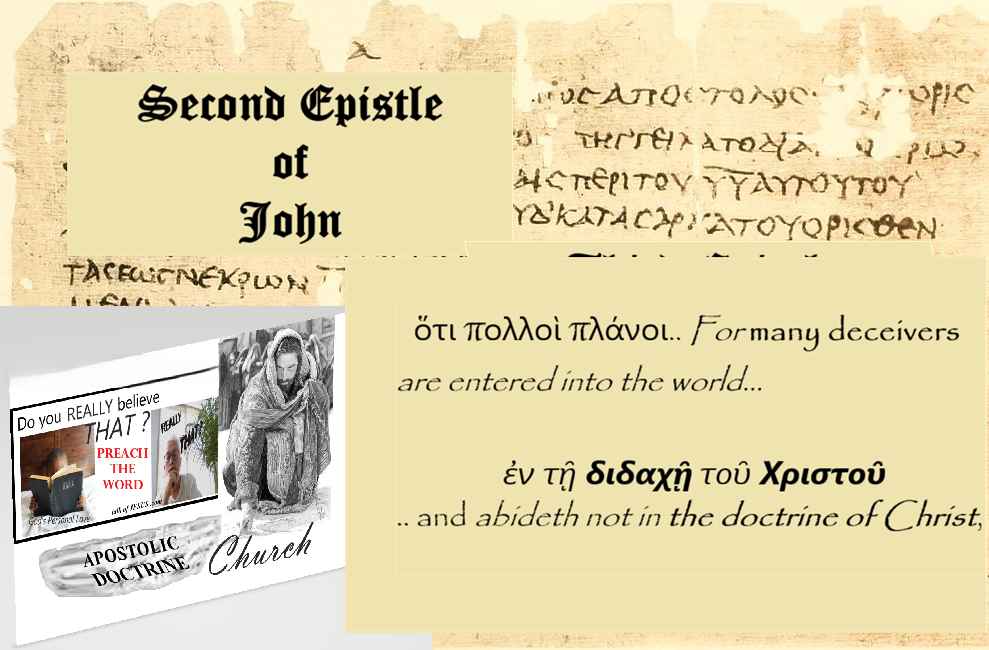
This is the commandment That, as ye have heard from the beginning, ye should walk in it. For many deceivers are entered into the world, who confess not that Jesus Christ is come in the flesh.
This is a deceiver and an antichrist.
Look to yourselves, that we lose not those things which we have wrought, but that we receive a full reward. Whosoever transgresseth, and abideth not in the doctrine of Christ, hath not God.
He that abideth in the doctrine of Christ, he hath both the Father and the Son.
If there come any unto you, and bring not this doctrine,receive him not into your house, neither bid him God speed: for he that biddeth him God speed is partaker of his evil deeds.
Having many things to write unto you, I would not write with paper and ink: but I trust to come unto you, and speak face to face, that our joy may be full.
The children of thy elect sister greet thee. Amen.
John writes a brief note of less than 300 words in the common Greek of the first century Roman Empire on a single piece of papyrus sometime near the year of our Lord ninety-five (A.D. 90-95) in lieu of a personal visit the aging Apostle intends.
It appears that the great purpose of II John was to warn the believers not to give indiscriminate hospitality to strangers or traveling evangelist-teachers. Those who did not meet the sure test of sound doctrine were to be refused hastily.
King James Bible commentary 2-3 John p.1763
He who abides in the doctrine of Christ has both the Father and the Son.
– 2 John v.9
The URGENT WARNING of this last living Apostle of Jesus Christ is both clear and relevant to leaders of the Church up to this day.
The Second Epistle of John cautions against hospitality or the receiving of heretics.
As the Apostle emphasized in his earlier letter to the Church, the mystical approach of some antichrists, namely Gnostics, opposed the truth of Scripture and the incarnation of God in the Person of JESUS Christ, His suffering and crucifixion and especially the Lord’s resurrection IN THE BODY and ascension into heaven until Jesus’ return at the last day.
The Elder’s purpose in writing is to urge the faithful to REJECT false gospels, false philosophies cloaked in christian garments and especially to send away FALSE teachers.
Theologians may debate a small point of who ‘the elect lady’ is.
The “elect lady and her children,” addressed in verse 1, are taken by most interpreters to mean a church and her members.
There is.. deep concern for truth (vv. 4-6) and the warning against false doctrine (7-11) are there as in all John’s writings.
Authorized King James Version intro 2 JOHN
Lady (Gr kyria) is the same word as “Lord” in the New Testament, except that it is feminine here (and in vs. 5) and refers not to a literal “lady” but to the “congregation” or “church’ in a figurative sense.
King James Bible Commentary into 2 JOHN
“The children of thy elect sister greet thee” ( 2Jo 1:13 ).
the word “Church” comes from a Greek word (kyriake) cognate to the Greek for “lady” (kyria; “belonging to the Lord,” kyrios)
Jamieson, Fausset & Brown Introduction to 2 John
John, an elder or bishop of churches would in person certainly apply his warning to the body of believers as a whole and especially to any pastor, host or hostess of a home church.
House Churches
Some theologians would point out that many early churches were ‘house churches’ and that the “lady” and “her children” may well have been an actual unnamed woman (such as John will name an addressee of his third and final epistle to “Gaius.”
Since inns in the first century were notoriously flea-infested and rapacious, where would a Christian stay while traveling? The answer was in the home of another Christian.
KJ Bible Commentary ibid.
I had to look up this definition and it is culturally worth noting for Christians of the first century or 21st. Some synonyms for Rapacious - greedy, insatiable, gluttonous, materialistic selfish, devouring, savage, preying... Get the idea?
So some theologians believe that John wrote to warn a woman hosting a house church against welcoming such heretical predators, let alone let any teaching of such men or women be heard by the saints she welcomes into her home for worship.
Think of these as evangelists of the antichrist. John also calls them antichrists. The danger of false teaching became so prevalent that by the second century AD other Elders (Bishops) wrote about them.
Elder Successors to John
Without digging into early writings of the early church, note one well-documented warning from the 2nd century AD.
Irenaeus of Lyons, born in Asia Minor ~AD 125 and ‘mentioned as a hearer of Polycarp, the bishop of Smyrna, who in turn was traditionally associated with the Apostle John’ writes a major theological book:
“Against Heresies” (Adversus Haereses), composed around AD 180.
He systematically refuted Gnostic teachings, which challenged the reliability of Scripture and the nature of Christ’s Incarnation. By reinforcing the unity of God as Creator, as well as the integral unity of Scripture, Irenaeus defended fundamental Christian doctrines, including the bodily resurrection of Jesus.
Christians (especially women) can be ‘too nice’ — we’ve all witnessed that. But the Elder John and others caution against it (until the true character of one is tested).
CLEMENT OF ALEXANDRIA (A.D. 192) [Miscellanies, 2.66].. says, “John’s Second Epistle which was written to the virgins (Greek, “parthenous”; perhaps Parthos is what was meant) is the simplest; but it was written to a certain Babylonian named the Elect lady.”
John MacArthur also suggests that John writes to an individual lady and that the whole purpose of the Elder’s brief epistle is focused on truth.
Truth
John writes of her and her children (whether specific individuals or all those of a house church he plans to visit):
“whom I love in the truth” —agapaōen alētheia—
.. but also all they that have known the truth;
Pretty inclusive of true believers already established as part of her household of saints separated to Christ.
for the truth’s sake… — again, alētheia
AND then John adds to his greeting:
which abides in us [NKJV] or
which lives in us [NIV and others]
because of the truth that remains in us and will be with us forever. [CSB]
2 John 1:2
Is the Apostle reminding here of the Holy Spirit whom we may consult in our discernment of truth — ἀλήθεια – alētheia?
A reminder from John's introduction in his Gospel:
For the Law was given through Moses; grace and truth came through Jesus Christ.
John 1:17 LSB
MacArthur’s commentary outlines this brief second epistle of John as follows:
The Basis of Christian Hospitality
vs 1-3, with truth mentioned 4X
The Behavior of Christian Hospitality
vs 4-6, with truth mentioned in v.4
The Bounds of Christian Hospitality
vs 7-11, with a test of truth in v. 9
The Blessings of Christian Hospitality
vs. 12-13, the Elder will come to her in person
Recognizing that all the readers of his letter faced and always would face a world of lies and deceit, he wrote to call them to live in God’s truth… John reveals four features of living in the truth: the truth unites, indwells, blesses and controls believers.
Everyone who believes that Jesus is the Christ has been born of God, and everyone who loves the Father loves whoever has been born of him.
1 John 5:1 ESV
MacArthur applies the Apostle’s test specifically to John’s second letter.
John’s statement encapsulates the main theme of this brief epistle, that truth must always govern the exercise of love. Christians’ deep, mutual affection flows out of their shared commitment to the truth.
ibid. p.217
John emphasized Christ’s identity as God’s Son because the false teachers were denying that truth.
ibid. p. 220
MANY deceivers have gone out into the world.
WATCH YOURSELVES!
2 John v.7a,8a
Do you, beloved lady of this 21st century of the common era, imagine that anything in the life of a Christian has changed one iota?
But there were false prophets also among the people, even as there shall be false teachers among you..
2 Peter 2:1a – King James Version
Accepting Apostolic Testimony OR Following False Prophets
After presenting his Apostolic testimony to wavering preachers, elders, and marginal followers of “The Way,” Simon Peter now alerts the church to dangerous heresies taught by some seeking to undermine the true Gospel of the Lord Jesus Christ.
The Trustworthy Prophetic Word, reads the heading in this section of 2 Peter 1 of the Christian Standard Bible, also citing testimony from all the synoptic Gospels [Matthew, Mark & Luke].
For we have not followed cunningly devised fables, when we made known unto you the power and coming of our Lord Jesus Christ, but were eyewitnesses of his majesty.
We have also a more sure word of prophecy; where unto ye do well that ye take heed..
For the prophecy came not in old time by the will of man: but holy men of God spake as they were moved by the Holy Ghost.
2 Peter 1:17-21 excerpt KJV
The Apostle now warns of pernicious perils of false prophets and false teaching of those who deny Apostolic testimony.
2 Peter 2:
There were indeed false prophets among the people, just as there will be false teachers among you.
2 Peter 2:1a – Christian Standard Bible
Peter, Apostle of Jesus, provides familiar examples from the Jewish Bible (Old Testament):
and if he didn’t spare the ancient world, but protected Noah v.5a
and if he reduced the cities of Sodom and Gomorrah to ashes v.6a
and if he rescued righteous Lot, v.7a
Compare yourself to Noah. Or compare yourself to Lot, Paul suggests, a righteous man living in Sodom surrounded by every wickedness conceived by evil men in charge of his community.
Are Sodom and Gomorrah not the cities of our home churches to whom Simon Peter writes once again?
And doesn’t our world reminiscingly resemble that near to destruction in the time of Noah?
Take heed that we have survived thus far only be saved from the final judgment of fire by Christ’s righteousness!
How do the Apostle’s examples from Genesis apply to us?
The believers to whom Peter writes live in Asian and Roman and new worldly cities not unlike Sodom — as do we in our towns and churches susceptible to every evil tolerated and encouraged by leaders of every gathering in our home community.
Destructive Doctrines
HEADING from the New King James Version
WATCH OUT! warns the Apostle in his second epistle.
.. even as there will be false teachers among you, – v.1b – NKJV
You know these preachers and elders who CLAIM JESUS.
Some saints succumb to their subtle sweet tolerance. For their deceptive doctrine suggests Christ while discounting His lordship over our saved SELF’s still flourishing in the flesh of this life.
Pernicious Preachers of Their Own Doctrines
ψευδοδιδάσκαλος – pseudodidáskalos, psyoo-dod-id-as’-kal-os; from G5571 and G1320; a spurious teacher, i.e. propagator of erroneous Christian doctrine:—false teacher.
No, it isn't only the preacher in the pulpit who purveys false doctrine, though some succumb at times as the Apostle fears.
They will bring in destructive heresies, even denying the Master who bought them, and will bring swift destruction on themselves.
– 2:1c CSB
.. who privily shall bring in damnable heresies, even denying the Lord that bought them.
2 Peter 2:1c King James Version
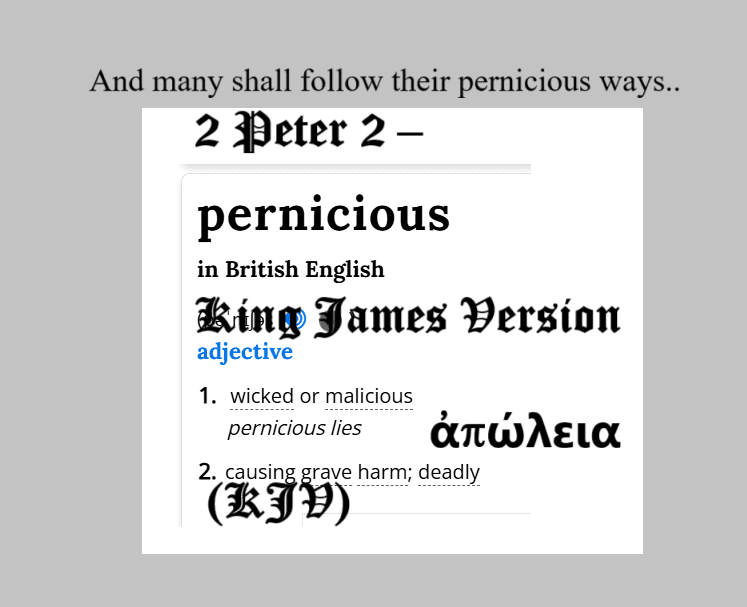
And many shall follow their pernicious ways
Time to define a key word Paul uses FIVE TIMES in his Second Epistle (translated in 2 Peter 2:2 KJV as "pernicious ways").
ἀπώλεια – apōleia –
The KJV translates Strong‘s G684 in the following manner: perdition (8x), destruction (5x), waste (2x), damnable (1x), to die (with G1519) (1x), perish (with G1498) (with G1519) (1x), pernicious (1x).
The Apostle Peter chooses STRONG language to describe these sins against the Lord.
And in fact, Jesus had spoken the same to describe Judas Iscariot!
While I was with them in the world, I kept them in thy name: those that thou gavest me I have kept, and none of them is lost, but the son of perdition;G684 that the scripture might be fulfilled.
Gospel of John 17:12 KJV – the words of Jesus
What must Peter — one of the Twelve — have thought when Judas took the cup the Lord shared at their last Passover meal?
The Lure of their Depravity
Common Era preachers may draw in the multitudes to gatherings of those seeking an advantage in the life of proclaiming Jesus.
(Judas, who minded their money, was like that.)
Peter continues in his second epistle warning the faithful:
And in their greed they will exploit you with false words, their judgment from long ago is not idle, and their destruction is not asleep.
2 Peter 2:3 LSB
The Apostle describes how to spot false teachers scemingly opposed to all Truth:
Bold, arrogant people!
They are not afraid to slander the glorious ones [2:10b LSB]
go after the flesh in its corrupt lust
and despise authority.
(even that of the Lord’s Apostles, Peter implies)
Daring,
self-willed,
they do not tremble when they blaspheme [angels] glorious ones 2:10 LSB
(We’ll continue Peter’s mention of angels momentarily.)
They brag about themselves with empty, foolish boasting.
With an appeal to twisted sexual desires, they lure back into sin those who have barely escaped from a lifestyle of deception.
2 Peter 2:18 LSB
The APOSTLE’S WARNING!
These people are springs without water, mists driven by a storm. The gloom of darkness has been reserved for them.
For by uttering boastful, empty words, they seduce, with fleshly desires and debauchery, people who are actually escaping from those who live in error.
2 Peter 17-18 CSB
Peter has already presented his powerful case of his authority as an Apostle of Jesus Christ — who IS the only Son of GOD the Father and One with the Holy Spirit.
Won’t you obey an Apostle of the Lord Jesus Christ?
“For when he received honor and glory from God the Father, and the voice was borne to him by the Majestic Glory, “This is my beloved Son,with whom I am well pleased,”
2 Peter 1:17 ESV
OR
Will you subtly slide back into the vomit of your former overindulgence in every sin of this world?
What the true proverb says has happened to them:
“The dog returns to its own vomit, and the sow, after washing herself, returns to wallow in the mire.”
2 Peter 2:22 ESV
Like a dog that returns to his vomit is a fool who repeats his folly.
Do you see a man who is wise in his own eyes? There is more hope for a fool than for him.
Proverbs 26:11,12 ESV
GOD, Angels, Men, Apostles, creatures & authority
FOLLOW PETER'S LOGIC:
In the beginning, God [ĕlōhîm] created the heavens and the earth. – Genesis 1:1
The apostle of Jesus Christ.. stands [in] the righteousness of our God and Savior Jesus Christ: – 2 Peter 1:1
Jesus is associated with righteousness, highlighting His sinless nature and the moral perfection that He imparts to believers.
2 Peter 2:1 The term “Master” is used in the context of false teachers denying “the Master who bought them.” It underscores Jesus’ ownership and authority over believers, as well as the cost of redemption.
ibid.
Peter introduces himself as a servant [doulos] of Jesus
2 Peter 1:1
and in his first epistle the Apostle instructs those chosen in Christ:
The Apostle Peter, as servant of the Lord and witness to God in the flesh embraces great responsibility for the faith of those chosen as elect saints in Jesus Christ.
Creation, its creatures and Angels
For if God spared not the angels that sinned, but cast them down to hell, and delivered them into chains of darkness, to be reserved unto judgment;
… The Lord knoweth how to deliver the godly out of temptations, and to reserve the unjust unto the day of judgment to be punished:
2 Peter 2:4,9 KJV
The Apostle connects evil men affecting the righteous like Noah and Lot within a lengthy tirade citing angels that sinned. Though we know little of the unseen messengers (evil or good), Peter reminds us of a comparison of Jesus to Adam, who was tempted into our fall by a most-powerful angel.
.. and his angels he charged with folly: – Job 4:18b KJV
.. but cast them into hell..
“How you are fallen from heaven, O Lucifer,[lit. Day Star] son of the morning! How you are cut down to the ground, You who weakened the nations!
For you have said in your heart: ‘I will ascend into heaven, I will exalt my throne above the stars of God; .. Yet you shall be brought down to Sheol, To the lowest depths of the Pit.
and committed them to pits of darkness, held for judgment…
[2 Peter 2:4b NASB]
These cunning false teachers speaking against Apostolic Authority — granted through the same Holy Spirit of God by which the Prophets spoke — do not tremble when they revile angelic majesties [Doxa] – ‘they blaspheme the glorious ones’ – v.10
FALSE TEACHERS, who are no better than evil men who refused to listen to GOD’s Prophets speaking by the Holy Spirit and less powerful than angels, will also suffer the judgment of angels who turned against the Creator.
.. whereas angels, though greater in might and power,
do not pronounce a blasphemous judgment against them before the Lord.
2 Peter 11 ESV
Balaam, False Prophets and Pernicious Popes!
YES, we are still addressing the warning of the Apostle Peter in his second epistle to the 1st century church.
If you have noted in 2 Peter 2 that I quoted Scripture including men the Apostle lists as negative examples, but I missed a false prophet mentioned only once, you would be right.
Peter’s full list (chronologically) includes:
Angels – vs.4 & 11
mankind, except Noah – v.5
community of mankind in Sodom and Gomorrah, except Lot – v.6
the Prophet Balaam – vs. 15-16
ALL these are WARNING SIGNS from the LAW of Moses — cited by the Apostle Peter, servant of God and JESUS Christ, sent by true direction of the Holy Spirit — to BELIEVERS in the first century churches AND those including a Lot from Common Era elect yet to be born into the body of Christ before the Day of Judgment.
I have nearly bogged down in the mire of Moses’ serious warning in the book of Numbers concerning Balaam.
Moses, Prophet and Lawgiver of Israel, sheds light enough on such men and women who cunningly lead communities of the faithful away from the Lord our God — from then nearer the Beginning until the Day of Jesus Christ.
What Popes, you may ask?
Which false prophets since Jesus, you may wonder?
AND what do these have to do with the Apostle’s example of Balaam in 2 Peter 2?
NEXT – We will examine the timeless application of Balaam to Peter’s prophesies of false teachers and HERESIES already evident to the Common Era church.