Category: Acts for a 21st c. Church

Acts Apostolos - Acts of the Apostles - the chronicles of Christ's Apostles - a history of Christ's Church including early leaders like Stephen, Philip the Evangelist, Paul, Barnabas and many others
Acts of the Apostles + a History of Christ’s Church

Acts of the Apostles 1-28


Acts of the Apostles:
+ The first century Church SHARED Christ while suffering severe persecution.
+ Luke records a historic account of the Church which gives 21c Christians a context to SHARE the Gospel of Jesus Christ with others.

Read more about the Early Church & add your COMMENT on Scripture.

ACT now.

+ SHARE the Gospel history witnessed in the CURRENT chronological SERIES from ACTS of the APOSTLES.

  • a Roman Conclusion – Acts of the Apostles

    a Roman Conclusion – Acts of the Apostles

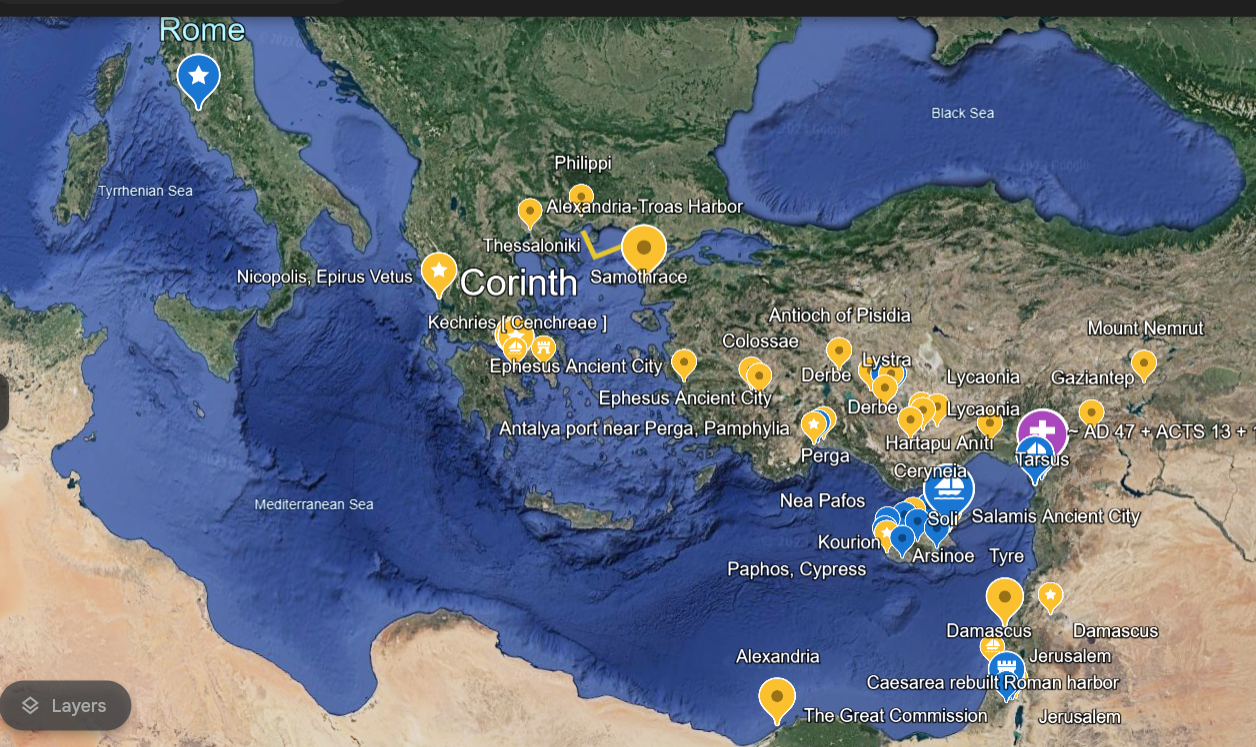
    Several missionary stops of the apostle Paul before going to Rome - Acts of the Apostles

    All roads lead to Rome

    Who has not heard the expression recalling a time of glory for the Roman Empire of the A.D. first century.?

    But this second account of the Hellenist physician Luke records that the Gospel is sent out from Jerusalem and then Antioch.

    “But you will receive power when the Holy Spirit has come on you, and you will be my witnesses in Jerusalem, in all Judea and Samaria, and to the ends of the earth.”

    Acts of the Apostles 1:8 CSB – words of the risen Jesus to His disciples

    The apostles and the brothers and sisters who were throughout Judea heard that the Gentiles had also received the word of God.

    Acts 11:1 CSB

    For a whole year they [Barnabas and Paul] met with the church and taught large numbers. The disciples were first called Christians at Antioch.

    Acts of the Apostles 11:26 CSB

    Paul’s Previous 3 Missionary Journeys

    READ MORE about the timeline of Paul's missions with numerous maps of the Roman world of the A.D. 1st century. 

    An Apostle known by his Letters
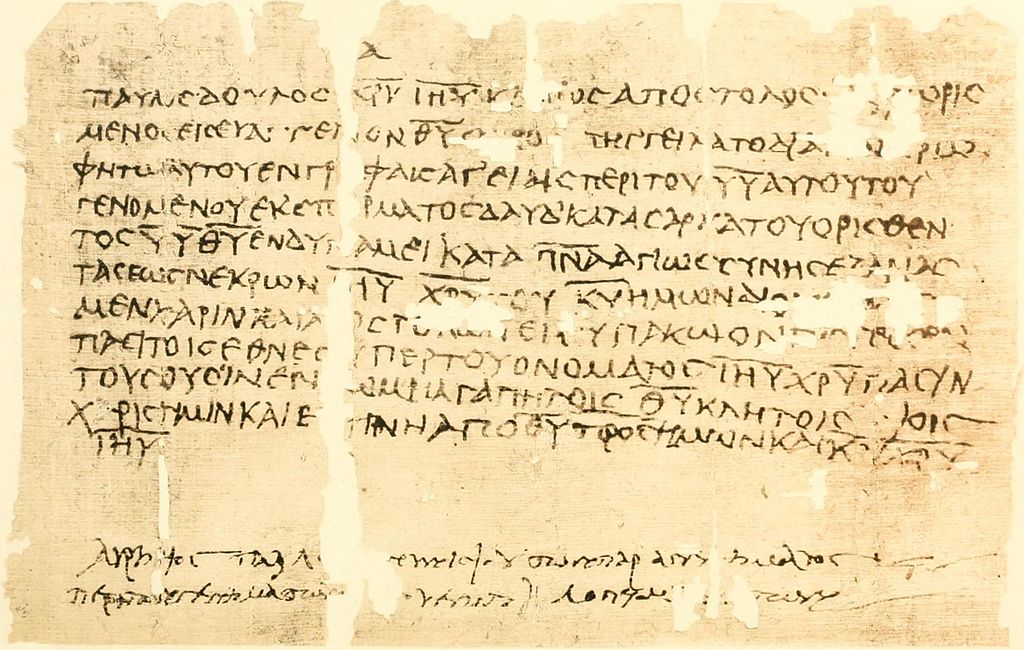
    Epistle of Paul to the Romans 1 - the Apostles sends a church letter to Rome and the local saints of area churches
    Epistle of Paul to the Romans

    As did Peter, John, James and others, the Apostle Paul communicates with converts to Christ frequently by letter, in addition to their Apostolic missions to live and worship with these believers for a time.

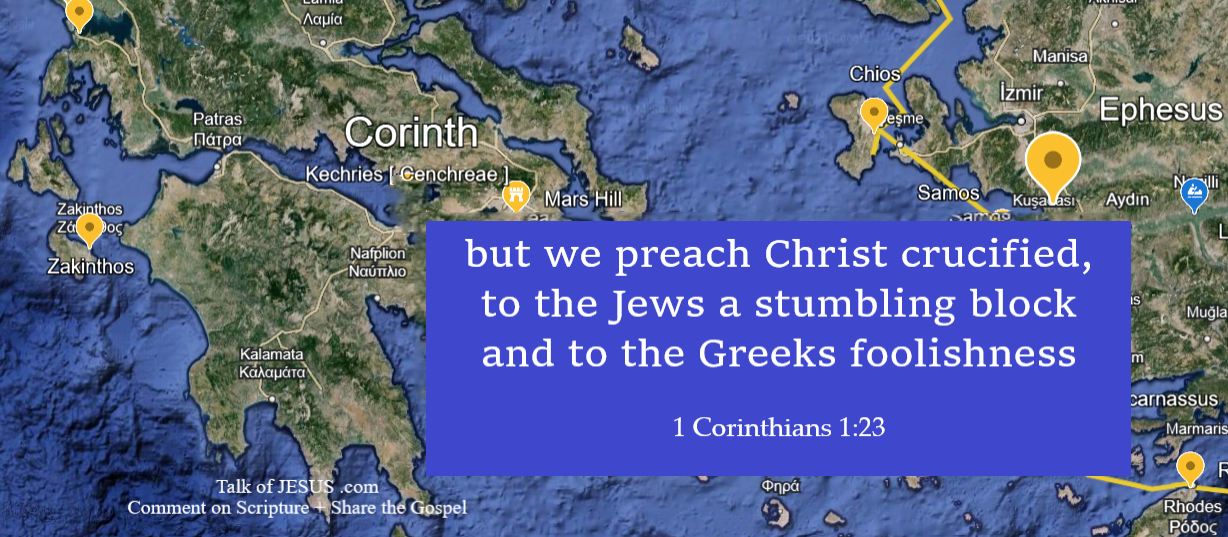
    but we preach Christ crucified, to the Jews a stumbling block and to the Greeks foolishness - 1 Corinthians 1:23a

    • AD 57

    Two years BEFORE Paul is brought to Rome on spurious charges of the Jews and the Apostle’s appeal to Caesar Nero (as a Roman citizen), Paul writes his masterful theological Epistle to the Romans, instructing his fellow Roman citizens in the Gospel of Jesus Christ.

    We will read more of the Apostle's personal joy in meeting these Romans shortly. 
    • AD 60-62
      • From Rome (and possibly other cities away from Rome) the Apostle to the Gentiles writes to the church in:
        • Ephesus, Philppi and Colossae
        • a letter concerning Philemon
    • AD 62-66
      • Paul writes a first pastoral letter to Timothy
      • and also to Titus
    • July 19, AD 64 – Caesar Nero burns Rome, blames and persecutes the Christians, Apostle’s under house arrest face execution at Nero’s command
    • AD 66-67 – Facing imminent execution (as does the Apostle Paul, now in Rome), Peter writes a second and final pastoral epistle to Timothy to encourage and guide the Church.

    Paul brought to Rome
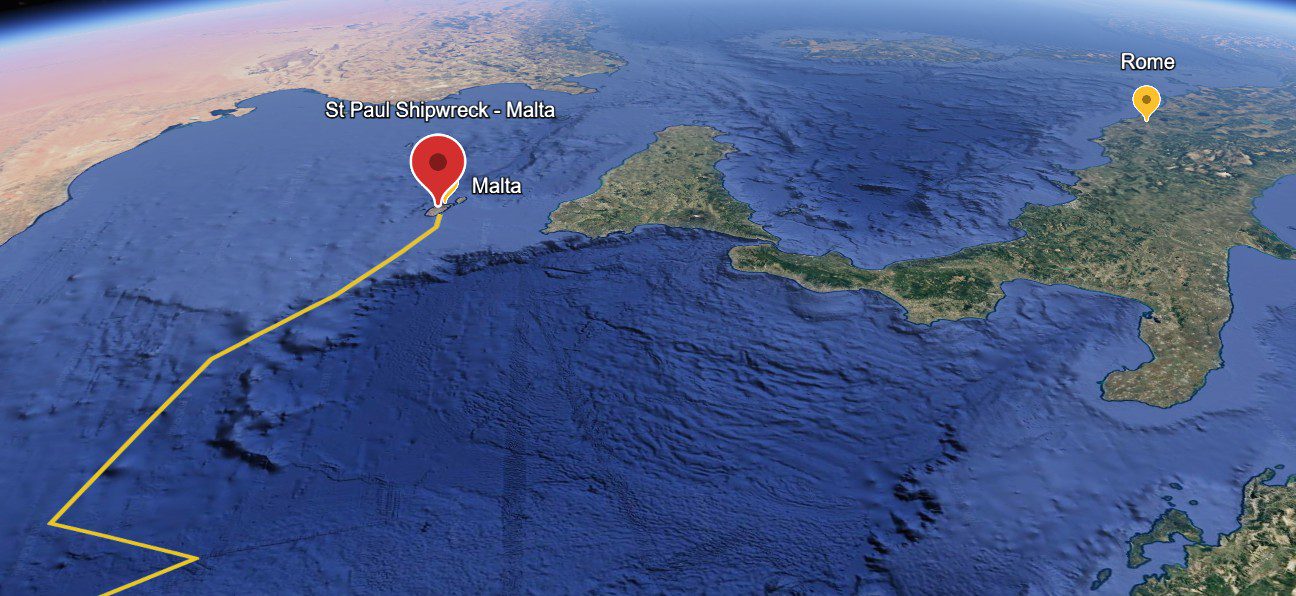
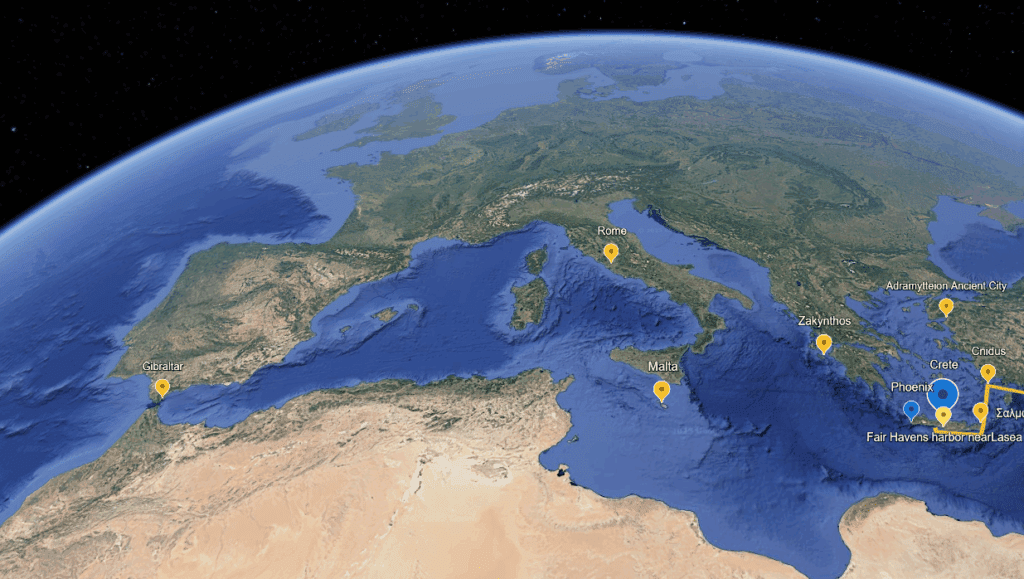
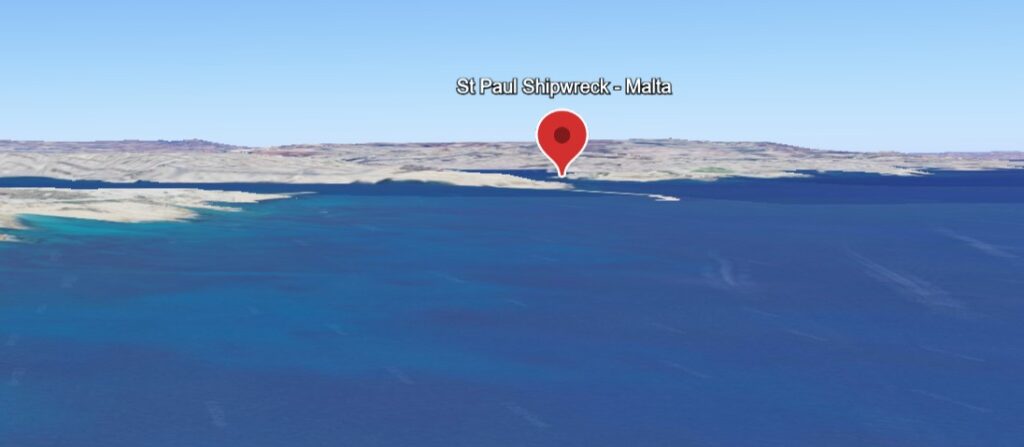
    Malta - Earth view of Malta in the Mediterranean Sea

    Previously, we left the Apostle having survived a shipwreck in Malta.

    The Centurion Julius, the Apostle Paul and now more than 300 men witness the power of God in Christ’s Apostle to the gentiles delayed in a violent storm on his way to Rome.

    In these few verses THREE MONTHS PASS.


    ACTS of the Apostles 28 – Conclusion

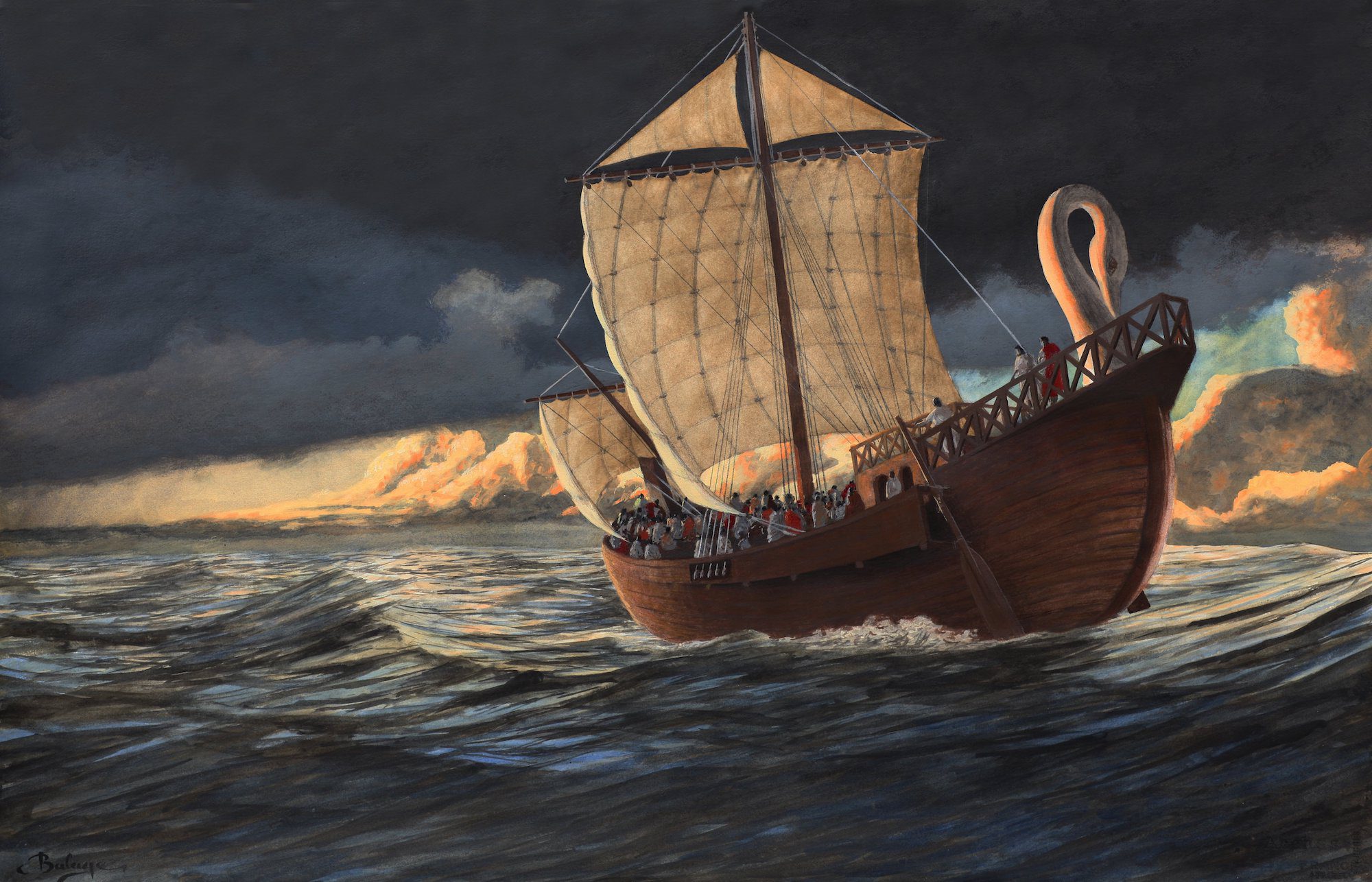
    After three months we set sail in an Alexandrian ship that had wintered at the island, with the Twin Gods as its figurehead.
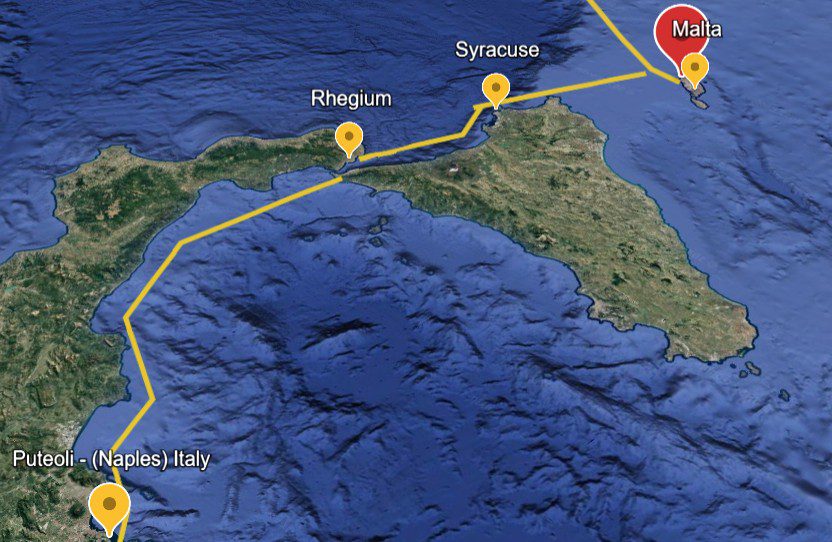
    12 Putting in at Syracuse, we stayed three days.

    13 From there, after making a circuit along the coast, we reached Rhegium. After one day a south wind sprang up, and the second day we came to Puteoli.

    CSB

    Where we found brethren, and were desired to tarry with them seven days: and so we went toward Rome.

    Acts 28:14 KJV

    140 miles (225 kilometers) southeast of Rome. “Puteoli” literally means “little wells” in reference to the many hydrothermal wells that were in the city, which was well-known as a large port that could accommodate big ships.

    In fact, adjacent to Puteoli was Misenum, the Roman naval base that housed the largest naval fleet in the ancient world. Earthquakes have since sunk most of Puteoli under water.

    Source: Bibleversestudy.com


    And the brothers, when they heard about us, came from there as far as the Market of Appius and Three Inns to meet us.

    When Paul saw them, he thanked God and took courage.
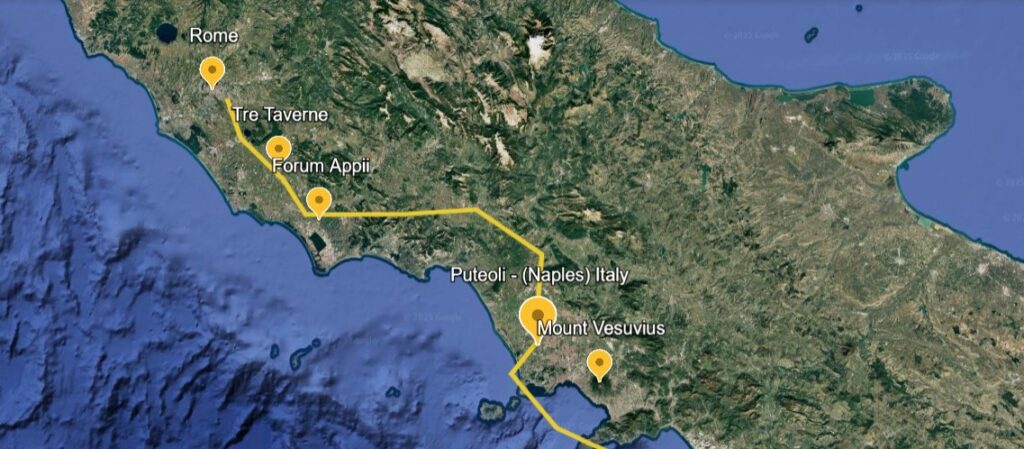
    Paul escorted to Rome along the Appian Way

    And when we entered Rome,

    Paul was allowed to stay by himself,

    with the soldier who was guarding him.

    Acts 28:16 LSB

    Paul Addresses Prominent Jews of Rome

    And it happened that after three days Paul called together those who were the leading men of the Jews,

    and when they came together, he began saying to them,

    Brothers, though I had done nothing against our people or the customs of our fathers, yet I was delivered as a prisoner from Jerusalem into the hands of the Romans.

    And when they had examined me, they were willing to release me because there was no ground for putting me to death. But when the Jews [spoke against me], I was forced to appeal to Caesar, not that I had any accusation against my nation.

    Acts 28:17-19


    Note two points from Paul's self-introduction to the Roman Jews: 

    The Apostle refers to himself as a brother of these Jews, also referring to OUR people, customs and fathers [patrōos].

    Paul had identified with the fathers of the faith in defense of the Gospel before:

    “I am a Jew, born in Tarsus of Cilicia.. instructed .. according to the strictness of the law of our fathers, being zealous for God just as you all are today,

    Acts 22:3 excerpt LSB

    And hear Paul’s defense in his first Trial Before Felix:

    “But this I confess to you, that according to the Way which they call a sect,

    so I worship the God of my fathers, believing all things which are written in the Law and in the Prophets.

    Acts 24:14 NKJV

    Ethnos

    The APOSTLE and ROMAN CITIZEN parenthetically adds:

    .. not that I had anything of which to accuse my nation.

    Acts 28:19b NKJV

    Paul has NO extra-judicial accusation against his accusers with whom he identifies by calling them: ‘MY NATION” — ἔθνος – ethnos

    • a multitude [together]
    • the human family
    • tribe, nation, people group
    • Gentiles [OT]
    • Paul uses the term for Gentile Christians

    Source: BlueLetterBible.org Strong’s G1484 – ethnos

    HERE in his defense to the Jews, Paul uses ethnos to describe OTHER Jews including his Jewish accusers in Jerusalem AND those in Rome whom the Apostle has summoned.

    Luke opens Acts of the Apostles telling readers: 

    Now there were Jews living in Jerusalem, devout men from every nation G1484ethnos – under heaven.

    Acts of the Apostles 2:5 LSB


    מִקְוֵה יִשְׂרָאֵל מוֹשִׁיעוֹ

    Jeremiah 14:8a -yirmᵊyâ יִרְמְיָהוּ

    Understanding you (Paul) for ourselves

    These leading Jews of Rome of course know Scripture and realize that Paul preaches about the Messiah.

    And they said to him,

    “We have neither received letters from Judea concerning you, nor have any of the brothers come here and reported or spoken anything bad about you. But we desire to hear from you what you think;

    for concerning this sect, it is known to us that it is spoken against everywhere.”

    Acts 28:21-22 LSB
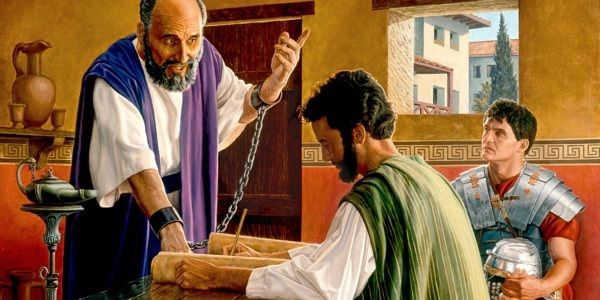
    Paul under house arrest with Luke, his scribe and physician and a Roman Centurian responsible for his prisoner

    And when they had set a day for Paul, they came to him at his lodging in large numbers..

    and he was explaining to them by solemnly bearing witness about the kingdom of God and trying to persuade them concerning Jesus, from both the Law of Moses and from the Prophets,

    from morning until evening.

    And some were being persuaded by the things spoken, but others were not believing.

    And when they disagreed with one another, they began leaving after Paul had spoken one word,

    Acts 28:23-25a LSB

    “The Holy Spirit rightly spoke

    through Isaiah the prophet to your fathers, saying,

    And He said, “Go, and tell this people:
    ‘Keep on hearing, but do not understand;
    Keep on seeing, but do not perceive.’

    “Make the heart of this people dull,
    And their ears heavy,
    And shut their eyes;

    Lest they see with their eyes,
    And hear with their ears,
    And understand with their heart,

    And return and be healed.”

    Isaiah 6:9-10 (quoted by Paul) NKJV

    Paul’s final word for the Roman Jews

    And when he had said these words, the Jews departed and had a great dispute among themselves.

    Then Paul dwelt two whole years in his own rented house, and received all who came to him,

    preaching the kingdom of God

    and teaching the things which concern the Lord Jesus Christ with all confidence, no one forbidding him.

    Acts 28:30-31 NKJV

    Acts Apostolos - Acts of the Apostles - the chronicles of Christ's Apostles - a history of Christ's Church including early leaders like Stephen, Philip the Evangelist, Paul, Barnabas and many others

    second account of Luke, the physician .


    Comment on Scripture – Share the Gospel

  • Acts 28 – Malta – Not nearly to Rome

    Acts 28 – Malta – Not nearly to Rome

    Malta - Earth view of Malta in the Mediterranean Sea

    Acts of the Apostles 28:

    Roman grain ship

    Once safely ashore, we then learned that the island was called Malta.

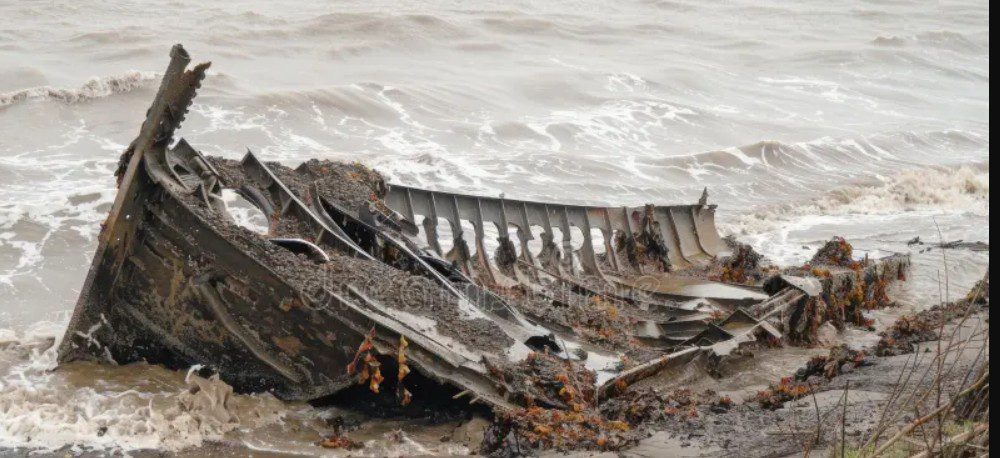
    shipwreck remains washed to shore as Paul's ship would have been devastated in a storm near Malta

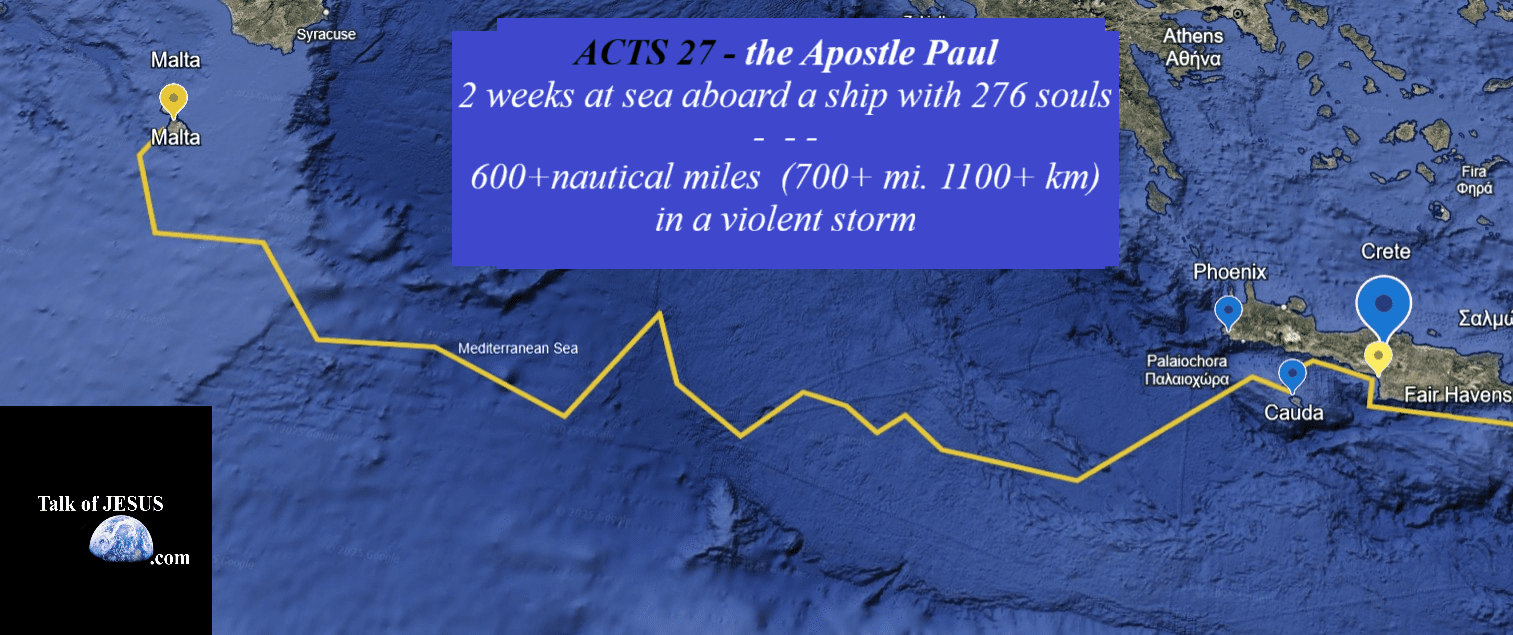
    Two hundred seventy-six men in the hand of God tossed about in an autumn storm of the Mediterranean Sea survive —  some on planks and some on debris from the ship on a remote beach of Malta — far from their destination of Rome.

    And the barbarous people shewed us no little kindness: for they kindled a fire, and received us every one, because of the present rain, and because of the cold.

    Acts of the Apostles 28:2 KJV

    Melita or Malta history

    3 inhabited islands & 18 uninhabited

    Mediterranean Gibraltar to Crete - winter Tempests

    Ancient Greeks in 700 BC, then the Phoenician traders who were followed by the Romans.

    the Phoenicians referred to Mdina as Maleth, which means “shelter”. The Phoenicians were highly civilized people, with many great sailors and traders, who used the Maltese islands as a stop on their trade routes. Carthage (now known as Tunisia) was a city founded by the Phoenicians on the north coast of Africa and the Carthaginians ruled Malta from about 400 BC.

    The Carthaginians ruled the Maltese islands for ~250 years, until the Romans seized Malta in 218 BC at the second Punic War. Twisting the island’s Phoenician name, the Romans called MaltaMelita”.

    Source: Malta.com/en/

    Maltese Barbarians

    βάρβαρος - the barbourous people 

    The KJV contrasts the culture of these resident natives along the shore calling them barbarians simply because like all the rest of the Roman world and an inland city on Malta, they didn’t speak Greek.

    As Paul gathered an armful of sticks and was laying them on the fire, a poisonous snake, driven out by the heat, bit him on the hand. But Paul shook off the snake into the fire and was unharmed.

    Acts 28:3,5 NLT

    And when the barbarians saw the venomous beast hang on his hand, they said among themselves, No doubt this man is a murderer, whom, though he hath escaped the sea, yet vengeance suffereth not to live.

    Howbeit they looked when he should have swollen, or fallen down dead suddenly:

    but after they had looked a great while, and saw no harm come to him, they changed their minds, and said that he was a god.

    Acts 28:4,6 KJV


    Was it not a miracle that this man among more than 200 men had survived the raging sea?

    ship on the rocks like that in Acts 28 where Paul survives on Malta

    Acts 28: moving inland on Malta

    Near the shore where we landed was an estate belonging to Publius, the chief official of the island.

    (Note the Roman name of the man in charge of the island, as Julius had been in charge of Paul's ship wrecked on its shore.)

    He welcomed us and treated us kindly for three days.

    As it happened, Publius’s father was ill with fever and dysentery. Paul went in and prayed for him, and laying his hands on him, he healed him.

    Then all the other sick people on the island came and were healed.

    As a result we were showered with honors…

    Acts of the Apostles 28:7-10a NLT

    Safe and Blessed for the Winter

    DON’T MISS THIS:

    The Centurion Julius, the Apostle Paul and now more than 300 men witness the power of God in Christ’s Apostle to the gentiles delayed in a violent storm on his way to Rome.

    In these few verses THREE MONTHS PASS.

    Once the dangers of winter will no longer threaten Paul and his Roman companions and the Centurion Julian finds a new ship for their voyage, God-willing, we will sail on to Rome.

    Alexandrian ship in storm near Malta

    NEXT

    In the meantime, we will take a brief overview of ALL of Acts of the Apostles and timely connections of LETTERS written by Paul and other Apostles during these same years.

    I pray that you will join us as we continue our journey into all the world with the Gospel.

    Roger@TalkofJesus.com


    Comment on Scripture – Share the Gospel
  • Tossed About in a Sinking Ship

    Tossed About in a Sinking Ship

    Acts of the Apostles 27

    Sailing so slowly into a billowing whirlwind of destruction.

    That’s how it must have felt for the Roman Centurion Julian, various guards and now others aboard a large Greek merchant ship hauling grain into a storm.

    How did we arrive at these last days of a failed voyage to Rome?

    AD 59 - Acts [27] of the Apostle Paul
    • v.3 entering a (small) ship of Adramyttium, sailing only to nearby Tyre
    • v.4-6 crawling along the coasts of Pamphylia and Asia to board this large ship hauling grain to Rome
    • v.7  we had sailed slowly many days, and arrived with difficulty off Cnidus [still only along the coast of Asia {Minor} at the Southeast edge of the Aegean Sea], the wind not permitting us to proceed.
    • Their ship had drifted on gentle waters into harbors along Crete. Barely had their voyage into the Mediterranean begun.
    • The winds of winter near upon them now, their only hope a sheltered harbor away from which they were suddenly swept into the tempest. [v.7-17]
    Mediterranean Gibraltar to Crete - winter Tempests

    “Men, I perceive that this voyage will end with disaster and much loss, not only of the cargo and ship, but also our lives.”

    Acts of the Apostles 27:10 NKJV – Paul, addressing the men onboard their grain ship

    Paul — Shipwrecked

    276 souls on a sinking ship

    Acts 27:18-21 excerpt CSB

    Message of an Angel to Paul and all souls aboard

    We have not heard from the Apostle for several days now since his warning to the Centurian Julian had been ignored. As would have been his regular practice, no doubt Paul and Aristarchus had been praying. 

    Now the Apostle appears with a new messenge of hope from an angelic messenger of God.

    “You men should have followed my advice not to sail from Crete and sustain this damage and loss. Now I urge you to take courage, because there will be no loss of any of your lives, but only of the ship.

    Acts 27:21b-22 CSB

    'Preposterous,' these hungry men on a sinking ship laden with grain must have thought - Roman men and Greek sailors who would have been weak from fighting for their lives.

    'YOU told us we would die and now that we're almost sinking into the sea you say that we will not.'

    “For last night an angel of the God I belong to and serve stood by me and said, ‘Don’t be afraid, Paul. It is necessary for you to appear before Caesar. And indeed, God has graciously given you all those who are sailing with you.’

    Acts 27:23-24

    The crew must still be skeptical.
    'Your god has graciously given you all of us sailing with you?' Many of these sailors and guards must have thought, 'You're the prisoner, not us!'

    Paul has already established his credibility as a Roman citizen with Julian, the Centurion officer charged with delivering the Apostle to Caesar.

    And we are about to learn that in the protocol of the Roman Empire, it is the Centurion who is in charge of ALL of these men — NOT a captain or pilot of the ship or enlisted Roman guard.

    The Apostle continues by prophesying what is about to take place (rather than drowning in the depths of the sea as their ship sinks into the depths of the sea). 

    Google Earth approximation of Paul's sailing route toward Malta in a storm - Acts 27

    “So take courage, men, because I believe God that it will be just the way it was told to me. But we have to run aground on some island.”

    Acts 27:25-26

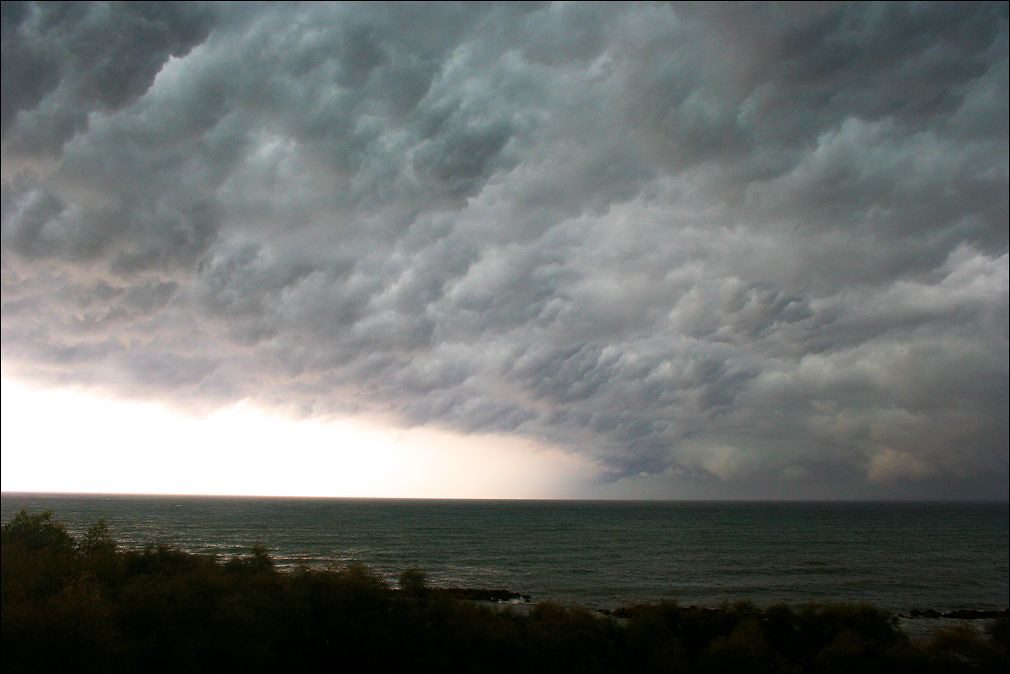
    Adriatic Sea with storm clouds

    drifting in the Adriatic Sea

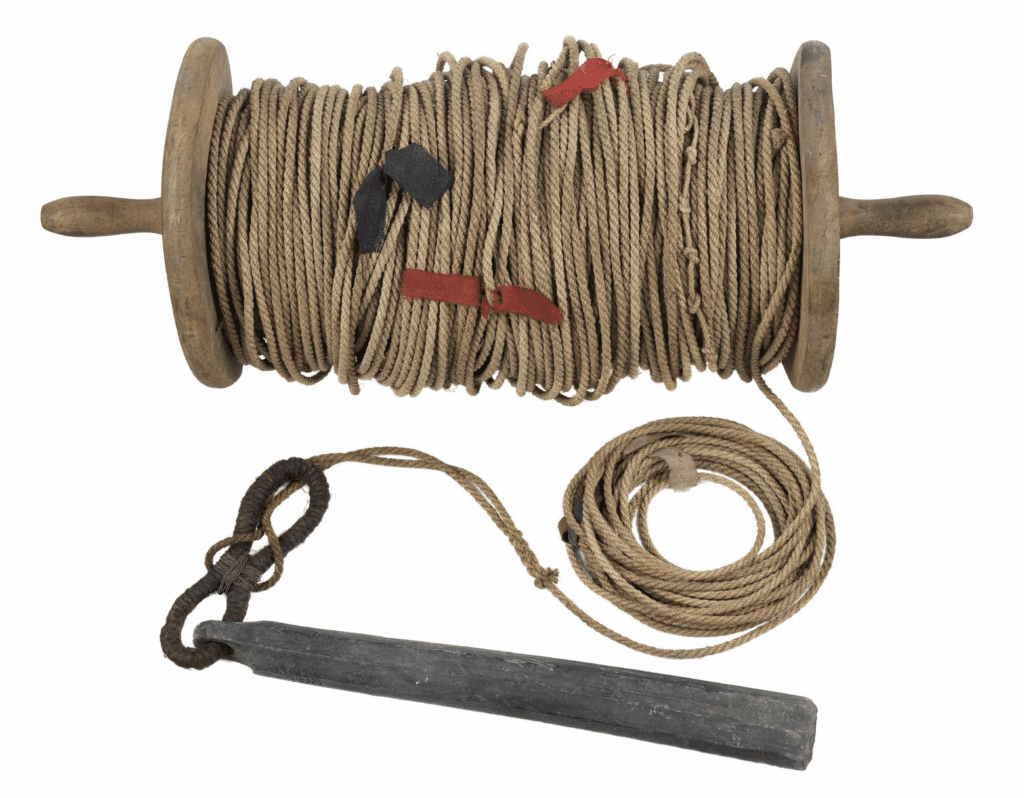
    βολίζω – bolizō

    • to heave the lead, take a sounding
      • a line and plummet with which mariners sound the depth of the sea

    ὀργυιά – fathom

    • the distance across the breast from the tip of one middle finger to the tip of the other when the arms are outstretched, 5 to 6 feet (2 m)

    Some sailors tried to escape from the ship;

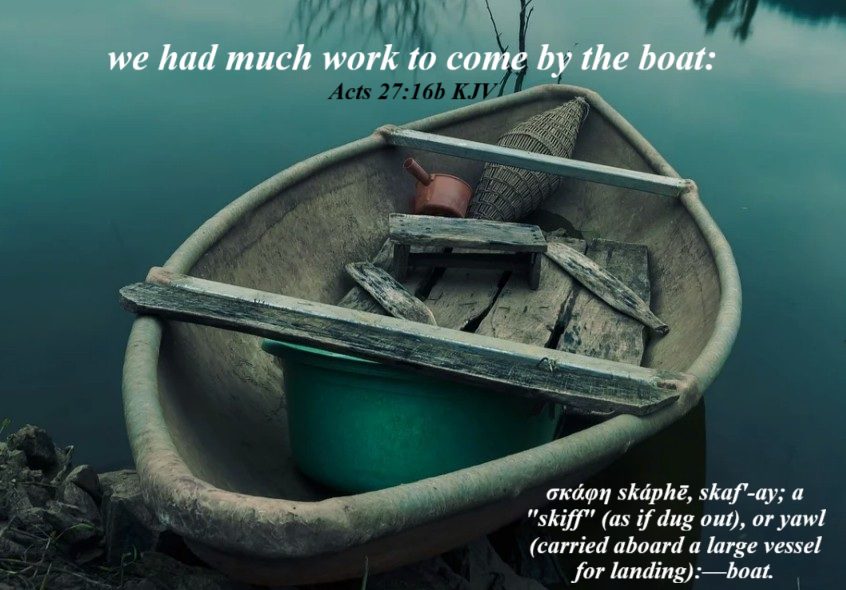
    they had let down the skiff into the sea, pretending that they were going to put out anchors from the bow.

    Julian the Centurion in COMMAND

    “Today is the fourteenth day that you have been waiting and going without food, having eaten nothing. So I urge you to take some food. For this is for your survival, since none of you will lose a hair from your head.”

    Acts 27:33b-34 CSB – encouragement of the Apostle Paul to the men of the ship

    Recall that Paul has this prophesy first hand from an Angel of God. 

    Breaking the Bread of Thanks

    After he said these things and had taken some bread, he gave thanks to God in the presence of all of them, and after he broke it, he began to eat.

    They all were encouraged and took food themselves.

    Acts 27:35-36 CSB

    And we were in all in the ship two hundred threescore and sixteen souls.

    ACTS 27:37 KJV

    And when they had eaten enough, they lightened the ship, and cast out the wheat into the sea.


    Fleeing a Sinking Ship

    Island of Malta - St Paul shipwreck Acts 27=78

    When daylight came, they did not recognize the land but sighted a bay with a beach. They planned to run the ship ashore if they could.

    After cutting loose the anchors, they left them in the sea, at the same time loosening the ropes that held the rudders.

    Roman grain ship

    Then they hoisted the foresail to the wind and headed for the beach.

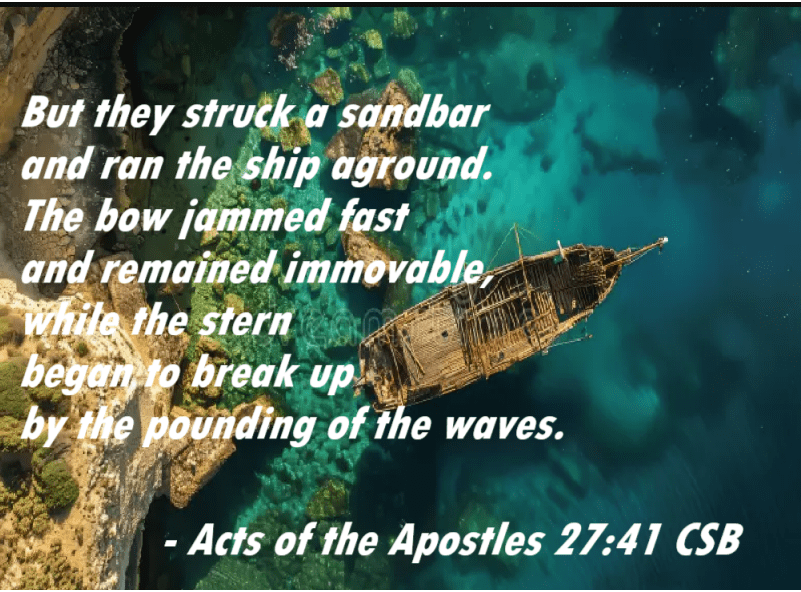
    But they struck a sandbar and ran the ship aground. The bow jammed fast and remained immovable, while the stern began to break up by the pounding of the waves. Acts 27:41 CSB rendering of shipwreck of the Apostle Paul

    Julian – Responsible for all men

    The soldiers’ plan was to kill the prisoners so that no one could swim away and escape. But the centurion kept them from carrying out their plan because he wanted to save Paul,

    and so he ordered those who could swim to jump overboard first and get to land.

    The rest were to follow, some on planks and some on debris from the ship.

    In this way, everyone safely reached the shore.

    Acts of the Apostles 27:44 CSB

    Once safely ashore, we then learned that the island was called Malta.

    Acts of the Apostles 28:1

    To be continued…