he who believes in me, though he die, yet shall he live, and whoever lives and believes in me shall never die.
Do you believe this?”
Gospel of John 11:25-26 RSV
The Son of God Who rose from the dead after being sacrificed on a cross for those who believe until His coming again, authoritively ANSWERED the timeless questions of mortal men, women and curious children of WHAT HAPPENS WHEN WE DIE?
Many men have pondered this relative relationship between the timeless Creator of all things with mortal men made in his image.
Before Christ
Job 3:
of the grave
“There the wicked cease from raging,
And there the weary of strength are at rest.
“The prisoners are at ease together;
They do not hear the voice of the taskmaster.
“The small and the great are there,
And the slave is free from his master.

“Why is light given to him who is troubled,
And life to the bitter of soul,
Who long for death, but there is none,
And dig for it more than for hidden treasures,
Who are glad with joy,
And rejoice when they find the grave?
“But regarding the resurrection of the dead, have you not read that which was spoken to you by God, saying, ‘I am the God of Abraham, and the God of Isaac, and the God of Jacob?’ He is not the God of the dead but of the living.” (Matt 22:31-32 NAS)
“And inasmuch as it is appointed for men to die once and after this comes judgment, so Christ also, having been offered once to bear the sins of many, shall appear a second time for salvation without reference to sin, to those who eagerly await Him.” (Heb 9:27-28 NAS)
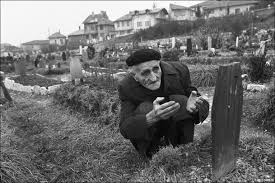
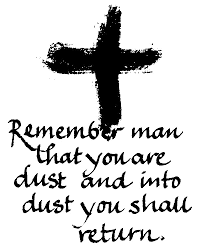
The body dies — returns to the dust from which God created mankind. And the soul — not just the breath of life,brain or your lifeless heart where blood flows no more — your soul and mine will return to its place in the light of THE LORD or judged — separated from Christ and God — to the place of darkness and punishment.
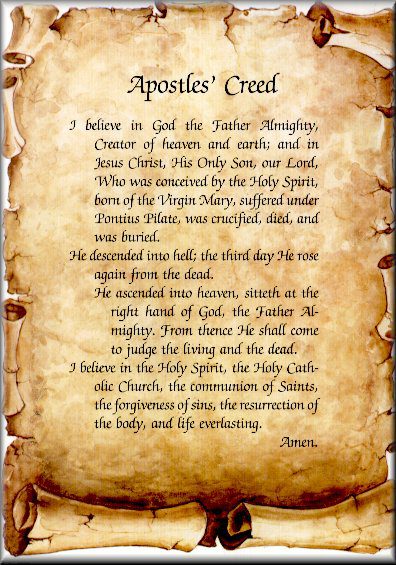
The Apostle Paul, whose Scriptures anchor the Apostles’ Creed, explains resurrection more thoroughly in his first epistle to the Saints in Corinth:
But if it is preached that Christ has been raised from the dead, how can some of you say that there is no resurrection of the dead?
If there is no resurrection of the dead, then not even Christ has been raised. And if Christ has not been raised, our preaching is useless and so is your faith… If only for this life we have hope in Christ, we are of all people most to be pitied.
The Apostle addresses issues of unbelief in the Church, as well as growing heresies about Jesus Christ, His body and His Spirit.
But Christ has indeed been raised from the dead, the firstfruits of those who have fallen asleep…
For as in Adam all die, so in Christ all will be made alive...
The body that is sown is perishable, it is raised imperishable;
it is sown in dishonor, it is raised in glory;
it is sown in weakness, it is raised in power;
it is sown a natural body, it is raised a spiritual body…
Listen, I tell you a mystery: We will not all sleep, but we will all be changed— in a flash, in the twinkling of an eye, at the last trumpet. For the trumpet will sound, the dead will be raised imperishable, and we will be changed.
Then quoting and answering the Prophets Isaiah and Hosea, Paul writes:
“Death has been swallowed up in victory.”
“Where, O death, is your victory?
Where, O death, is your sting?”
1 Corinthians 15 excerpts continued
But thanks be to God! He gives us the victory through our Lord Jesus Christ.
Then I saw an angel coming down from heaven, having the key of the abyss and a great chain in his hand…
Then I saw thrones, and they sat on them, and judgment was given to them.
And I saw the souls of those who had been beheaded because of their witness of Jesus and because of the word of God..
And they came to life and reigned with Christ for a thousand years.
The rest of the dead did not come to life until the thousand years were finished. This is the first resurrection.
Blessed and holy is the one who has a part in the first resurrection. Over these the second death has no authority, but they will be priests of God and of Christ and will reign with Him for a thousand years.
.. And the devil who deceived them was thrown into the lake of fire and brimstone, where the beast and the false prophet are also, and they will be tormented day and night forever and ever.
Then I saw the dead, the great and the small, standing before the throne, and books were opened…
Then death and Hades were thrown into the lake of fire. This is the second death, the lake of fire.
And if anyone’s name was not found written in the book of life, he was thrown into the lake of fire.
“Truly, truly, I say to you, he who believes has eternal life. “I am the bread of life.
Note that communion here is the fellowship of the saints whick follows learning the teaching or doctrine of the Apostles.
AND that Communion (as we call it) is a corporate breaking of the bread [klasis artos], a symbolic remembrance of Christ’s broken body.
They devoted themselves to
(from the CSB) (and in addition to;)
the apostles’ teaching,
to the fellowship (communion of the saints),
to the breaking of bread,
and to prayer.
ALL these together, as Christ’s local church, to keep them holy and separate from the sin and surrounding sinners of whom they once embraced.
κοινωνία koinōnía, koy-nohn-ee’-ah; from G2844; partnership, i.e. (literally) participation, or (social) intercourse, or (pecuniary) benefaction (giving to the benefit of the church):—(to) communicate(-ation), communion, (contri-)distribution, fellowship.
After the Hebrews had abandoned the Law of Moses and their priest Ezra reads it to the people.
.. the children of Israel were assembled with fasting, and with sackclothes, and earth upon them.
repentant prayer
.. And the seed of Israel separated themselves from all strangers,
sanctification or holiness apart from the sin of their former life
and stood and confessed their sins, and the iniquities of their fathers.
Confession to God precedes asking for forgiveness.
But they and our fathers dealt proudly, and hardened their necks, and hearkened not to thy commandments,
And refused to obey, neither were mindful of thy wonders that thou didst among them; but hardened their necks, and in their rebellion appointed a captain to return to their bondage:
but thou art a God ready to pardon, gracious and merciful, slow to anger, and of great kindness, and forsookest them not.
Nehamiah 9:16-17 KJV
the remission of sins,
Admittedly 'remission from the Creed is a little 'King James' in its sound. But recognize the New Testament application with which you may be able to relate from a familiar prayer and Scripture.
Forgive us our debts
(Which comes from this OT application of the Law)
“At the end of every seven years you shall grant a remission of debts.
מִקֵּץ שֶׁבַע־שָׁנִים תַּעֲשֶׂה שְׁמִטָּה׃
Deuteronomy 18:1 LSB
‘And forgive us our debts, as we also have forgiven our debtors.
Gospel of Matthew 6:12 LSB
“For if you forgive others for their transgressions,
your heavenly Father will also forgive you.
“But if you do not forgive others,
then your Father will not forgive your transgressions.
Matthew 6:14-15 LSB – the teaching of Jesus, the Son of Man, to followers
the concept of “wages,” which implies a payment or consequence that is earned. In the biblical context,
sin refers to any action, thought, or attitude that falls short of God’s holiness and commands.
Death here is both physical and spiritual, indicating separation from God.
Theologically, this underscores the seriousness of sin and its inevitable outcome without divine intervention.
Contrasting with the earned wages of sin, the “gift of God” emphasizes grace, which is unmerited favor. Eternal life is not something humans can earn; it is a gift freely given by God.
It is only through Jesus Christ, His death, and resurrection, that believers receive this gift. Jesus is seen as the fulfillment of Old Testament types and prophecies, such as the Passover Lamb (Exodus 12) and the Suffering Servant (Isaiah 53).
Most of us give little thought to ancient history and political failings as they affect the lives of so many so long ago. Few consider these ancient interactions between religion, philosophy and the outcomes impacting the Church.
However I believe you may find some helpful insights into the Creeds of the Church with just a few facts (and limited study of such political events from ancient Roman history).
Some Dates and culture of note:
~ AD (anno Domini, Latin for in the year of our Lord) 30 – Jesus Christ crucified (4), rose from the dead (5) and ascended into heaven (6).
(#’s listed above from the Roman Creed)
~ AD 44 – the first Apostle martyred – James, son of Zebedee
~ AD 70 – Romans destroy Jerusalem and the Temple
~ AD 90’s the last surviving Apostle John dies on the island of Patmos
Greek is the universal language of the Early Church, including in Rome.
~ AD 117 the Roman Empire reaches its largest and thereafter, Rome’s influence begins to fail to govern effectively.
AD 284 the Emperor divides the Empire into East and West for administrative purposes and to a large extent the Church will do the same.
A divided Roman Empire leads to a divided Church
AD 312 – TWO Roman Emperors (Maxentius, who lost, and Constantine I, who won) meet in battle.
AD 313 – Constantine converts to Christianity, moves the Empire’s capital west and re-names the New Roman Capital, Constantinople (modern Istanbul, Turkie).
AD 325 – The Nicene Creed (Nicene being near the religious leaders in Constantinople).
AD 340 – The Apostles’ Creed, the text is similar to a Baptismal Creed already in use in Rome as early in the 2nd and 3rd century.
AD 410 Rome itself is sacked
and as you probably know,
AD 476 Fall of the entire Roman Empire
MORE: of later Church divisions leading to the Protestant Reformation from an earlier SERIES on TalkofJESUS.com
Here is a bit about the printing press, Bibles for common folk to read, St. Augustine and of course that troublesome German priest, Martin Luthur.
Peter later writes two epistles (a Greek word meaning, letter) to the churches. From our recent series:
The Apostle (or Saint, if your must) but really Peter acts as a Bishop overseeing many churches) writes:
To those who are elect exiles of the Dispersion in Pontus, Galatia, Cappadocia, Asia, and Bithynia, according to the foreknowledge of God the Father, in the sanctification of the Spirit, for obedience to Jesus Christ and for sprinkling with his blood:
This points toward a Holy and separated group of Christians – persecuted Christians – and any of these saints of the churches deserving of honor for the example they lived in Christ.
Holy, holy
Capitalization: semantics, really. Little if any effect on meaning.
The Apostle Paul, a mater of language (Greek, as well as Hebrew) clarifies this even more in his first epistle to the Corinthians.
Paul, called as an apostle of Jesus Christ by the will of God, and Sosthenes our brother,
To the church of God which is at Corinth, to those who have been sanctified in Christ Jesus, saints by calling, with all who in every place call on the name of our Lord Jesus Christ, their Lord and ours:
1 Corinthians 1:1-2 NASB
Paul humbly introduces himself noting the he is CALLED AS AN APOSTLE OF JESUS CHRIST. He’s no SAINT – with a CAPITAL S – speaking down to the saints- SMALL ‘s’ who must listen to the Apostle.
And of course no saint would have ever addressed him as , Saint Paul, Apostle Paul, Arch-Bishop Paul, your most-reverend Apostleness or any other inappropriate greeting. He is their loving brother and father in the faith.
Paul’s theological guidance to the church – every church – every believer and saint is confirming that they have been SANCTIFIED in Christ Jesus. This is what makes all Christians saints.
Of course the Apostles describe Christ followers, sanctified in His Blood sacrificed for sinners, as saints — HOLY ONES
It did not take long for the Apostle Peter to get to this KEY point in his first epistle either AND quoting the holy scripture of Moses AND referring to Christ:
.. but like the Holy One who called you, be holy yourselves also in all your conduct;
because it is written,
“YOU SHALL BE HOLY, FOR I AM HOLY.”
1:Peter 1:15-16 LSB
catholic
So remember that the purpose of agreement on the Church (or churches)confessing or saying the same Creed is to say the WE all are alike in that WE BELIEVE these same things.
AND ALSO what WE believe and confess separates us from those who do NOT follow Christ. Therefore we are sanctified or purified by Christ.
IT IS A UNIVERSAL or CATHOLIC confession and affirmation that binds us as CHRIST followers … or saints of His Church.
NOT Peter’s church. NOT Paul’s church. Not that of some holy mother or fatherly Saint of the past…
We are part of Christ’s Holy Church, made Holy by Him.
WE believe in the Holy Catholic Church
Christ’s Church
Although WE do not accept every accusation of heresy or claim of special authority outside of the Holy written word of God and Jesus Christ.
I suppose, beloved fellow saint, that you too have an opinion on this.
(That's why the Church fathers emphasized these few important words in The Apostles' Creed.)

Why not COMMENT with your thoughts on the Holy Catholic Church at the end of this post, if you will?
Used to monitor number of Google Analytics server requests
10 minutes
__utmb
Used to distinguish new sessions and visits. This cookie is set when the GA.js javascript library is loaded and there is no existing __utmb cookie. The cookie is updated every time data is sent to the Google Analytics server.
30 minutes after last activity
__utmc
Used only with old Urchin versions of Google Analytics and not with GA.js. Was used to distinguish between new sessions and visits at the end of a session.
End of session (browser)
__utmz
Contains information about the traffic source or campaign that directed user to the website. The cookie is set when the GA.js javascript is loaded and updated when data is sent to the Google Anaytics server
6 months after last activity
__utmv
Contains custom information set by the web developer via the _setCustomVar method in Google Analytics. This cookie is updated every time new data is sent to the Google Analytics server.
2 years after last activity
__utmx
Used to determine whether a user is included in an A / B or Multivariate test.
18 months
_ga
ID used to identify users
2 years
_gali
Used by Google Analytics to determine which links on a page are being clicked
30 seconds
_ga_
ID used to identify users
2 years
_gid
ID used to identify users for 24 hours after last activity
24 hours
_gat
Used to monitor number of Google Analytics server requests when using Google Tag Manager
1 minute
_gac_
Contains information related to marketing campaigns of the user. These are shared with Google AdWords / Google Ads when the Google Ads and Google Analytics accounts are linked together.