Category: 4 Gospels + Good News of the NEW Testament

What are the Gospels?

FOUR Gospels:

GOOD NEWS! (That’s what Gospel means.)

Matthew, Mark, Luke & John begin the New Testament proclaiming the Good News of Israel’s long-awaited Messiah and talk of JESUS Christ.

The four Gospels are first hand witness + proclaiming GOOD NEWS

  • by two Jewish Apostles of the Messiah JESUS, Matthew & John
  • Two gentile (non-Jewish) followers of THE WAY of Jesus Christ, Mark & Luke, who proclaim the GOSPEL recorded from witness of Peter, Paul and other Apostles and disciples of JESUS in the first century.

READ the Good News of the Messiah and Savior Jesus from accounts of His twelve Apostles & others witnessing the resurrection of the Lord Jesus from the four Gospels of the New Testament: Matthew, Mark, Luke and John.

SHARE the Gospel

  • with your Christian friends and those who do not yet believe in JESUS CHRIST.
  • Comment on a Talk of JESUS post and SHARE in your social media world.
  • Ashes to Ashes

    Ashes to Ashes

    Genesis 18:27 KJV And Abraham answered and said, Behold now, I have taken upon me to speak unto the Lord, which am but dust and ashes:

    Do you know the context of this? (Answer in a moment; but first another quote and some additional background.)

    Forasmuch as it hath pleased Almighty God of his great mercy to take unto himself the soul of our dear brother here departed, we therefore commit his body to the ground; earth to earth, ashes to ashes, dust to dust; in sure and certain hope of the Resurrection to eternal life, through our Lord Jesus Christ; who shall change our vile body, that it may be like unto his glorious body, according to the mighty working, whereby he is able to subdue all things to himself.

    Remember: you are dust and to dust you will return.

    Genesis 3:4 But the serpent said to the woman, “You will not surely die. 5 For God knows that when you eat of it your eyes will be opened, and you will be like God, knowing good and evil.”

    17 And to Adam he said,

    “Because you have listened to the voice of your wife
    and have eaten of the tree
    of which I commanded you,
    ‘You shall not eat of it,’
    cursed is the ground because of you…
    19 By the sweat of your face
    you shall eat bread,
    till you return to the ground,
    for out of it you were taken;
    for you are dust,
    and to dust you shall return.”

    Numbers 19

    9 And a man who is clean shall gather up the ashes of the heifer and deposit them outside the camp in a clean place. And they shall be kept for the water for impurity for the congregation of the people of Israel; it is a sin offering. 10 And the one who gathers the ashes of the heifer shall wash his clothes and be unclean until evening. And this shall be a perpetual statute for the people of Israel, and for the stranger who sojourns among them.

    The ashes are a sin offering to the Lord for the altar of worship.

    Returning to Abraham in Genesis 18:

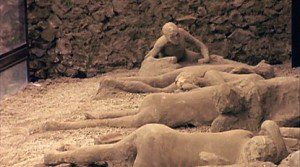
    Pompeii2Abraham is standing before God pleading for mercy for the people of his nephew Lot’s city. It is a city and a place full of sin on which God will rain down His Almighty wrath and judgment – the city of Sodom.
    26 And the Lord said, “If I find at Sodom fifty righteous in the city, I will spare the whole place for their sake.”

    27 Abraham answered and said, “Behold, I have undertaken to speak to the Lord, I who am but dust and ashes. 28 Suppose five of the fifty righteous are lacking. Will you destroy the whole city for lack of five?” And he said, “I will not destroy it if I find forty-five there.” 29 Again he spoke to him and said, “Suppose forty are found there.” He answered, “For the sake of forty I will not do it.” 30 Then he said, “Oh let not the Lord be angry, and I will speak. Suppose thirty are found there.” He answered, “I will not do it, if I find thirty there.” 31 He said, “Behold, I have undertaken to speak to the Lord. Suppose twenty are found there.” He answered, “For the sake of twenty I will not destroy it.” 32 Then he said, “Oh let not the Lord be angry, and I will speak again but this once. Suppose ten are found there.” He answered, “For the sake of ten I will not destroy it.” 33 And the Lord went his way, when he had finished speaking to Abraham, and Abraham returned to his place.

    It is the office of the Priest to intercede for the sins of the people. Abraham, in this instance, is a Priest before Almighty God.

    Christians have a greater Priest and Perfect Sin Offering, Christ Jesus the Very Son of God.

    Abraham failed in saving Sodom, because not even ten righteous men could be found; only Lot. Even Lot’s wife (who did not obey the Lord) was lost for her sin. The wrath of God brought quick and unexpected justice against the entire town and valley.

    Ashes rained down and purified the sinful.

    God had formerly judged the whole earth and purified it by water, saving only Noah and his family. Yet God kept His covenant to never destroy the whole earth again by water. Part of it? Yes. Cities by fire? Yes. By war? Certainly. God confirms in scripture His support of enemies to purify the unfaithful Chosen who by obedience to God’s Law are supposed to live with God’s righteousness.

    Time after time and Prophet after Prophet, up until John the Baptist and even the teaching of our Lord, Christ Jesus; the message of God does not change.

    Repent. Return to God. Turn from your sin. Return to righteousness.

    Repent to dust and ashes and bow down in worship to the Lord, your God.

    We have been following Jesus’ early ministry and many miracles in Galilee. (This is not even to mention His Sacrifice of the Cross for your sins and for mine.)

    Do you recall what Jesus said of repentance to these towns where He has just preached to the multitudes, yet most would not follow Him by faith?

    Here is Jesus’ warning to those who refuse to hear the Gospel from us:

    Luke 10

    10 But whenever you enter a town and they do not receive you, go into its streets and say, 11 ‘Even the dust of your town that clings to our feet we wipe off against you. Nevertheless know this, that the kingdom of God has come near.’

    12 I tell you, it will be more bearable on that day for Sodom than for that town.

    Woe to Unrepentant Cities

    13 “Woe to you, Chorazin!

    Woe to you, Bethsaida!

    For if the mighty works done in you had been done in Tyre and Sidon, they would have repented long ago, sitting in sackcloth and ashes. 14 But it will be more bearable in the judgment for Tyre and Sidon than for you.

    15 And you, Capernaum, will you be exalted to heaven?

    You shall be brought down to Hades.

    16 “The one who hears you hears me, and the one who rejects you rejects me, and the one who rejects me rejects him who sent me.”

    Therefore, dear brother or sister in Christ Jesus, know that as you call on the world around you to repent to dust and ashes and they will not listen; neither did they hear our Lord. For they hung Him in disgrace on a Cross, for all to see His Sacrifice for the sins of the world.

    The Blood of Christ, sacrificed in Jerusalem, cries out from the Altar of all Righteousness for the wrath of God to rain down, even as His mercy has been sacrificed for us.

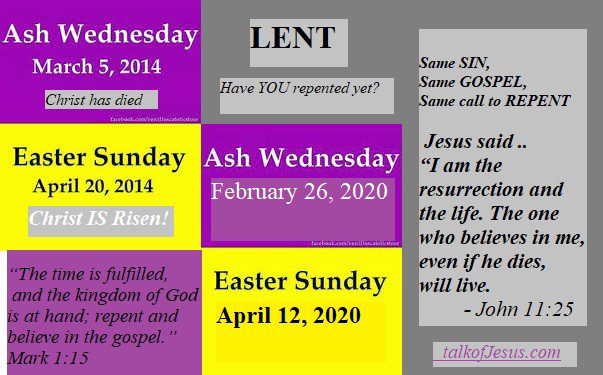
    It is Ash Wednesday – a time for repentance, in these last days.

    It is a time of urgency for us to proclaim the love of our Lord and Savior Christ Jesus, who gave Himself that we might have eternal life.


  • Jesus – Siloam – “I washed and I see

    Jesus – Siloam – “I washed and I see

    “Go,” he told him, “wash in the pool of Siloam” (which means “Sent”). So he left, washed, and came back seeing.

    John 9:7 CSB

    Sight to a blind man

    Previously we looked at John’s introduction to Jesus healing a man who was blind from birth. We left off with the Messiah sending the man to Siloam (which means ‘sent’) with mud Jesus had created by spitting on dust covering the blind man’s eyes.

    Besides being a clear sign of the Messiah’s mysterious power from God the Father, it’s important to note two things here:

    1. Right in the middle of John 9:7 at the beginning his witness of the Good News of Jesus healing a man blind from birth, time passes as the blind man leaves then returns later with sight.
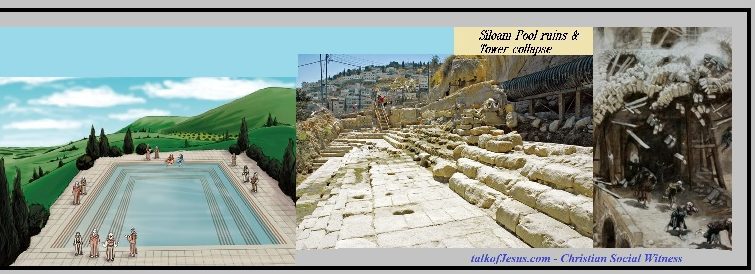
    2. Witnesses would have been familiar with the mysteries of God associated with the Pool of Siloam, but also the tragic deaths of those who had been killed in this same place when the Tower of Siloam fell upon them. (Luke later records this in his Gospel.)

    John tells of this sign of the blind man healed after he washed at Siloam, but to a later audience not present his testimony is scene of what others witnessed firsthand like him. Like most miracles of the Messiah those present had to debate the seemingly impossible scene which confronted their faith. Were they really seeing a miracle?

    I am the one

    John 9:

    So he … came back seeing.

    8 Therefore the neighbors, and those who previously saw him as a beggar, were saying,

    “Is not this the one who used to sit and beg?” (Yes.)

    9 Others were saying,

    “This is he,” (Yes, I am that man.)

    still others were saying,

    “No, but he is like him.” (Friend, you know it is me. Neighbor, you see that it is me.)

    He kept saying, “I am the one.”

    Of course any witnesses of the miraculous must ask: HOW?

    10 So they were saying to him, “How then were your eyes opened?”

    Therefore once again the man formerly blind, speaking to the crowds of Jerusalem (some who were not present before and others who were), now retells what has just happened.

    The Messiah however has moved with the crowds to other parts of Jerusalem.

    He ‘Sent’ me

    I remind us here of the context of what we already learned about Jesus, the true Light ‘sent’ to the world.

    When John writes, “Siloam” (which is translated, Sent), the Apostle uses a Greek word which should sound familiar to the Christian of this day: apostellō, ἀποστέλλω related to the word “Apostle,” ἀπόστολος – apostolos.

    The Apostle John also previously witnessed Jesus’ light hidden from the eyes of the Pharisees, using this same word for ‘sent’ and describing that He the Son was sent by God the Father.

    • Jesus said to them, “If God were your Father, you would love Me, for I proceeded forth and have come from God, for I have not even come on My own initiative, but He sent G649 Me. – John 8:42 (after which the Lord said: Before Abraham was, I AM.)
    • “What shall we do, so that we may work the works of God?” Jesus answered and said to them, “This is the work of God, that you believe in Him whom He has sent.” G649John 6:28b-29 (after Jesus had feed 5000 and walked on the Sea of Galilee)

    Same word as John uses to describe Siloam as meaning sent: apostellō. You likely know it best from John 3.

    “For God did not send G649 the Son into the world to judge the world, but that the world might be saved through Him.

    John 3:17 NASB – Strong’s G649 = apostellō

    11 He answered, “The man who is called Jesus made clay, and anointed my eyes, and said to me, ‘Go to Siloam and wash’; so I went away and washed, and I received sight.”

    I went and received sight

    Miraculous! We know how (after Jesus sent him to Siloam).

    12 They said to him, “Where is He?”

    He said, “I do not know.”

    Confirming the Sign (of the Messiah)

    We will find no group working harder on the Sabbath than religious authorities working to enforce religion.

    Pharisees believe in the resurrection, but deny the true life through the Messiah of God. John witnesses rejection of Jesus by their works of darkness.

    13 They brought him who formerly was blind to the Pharisees. Now it was a Sabbath when Jesus made the clay and opened his eyes.

    15 Then the Pharisees also asked him again how he had received his sight.

    Once again, controversy like in previous debates within the crowds witnessing the miracle.

    He said to them, “He put clay on my eyes, and I washed, and I see.”

    16 Therefore some of the Pharisees said, “This Man is not from God, because He does not keep the Sabbath.”

    Others said, “How can a man who is a sinner do such signs?”

    And there was a division among them.

    The Pharisees in charge continue to prosecute the man who can see even after rendering their judgment of the Messiah Jesus as witness to the court.

    “What have you to say about him? It was your eyes he opened.”

    “He is a prophet.”

    Calling Jesus a prophet compares Him to John the Baptist, Elijah and others. Refusing his truthful answer, they call the man’s parents to the stand.

    “Is this your son, who you say was born blind? Then how does he now see?”

    20 “We know this is our son and that he was born blind,” his parents answered. “But we don’t know how he now sees, and we don’t know who opened his eyes. Ask him; he’s of age. He will speak for himself.”

    Confess, for we find you guilty

    John now gives us an earlier insight from the trial here in addition to their judgment that Jesus is not the Messiah.

    22 His parents said these things because they feared the Jews, for the Jews had agreed already that if anyone confessed that He was Christ, he would be put out of the synagogue.

    So again they call the defendant who could now see to the stand.

    Give glory to God

    “Give God the glory! We know that this Man is a sinner.” – John 9:24 NKJV

    Give God (Theos) glory (Doxa)! Nothing wrong with that.

    Certainly those in the audience riveted to the outcome of this man’s trial to determine if he may remain a part of the community of the Jews with full participation in the worship of their places of learning (synagogues) would tend toward a praise of their opening. But then these judges (of the Sanhedrin) betray who they really put on trial here.

    The Messiah, a sinner?

    “We know this man (anthropos) is a sinner (hamartōlos).”

    Is JESUS ‘devoted to sin,’ a sinner? (For this is the definition of their judgment NOT of the defendant, but of their Messiah.)

    Has the Son of Man, as Jesus self-identifies as One born of Mary, a King of the Jews in the line of David, — has He shown Himself to be “pre-eminently sinful, especially wicked,” or even a lesser violation of Pharisaic interpretation of ‘work’ on the Sabbath as a lesser accusation that Jesus is not free from sin?

    Jesus has already accused them (not the man formerly blind on trial here):

    “You are of your father the devil, and you want to do the desires of your father. He was a murderer from the beginning, and does not stand in the truth because there is no truth in him. Whenever he speaks a lie, he speaks from his own nature, for he is a liar and the father of lies. But because I speak the truth, you do not believe Me.

    “Which one of you convicts Me of sin? If I speak truth, why do you not believe Me?

    John 8:44-46 NASB – Jesus the Messiah on Truth

    The Apostle John has already laid the foundation of Truth behind the accusations against the blind man who now sees and the Pharisees who convict out of the darkness.

    Conclusive evidence: Now I see

    25 He then answered, “Whether He is a sinner, I do not know; one thing I do know, that though I was blind, now I see.”

    “Now I see,” the man truthly states ONLY the facts. One thing further he does in which the court fails, he judges rightly that he cannot know if the man who healed him is a sinner. You see the evidence, I see. (Why ask me about another man, even the One who healed me?)

    “What did He do to you? How did He open your eyes?”

    “I told you already and you did not listen; why do you want to hear it again?

    (Perhaps a pregnant pause, as the audience hears his indisputable evidence.)

    Then a more personal question to the Court which certainly must have brought silent smiles to some witnesses of this precursor of a trial yet to come before them.

    You do not want to become His disciples too, do you?” (We can only imagine the uproar, but their reaction is severe.)

    You are His disciple?

    Their next accusation, false at this time because the blind man had never known Jesus’ teaching, draws the line of the Pharisees by which they held tightly their religions authority.

    But first for the crowds, they restate their tenuous authority.

    “We know that God has spoken to Moses, but as for this man, we do not know where He is from.”

    Now the answer from the man who repeatedly said, “now I see” that offends most.

    “Well, here is an amazing thing, that you do not know where He is from, and yet He opened my eyes… (Again, now I see!)

    Witness of the man who now sees

    The man who was once blind continues. John concludes with his witness and expulsion from the religious Jewish community.

    31 We know that God does not hear sinners; but if anyone is God-fearing and does His will, He hears him. Since the beginning of time it has never been heard that anyone opened the eyes of a person born blind. If this man were not from God, He could do nothing.”

    Guilty of witness of the Messiah

    34 They answered and said to him, “You were completely born in sins, and are you teaching us?”

    And they cast him out.

    It’s not just that the Court of the Pharisees ‘cast the man who witnessed ‘now I see’ and the sign that Jesus IS the Messiah; he would now be excluded from Jewish culture as well and subject to further persecution.

    The New King James Version of John’s Gospel emphasizes the gravity of the Court’s predetermined verdict:

    The Pharisees Excommunicate the Healed Man

    John will continue his Good News of the Messiah Jesus with yet another encounter with the blind man who witnessed, I washed and I see.’

    What must you do?

    On a more personal level I ask you, as the man once blind asked the Pharisees, ‘Do you want to be His disciples too,’ what will you do with the mud covering your eyes?

    Siloam – Sent by the Messiah

    … but have you washed?

    Then one of the elders answered, saying to me, “These who are clothed in the white robes, who are they, and where have they come from?”

    I said to him, “My lord, you know.”

    And he said to me, “These are the ones who come out of the great tribulation, and they have washed their robes and made them white in the blood of the Lamb.

    The Revelation of Jesus Christ to John: 7:13-14 NASB
    To be continued...

  • Jesus – Disaster & Sin – Tower of Siloam

    Jesus – Disaster & Sin – Tower of Siloam

    “I tell you, no! But …

    What day’s NEWS doesn’t HEADLINE: DISASTER? The world asks why God would allow this. Were those killed worse sinners than others, so God punished them by death?

    This is how we think. Even if we acknowledge sin (in others) we want to blame God for punishment, especially in providential ‘acts of God’ which end lives unexpectedly.

    The Good News of Luke briefly describes two such incidents.

    world trade center towers burning on 9-11-2001

    Such disasters do imprint our memories for a time, for example in this 21st century just mention of NINE-ELEVEN.

    Like the unexpected question, Who Sinned? , here Jesus gives a similar answer to disaster similar to the “WHY” about a man born blind from birth.

    This time the crowds had complained of persecution of Galileans by the Roman Prefect of Judea Pontius Pilate. Jesus responds to the crowds with a rhetorical question about sin. (You need to think about what the Lord tells us here about the nature of sin and how we must approach it.)

    Unless you repent …

    Luke 13:

    2 Jesus answered, “Do you think that these Galileans were worse sinners than all the other Galileans because they suffered this way? 3 I tell you, no!

    But unless you repent, you too will all perish.”

    Were these who died at the hand of Pilate worse sinners? NO.

    The Messiah then addresses a local disaster, a recent act of God well-known to Jerusalem.

    painting of tower of Siloam crumbling on men of Jerusalem

    4 Or those eighteen who died when the tower in Siloam fell on them—do you think they were more guilty than all the others living in Jerusalem?

    5 I tell you, no!

    But unless you repent, you too will all perish.”

    ‘Unless WE REPENT,’ the Messiah’s listeners must have thought? This rabbi preaches the same message as John the Baptizer and the Prophets of old.

    Then in typical His typical teaching technique, Jesus tells a symbolic parable to illustrate his point that we must repent or we will also perish.

    The fig tree, an ancient symbol of life in Israel and the middle east, represents prosperity, peace and righteousness throughout the Bible.

    Parable of the Fig Tree

    6 Then he told this parable:

    “A man had a fig tree growing in his vineyard, and he went to look for fruit on it but did not find any.

    No life in the tree, no prosperity for the owner of the vineyard, no peace here in Jerusalem where fig trees blossom and bear fruit.

    7 Then he said to the keeper of his vineyard,

    ‘Look, for three years I have come seeking fruit on this fig tree and find none. Cut it down; why does it use up the ground?’

    The Son of Man, the Messiah has been sowing righteousness in the land for three years. Does Jesus ask this crowd of Jews (keeper of God’s vineyard), ‘Why has your faith not yielded fruit?’

    Some Jews have believed and followed their Messiah. A faithful servant in God’s vineyard would plea for mercy for the vine. So his repentant answer would ask the Owner of the vineyard for mercy. He will promise to do his Lord’s work of righteousness once more.

    8 “‘Sir,’ the man replied, ‘leave it alone for one more year, and I’ll dig around it and fertilize it. 9 If it bears fruit next year, fine! If not, then cut it down.’”

    You too will all perish

    There’s something about disaster and death which gets demands our attention: our own mortality.

    Any story of suffering and sudden death of others reminds us of our own helpless before Almighty God. And some will recall their own past sins and immediacy of repentance.

    One recent story of annual flooding in Jerusalem reminds us of the suddenness of the expected. These events often reveal the heritage of our past in addition to the mortality of its victims.

    Siloam was an area just outside the walls of Jerusalem on the southeast side of the city. A spring-fed pool was there, which was the scene of one of Christ’s miracles (John 9). The tower of Siloam may have been part of an aqueduct system or a construction project that Pilate had begun. In any case, the tower fell, and eighteen people were killed in the catastrophe.

    Why did Jesus mention the tower of Siloam in Luke 13:4?

    Why mention a recent disaster?

    Second COVID-19 death sparks fears, lockdown in Italian towns – Agence France-Presse
    Posted at Feb 22 2020 08:08 PM [local time]

    I could have chosen pictures & NEWS from just this month, February 2020, even from contemporary Jerusalem where Jesus addressed sin and disaster in speaking of both the tower and pool of Siloam.

    Refugees of natural disasters, even so common as annual hurricanes or typhoons (as pictured here from 2013 in the Philippines) remind us that our earthly home is temporary. The displaced ships in Luzon Philippines (above) are part of a witness by Pastor BERMIE DIZON who lived there at the time. He witnesses comparison to Jesus’ teachings about the tower and pool of Siloam.

    “I was only a few miles away from the volcano, Mt. Pinatubo when it exploded in 1991. At that very moment of explosion, I really thought my family and I will die buried like those in the ancient city of Pompeii.

    Pastor Bermie Dizon of GCI Ministries, Luzon Philippines bermiedizon.com/disasters/

    I ask the same question of Jesus of those who perished in the fall of the Tower of Siloam:

    Contemporary application by paraphrase of Jesus’ questions

    “Do you think that these FILIPINOS were more sinful than all the other FILIPINOS because they suffered these things?

    3 No, I tell you; but unless you repent, you will all perish as well.

    COVID-19 tally: 76,785 cases, 2,249 deaths, 34 cases in the U.S.
    Published: Feb 21, 2020 2:50 p.m. ET

    “Or those two thousand killed by the #Coronavirus —do you think they were more sinful than all the other people who live in China and other places in this world?

    5 No, I tell you; but unless you repent, you will all perish as well.”

    Therefore, feed your faith

    “‘… Perhaps it will produce fruit next year, but if not, you can cut it down.’”

    Luke 13:9 CSB – Jesus’ Parable of the Barren Fig Tree
    God-willing we will return to the pool of Siloam in John 9.
    To be continued...