Category: 4 Gospels + Good News of the NEW Testament

What are the Gospels?

FOUR Gospels:

GOOD NEWS! (That’s what Gospel means.)

Matthew, Mark, Luke & John begin the New Testament proclaiming the Good News of Israel’s long-awaited Messiah and talk of JESUS Christ.

The four Gospels are first hand witness + proclaiming GOOD NEWS

  • by two Jewish Apostles of the Messiah JESUS, Matthew & John
  • Two gentile (non-Jewish) followers of THE WAY of Jesus Christ, Mark & Luke, who proclaim the GOSPEL recorded from witness of Peter, Paul and other Apostles and disciples of JESUS in the first century.

READ the Good News of the Messiah and Savior Jesus from accounts of His twelve Apostles & others witnessing the resurrection of the Lord Jesus from the four Gospels of the New Testament: Matthew, Mark, Luke and John.

SHARE the Gospel

  • with your Christian friends and those who do not yet believe in JESUS CHRIST.
  • Comment on a Talk of JESUS post and SHARE in your social media world.
  • God’s Love Through John – Sign of a Raised Serpent

    God’s Love Through John – Sign of a Raised Serpent

    He seized the dragon, that ancient serpent who is the devil and Satan, and bound him for a thousand years.

    Revelation of Jesus Christ to John 20:2 CSB

    A Sign for followers of Moses

    The Apostle John mentions the serpent in Revelation and also as a sign to the Jews in the Gospel of John. Jesus knew well the symbolism presented to Nicodemus associated with Moses, but He presents a connection to the Cross and what the Lord will teach to all as the purpose of His Incarnation.

    And as Moses lifted up the serpent in the wilderness, even so must the Son of man be lifted up:

    John 3:14 KJV


    You may have missed the familiar symbolism of the serpent in some translations using ‘snake’ or ‘bronze snake on a pole,’ so we will explore this from the Book of Numbers. But first, let’s return to the context of this conversation in John’s Gospel.

    “Are you a teacher of Israel…?

    We began our look at a theological debate between Nicodemus and Christ Jesus which the Apostle John records in God’s Love Through John: Of water and the Spirit. We associate Nicodemus mostly with Jesus’ clear answer to the initial question of the Israelite leader.

    John 3:4 KJV Nicodemus saith unto him, How can a man be born when he is old? can he enter the second time into his mother’s womb, and be born?

    Nicodemus is already old by measure of lifespans of his day. He is a ruler of the council and the most prominent Pharisee of the Temple, who must come to Jesus at night to have this conversation.

    He receives reports from others, including Pharisees and other Temple officials sent to John the Baptist, who testified that Jesus IS the Messiah, the Promised One. And Jesus’ bold actions have already made this Messiah even more controversial than John the Baptist.

    Most certainly, Nicodemus was either present at the Temple as witness to the earlier destruction by Jesus in the Temple courtyard, either as it happened or immediately after the disruption of the order of ritual sacrifices.

    John 2:

    15 After making a whip out of cords, he drove everyone out of the temple with their sheep and oxen. He also poured out the money changers’ coins and overturned the tables. 16 He told those who were selling doves, “Get these things out of here! Stop turning my Father’s house into a marketplace!”

    Do you suppose Nicodemus and other officials of the Temple council had a few questions for Jesus about this incident during the profitable Passover pilgrimage festival? Of course they did.

    John records (perhaps from a later memory after the Resurrection), 17 And his disciples remembered that it is written: “Zeal for your house will consume me.”

    He quotes the scriptural songbook of Israel of the day.

    from Psalm 69

    • 4 They that hate me without a cause…
    • 7 Because for thy sake I have borne reproach; shame hath covered my face.
    • 8 I am become a stranger unto my brethren, and an alien unto my mother’s children.
    • 9 For the zeal of thine house hath eaten me up; and the reproaches of them that reproached thee are fallen upon me.
    • 12 They that sit in the gate speak against me…
    • 19 Thou hast known my reproach, and my shame, and my dishonour: mine adversaries are all before thee.
    • 21 They gave me also gall for my meat; and in my thirst they gave me vinegar to drink.
    • 32 The humble shall see this, and be glad: and your heart shall live that seek God.

    Zeal for the Temple; and reproaches of those who disgrace the LORD will shame the Son of Man, the Son of God to be lifted on a Cross!

    Jesus is well-known to many witnesses. Nicodemus, no doubt, has both seen and heard the evidence of the Messiah, the Son of Man.


    So the Jews replied to him, “What sign will you show us for doing these things?”

    John 2:18


    19 Jesus answered, “Destroy this temple, and I will raise it up in three days.”

    23 While he was in Jerusalem during the Passover Festival, many believed in his name when they saw the signs he was doing…

    The Sign of the Serpent

    Numbers 21: CSB

    4 Then they set out from Mount Hor by way of the Red Sea to bypass the land of Edom, but the people became impatient because of the journey.

    5 The people spoke against God and Moses: “Why have you led us up from Egypt to die in the wilderness? There is no bread or water, and we detest this wretched food!”

    6 Then the Lord sent poisonous snakes [fiery serpents – KJV] among the people, and they bit them so that many Israelites died.

    7 The people then came to Moses and said, “We have sinned by speaking against the Lord and against you. Intercede with the Lord so that he will take the snakes [serpents] away from us.” And Moses interceded for the people.

    8 Then the Lord said to Moses,

    “Make a snake image [a fiery serpent] and mount it on a pole. When anyone who is bitten looks at it, he will recover.”

    9 So Moses made a bronze snake [a serpent of brass] and mounted it on a pole. Whenever someone was bitten, and he looked at the bronze snake, he recovered.

    A Sign of Healing

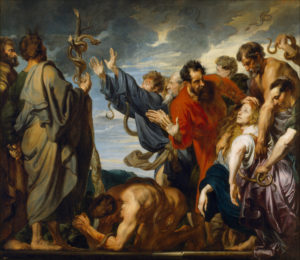
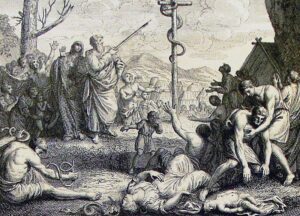
    Moses lifts up the brazen serpent in the wilderness

    The great symbolism of the snake raised in the wilderness connects

    to the very power of the Lord and Creator as well as the intercessor for the people; in the wilderness, Moses, and in the presence of Nicodemus, the miraculous intercessor healer, Christ Jesus.

    שָׂרָף saraph described as a poisonous serpent (fiery from burning effect of poison) is also the description found of a seraph or seraphim – majestic beings with six wings, human hands or voices in attendance upon God.

    … and it came to pass, that if a serpent had bitten any man, when he beheld the serpent of brass, he lived.

    Numbers 21:9b KJV

    Are you a Teacher of Israel…?

    John 3:

    9 “How can these things be?” asked Nicodemus.

    10 “Are you a teacher of Israel and don’t know these things?” Jesus replied.

    Every teacher of Israel knows that the LORD requires sacrifice as substitution for sin. And all Pharisees knew the significance of the ‘Lamb of God,’ as the Prophet John had witnessed of Christ Jesus.

    Teachers of the Law and the Prophets recognized the challenge of the analogy of Jesus. Jesus next addresses the association of the healing of the Cross and the Resurrection to Nicodemus.

    John 3:

    13 No one has ascended into heaven except the one who descended from heaven —the Son of Man.

    14 And as Moses lifted up the serpent in the wilderness, even so must the Son of man be lifted up:

    15 so that everyone who believes in him may have eternal life.

    To be continued…

  • God’s Love Through John: Signs

    John was the youngest of Jesus’ Disciples and the only Apostle who would live to an old age, actually several decades after Christ’s Sacrifice and Resurrection. The Apostle John makes a case to Jews and gentiles alike that Jesus IS God!

    John, a disciple of John the Baptist, now follows the Messiah Jesus
    Andrew and John follow Jesus
    He had been a follower of John the Baptist, whom many recognized as a Prophet. After John testified that Jesus was the expected Messiah, John’s disciples followed Jesus; some immediately like the young disciple John and others after Herod imprisoned John.

    Do you believe in God?

    If you believe that the heavens and earth are created, John illustrates the event which precedes all mankind in a manner similar to the Book of Genesis, then immediately makes a connection between God the Father and God the Son.

    In the beginning was the Word, and the Word was with God, and the Word was God. 2 He was with God in the beginning. 3 All things were created through him…

    John 1: CSB

    We began this series  with John’s ‘in the beginning’ explanation of Christ from his Gospel and some of John’s letters, then proceeded to ask some basic questions about God.

    God is Spirit

    John also points to the Spirit, in the same way as Genesis points to the Spirit of God having an active role in Creation.

    The wind blows where it pleases, and you hear its sound, but you don’t know where it comes from or where it is going. So it is with everyone born of the Spirit.”

    John 3:8 CSB

    Jesus receives the Spirit of God

    John introduces the respected Prophet John the Baptist, who testifies to the authenticity of Jesus as the Messiah.

    And John testified, “I saw the Spirit descending from heaven like a dove, and he rested on him. 33 I didn’t know him, but he who sent me to baptize with water told me, ‘The one you see the Spirit descending and resting on—he is the one who baptizes with the Holy Spirit.’ 34 I have seen and testified that this is the Son of God.

    John 1:32-34

    Signs – Proof from God

    John’s Gospel presents witnesses and evidence that Jesus is the Messiah with proofs presented throughout his Gospel.

    “Rabbi, we know that you are a teacher who has come from God, for no one could perform these signs you do unless God were with him.”

    John 3:2 – the words of the Pharisee Nicodemus to Jesus

    Perhaps you are a skeptic and because others saw the signs and attested to them a long time ago, you need proof.

    This is where faith and a reasonable logic connect the evidence of the Good News witnessed twenty-one centuries ago. 

    ‘What are these signs that Jesus is the Messiah of Almighty God?’

    Seven Signs John Records

    Jesus told him, “Unless you people see signs and wonders, you will not believe.”

    Jesus to a Roman nobleman – John 4:48


    Perhaps Jesus spoke these words not only for the Roman official who showed respect and faith to Him, but also to the crowds of Jewish disciples who had begun seeking signs that Jesus IS the Messiah.

    • John 5:1-16 At a festival in Jerusalem, witnessed by crowds of Jewish pilgrims, Jesus asked a man who had no strength [astheneia] for thirty-eight years, “Do you want to get well?” And the Lord heals him.
    V0012780 Pool of Bethesda, Jerusalem, Israel. Coloured aquatint by L. Credit: Wellcome Library, London. Wellcome Images images@wellcome.ac.uk http://wellcomeimages.org Pool of Bethesda, Jerusalem, Israel. Coloured aquatint by L. Mayer, 1804. 1804 By: Luigi MayerPublished: 1804 Copyrighted work available under Creative Commons Attribution only licence CC BY 4.0
    Pool of Bethesda

    What a seemingly odd question, “Will you be made whole?”

    The dual meaning from the Greek, Judea’s and the Empire’s common language, implies not only receiving a healthy body once more, but also receiving teaching which does not deviate from the truth.

    Would that be something the multitudes present and saints today would want? Do you want to be made whole, by the Power of God?

    What is your answer?

    8 “Get up,” Jesus told him, “pick up your mat and walk.”

    … 14 After this, Jesus found him in the temple and said to him, “See, you are well. Do not sin anymore, so that something worse doesn’t happen to you.” 

    Jesus asks us, “Do you want to be made well?”

    Miracle of the Loaves and Fish

    A huge crowd was following him because they saw the signs that he was performing by healing the sick.

    John 6:2 


    14 When the people saw the sign he had done, they said, “This truly is the Prophet who is to come into the world.”

    15 Therefore, when Jesus realized that they were about to come and take him by force to make him king, he withdrew again to the mountain by himself.

    Only the Twelve witnessed this directly; however note what the crowds would have realized after Jesus had left them to be alone.

    22 The next day, the crowd that had stayed on the other side of the sea saw there had been only one boat. They also saw that Jesus had not boarded the boat with his disciples, but that his disciples had gone off alone.

    ‘How did this Prophet get to the other side without a boat,’ the crowds witnessing a miracle the day before must have wondered? Then they got in their own boats and crossed to the other side to seek Jesus.

    • John 9 Jesus heals a blind man

    We will not dwell on the richness of this later sign of Jesus’ healing of a man who is blind from birth. This miracle as well becomes a sign to us that not everyone who hears the eyewitness accounts has ‘ears to hear’ the truth.

    Not everyone who sees a miracle with our own eyes will ‘have eyes to see’ the wonder of God at work in the life of another mere mortal.

    39 Jesus said, “I came into this world for judgment, in order that those who do not see will see and those who do see will become blind.”

    Resurrection of the dead

    • John 11:32-40 Jesus raises Lazarus from death

    32 As soon as Mary came to where Jesus was and saw him, she fell at his feet and told him, “Lord, if you had been here, my brother would not have died!”

    33 When Jesus saw her crying,

    and the Jews who had come with her crying,

    he was deeply moved in his spirit and troubled.

    This is the compassion of the Lord, love for the family as a fellow friend of the dead man, Lazarus. Jesus loves them. Therefore, God loves them all; for they have suffered in the death of a loved one – a mortal man.

    34 “Where have you put him?” he asked.

    “Lord,” they told him, “come and see.”

    35 Jesus wept.

    The proof is not yet come. No miracle to have saved Jesus’ beloved friend from his inevitable death, even when Jesus was not present. And the sign of Jesus is not just so that they might rejoice in their friendship one last time before Christ’s own suffering.

    Look again to the two very different reactions to this seventh sign John provides that Jesus IS the Messiah of God.

    36 So the Jews said, “See how he loved him!”

    37 But some of them said, “Couldn’t he who opened the blind man’s eyes also have kept this man from dying?”

    …  41 So they removed the stone…

    “Lazarus, come out!”

    44 The dead man came out bound hand and foot with linen strips and with his face wrapped in a cloth.

    Reaction to Jesus’ Signs

    What was it they had said before Jesus called Lazarus out of the tomb?

    “Couldn’t he who opened the blind man’s eyes also have kept this man from dying?”

    Yes. He could have. But instead Jesus showed God’s power by raising Lazarus from death.

    Lazarus would be a walking witness to Jesus, conviction to those who would crucify their own Messiah and proof of not only his resurrection but witness that Jesus IS the Messiah.

    Many believed in Jesus because of Lazarus. Many others followed Jesus because of their personal witness to other signs recorded by the Apostle John.

    Yet others remained unrepentant. It was not so unlike those we encounter in these last days.

    “What are we going to do since this man is doing many signs?

    If we let him go on like this, everyone will believe in him, and the Romans will come and take away both our place and our nation.”

    John 11:47b-48 CSB


    The religious leaders could never again be comfortable with Jesus. Our comfortable status-quo will change, even before the judgement which follows death.

    Indeed, what will you do, now that the testimony of John has shown you the signs of Jesus?

    To be continued...
  • God’s Love Through John: Light of a greater testimony

    “John was a burning and shining lamp, and you were willing to rejoice for a while in his light.

    Jesus, of John the Baptist – John 5:35 CSB 

    The Illustration

    The Apostle John makes more references to light in his Gospel than any other New Testament writer.

    Job, Psalms and Isaiah in the Old Testament also use the concept to evoke reflection on varying comparisons, as Jesus does in John 6. Here are just a few illustrations from the Hebrew definition, familiar to disciples of both John the Baptist and followers of Jesus.

    אוֹר ‘owr [used 122 times as a noun] means:

    Light of day, of heavenly luminaries (moon, sun, stars), day-break, dawn, morning light, daylight, lightning, of a lamp (as Jesus uses here to refer to John the Baptist), of life, of prosperity,

    As a teacher with the greater ‘light of instruction,’ Jesus compares Himself to John the Baptist.

    John 1: a brief reflection

    Although we will not continually return to the beginning of John’s Gospel, it is important for us to understand the Apostle’s perspective as events unfold in the teaching ministry of Christ Jesus.

    Orazio Fidani, Saint John the Apostle, c. 1640-56

    Just a reminder here that the events of Jesus’ ministry occurred around AD 30 when the Apostle was a young man and John wrote his Gospel [Good News] between AD 70-100 as the only remaining Disciple who had not been martyred for Christ.

    John makes many references to light, including many in John 1, as we have already seen in ‘God’s Love Through John: In the Beginning.’

    Reflections of the Teacher

    John 1:4 In him was life, and that life was the light of men. That light shines in the darkness, and yet the darkness did not overcome it.

    John’s reference to Christ Jesus

    7 He came as a witness to testify about the light, so that all might believe through him.

    John refers to Jesus and the witness mentioned is the teacher, John the Baptist. Then John continues to clarify the difference by restating the comparison of John the Baptist to Jesus.

    8 He was not the light, but he came to testify about the light.

    The Gospel-writer then unequivocally states that Jesus the Messiah is both ‘the true light’ and the greater light than John. He was coming to the world as the light – a light of hope – for everyone in the world.

    9 The true light that gives light to everyone, was coming into the world.

    Gospel of John, of the Messiah Jesus

    As mentioned earlier, John then proceeds to both explain the role of Jesus and continues to reflect on the relationship of the Prophet of the wilderness, John, to the Messiah.

    What John’s Gospel does not say

    And there are also many other things that Jesus did, which, if every one of them were written down, I suppose not even the world itself could contain the books that would be written.

    John 21:25 CSB

    Although we are studying the Gospel of John, it is important for us to put some missing events detailed in other gospels about the life of John the Baptist. So before we proceed with Jesus’ teachings, let’s briefly chronicle a few events of the well-known teacher, John.

    Matthew

    Matthew, of course, was the other Jewish writer of the gospels who adds additional detail.

    In those days John the Baptist came, preaching in the wilderness of Judea and saying, “Repent, because the kingdom of heaven has come near! ”

    Matthew states later of Jesus and his reaction to the political events which led to the Baptist’s arrest, 

    When he heard that John had been arrested, he withdrew into Galilee.

    Matthew 4:12

    Jesus had been in Judea, but leaves for Galilee and gathers Disciples to Himself. John, no doubt, hears of this and sends some of his own disciples to Jesus with questions from John asking for assurance.

    Matthew 11:

    Now when John heard in prison what the Christ was doing, he sent a message through his disciples… Jesus replied to them, “Go and report to John what you hear and see:

    We will continue shortly from the Gospel of John with the signs they would witness to the Baptist and others. 

    “From the days of John the Baptist until now, the kingdom of heaven has been suffering violence, and the violent have been seizing it by force. … “Let anyone who has ears listen.

    The Messiah Jesus, Matthew 11:12

    Later in Jesus’ three-year ministry we learn the fears of Herod about Jesus from Matthew:

    At that time Herod the tetrarch heard the report about Jesus. 2 “This is John the Baptist,” he told his servants. “He has been raised from the dead, and that’s why miraculous powers are at work in him.”

    The Greater Light

    Immediately after John’s most quoted Scripture he testifies to the Messiah’s purpose and mission in Jesus’ own words. Jesus again uses comparisons of light and darkness.

    John 3:

    19 This is the judgment:

    The light has come into the world,

    and people loved darkness rather than the light

    because their deeds were evil.

    John 3:19

    20 For everyone who does evil hates the light and avoids it, so that his deeds may not be exposed. 21 But anyone who lives by the truth comes to the light, so that his works may be shown to be accomplished by God.”

    Before we speak of Jesus’ love we must remember repentance. Darkness and evil envelope our lives, yet some love the darkness. Jesus offers love not only to Israel but to the world.

    The Gospel of John shows many signs of the Messiah which should be recognizable to the Jews, even though many chose darkness.

    Where will you look? Do you have eyes to see?

    Do you rely on a lesser lamp or perhaps even live in complete darkness?

    John presents signs, evidence and explanation of the Messiah.

    Who is your hope?

    To be continued...