Category: 4 Gospels + Good News of the NEW Testament

What are the Gospels?

FOUR Gospels:

GOOD NEWS! (That’s what Gospel means.)

Matthew, Mark, Luke & John begin the New Testament proclaiming the Good News of Israel’s long-awaited Messiah and talk of JESUS Christ.

The four Gospels are first hand witness + proclaiming GOOD NEWS

  • by two Jewish Apostles of the Messiah JESUS, Matthew & John
  • Two gentile (non-Jewish) followers of THE WAY of Jesus Christ, Mark & Luke, who proclaim the GOSPEL recorded from witness of Peter, Paul and other Apostles and disciples of JESUS in the first century.

READ the Good News of the Messiah and Savior Jesus from accounts of His twelve Apostles & others witnessing the resurrection of the Lord Jesus from the four Gospels of the New Testament: Matthew, Mark, Luke and John.

SHARE the Gospel

  • with your Christian friends and those who do not yet believe in JESUS CHRIST.
  • Comment on a Talk of JESUS post and SHARE in your social media world.
  • For you will always have the poor – 4

    For you will always have the poor – 4

    ἀλάβαστρον – alabastron

    The alabaster receptacle of the anointing oil

    To understand why Jesus would say, the poor are with you always,” we must understand anointing as commonly understood in the culture of the day.

    People traveled to and from homes with no running water mostly by foot and anointing is often associated with washing or cleansing. Jesus instructs us to give to the poor. He cautions not to neglect washing or anointing ourselves with oil when we fast for the Lord.

    MATTHEW 6:17-18

    But when you fast, anoint your head and wash your face, that your fasting may not be seen by others but by your Father who is in secret. And your Father who sees in secret will reward you.


    A common anointing

    Anointing with oil along with washing up was part of hospitality, a godly attribute commanded of the Jews. Of course these various oils and ointments needed kept in some sort of container.

    On special occasions a newly opened, expensive fresh oil was most appropriate. The ancients considered alabaster to be the best material in which to preserve their ointments. Breaking the box, probably means breaking the seal of the box. 1. 

    An earlier anointing

    This scene takes place in the early days of Jesus’ preaching of the Good News in Galilee. Jesus cleansed lepers. Jesus healed a man who could not walk and a man who could not use his hand.

    Crowds came to hear him and to be healed of their diseases. Those troubled with unclean spirits cured and all the crowd sought to touch him, for power came out from him and healed them all.

    LUKE 7:

    Jesus heals the servant of a Roman soldier by command from afar. Amazingly, Jesus raised the son of a widow to life from a coffin at his funeral! Healing – healing of every imaginable sort, cleansing of the body and soul by the hand of God!


    36 One of the Pharisees asked him to eat with him, and he went into the Pharisee’s house and reclined at table. 37 And behold, a woman of the city, who was a sinner, when she learned that he was reclining at table in the Pharisee’s house, brought an alabaster flask of ointment, 38 and standing behind him at his feet, weeping, she began to wet his feet with her tears and wiped them with the hair of her head and kissed his feet and anointed them with the ointment.


    Jesus accepts our common anointing

    There it is again, earlier in Jesus’ ministry, the alabaster flask of ointment. How does Jesus react here in the presence of his esteemed host?

    44 Then turning toward the woman he said to Simon, “Do you see this woman? I entered your house; you gave me no water for my feet, but she has wet my feet with her tears and wiped them with her hair. 45 You gave me no kiss, but from the time I came in she has not ceased to kiss my feet. 46 You did not anoint my head with oil, but she has anointed my feet with ointment.

    Consequently, Jesus admonishes his host for neglecting the very least of hospitality commonly extended to guests. He corrects Simon’s hesitation to honor a guest by instead praising the anointing by this woman. For she has done what Simon was obliged to do. And the Lord further emphasizes his authority by his peace of dismissal.

    ” 48 And he said to her, “Your sins are forgiven.”

    50 And he said to the woman, “Your faith has saved you; go in peace.”


    Anointed as a welcome guest, healer, one who revives the soul of one dead in the flesh. Jesus, anointed as a King given His due. And finally, anointed for his own burial, only to rise again to rule eternally.


    To be continued…

  • For you will always have the poor – 2

    For you will always have the poor – 2

    “For the poor you have with you always, but Me you do not have always.” – John 12:1 NKJV

    This remark of Jesus cuts right to the quick, does it not? A sense of urgency here: the Son of Man is about to depart from the company of those the Lord came to save.

    An earlier story (in the home of Lazarus)

    Once again, I ask us to examine the 5 W’s of the gospel accounts.

    In the first part of this series we examined the gospel of Mark.

    We established some facts:

    1. It took place on Tuesday, two days prior to the Passover.
    2. It took place in Bethany, in the home of Simon the Leper.
    3. An unnamed woman came in and broke an alabaster flask, anointing Jesus’ head.
    4. There were some who said to themselves indignantly, “Why was the ointment wasted like that?” [Once more, ‘to themselves.’]
    5. Jesus praises the unnamed woman.

    Read carefully a similar, earlier incident from the gospel of John:

    John 12:

    Six days before the Passover, Jesus therefore came to Bethany, where Lazarus was, whom Jesus had raised from the dead.


    Again, earlier – six days before the Passover, not two. And as we mentioned the Passover that year was a Thursday; therefore, most likely on the evening of the Sabbath, Friday, not the following Tuesday after Jesus’ triumphal entry into Jerusalem.


    Jesus therefore came to Bethany, where Lazarus was, for a final Sabbath meal with his dear friends.

    2 So they gave a dinner for him there. Martha served, and Lazarus was one of those reclining with him at table.


    Once again, we are in Bethany, but with all certainty Lazarus is hosting the meal with Jesus as honored guest in his own home (not one of another resident of Bethany who will host them all just four days later). Martha, Mary, Lazarus and Judas Iscariot are all named in addition to Jesus.


    3 Mary therefore took a pound of expensive ointment made from pure nard, and anointed the feet of Jesus and wiped his feet with her hair. The house was filled with the fragrance of the perfume.


    Some new detail

    In addition to naming Lazarus, Mary and Martha, we now learn that Mary anointed the feet of Jesus and wiped his feet with her hair. It is the act of a servant, an act of humility. Furthermore, we learn from the Apostle John, who wrote this account and knew the disciples well, that Judas complains about the value of the pure nard. It is Judas who suggests to all the value that could be uses for the poor; yet John reveals Judas’ motive in mentioning the poor, that Judas steals cash from this treasury of the disciples.


    4 But Judas Iscariot, one of his disciples (he who was about to betray him), said, 5 “Why was this ointment not sold for three hundred denarii and given to the poor?” 6 He said this, not because he cared about the poor, but because he was a thief, and having charge of the moneybag he used to help himself to what was put into it.

    7 Jesus said, “Leave her alone, so that she may keep it for the day of my burial. 8 For the poor you always have with you, but you do not always have me.”


    Jesus, of course, ignores the false suggestion that Judas and the disciples can sell Mary’s expensive ointment for a profit to ‘help the poor.’ Jesus defends Mary’s generous and kind act of worship.

    I ask us, though: aren’t you and I just like Judas in that way?

    Don’t we so often accuse the generous act of another in a way to imply that we could be better stewards of their gift to the Lord?


    Jesus’ last Sabbath before the Sacrifice

    Exodus 16:26  שֵׁשֶׁת יָמִים תִּלְקְטֻהוּ וּבַיֹּום הַשְּׁבִיעִי שַׁבָּת לֹא יִֽהְיֶה־בֹּֽו׃

    It is now Saturday, the Sabbath.


    9 When the large crowd of the Jews learned that Jesus was there, they came, not only on account of him but also to see Lazarus, whom he had raised from the dead.

    10 So the chief priests made plans to put Lazarus to death as well, 11 because on account of him many of the Jews were going away and believing in Jesus.

    The Triumphal Entry

    12 The next day the large crowd that had come to the feast heard that Jesus was coming to Jerusalem. 13 So they took branches of palm trees and went out to meet him, crying out, “Hosanna! Blessed is he who comes in the name of the Lord, even the King of Israel!”


    Jesus, the Twelve and some followers had traveled one final journey from Galilee to Jerusalem, via Bethany. In preparation for the time at hand, they rest in the home of their risen friend, Lazarus.

    Do you remember what Jesus had assured Mary after Lazarus had been in the grave four days?

    (This was not the first resurrection Jesus caused, but it was the most recent.)

    John 11:

    25 Jesus said to her, [ctt title=”“I am the resurrection and the life. Whoever believes in me, though he die, yet shall he live, and everyone who lives and believes in me shall never die.” tweet=”Do you believe this? – John 11:25-26 ESV” coverup=”Q4g8Y”]

    Do you believe this?”

    27 She said to him, “Yes, Lord; I believe that you are the Christ, the Son of God, who is coming into the world.”


    No words speak more of the life of one who believes than these:

    To be continued…


  • For you will always have the poor

    For you will always have the poor

    Why mention the poor?

    Once again, Jesus makes what appears to be an offhand remark about the poor. Jesus often criticized the leaders of Temple and Pharisees for their treatment of the poor; doesn’t this remark catch you off guard?

    It would be easy enough to lose the context of Jesus’ apparent ambivalence toward the poor in the rush of events surrounding Passover week. Jesus’ final entry into Jerusalem has many seemingly more important things going on than what to us would first appear to be a slip of the tongue (sort of like cursing the fig tree).  Yet like in our previous series you may find some subtleties worthy of note that impact more than just the poor.

    The Gospel Quotes:

    Prior to examining Jesus’ point of the comment, which we will do later in this series, let’s begin quotes from the view points of three different gospel writers.

    Mark 14:7

    For you always have the poor with you, and whenever you want, you can do good for them.

    Matthew 26:7

    For you always have the poor with you, but you will not always have me.

    John 12:8

    For the poor you always have with you, but you do not always have me.”

    The 5 W’s

    Now to discover the context we must examine all three stories asking:

    Who, what, where, when and why?

    You will find some variation in the three Gospel stories and some similarities. We begin today with Mark’s gospel.


    Mark 14:

    It was now two days before the Passover and the Feast of Unleavened Bread. And the chief priests and the scribes were seeking how to arrest him by stealth and kill him, 2 for they said, “Not during the feast, lest there be an uproar from the people.”


    We have the ‘when:’ two days before the Passover, which in this particular year with the Passover on a Thursday, was Tuesday.


    3 And while he was at Bethany in the house of Simon the leper, as he was reclining at table, a woman came with an alabaster flask of ointment of pure nard, very costly, and she broke the flask and poured it over his head.

    4 There were some who said to themselves indignantly, “Why was the ointment wasted like that? 5 For this ointment could have been sold for more than three hundred denarii and given to the poor.” And they scolded her. 6 But Jesus said, “Leave her alone. Why do you trouble her? She has done a beautiful thing to me. 7 For you always have the poor with you, and whenever you want, you can do good for them. But you will not always have me. 8 She has done what she could; she has anointed my body beforehand for burial. 9 And truly, I say to you, wherever the gospel is proclaimed in the whole world, what she has done will be told in memory of her.”


    Where? In the house of Simon the Leper, in Bethany, near Jerusalem.

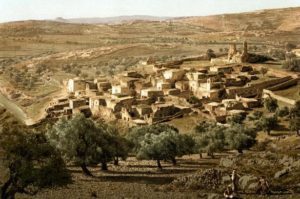
    Bethany is today el ‘Azareyeh (“the place of Lazarus”- the L being displaced to form the article).

    Who is present? Jesus, of course; Simon, host of the meal (who Jesus had likely healed from leprosy; ‘some,’ likely the Twelve and others; and an unidentified woman who enters Simon’s home.

    What happens? She pours out some very expensive oil on Jesus, an act of great humility and worship.

    (More about her and her gracious act later.)


    To be continued…