Category: 4 Gospels + Good News of the NEW Testament

What are the Gospels?

FOUR Gospels:

GOOD NEWS! (That’s what Gospel means.)

Matthew, Mark, Luke & John begin the New Testament proclaiming the Good News of Israel’s long-awaited Messiah and talk of JESUS Christ.

The four Gospels are first hand witness + proclaiming GOOD NEWS

  • by two Jewish Apostles of the Messiah JESUS, Matthew & John
  • Two gentile (non-Jewish) followers of THE WAY of Jesus Christ, Mark & Luke, who proclaim the GOSPEL recorded from witness of Peter, Paul and other Apostles and disciples of JESUS in the first century.

READ the Good News of the Messiah and Savior Jesus from accounts of His twelve Apostles & others witnessing the resurrection of the Lord Jesus from the four Gospels of the New Testament: Matthew, Mark, Luke and John.

SHARE the Gospel

  • with your Christian friends and those who do not yet believe in JESUS CHRIST.
  • Comment on a Talk of JESUS post and SHARE in your social media world.
  • Interrupting Jesus 4 – Samaritans & family black sheep

    Interrupting Jesus 4 – Samaritans & family black sheep

    Israel.

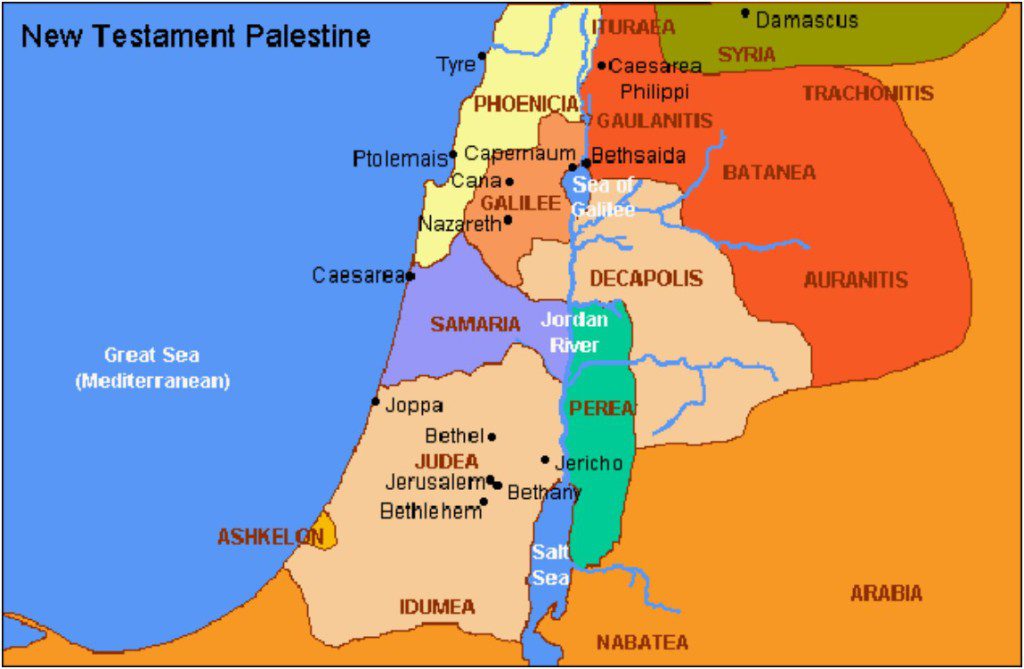
    Let’s get something straight: There was NO Israel in the Roman Empire. (Just take a look at the map).New Testament Palestine

    Call it Israel or call it Palestine; you will see that to the Romans, Judeans and Samaritans, Israel does not exist except as part of a long-gone past.

    A certain hatred existed in the days of Christ Jesus as it does today. Mention the name ‘Israel’ and it means different things to different people. Observant Jews look back to a Kingdom united by David and Solomon, a Kingdom and alliance of the twelve tribes of Jacob (whose name was changed to Israel). After the United Kingdom was divided, ten tribes lived in Israel to the north. Judah was just two of the tribes. Samaria had been purchased in 925 B.C. and became the capital of Israel (after the division of the United Kingdom of Israel).

    You might say that most people of Hebrew heritage in Galilee, Samaria and Judea were ancestral cousins.

    Residents of these northern Roman provinces of Samaria and Galilee were perceived as black sheep of the family of Abraham, not quite so pure as the Judeans of Jerusalem. Samaritans refused to worship the LORD in Jerusalem. Look to post-Davidic history and stories of the Gospels and you will discover that Samaritans are treated no better than contemptible foreigners by faithful Jews, even though Samaria lies only about 30 miles from Jerusalem.

    Christians and non-Christians alike probably know the story of ‘the good Samaritan‘ told by Jesus. In it he tells of a man who encounters robbers in his travels on a journey such as those Jesus and His Disciples made frequently through the mountain trade routes. The point of the parable is that it is not the religious men who showed a man mercy, but a resented Samaritan.

    What does a merciful God require of us? Show mercy to others, as God has shown us.

    Jesus’ mission to Israel (the remnant of faithful Jews of Judah, Galilee and beyond) would seem to include redemption of even the lost sheep in the hills of Samaria.

    On their way back to Galilee from Jerusalem, Jesus sends the Disciples ahead for some lunch ‘to go.’ When they return to Jesus with the food they discover how our Lord has dealt with an interruption of the lowest of those Samaritans, a woman living with a man not her husband.

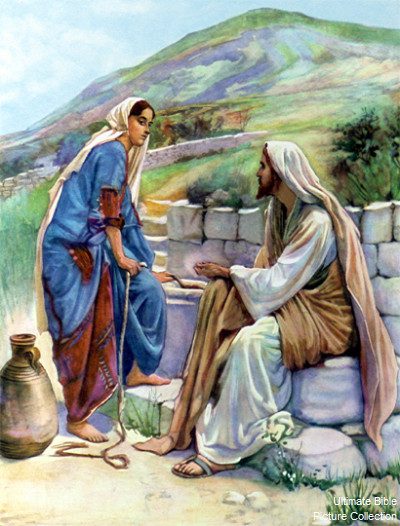
    It all started out with Jesus asking for a drink of water. Christ Jesus was thirsty, as any man would be after walking to this well. Jesus interrupts this Samaritan woman as He waits for His Disciples to return with lunch.

    John 4

    A woman from Samaria came to draw water. Jesus said to her, “Give me a drink.”

    The Samaritan woman said to him, “How is it that you, a Jew, ask for a drink from me, a woman of Samaria?” 10 Jesus answered her, “If you knew the gift of God, and who it is that is saying to you, ‘Give me a drink,’ you would have asked him, and he would have given you living water.”

    11 The woman said to him, “Sir, you have nothing to draw water with, and the well is deep. Where do you get that living water? 12 Are you greater than our father Jacob? He gave us the well and drank from it himself, as did his sons and his livestock.”

    13 Jesus said to her,“Everyone who drinks of this water will be thirsty again, 14 but whoever drinks of the water that I will give him will never be thirsty again. The water that I will give him will become in him a spring of water welling up to eternal life.”

    15 The woman said to him, “Sir, give me this water, so that I will not be thirsty or have to come here to draw water.”

    [What’s going on here? Why doesn’t this Samaritan woman just give the man, Jesus, a drink?]

    16 Jesus said to her, “Go, call your husband, and come here.”

    17 The woman answered him, “I have no husband.”

    Jesus said to her, “You are right in saying, ‘I have no husband’; 18 for you have had five husbands, and the one you now have is not your husband. What you have said is true.”

    [Jesus had never met her. How could He possibly know that? How this woman must have been astonished at His unveiling of hidden truth of her sinful situation.]

    19 The woman said to him, “Sir, I perceive that you are a prophet. 20 Our fathers worshiped on this mountain, but you say that in Jerusalem is the place where people ought to worship.”

    21 Jesus said to her, “Woman, believe me, the hour is coming when neither on this mountain nor in Jerusalem will you worship the Father. 22 You worship what you do not know; we worship what we know, for salvation is from the Jews. 23 But the hour is coming, and is now here, when the true worshipers will worship the Father in spirit and truth, for the Father is seeking such people to worship him. 24 God is spirit, and those who worship him must worship in spirit and truth.”

    25 The woman said to him, “I know that Messiah is coming (he who is called Christ). When he comes, he will tell us all things.”

    26 Jesus said to her, “I who speak to you am he.”

    27 Just then his disciples came back. They marveled that he was talking with a woman, but no one said, “What do you seek?” or, “Why are you talking with her?”

    28 So the woman left her water jar and went away into town and said to the people, 29 “Come, see a man who told me all that I ever did. Can this be the Christ?” 30 They went out of the town and were coming to him.

    … 39 Many Samaritans from that town believed in him because of the woman’s testimony, “He told me all that I ever did.” 40 So when the Samaritans came to him, they asked him to stay with them, and he stayed there two days. 41 And many more believed because of his word. 42 They said to the woman, “It is no longer because of what you said that we believe, for we have heard for ourselves, and we know that this is indeed the Savior of the world.”

    43 After the two days he departed for Galilee. 44 (For Jesus himself had testified that a prophet has no honor in his own hometown.) 45 So when he came to Galilee, the Galileans welcomed him, having seen all that he had done in Jerusalem at the feast. For they too had gone to the feast.

    When did you ever set out on a journey or send out for lunch and instead pause to minister to a needy soul? When have you ever interrupted your daily life for two days to tell the Good News of Christ Jesus to some soul in a place off your route?

    A lowly Samaritan woman may have been the first Jew to hear from His own mortal lips, ‘I AM the Christ, the Messiah, the Promised One.’ Jesus had time for her and for the misled people of her town who had continued in the sins of their ancestors.

    Do you have a minute to ask someone for a drink of water? Is your compassion for saving souls of the lost sufficient to minister to their friends and family for a couple of days?

    Do interruptions of your day demonstrate a Christ-like love of a Good Samaritan?

    Does your journey treasure time for the people you encounter?


  • Interrupting Jesus 3 – interrupted by academia

    Interrupting Jesus 3 – interrupted by academia

    We’ve all met them: the academicians, professors, learned men of logic with indisputable researched proofs of their position; the Doctors of Divinity and PhD’s of wisdom: we’ve all met them.

    If you have not read the books of wisdom in the Bible, notably Proverbs and Ecclesiastes, you have neglected your own education by God. Of course Bibles were not printed in the days of Jesus of Nazareth and such wisdom was only to be gained from the scholars and academicians of the Temple and synagogues who had access to the scrolls of the written word. Young Jesus was not schooled by such learned men, but held his own in their eyes.

    You may be familiar with this story from a parental perspective, yet take a look at this young lad through the eyes of some of the Pharisees present:

    Luke 2:

    41 Now his parents went to Jerusalem every year at the Feast of the Passover.42 And when he was twelve years old, they went up according to custom. 43 And when the feast was ended, as they were returning, the boy Jesus stayed behind in Jerusalem. His parents did not know it…

    46 After three days they found him in the temple, sitting among the teachers, listening to them and asking them questions. 47 And all who heard him were amazed at his understanding and his answers. 48 And when his parents saw him, they were astonished…

    52 And Jesus increased in wisdom and in stature and in favor with God and man.

    Jesus’ mission from his youth was interrupted by the trappings of everyday life.

    Again, another story so familiar for the importance of Jesus’ teachings to a teacher of Israel that we may have missed sight of the person who was the interruption in Jesus’s journeys. Nicodemus is part of the inner circle of Bible scholars. His knowledge of God’s word, Hebrew history and influence is comparable to Saul of Tarsus (Paul) who will follow in just a few years. Jesus is sitting with a VIP of the highest caliber, once again more than holding his own.

    John 3:

    Now there was a man of the Pharisees named Nicodemus, a ruler of the Jews. This man came to Jesus by night.

    “Rabbi, we know that you are a teacher come from God, for no one can do these signs that you do unless God is with him.”

     “Truly, truly, I say to you, unless one is born again he cannot see the kingdom of God.”

    “How can a man be born when he is old? Can he enter a second time into his mother’s womb and be born?”

    “Truly, truly, I say to you, unless one is born of water and the Spirit, he cannot enter the kingdom of God. That which is born of the flesh is flesh, and that which is born of the Spirit is spirit.

    Do not marvel that I said to you, ‘You must be born again.’ The wind blows where it wishes, and you hear its sound, but you do not know where it comes from or where it goes. So it is with everyone who is born of the Spirit.”

    “How can these things be?”

    10 Jesus answered him,“Are you the teacher of Israel and yet you do not understand these things?

    11 Truly, truly, I say to you, we speak of what we know, and bear witness to what we have seen, but you do not receive our testimony. 12 If I have told you earthly things and you do not believe, how can you believe if I tell you heavenly things? 13 No one has ascended into heaven except he who descended from heaven, the Son of Man. 14 And as Moses lifted up the serpent in the wilderness, so must the Son of Man be lifted up, 15 that whoever believes in him may have eternal life.

    Even unbelievers have heard Jesus’ statement to Nicodemus, the reason God our Father sent the Messiah to the world in the flesh.

    Jesus is sitting in the room with Nicodemus, a VIP Jew of Jews, who wants to do what God wants him to do. Nicodemus has come to the Son of Man at night, to where our Lord is resting. Nicodemus, a leader of the Jews, does not invite Jesus Christ to his home; rather Nicodemus interrupts him privately.

    Jesus tells the respected leader of the Temple:

    • You must be born of water and the Spirit. (Purified by repentance and receive the Holy Spirit of God as Counselor to your eternal soul.)
    • No one has ascended into heaven except he who descended from heaven, the Son of Man. (Jesus is saying to Nicodemus, ‘I AM the Messiah.’)
    • 16 “For God so loved the world, that he gave his only Son, that whoever believes in him should not perish but have eternal life. 17 For God did not send his Son into the world to condemn the world, but in order that the world might be saved through him. 18 Whoever believes in him is not condemned, but whoever does not believe is condemned already, because he has not believed in the name of the only Son of God.

    Imagine that you think you have learned all there is to know about God from the Bible, historical books and prayer. You walk into the home of a man at night to learn more. Then Jesus tells you: I AM the Son of God, sent as the Messiah of Israel and Savior of the world! You have interrupted God Almighty the Person of the Son, who tells you:

    God loves you. Believe in the Son, Christ Jesus, and you will have eternal life.

    Nicodemus and the Pharisees believed in the resurrection. Some like him met Christ and believed.

    How old was Nicodemus when he met Jesus?

    I could speculate that as a leader of the Sanhedrin, Nicodemus may have been in his fifty’s or sixty’s, while Jesus is a relatively young man of thirty. It is not inconceivable that Nicodemus could have been one of the up and coming young men of the Temple twenty years earlier when Jesus as a boy interrupted His parent’s pilgrimage with a three-day schooling in ‘His Father’s House.’ At the very least, Nicodemus undoubtedly would have known of the encounter, not to mention the recent teachings of John the Baptizer.

    John 1:

    In the beginning was the Word, and the Word was with God, and the Word was God.

    The Testimony of John the Baptist

    19 And this is the testimony of John, when the Jews sent priests and Levites from Jerusalem to ask him, “Who are you?” 20 He confessed, and did not deny, but confessed, “I am not the Christ.”

    24 (Now they had been sent from the Pharisees.) 25 They asked him, “Then why are you baptizing, if you are neither the Christ, nor Elijah, nor the Prophet?”26 John answered them, “I baptize with water, but among you stands one you do not know, 27 even he who comes after me, the strap of whose sandal I am not worthy to untie.”

    Nicodemus knew the Messiah (the Christ) of God was coming and wanted to confirm His identity.

    Nicodemus may have been waiting for the Son of God to give him a command of what to do as a leader of the Temple. Rather than taking His rightful authoritative position over the Temple and Jerusalem, the Son of Man chose to humbly obey the purpose of Sacrifice for which He was sent.

    Jesus has a mission of love for those who will believe. All evidence points to the fact that Nicodemus believed.

    Faith does not dispute knowledge, but confirms truth beyond the limits of its proof.

    Nicodemus would argue that Jesus should be given a fair trial. [John 7:50-51] Nicodemus obtained permission for the crucified Christ Jesus to be buried and contributed to the costs. [John 19:38-40] Nicodemus may have even been one of the many to whom Christ appeared after His resurrection. [1 Corinthians 15:6]

    Suppose a VIP comes to you unexpectedly and asks if Jesus is the Christ. Are you prepared for that interruption?


  • Interrupting Jesus 2 – gift for a bride & groom

    Interrupting Jesus 2 – gift for a bride & groom

    “Woman, what does this have to do with me? My hour has not yet come.” John 2:4

    A young Jewish man from an insignificant town of Nazareth in Roman occupied Galilee, though only thirty years old, begins to gain a following. He is unmarried and head of his family, consisting of a widowed mother and younger brothers. Disciples of this young likable rabbi, who had worked as a carpenter in his deceased father’s shop, joined Jesus at a nearby wedding in Cana.

    Jesus had just begun to call disciples (or followers of a Rabbi/teacher) for His three-year earthly and eternal mission. A righteous man in everyone’s eyes, young Jesus is now called to a mission worthy of His Name.

    John 1:

    49 Nathanael answered him,“Rabbi, you are the Son of God! You are the King of Israel!”

    Of course, Jesus’ mother knew well the divinity of Jesus. Mary knew from before conception that God alone was His Father!

    In the great traditions of Jewish hospitality and celebration of the occasions and milestones of this earthly life, Jesus and His family (mother and brothers) accept the invitation to the wedding of a friend. Jesus and his family are guests just having a good time at this celebration. In addition to His family, Jesus had invited His new followers as well. Cana is a nearby small town. It was just a joyous, typical wedding celebration.

    When the wine ran out, the mother of Jesus said to him, “They have no wine.”And Jesus said to her, “Woman, what does this have to do with me? My hour has not yet come.” His mother said to the servants, “Do whatever he tells you.”

    The wedding, of course, is all about celebration. It is all about the joining of the bride and the groom in holy matrimony, a man and a woman pledged to each other for life. A father of the bride gives his beloved daughter to a man to have as his wife for the rest of their lives together. The father of the bride, the groomsmen, the hosts of the celebration are honored for their hosting of this grande wedding feast.

    BUT, the wine ran out early. (Too many people.) What now? Dishonor? The widow Mary suggests to her friends that her son could help?

    Jesus, his family and disciples are just invited guests. The celebration is not about them. In fact, it seems like just an interruption (a previous commitment, perhaps) to the beginning of our Lord’s mission. What to do?

    Now there were six stone water jars there for the Jewish rites of purification, each holding twenty or thirty gallons. Jesus said to the servants, “Fill the jars with water.” And they filled them up to the brim. And he said to them,“Now draw some out and take it to the master of the feast.” So they took it.When the master of the feast tasted the water now become wine, and did not know where it came from (though the servants who had drawn the water knew), the master of the feast called the bridegroom 10 and said to him, “Everyone serves the good wine first, and when people have drunk freely, then the poor wine. But you have kept the good wine until now.”

    11 This, the first of his signs, Jesus did at Cana in Galilee, and manifested his glory. And his disciples believed in him.

    He seemed liked just a popular guest at the local wedding. He seemed to be a teacher gaining followers (like John the Baptizer). He seems like just the kindest friend or son or brother you could ever meet. Yet by this interruption to Jesus’ work and daily life and travels, our Lord began ministering to the needs of those He loved in a most perfect way.

    To be continued…