Category: Epistles – Is his letter to our church?

Epistle of Paul to the Romans 1 - the Apostles sends a church letter to Rome and the local saints of area churches
Epistle of Paul to the Romans

Epistles ἐπιστολή or Letters

I charge you by the Lord that this epistle be read to all the holy brethren.

Paul’s First Letter to the Thessalonians 

Don’t  miss our recent FEATURED SERIES

JUNE 2024 – 2025 —

1 CORINTHIANS 

———————————————————-

Letters – Is he writing to me?
The short answer: YES.

In their epistles or 1st century church letters the Apostles and other men sent out by Jesus build up the saints [small – ‘s’] or members of local first century churches.

A Disciple or other witness of JESUS would write it. Messengers then delivered these church letters to many isolated worshipers.

Followers of Jesus Christ receive these letters as a major encouragement to their personal faith. Then leaders read them to worshipers of their church.

Although the Epistles 0r Letters to the Church were originally written to churches of the first century,

Romans through Jude will seem like letters to your 21st century church.

  • What do Peter, Paul, John and others tell us we must do?
  • Is he talking about an issue in your 21st c. church as well?
  • How does the writer’s advice, warning, or encouragement to the 1st c. believers apply to you as well
  • Is the writer of this letter talking about something you need to address in your 21st century ‘christian’ life?

Contemporary Application of the Letters (Epistles)

Most New Testament writers take on specific issues confronting faithful followers of Jesus Christ. These same issues continue to confront believers until the Lord’s coming again in these last days.

Certainly Christ our Lord will come again to those God has chosen for eternal life.

Believers currently suffer more than most of you who know Christ in your local church can imagine.

In other lands Christians continue to suffer by the hand of the ungodly.
Go into all the world

A 21st century Common Era church can see and hear nearly any atrocity of man or artificial imagination of sinful man’s mind, yet ‘christians‘ dare not speak of any absolute truth of the Lord God or talk of JESUS CHRIST.

Will YOU comment on Scripture and share the Gospel?

I invite you to read the inspired word of Scripture written in these LETTERS TO THE CHURCH.

YES, He IS writing to YOU.

Beloved brother or sister in Christ Jesus,

Will you read this ‘CHURCH LETTER’ and talk of JESUS through your comment, sharing and email to me about this ‘Letter to you?”

Roger@talkofJesus.com

  • Reintroducing John – a Biography and Background

    Reintroducing John – a Biography and Background

    Biography of a Man

    I wrestle with my own autobiography, let alone writing about the ancestry of such an important man of God as John.

    We struggle to understand anyone once we read such titles or relational roles of JESUS or any of the Lord’s Apostles.

    For instance, who do you see when I refer to:

    • ‘Jesus’ DISCIPLE John’ or
    • ‘John, one the the TWELVE‘, or
    • even including John with Peter and his older brother James as one of just three disciples in JESUS’ inner circle?
    And that only covers three years of John's life during Jesus' incarnation, overlooking John's earlier time as a disciple of John the Baptist. 

    Call him: SAINT John or John the Elder — give John reverence for receiving the very word of God in the Gospel — look at this man in awe, who later on Patmos was given the Revelation of Jesus Christ as an Elder of the first century Church.

    But when all is said (or even little) about John, he was just a man like us, a man chosen by JESUS CHRIST, the Son of God.

    Picturing John accurately – Painting a True Portrait

    I have searched endlessly for a painting of the Apostle John more truly representing the one Jesus loved at various important times in his long life.

    Of course we have no photo or ‘selfie’ of John from any time.


    Some renaissance depictions (often commissioned by the Roman Catholic Church) depict a very young John (even holding a cup of communion) making him appear similar to a French altar boy.

    The Apostle John
    Peter Paul Rubens, 1610-12 A.D.
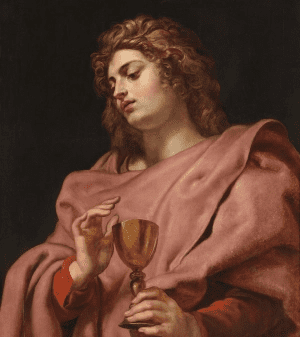
    Jesus’ description of James and John as, ‘sons of thunder’ suggests two tough Galilean fisherman, tenaciously seeking the Messiah of captive Israel — two disciples of an Elijah-like prophet John the Baptist, who instructed these sons of thunder in the Judean wilderness.

    The young Apostle John, who accompanied Peter to preach in the Temple just after Christ’s ascension, certainly was not so silent as to be overlooked by powerful Jewish leaders, who included this young Disciple ofJesus with Peter in their summons to defend their public witness (or rather be silent about Jesus).

    Both Apostles would be imprisoned for the Gospel and then released by an angel to once again proclaim Jesus as the Messiah to the Jews and the all the world.

    IF YOU can suggest any painting or art which paints a true picture of JOHN at any stage of his life, how about letting us know in a COMMENT following this post. - RH 

    So in order to get a better picture of John, let’s look back at a few brief biographical facts mixed in with some scholarly speculation, hoping to see into the heart and life of the one Jesus loved.’

    Family and Ancestry

    John grew up in a small village (as it happened I did too). Everybody typically knows everyone (and much of everyone’s business). Family, of course, was important to the Jews as our families tend to identify ‘who we are’ to our own neighbors.

    When I was a young man my dad was a volunteer fireman and one of the older firemen always addressed me as, “Chief.” Our family name was attached to the business of Dad and his brother. John was in business with his brother James, both known to all as the sons of Zebedee, head of his family fishing business.

    Ancestry and Connection of Names

    Chief,’ immediately connected me to my dad, our volunteer fire chief and to his father whose name identified Dad’s family business.

    Certainly John’s vocation, faith and identity were rooted in his upbringing and like me, growing up as John the Son of Zebedee would identify Jesus’ Disciple into his early manhood.

    In fact, the younger of Zebedee’s sons probably felt more like ‘the brother of James , son of Zebedee;’ similar to an earlier unnoticed, Son of Jesse not even introduced to an important man such as Samuel.


    About Zebedee:

    Let's connect these family names: 
    • Ζεβεδαῖος – Zebedee
      • From זֶבֶד (H2065) – endowment (or my gift)
    • Ἰάκωβον τὸν τοῦ Ζεβεδαίου – James (son of Zebedee)
      • The same as Ἰακώβ (G2384), Jacob (meaning ‘supplanter’)
    • Ἰωάννης
      • pronounced: ee-o-an’-nace {original Greek doesn’t really sound at all like, “John,” in English}
      • from Hebrew: יוֹחָנָן Yôwchânân, yo-khaw-nawn’; a form of H3076; Jochanan, the name of nine Israelites:—Johanan.
      • John = “Jehovah is a gracious giver”
        • Same name as John son of Zacharias, ‘the Baptist’
        • root meaning: “Jehovah has graced”

    Source: Strong’s Concordance / BlueLetterBible.org


    Later we’ll connect some other Biblical names, but first let’s learn more about the fisherman father of James and John.
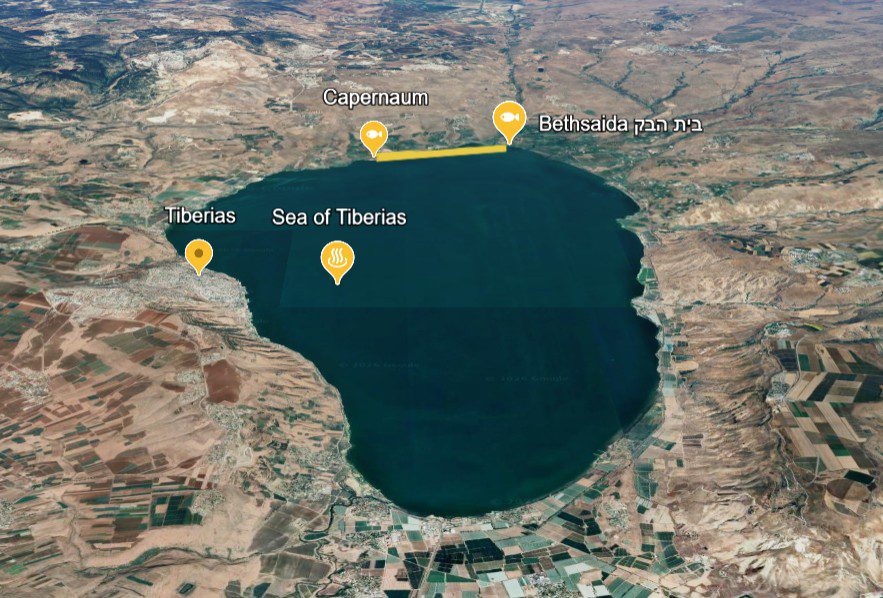
    the ‘Sea of Galilee’

    The Sea of Galilee provided a livelihood for many families, and fishing was a respected trade. Zebedee’s ability to employ hired men suggests a level of affluence and stability, which may have afforded his sons the opportunity to leave and follow Jesus without jeopardizing the family’s welfare.

    source: Biblehub.com

    Sometimes landmarks in the Bible can be as confusing as names, because in context over time the names change.

    Let’s zoom in on the home and livelihood of Zebedee —

    (James and John, Andrew and Simon, hired servants – local carpenters, boat builders, sail and tent makers, and more).

    Many families lived just north of Galilee’s most important body of water where the Jordan River flowed down from inland hills.
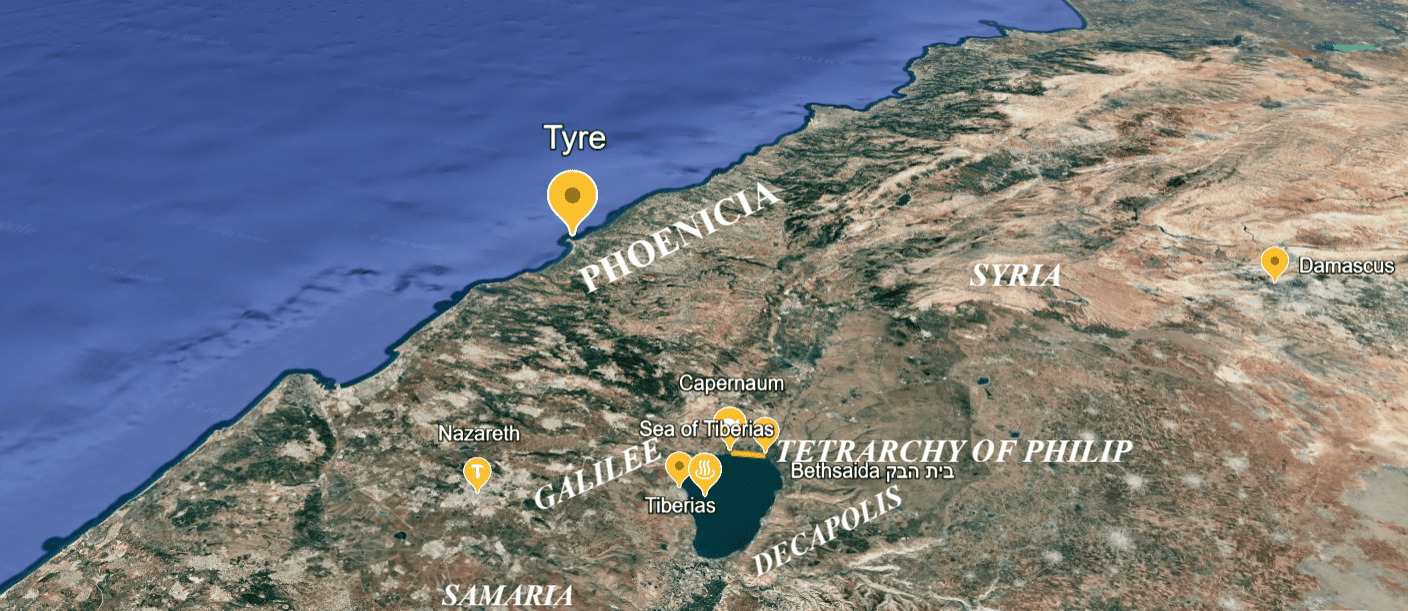
    Note some names of the inland body of water on our map.

    • ‘The sea of Chinnereth,’ Numbers 34:11,
    • ‘The sea of Genesar’
    • ‘The sea of Tiberiah.’
      • Source: BibleHub.com

    Herod Antipas, wanting to make a big name for himself, named this body of water the “Sea of Tiberius” after the Roman Emperor Tiberius Caesar.

    Once it was renamed, it was considered treason against Caesar for a Roman citizen to call the lake anything else.

    Non-Romans, however, were not held to that standard. Because the Jews hated Rome and their occupation of Israel they were not in any hurry to call their lake the Sea of Tiberius. So they continued calling the lake by the name most familiar to them and already widely accepted among the people who lived in the region of Galilee:

    “The Sea of Galilee.”

    source: NTBCStafford.org

    Rome controlled the coasts of the Mediterranean Sea and inland commerce. The strategic importance of the Sea of Galilee held military importance, perhaps even more than Jerusalem.

    Although sudden storms from winds sweeping down upon the sea could make it dangerous even for seasoned fishermen, in fact two other names more accurately described it:

    • Genezareth or Kineret Lake

    The lake has a surface area of 64 square miles .. Extending 13 miles (21 km) from north to south and 7 miles (11 km) from east to west, it is pear-shaped. Its surface elevation was long given as 686 feet (209 metres) below sea level..

    Source: Britannica

    The Sea of Galilee is a FRESH WATER LAKE, the largest in Israel, fed by the Jordan River and undground springs, with its surface ~700 feet below sea level making it the lowest fresh water lake on earth. From this important lake the lower Jordan flows south into the lowest body of water on earth - the Dead Sea. 

    Successful fishing businesses such as Zebedee’s were vital to the Roman army, even Jerusalem in the hills above the Jordan, as well as locally in villages of the rural Galilean hills.

    map of Jordan River and Bethany where John baptized Jesus

    James and John Sons of Zebedee

    When John followed his older brother James to become a disciple of John the Baptist it seems not to have affected the larger merchant enterprise of their father’s fishing business. They may have even traveled to Jerusalem previously with their father to deliver and sell fish to some of Jerusalem’s ruling families.

    Zebedee employed servants in his fishing enterprise and likely worked with other fishing families. Capernaum and Bethsaida are situated strategically (for fishing) less than three miles apart on the north shore of the lake.

    Sons and servants of other fishing enterprises, such as that of Jonah (also: Jonas or John), father of Andrew, who also had followed John the Baptist before becoming Jesus’ first Disciple, certainly all knew each other (as those in small towns tend to do).

    Sons of Salome

    Zebedee was married to Salome, who is believed to have been a follower of Jesus and possibly one of the women who supported His ministry.

    Source: BibleHub.com

    The Gospels of Matthew and Mark mention Salome’s presence along with others at the Cross of Jesus.

    Some commentators speculate that Salome may have been the sister of Mary, mother of Jesus.

    Therefore the soldiers did these things.
    But standing by the cross of Jesus were His mother, and His mother’s sister, Mary the wife of Clopas, and Mary Magdalene.

    Gospel of John 19:25 LSB

    It would be consist with the Apostle’s humility of not mention his own name in his Gospel for John to not mention his own mother by name.

    The Gospels reveal further evidence that Salome (wife of Zebedee) accompanied her sons.

    Then the mother of the sons of Zebedee came to Him with her sons, bowing down and making a request of Him.

    And He said to her, “What do you wish?” She said to Him, “Command that in Your kingdom these two sons of mine may sit one on Your right and one on Your left.”

    Gospel of Matthew 20:20-21 LSB

    John’s early days

    He was possibly born around 6 A.D. in the city of Bethsaida.

    If this is true, he would have been about twenty years old when he and Jesus met for the first time in late 26 A.D. .. What few realize is that Salome and Jesus’ mother Mary were likely sisters.

    “This means that Christ and John were first cousins as far as legal matters were concerned among the Jewish people” (Restoring the Original Bible, pg. 313).

    John’s possible bloodline relationship to Jesus also means that he and is older brother James the Greater (Matthew 4:21) were full cousins to the Lord’s half-brothers James and Jude. Both James and Jude wrote New Testament books and were leaders in the early New Testament church (see Acts 1:14, 15:13).

    source: BibleStudy.org


    John in his 20’s and 30’s

    Everything we read in the Gospels about John, beloved Disciple of Jesus, takes place when John is in his early twenties. Most of what we witness about John from Acts of the Apostles takes place when the Apostle is still in his late twenties or thirties.

    NEXT - We will observe Jesus' young Disciple John from the witness of all four Gospel writers, followed by observations of an Apostle sent out by the risen Christ in ACTS of the Apostles. 

    TalkofJESUS.com earth from space

  • The Longest Faithful Apostolic Journey of John

    The Longest Faithful Apostolic Journey of John

    How do you picture the Apostle John?

    • From familiar Scripture as a young man near Jesus,
    • or an old man on Patmos;
    • or do you see a faithful man following Jesus on an extraordinary journey lasting many years?


    INTRODUCTION to JOHN’s Apostolic Faith

    map of Jordan River and Bethany where John baptized Jesus

    late A.D. 20’s at the Jordan river near Bethany

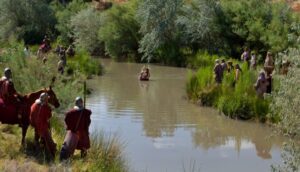
    depiction of John baptizing a man at the Jordan river

    John was there again with two of his disciples. When he saw Jesus walking by, he said, “Look, the Lamb of God!” And when the two disciples heard him say this, they followed Jesus.

    Jesus turned and saw them following.

    “What do you want?”

    “Rabbi”

    “where are You staying?”

    “Come and see,”

    So they went and saw where He was staying, and spent that day with Him.

    Gospel of John 1:35-39 excerpt, BSB


    James and his young brother John were not sleeping when the Messiah of Israel came to their Rabbi, John the Baptist.

    In fact, these two sons of Zebedee had sought the savior of Israel, and then found and followed John the Baptist (who many Jews believed could be the one).

    Then they would join the Master of whom John spoke, and follow Him when the Lord sought His own disciples from their own little fishing village far removed from Jerusalem.

    Introduction to Jesus’ Disciple John

    John is a familiar and beloved Disciple of Jesus, well-known to Christians and unbelievers alike through the Gospels, as well as numerous illustrations and paintings often commissioned by the Roman or Orthodox Church many centuries later.

    the young Apostle John embracing the Cross of Jesus

    ~ in the year of our Lord 30


    He and others likely didn't have a visible halo over their heads. And art such as DaVinci's, 'The Last Supper,' — with young John clinging to Jesus, which illustrates John's actual devotion — shows a long table and chairs never used in upper rooms of the A.D. first century. 

    Acts Apostolos - Acts 1 of the Apostles begins a 28 chapter account of the chronicles of Christ's Apostles - a history of Christ's Church

    A.D. 30’s – A.D. 50’s

    Perhaps Christians will recall that prior to His crucifixion, JESUS sent the Twelve out to some cities to proclaim the Gospel.

    And some may recall that the APOSTLE John was with Peter when both Apostles had been sent to preach in the Temple after Pentecost (~A.D. 30), were witnessed to work miracles.


    “How is it that each of us can hear them in our own native language?

    Acts of the Apostles 2:8 CSB

    • Here is one brief look [October 2021 C.E.] from our TalkofJESUS SERIES from Acts of the Apostles.
      • Perhaps five years later you will still recognize some of the faces.

    Three Score Years of John’s Apostlic Faith

    Followers of Jesus Christ in these last days will generally picture the Apostle Jesus loved as he began his faithful path of life in the early years of John’s life (when he was only in his twenties).

    Even in Acts of the Apostles, our early focus turns from Peter (and John, somewhat) primarily to Paul.

    Although John’s Gospel details key witness of the Lord Jesus Christ prior to the Lord’s death, resurrection and ascension, the Apostle wrote his Gospel for the Church many years later, around the year of our Lord (A.D.) 85 – fifty some years after Pentecost.

    ~ A.D. 50 – ~ A.D. 100

    The Apostle John wrote his final letters near the end of the A.D. First Century!

    Written between a mid-first century Council in Jerusalem and his own natural death near the end of the A.D. First Century, the Epistles of John reveal a familiar festering of indignancy between Jerusalem’s Jews and occupying Roman legions.

    Christians were caught in a new light leading them to dangerous intersections of worldly clashes affecting the lives of Jews, Romans, Greeks and every saint seeking Christ.

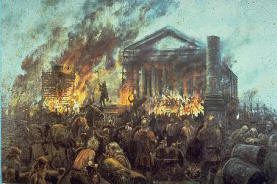
    Fall of Jerusalem
    Pictured: A.D. 70 burning of the Temple in Jerusalem by the occupying Roman army.

    Writing to the Jews, the saints and the Romans

    The saints of the Church witnessed Apostolic faith in a Roman governed world with diminished Jewish influence throughout Syria, Asia, and Europe (including Rome) — and even in Rome’ s local Herodian tetrarchies which included Galilee and Judea, with the city of Jerusalem.

    The Apostle John wrote to saints who came to Christ from all of these varied backgrounds — saints and their Elders new to the Gospel, in need of sound teaching and vulnerable to temptations of false teaching.

    Introduction to John’s Epistles

    In order to further understand a turbulent historic setting for this SERIES on the final LETTERS of JOHN, we will first take a brief look at the first century Church and also look ahead to John’s other well-quoted book, Revelation.

    FINALLY — with God’s help and that of theologians more studied than me —I hope to tie it all together by studying the two briefest letters in the New Testament: the Epistles of Second John and Third John.

    COMMMENT with your QUESTIONS and observations about the THREE Letters of John at anytime. 
    Your input may be important to our understanding of John's letters.

    NEXT: Reintroducing John, the man, disciple, Apostle and Elder

    Comment on Scripture – Share the Gospel


  • Paul – P.S. Personal Salutations from Prison

    Paul – P.S. Personal Salutations from Prison

    2 Timothy – Personal Requests

    The Apostle, having urged Timothy with all Authority of God and Christ in his final epistle, now adds several personal salutations and instructions concerning others.

    ~ A.D. 66

    Timothy might have expected that several fellow members had continued to attend Paul’s needs in Rome, but the Apostle writes:

    Demas has fallen in love with the present world and has deserted me and has gone to Thessalonica.

    Second Letter of Paul to Timothy 4:10 CEB

    And what of others Timothy would have known to be with Paul earlier when the Apostle was under house arrest?

    Paul leaves no doubt that they too have left Rome.

    Crescens has gone to Galatia, and Titus has gone to Dalmatia. Only Luke is with me..

    I sent Tychicus to Ephesus.

    2 Timothy 4:9-10a, 11 CEB

    Paul’s Post Script requesting personal help

    Get Mark, and bring him with you. He has been a big help to me in the ministry. When you come, bring along the coat I left with Carpus in Troas. Also bring the scrolls and especially the parchments.

    2 Timothy 4:11b, 13 CEB


    Reminiscing on Paul’s missions

    Recorded by Paul's personal physician, Luke, in Acts of the Apostles

    As mentioned earlier, Paul writes this in ~A.D. 66, probably more than a year since his first epistle. Over the years the Apostle to the Gentiles has forged many close personal relationships.

    Let’s take a brief look back at Paul’s missions and friends.

    ~ AD 47-49

    about 20 years earlier.. 

    John Mark, who the Apostle now requests to be brought to help him in Rome, had accompanied Paul and Barnabas only to Cypress backing out and returning home.

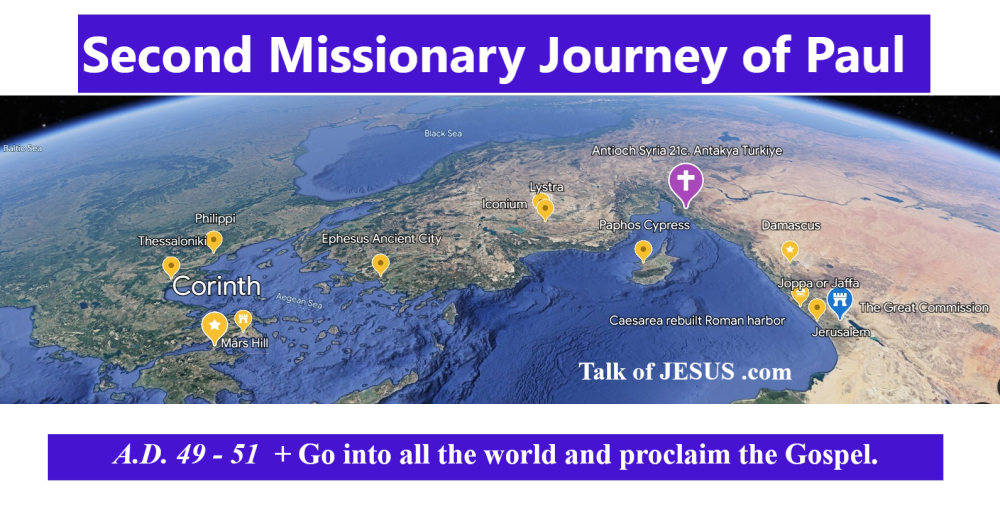
    Paul embarks on a much longer second mission after meeting the other Apostles in A.D. 49 at the important Council of Jerusalem.

    A.D. 49-51

    • Claudius, Emperor of Rome
    But on taking leave of them he said, “I will return to you if God wills,” and he set sail from Ephesus. Conclusion of the second missionary journey of Paul from Acts 18

    Paul first writes an Epistle to the Galatians, churches in the vast area of his first missionary journey.

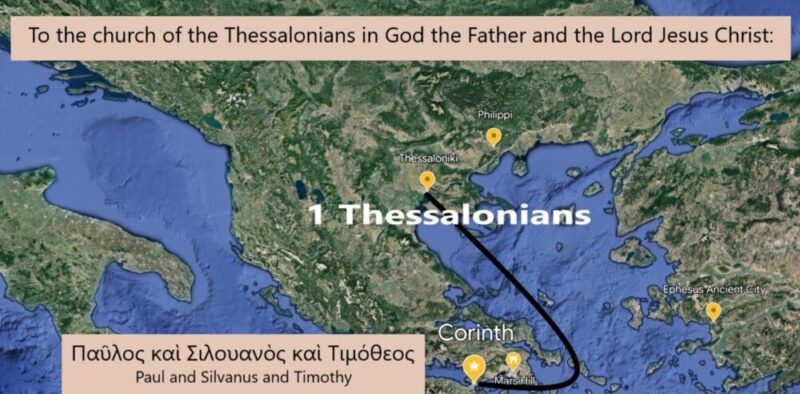
    The Apostle then writes two letters to the church in Thessaloniki, an important Roman port.

    1 Thessalonians - Paul, Silas & Timothy send a letter from Corinth to the church of the Thessalonians to encourage them in their sanctification in Christ. Google Earth map of the Aegean.

    The Apostle has added Timothy to his sojourning pastors which also includes Silas at that time.

    And one additional witness of the Gospel going out in written form beginning with John Mark, who had left Paul’s first mission and then spent time with Peter.

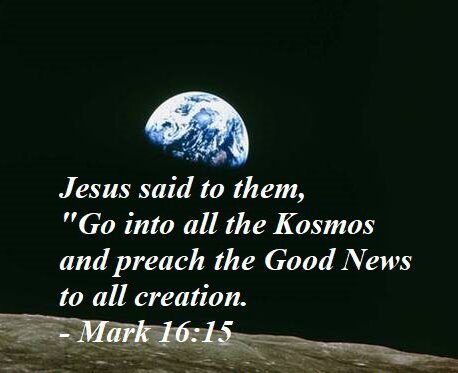
    view of earth from moon

    A.D. 54 – to the time of Paul’s final epistle

    Let us not forget that the world into which the Apostles went out was not dominated by Roman citizens focused on Christ or God — far from it (much like these last days of the Common Era).

    Governors had changed in these varied Roman provinces, but more importantly in Rome, we now have an even more evil opponent of Christ than Caligua (who declared himself a god) at the time of Saul’s conversion — an emperor more cruel than Caligua, Caesar at the time of Paul’s missions.

    The Apostle had been held in custody in Rome for some time now as a result of his appeal to Caesar. But now Nero was Caesar and Emperor of all Rome and the world Rome controlled.

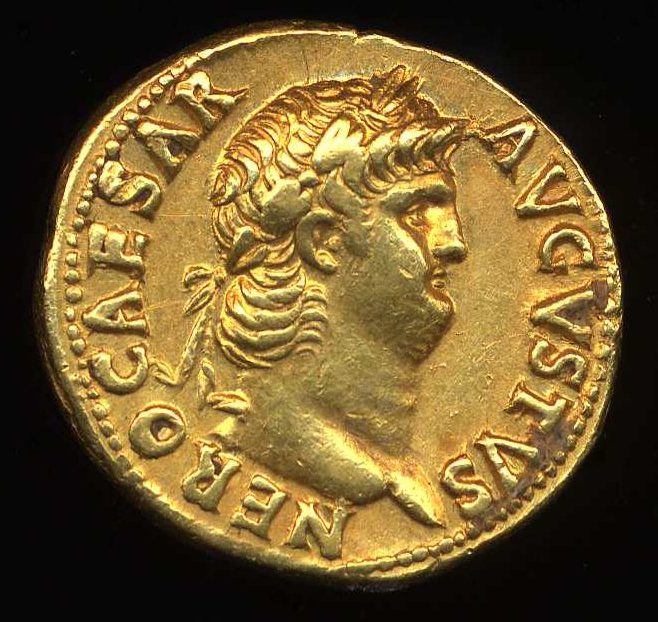
    Nero Claudius Caesar Augustus Germanicus

    (15 December 37 AD – 9 June 68 AD)

    Roman Coin with profile of Nero Caesar Augustus
    • Emperor Claudius died in 54 AD. According to the historical facts, he was poisoned by his wife, Agrippina.
    • Undoubtedly, the main event and threat to Nero’s reign were the Great Fire, which began on July 19, 64 AD, and lasted for six days. Rome was divided into fourteen districts, where ten of them were destroyed, hundreds of people died, and thousands became homeless.
    • Nero’s death [June 9, 68 AD] sparked a year of civil war known as the Year of the Four Emperors, as various generals and factions vied for control of the Roman Empire, further destabilizing the already volatile political climate.

    source: Rome.us roman emperors Nero

    Paul’s timely Epistles for turbulent times

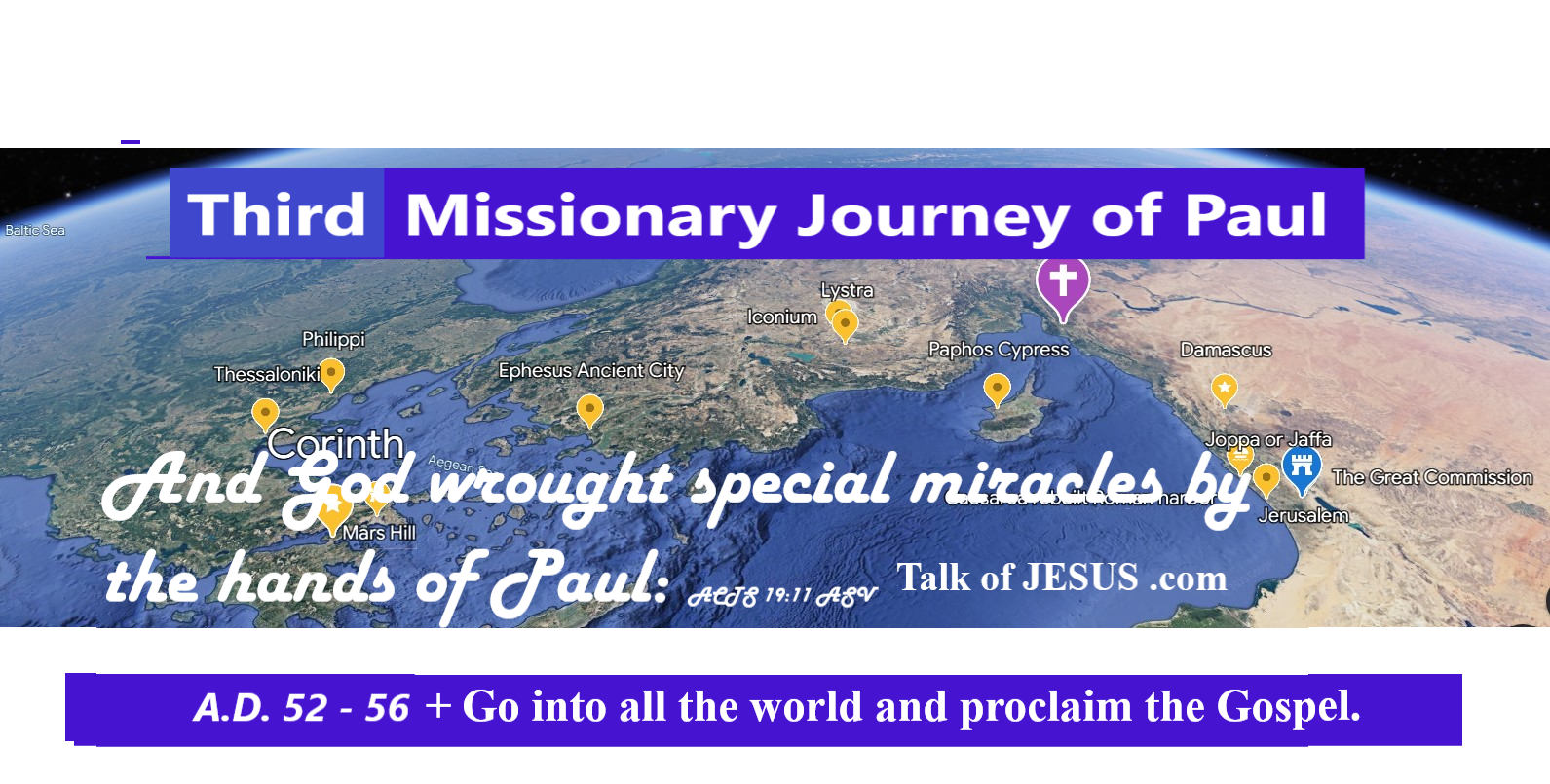
    Christians relate these letters to the time of the Apostle's third missionary journey.
    And God wrought special miracles by the hands of Paul: Acts 19:11 ASV graphic map of Third Missionary Journey of Paul
    • 2 Epistles to the Church at Corinth
    • A.D. 57 Paul writes his masterful theological Epistle to the Romans
      • Paul then returns to Rome [~ AD 59-60]
    • Paul makes personal mentions of:
      • Gaius, his Roman host and supporter of his mission
      • Erastus, a city treasurer and believer
      • and Timothy (who is with the Apostle when Paul writes his letter to his beloved saints in Rome).

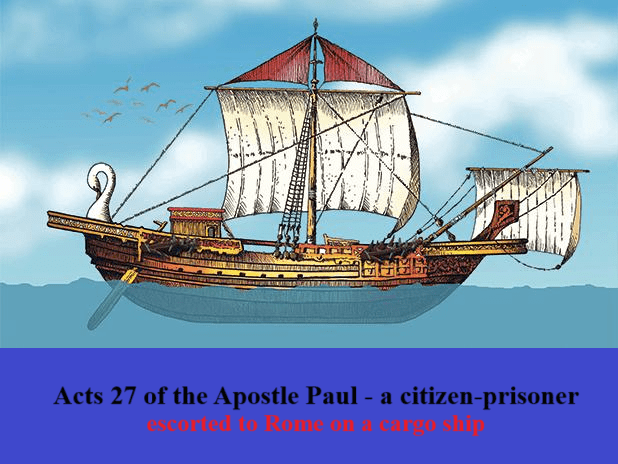
    model of a Roman sailing ship designed to haul cargo such as one on which the Apostle Paul was transported to Rome as a prisoner

    A.D. 60-66 – Apostolic faith —Paul’s prolific witness via letters to the Church

    ~ A.D. 60-62

    Two years before the great fire when Nero would have been in his early 20's. 

    Paul writes to the church in:

    • Ephesus
      • mentioning Tychicus as a “beloved brother and faithful servant in the Lord.”
    • Phillipi
      • co-authored by Timothy and mentioning
      • Epaphroditus (who ministered to Paul while under house arrest in Rome
      • Euodia and Syntyche, two women of the Philippian church
      • Clement, a Philippian saint who had worked with Paul
    • Colossae [part of a tri-city area with Laodicea and Hierapolis]
      • again, co-authored by Timothy
      • and again mentioning Epaphroditus
      • also Tychicus who Paul sent there
      • Onesimus, now a church member, but a run-away slave
      • Aristarchus, Justus, and Demas, who had accompanied the Apostle
      • Luke (of course) his physician and friend
      • Nympha, in whose home the church met
      • and Archippus, a member
      • John Mark, who has just complete his Gospel is mentioned as an encouragement to the church
    Although some refer to these as the Apostle's 'prison epistles,' we'll understand Paul's freedom to send letters best by recalling that the Apostle has not yet been brought to trial before the court of Caesar Nero. 

    • The Apostle also writes a personal letter to Philemon concerning his converted slave (and fellow saint) Onesimus
    • Paul writes his first pastoral Epistle to Timothy around this time [~ A.D. 62]

    When we read the Apostle’s P.S. of Second Timothy, remember the great interpersonal love of so many of Paul and his love and prayers for them.

    + In other NEWS:

    • The physician Luke writes his Gospel
    • Luke sends a second account out of the ACTS OF THE APOSTLES detailing a post-resurrection history of the Church
    • James, leader of the Jerusalem church and half-brother of Jesus, is martyred [~ A.D. 62]

    ~ A.D. 64 (-66)

    • Nero burns Rome, blames Christians
    • Judeans and others revolt against Roman rule
    • The Apostle Peter writes two Epistles
    • Paul writes another pastoral Epistle to Titus
      • Tychicus mentioned again, along with
      • Artemas
    • Apollos is mentioned alongside
    • Zenas. He is a well-known early Christian teacher and preacher, noted for his eloquence and knowledge of the Scriptures.
      • source: BibleHub.com Titus
    Had the brothers hoped for a chance that Zenas could defend Paul before Caesar to have his case dismissed? 

    But Nero would be seeking political cover rather than justice.


    Contention and betrayal

    Had someone bribed a false witness against the Apostle Paul, as Judas had betrayed the Lord Jesus?

    Alexander the coppersmith did me much harm. May the Lord repay him according to his works. You also must beware of him, for he has greatly resisted our words.

    At my first defense no one stood with me, but all forsook me. May it not be charged against them.

    2 Timothy 4:14-16 NKJV


    Although we feel the urgency of Paul’s personal salutations to those now mentioned in the closing of his final letter, the Apostle does not write any detail of his trial, imprisonment or impending execution.

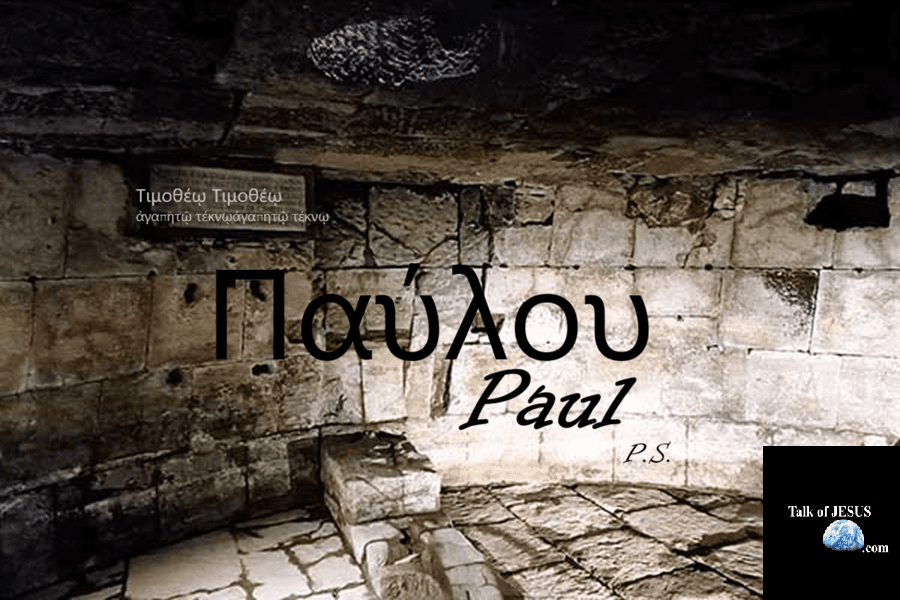
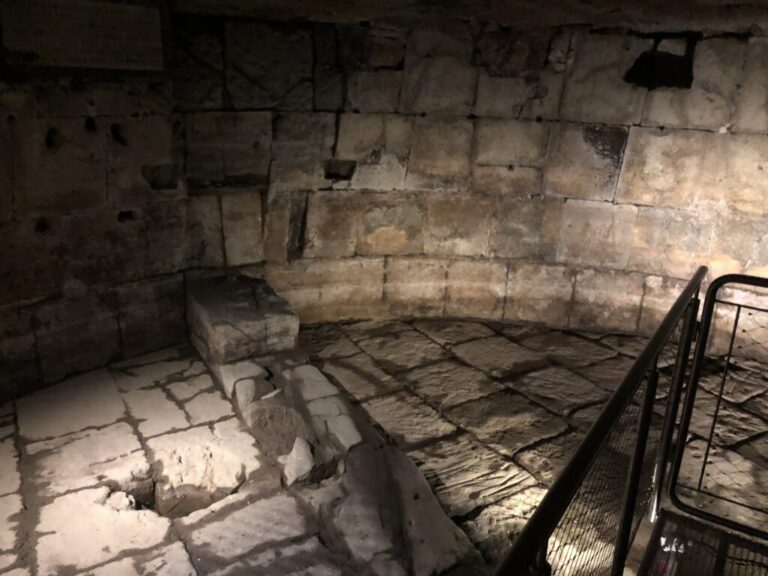
    from Carcere Mamertino

    a Last Testament of Paul

    Prisoners were lowered through an opening into the lower oubliette, known as the Tullianum.

    Incarceration (publica custodia) in facilities such as the Tullianum was intended to be a temporary measure prior to trial or execution

    source: Wikipedia


    But the Lord stood with me and strengthened me, so that the message might be preached fully through me, and that all the Gentiles might hear. Also I was delivered out of the mouth of the lion.

    And the Lord will deliver me from every evil work and preserve me for His heavenly kingdom.

    To Him be glory forever and ever. Amen!

    Second Epistle of the Apostle Paul to Timothy 4:17-18 NKJV


    P.S. – a personal salutations of fare well

    Greet Prisca and Aquila, and the household of Onesiphorus.

    Erastus stayed in Corinth, but Trophimus I have left in Miletus sick.

    2 Timothy 4:19-20 NKJV

    And a glimmer of hopeful reunion with Timothy:

    “Try to get here before winter,” Paul now asks.

    Paul had just written instructions for such a visit:

    “Try to join me soon… When you come, bring the cloak I left with Carpus in Troas, the papyrus rolls, and especially the parchments.

    2 Timothy 4:9a,13 NABRE

    Then Paul, in his usual graceful manner shares greeting to Timothy from mutual saints who he may have last seen before his current imprisonment, even at his trial.

    Eubulus greets you, and so do Pudens, Linus, Claudia and all the brothers and sisters.

    2 Timothy 4:21b NIV

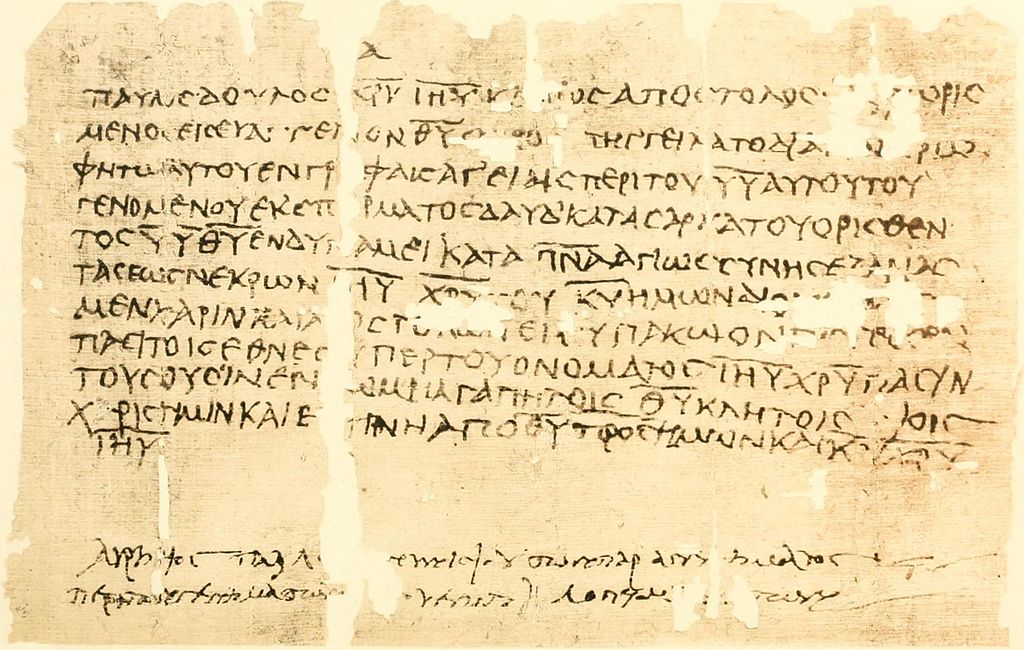
    the Last Written Words of the Apostle Paul:

    Ὁ κύριος Ἰησοῦς Χριστὸς μετὰ τοῦ πνεύματός σου ἡ χάρις μεθ᾽ ὑμῶν ἀμήν πρός Τιμόθεον δευτέρᾳ τῆς Ἐφεσίων ἐκκλησίας πρῶτον ἐπίσκοπον χειροτονηθέντα ἐγράφη ἀπό Ῥώμης ὅτε ἐκ δευτέρου παρέστη Παῦλος τῷ Καίσαρί Νέρωνι

    The Lord Jesus Christ be with thy spirit. Grace be with you. Amen.

    2 Timothy 4:22 – TEXTUS RECEPTUS, KJV


    Talk of JESUS . com

    Comment on Scripture – Share the Gospel

    To Timothy, my dearly beloved son [in Greek] Paul [Greek & English] P.S.