Category: Pentateuch Genesis-Deuteronomy

IN THE BEGINNING… Genesis, Exodus, Leviticus, Numbers, Deuteronomy – Pentateuch [5 books] It’s the LAW of GOD!
Forgive us our trespasses. Jesus teaches many lessons from these books of the Bible and we have forgotten MANY of the issues and applications to our 21st century life. How can you SHARE from the beginning of the Bible with your SOCIAL ‘Friends’ and talk of Jesus as Lord? Please TITLE your post by the topic, not the verse. Include links to scriptures and helpful references. — Please post or tell us in a COMMENT how you talk of Jesus through this topic and these Old Testament scriptures.

  • The Curse of Disease and Death – 2

    The Curse of Disease and Death – 2

    Moses, Privilege of the Wilderness

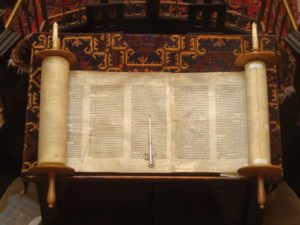
    In part one of this series about our attitude toward disease and death we briefly examined a story from the oldest book of the Bible, Job. Job was well-to-do, he had then lost nearly everything including his health, yet he blessed the Lord. תּוֹרָה‎Today we examine part of a too-familiar story from the Pentateuch [Torah ], written by Moses. The Book of the Law, or the first five books of the Bible, are written about the Lord and relationship to man (adam), but within this story we find a man not unlike Job, a man of privilege and wealth, Moses.
    Moses may have been the most learned man on earth in his day, raised as a prince of privilege in a palace of a most powerful man who accumulated wealth and knowledge from the many corners of the world he ruled, conquered or traded. The house of Pharaoh, a throne perhaps to which Moses could have ascended upon his death, was a Rome on the Nile to which the peoples of the land looked in worship.
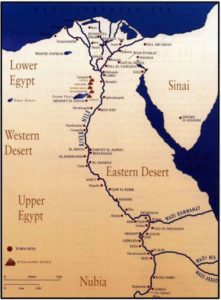
    Egypt of MosesMoses, Prince of Egypt, ruled over the important day-to-day projects in the extensive north-to-south agricultural empire whose glory was tied to management of the rich resources of the 4,160 mile [6670 km] long Nile River.

    Moses gave up much, first in fleeing for his life at age forty and later in returning at age eighty to challenge Pharaoh at the urging of the Lord, only to be led to live in the wilderness of Sinai for forty more years.

    The Torah breezes quickly over typically the most notable years of a man’s life to tell most about Moses’ life after age eighty.

    [ctt title=”The Torah is five Books about the LORD, not a book about Moses.” tweet=”תּוֹרָה‎” coverup=”U9Qna”]

    Exodus 2:

    Moses Flees to Midian

    11 One day, when Moses had grown up, he went out to his people and looked on their burdens…

    21 And Moses was content to dwell with the man [Jethro, Priest of Midian], and he gave Moses his daughter Zipporah. 22 She gave birth to a son, and he called his name Gershom, for he said, “I have been a sojourner in a foreign land.”

    God Hears Israel’s Groaning

    23 During those many days the king of Egypt died, and the people of Israel groaned because of their slavery and cried out for help. Their cry for rescue from slavery came up to God…

    Exodus 3 

    The Burning Bush

    Now Moses was keeping the flock of his father-in-law, Jethro, the priest of Midian, and he led his flock to the west side of the wilderness and came to Horeb, the mountain of God. And the angel of the Lord appeared to him in a flame of fire out of the midst of a bush. He looked, and behold, the bush was burning, yet it was not consumed…


    Most of us are fairly familiar with this part of Moses’ story, yet with minimal thought of his again comfortable life with a wife and children and a good job of shepherd. We fail to remember that much time has passed and Moses has survived his own flight from Pharaoh (father of his adoptive Egyptian mother) to establish a good life in the family of a Hebrew priest.

    Now there is a new Pharaoh, perhaps a son who came to the throne of Egypt who would have grown up with Moses, a son perhaps even jealous of the many talents of the former Prince of Egypt who had fled to Midian so many years before. “Exodus 2:23 During those many days the king of Egypt died…” Easy to have missed this. Time had passed in life as always it will.


    Exodus 3:

    10 “Come, I will send you to Pharaoh that you may bring my people, the children of Israel, out of Egypt.” 11 But Moses said to God, “Who am I that I should go to Pharaoh and bring the children of Israel out of Egypt?” 12 He said, “But I will be with you, and this shall be the sign for you, that I have sent you: when you have brought the people out of Egypt, you shall serve God on this mountain.”

    Moses is about to become (after a time) a man higher than the LORD’s High Priest, a mortal standing before the Lord as Adam had been in the very presence of the LORD! Yet first, much time would pass both in Egypt and in the wilderness.

    Exodus 4:19-20

    And the LORD said to Moses in Midian, “Go back to Egypt, for all the men who were seeking your life are dead.” So Moses took his wife and his sons and had them ride on a donkey, and went back to the land of Egypt. And Moses took the staff of God in his hand…

    27 The Lord said to Aaron, “Go into the wilderness to meet Moses.” So he went and met him at the mountain of God and kissed him. 28 And Moses told Aaron all the words of the Lord with which he had sent him to speak, and all the signs that he had commanded him to do.


    Exodus 7:

    Moses and Aaron Before Pharaoh

    And the Lord said to Moses, “See, I have made you like God to Pharaoh, and your brother Aaron shall be your prophet. You shall speak all that I command you, and your brother Aaron shall tell Pharaoh to let the people of Israel go out of his land. But I will harden Pharaoh’s heart, and though I multiply my signs and wonders in the land of Egypt,Pharaoh will not listen to you. Then I will lay my hand on Egypt and bring my hosts, my people the children of Israel, out of the land of Egypt by great acts of judgment.


    We know well the drama to follow: plagues and suffering of both Egyptian and Hebrew. What we may have missed in the big screen dramas is how the Lord used a now ordinary old man (Moses) to lead a suffering people to the promised land. We might not see the humble weakness of old Moses in light of the powerful work the Lord would do by his own hand.

    Now Moses was eighty years old, and Aaron eighty-three years old, when they spoke to Pharaoh.

    This, of course, was prior to the suffering of the plagues to follow or forty more years of a most difficult life dependant on the manna of God in the wilderness of the Sinai.


    Forty years of suffering

    You’ve lived a good life, one longer than most in those days, eighty years. Would you now choose to go out into the desert as leader of a difficult people? Would you now choose to suffer the severe hard life of a nomad refugee in desperate need of water and food, a people without home or shelter?

    Why would God allow this – yes, even command it?

    Like Job, Moses believed the covenant promise of the Lord. God does not always call us to receive double blessing at the end of our life. The Lord does not call us to always extend our years to one hundred and twenty, with sight of the land promised to your sons and daughters.

    If the Lord calls us to suffering, the loss of a child or loved one, the loss of city and home, the devastating loss of health; it is for His own righteous will and the redemption of His own worshipers.

    Are you a worshiper of the Lord God? Would you humble your flesh,  surrender your prideful ‘self?’

    Would you sacrifice your home, your wealth and everything you have ever known before Almighty God? For the LORD IS, He will judge of our souls and redeems the lives of His own. The Lord IS and He has suffered in the flesh for your sins and for mine.


    Jesus has been counted worthy of more glory than Moses—as much more glory as the builder of a house has more honor than the house itself. – Hebrews 3:3


    To be continued…


  • Balaam – Inauguration of a Politician’s Prophet – 3

    Balaam – Inauguration of a Politician’s Prophet – 3

    Journey to an Inauguration Interrupted

    [In case you missed Part 1 or Part 2 of our long journey] We heard Balaam’s inaugural address in part in Numbers 24:3-9, first introduced in Part 1. Now we return to his journey toward the ceremonies of that momentous occasion.

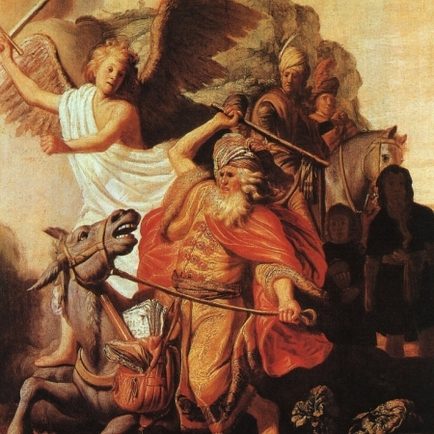
    [ctt title=”Then the Lord opened the eyes of Balaam, and he saw the angel of the Lord standing in the way, with his drawn sword in his hand. And he bowed down and fell on his face.” tweet=”Numbers 22:31 after an ass had to tell a prophet to see the angel of the Lord.” coverup=”8dHCr”]

    Numbers 22:

    32 And the angel of the Lord said to him, “Why have you struck your donkey these three times? Behold, I have come out to oppose you because your way is perverse before me. 33 The donkey saw me and turned aside before me these three times.


    How about this: your way is ‘perverse’ יָרַט [yarat] before the Lord!  Your self-driven actions precipitate, push headlong and drive recklessly. You oppose the LORD! In fact, even your ass [אָתוֹן] saw the Angel of the Lord, but you did not.

    Can you imagine the reaction of the prophet Balaam? First, his ass rebukes him, and now he finally sees the Angel of the Lord with a drawn sword asking why he struck his faithful donkey.

    “… If she had not turned aside from me, surely just now I would have killed you and let her live.”

    34 Then Balaam said to the angel of the Lord, “I have sinned, for I did not know that you stood in the road against me. Now therefore, if it is evil in your sight, I will turn back.”


    Awoken from Sin

    35 And the angel of the Lord said to Balaam, “Go with the men, but speak only the word that I tell you.” So Balaam went on with the princes of Balak.

    [At the end of their long 400 mile journey a King prepares for the Inauguration of a new era with the great prophet of God on his side, so he thinks.]

    38 Balaam said to Balak, “Behold, I have come to you! Have I now any power of my own to speak anything? The word that God puts in my mouth, that must I speak.”

    [Indeed, what can a man or woman belonging to the Lord say, except the word of the Lord?]

    41 And in the morning Balak took Balaam and brought him up to Bamoth-baal, and from there he saw a fraction of the people.

    Numbers 23:

    Next, we see ceremonies of the high event planned by Balaak. Seven altars become the focus of Inauguration events. But Balaam does the unexpected and blesses Israel.

    “From Aram Balak has brought me,
    the king of Moab from the eastern mountains:
    ‘Come, curse Jacob for me,
    and come, denounce Israel!’
    8 How can I curse whom God has not cursed?
    How can I denounce whom the Lord has not denounced?

    … 11 And Balak said to Balaam, “What have you done to me? I took you to curse my enemies, and behold, you have done nothing but bless them.” …

    18 And Balaam took up his discourse and said,

    “Rise, Balak, and hear;
    give ear to me, O son of Zippor:

    19 [ctt title=”God is not man, that he should lie, or a son of man, that he should change his mind. ” tweet=”Has he said, and will he not do it? Or has he spoken, and will he not fulfill it? – Numbers 23:19″ coverup=”97P9C”]

    Balak objects once more and desperately takes Balaam to a third place to worship and proclaim the ‘good omen’ of inauguration of a new era where Israel will not prevail. If you recall Balaam’s inaugural address from the beginning of our story, the speech follows from the third mountain ahead.

    Numbers 24:

    When Balaam saw that it pleased the Lord to bless Israel, he did not go, as at other times, to look for omens, but set his face toward the wilderness. 2 And Balaam lifted up his eyes and saw Israel camping tribe by tribe. And the Spirit of God came upon him, 3 and he took up his discourse and said,

    “The oracle of Balaam the son of Beor,
    the oracle of the man whose eye is opened…

    … 14 And now, behold, I am going to my people. Come, I will let you know what this people will do to your people in the latter days.”

    Prophesy of the latter days

    15 And he took up his discourse and said,

    “The oracle of Balaam the son of Beor,
    the oracle of the man whose eye is opened,
    16 the oracle of him who hears the words of God,
    and knows the knowledge of the Most High,
    who sees the vision of the Almighty,
    falling down with his eyes uncovered:


    Balaam will now speak of things to come.

    I would like to turn to the King James translation, revealing from the original Hebrew much more than a clashing of kings. My conclusion and image from the wilderness of this parable may challenge your perspective of this inauguration. Here I will share links to the scripture for your further Bible study.

    Numbers 24:17b KJV
    and a Sceptre shall rise out of Israel, and shall smite the corners of Moab

    I shall see him, but not now: I shall behold him, but not nigh: there shall come a Star [ כּוֹכָב ] out of Jacob [יַעֲקֹב], and a Sceptre [שֵׁבֶט] shall rise [קוּם] out of Israel [יִשְׂרָאֵל], and shall smite the corners of Moab, and destroy all the children of Sheth.

    An apocalypse spoken for the land of Moab and all the descendants of Sheth [שֵׁת ]. The land of Moab destroyed; but who are these ‘children of Sheth?’

    Let those with ears to hear hear the parable of Balaam, a parable of veiled meaning. שֵׁת [pronounced, shāth] means, “compensation,” but you will recognize the proper Hebrew name for which שֵׁת is used, “Seth,” third son of Adam.

    Consider the destruction of all the sons of Seth!

    [ctt title=”Could another inauguration of evil in the high places bring about completion of these last days? For even brash sons of perdition and a prophet turned from God would not heed the warnings of an ass.” tweet=”Hear the parable of Balaam for another unexpected inauguration.” coverup=”Fos4Z”]


    Let us pray that leaders of powerful countries heed the Word of the Lord.

    “I am the Son of David, the Lion of Judah, Redeemer of Israel, Savior of the nations.
    Glory to the Father and to the Son and to the Holy Ghost. Amen.

    +


  • Balaam – Inauguration of a Politician’s Prophet – 2

    Balaam – Inauguration of a Politician’s Prophet – 2

    Previously

    For those of you who missed Part 1 of our story of Balaam, we began by noting Balaam’s best inaugural speech in Numbers 24, to which we will return chronologically in Part 3. Now turning back to some background and the beginning of our story, King Balak of Moab sent diplomats to Balaam to urge him to prophesy against Israel, whose tribes have invaded nearby Canaan.


    Numbers 22:

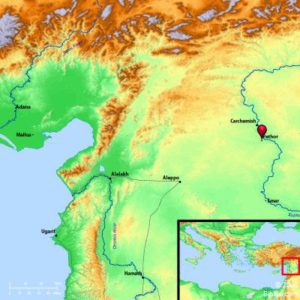
    … Moab was overcome with fear of the people of Israel. 4 And Moab said to the elders of Midian, “This horde will now lick up all that is around us, as the ox licks up the grass of the field.” So Balak the son of Zippor, who was king of Moab at that time, 5 sent messengers to Balaam the son of Beor at Pethor, which is near the River in the land of the people of Amaw, to call him, saying,

    “Behold, a people has come out of Egypt. They cover the face of the earth, and they are dwelling opposite me. 6 Come now, curse this people for me, since they are too mighty for me. Perhaps I shall be able to defeat them and drive them from the land, for I know that he whom you bless is blessed, and he whom you curse is cursed.”


    Some beckoning!

    This foreign king gives great compliment to a prophet living miles away in another land (modern day, Iraq). We may be familiar with a western perspective from Egypt of the Hebrew people crossing of the Sea of Reeds. Perhaps we recall the fall of the major Canaanite city, Jericho. But let’s look at these events as reported to a Prophet living by the Euphrates River. The invasion of Canaan by the Hebrews coming into Canaan looks different from the west beyond Moab.

    …  9 And God came to Balaam…

    What happens next, of course, is that Balaam listens to God and tells Balak’s ambassadors, “Go to your own land, for the Lord has refused to let me go with you.”

    Later they return with a more money for Balak’s campaign.

    20 And God came to Balaam at night and said to him, “If the men have come to call you, rise, go with them; but only do what I tell you.” 21 So Balaam rose in the morning and saddled his donkey and went with the princes of Moab.


    Seems fairly simple for a man to whom God speaks – a man who princes and kings know hear, a mere mortal who speaks the word of the Lord.

    So Balaam joins the entourage of important men for their long return journey to Moab. King Balak believes inviting Balaam will be the inauguration (under good omens) of a new era in his land near the Jordan.


    22 But God’s anger was kindled because he went, and the angel of the Lord took his stand in the way as his adversary.

    Wait just a minute

    Something’s wrong here. Why would God be angry with Balaam; for the Lord had said, “go with them?”

    Balaam’s attitude at a second return of more men with more political promises of riches in Moab must have swayed his original steadfastness to just send these politicians of Balak back home empty-handed. Look closely at some of the detail leading to Balaam’s return on this second journey of the Moabites and Midianites.


    Prior to the first diplomatic mission to Balaam:

    7 So the elders of Moab and the elders of Midian departed with the fees for divination in their hand… 13 So Balaam rose in the morning and said to the princes of Balak, “Go to your own land, for the Lord has refused to let me go with you.”

    I see no mention of acceptance of their ‘fees for divination.’


    Second Diplomatic Junket

    Take a look at Balaam’s challenge of the second mission of these diplomats from the Jordan River valley, a land promised to Israel by the Lord.

    15 Once again Balak sent princes, more in number and more honorable than these. 16 And they came to Balaam and said to him, “Thus says Balak the son of Zippor: ‘Let nothing hinder you from coming to me, 17 for I will surely do you great honor, and whatever you say to me I will do. Come, curse this people for me.’”


    Hear once more Balaam’s reply the first time:  “Go to your own land, for the Lord has refused to let me go with you.” (No room for negotiation in his words.)

    Listen to the subtlety of his second reply:

    “Though Balak were to give me his house full of silver and gold, I could not go beyond the command of the Lord my God to do less or more. 19 So you, too, please stay here tonight, that I may know what more the Lord will say to me.”


    If I’m a negotiator in the middle east, it sure sounds like an opening to me.

    ‘I’ll sleep on it. I’ll ask the Lord again. (Maybe God will change His mind.)

    Do you ask the Lord to command you twice?

    In response to these high officials coming again to him with promises of power and influence, after already having received the Lord’s answer, Balaam went to the Lord once more. “Are you sure.” he asked?

    Do we ask the Lord, “Are you sure?” Of course we do (even though the Lord’s command to us is clear).

    Pethor on the Euphrates – 400 miles from Moab

    Now comes the familiar story of Balaam’s journey with the princes and diplomats to the powerful capitals of their kings. It could be (if the Lord would allow) a great career move for Balaam.

    Now the prophet, distracted by men of influence and dreams of earthly riches, misses the Lord’s message for him. In fact, Balaam’s procession to this inauguration puts him in great danger.


    Balaam and his Donkey

    You probably know this story and like many, smirk at its absurdity.

    Now he was riding on the donkey, and his two servants were with him. 23 And the donkey saw the angel of the Lord standing in the road, with a drawn sword in his hand. And the donkey turned aside out of the road and went into the field.

    And Balaam struck the donkey, to turn her into the road. 24 Then the angel of the Lord stood in a narrow path between the vineyards, with a wall on either side. 25 And when the donkey saw the angel of the Lord, she pushed against the wall and pressed Balaam’s foot against the wall.

    So he struck her again. 26 Then the angel of the Lord went ahead and stood in a narrow place, where there was no way to turn either to the right or to the left. 27 When the donkey saw the angel of the Lord, she lay down under Balaam.

    And Balaam’s anger was kindled, and he struck the donkey with his staff.


    Balaam’s hopes for the inauguration

    Balaam certainly expected a reward at the end the journey of about 400 miles. rather than trouble at the beginning. Perhaps this new year will offer us opportunity to consider Balaam’s failure to go forward without listening to God.

    [ctt title=”Do your New Year\’s goals include God?” tweet=”What path does the LORD lead you to follow this year?” coverup=”6Gmbd”]

    28 Then the Lord opened the mouth of the donkey, and she said to Balaam, “What have I done to you, that you have struck me these three times?” 29 And Balaam said to the donkey, “Because you have made a fool of me. I wish I had a sword in my hand, for then I would kill you.”


    Again, let’s overlook the humor for a moment of an ass rebuking a prophet of God. And while we are at it, let’s not be so quick to miss that God can make an ass speak that is obedient to His will, when a man will not speak God’s will (as a prophet is expected to do).


    30 And the donkey said to Balaam, “Am I not your donkey, on which you have ridden all your life long to this day? Is it my habit to treat you this way?” And he said, “No.”

    31 Then the Lord opened the eyes of Balaam, and he saw the angel of the Lord standing in the way, with his drawn sword in his hand. And he bowed down and fell on his face. 32 And the angel of the Lord said to him, “Why have you struck your donkey these three times? Behold, I have come out to oppose you because your way is perverse before me.

    Are your ways contrary to the Lord?

    The leaders of Midian and the leaders of Moab led lives in opposition to the Lord. Their sacrifices to idol gods offended the Lord. (Surely Balaam knew of this.)

    Like Abraham he was willing to travel this great distance. Unlike Abraham, Balaam traveled because he refused to listen to command of the Lord. Even so, the Lord was merciful here and spared Balaam’s life.


    Balaam – Inauguration of a Politician’s Prophet – To be continued…