Tag: abraham

  • The Mystery of Melchizedek

    Psalm 110:

    A Psalm of David.

    The Lord says to my Lord:
    “Sit at my right hand,
    until I make your enemies your footstool.”
    2 The Lord sends forth from Zion
    your mighty scepter.
    Rule in the midst of your enemies!
    3 Your people will offer themselves freely
    on the day of your power,
    in holy garments;
    from the womb of the morning,
    the dew of your youth will be yours.

    The Lord has sworn
        and will not change his mind,
    “You are a priest forever
        after the order of Melchizedek.”

    5 The Lord is at your right hand;
    he will shatter kings on the day of his wrath.
    6 He will execute judgment among the nations,
    filling them with corpses;
    he will shatter chiefs
    over the wide earth.
    7 He will drink from the brook by the way;
    therefore he will lift up his head.


    Why would King David of Israel write a song about him? Who is this Melchizedek?

    In fact, note the beginning of David’s Psalm: “The Lord says to my lord…” Even Jesus quotes this Psalm with a question to the Scribes:

    But he said to them, “How can they say that the Christ is David’s son? For David himself says in the Book of Psalms,
    “‘The Lord said to my Lord,
    “Sit at my right hand, until I make your enemies your footstool.”’ – Luke 20:41-43

    לְדָוִד מִזְמֹור נְאֻם יְהוָה לַֽאדֹנִי שֵׁב לִֽימִינִי עַד־אָשִׁית אֹיְבֶיךָ הֲדֹם לְרַגְלֶֽיךָ׃

    Yĕhovah  nĕ’um ‘Adonay

    (The impact loses something in the English.)

    Jehovah = “the existing One.” the proper name of the one true God.

    אֲדֹנָי ʼĂdônây, ad-o-noy’; an emphatic form of H113; the Lord (used as a proper name of God only):—(my) Lord.

    To understand the full impact of Jesus’ challenge you must understand and accept the principle of lordship and hold reverence for the authority of God.

    Hear some of the synonyms for ‘adown, the root word of Ădônây:

    firm, strong, lord, master, superintendent of household or of affairs, king, prince, governor, captain, the Lord God, Lord of the whole earth, master, husband, prophet, father, Moses, priest, theophanic angel,
    general recognition of superiority, Lord of lords (probably = “thy husband, Yahweh”)

    AND one more definition which may help us in understand the mystery of Melchizedek:
    proprietor of hill of Samaria

    Talk of Abraham or Moses by the jews was reverence to the traditions of worship of the One God, the Lord YHWH. Kings of Jerusalem (once known as Salem) like David and Solomon were held in high honor and respect for our own heritage of leadership anointed on  a man by the One God – a man appointed by God as the Lord’s authority over all men.

    Therefore, for Jesus to speak of Abraham as if He Is over Abraham in authority is the very point of the discussion of the order of authority of kings and priests appointed by God, of whom Melchizedek is both!

    If Melchizedek is a proprietor of the hill of Samaria שמרון (Shomron), a proprietor of Salem שָׁלֵם Shalem, what is the meaning of this mystery?

    שמר I

    The verb שמר (shamar I) means to keep, guard, observe or give heed. HAW Theological Wordbook of the Old Testament sums up this verb with “to exercise great care over”. This ubiquitous verb is used to literally mean keeping a watch out or guarding:

    Psalm 110:

    5 The Lord ‘Adonay  is at your right hand;
    he will shatter kings on the day of his wrath.
    6 He will execute judgment among the nations,
    filling them with corpses;
    he will shatter chiefs
    over the wide earth.

    Have you considered why Abraham worshiped Melchizedek?

    Have you considered the proprietary authority of Christ over every hill of the earth, over every soul who walks ever-so-briefly over the wide earth?

    Have you considered the sudden return of Christ upon the clouds above all nations?

    To be continued…

  • Abraham, Prince of a Promise

    Genesis 12:

    6 Abram passed through the land to the place at Shechem, to the oak of Moreh. At that time the Canaanites were in the land.

    ElonMoreh
    Moreh – excellent research, additional photos & insight linked to this photo

    7 Then the Lord appeared to Abram and said, “To your offspring I will give this land.”

    Abram is no longer a Sheik of Ur. He is no longer a Sheik of the land between the rivers or of Haran. Abram is now a Prince only of promise. Yet the promise is from the Lord. Repeatedly, Abram worships the Lord. Consistently, Abram follows the command of the Lord by faith.

    7b So he built there an altar to the Lord, who had appeared to him.

    8 From there he moved to the hill country on the east of Bethel and pitched his tent, with Bethel on the west and Ai on the east.

    And there he built an altar to the Lord and called upon the name of the Lord.

    9 And Abram journeyed on, still going toward the Negeb.

    —–

    I ask you now, who are you following? Abram is no longer following his father. He is no longer following his family ways. Who are you following by faith? The Lord? Or perhaps some idol or false god in your life?

    Though Abraham lived thousands of years ago, One Is before him, after him, and among us.

    John 8:

    56 “.. Your father Abraham rejoiced that he would see my day. He saw it and was glad.”

    57 So the Jews said to him, “You are not yet fifty years old, and have you seen Abraham?”

    58 Jesus said to them, “Truly, truly, I say to you, before Abraham was, I am.”

    God IS! The Lord after Abraham identified Himself to Moses and the Hebrew descendants of Abraham as “I AM.” Jesus, the Lord makes this same true claim!

    Hebrews 6:

    The Certainty of God’s Promise

    13 For when God made a promise to Abraham, since he had no one greater by whom to swear, he swore by himself, 14 saying, “Surely I will bless you and multiply you.” 15 And thus Abraham, having patiently waited, obtained the promise.

    16 For people swear by something greater than themselves, and in all their disputes an oath is final for confirmation. 17 So when God desired to show more convincingly to the heirs of the promise the unchangeable character of his purpose, he guaranteed it with an oath, 18 so that by two unchangeable things, in which it is impossible for God to lie, we who have fled for refuge might have strong encouragement to hold fast to the hope set before us.

    19 We have this as a sure and steadfast anchor of the soul, a hope that enters into the inner place behind the curtain, 20 where Jesus has gone as a forerunner on our behalf, having become a high priest forever after the order of Melchizedek.


    A letter to the church reminds us of the promise of Abraham. Hebrews mentions Melchizedek, to whose story we will return in our next journey in Genesis. Jesus also points the focus of the Jews back to the faith of Abraham, in witness to His own identity. For Jesus clearly states, ‘Before Abraham was, I am.”

    We cannot read of a life like Abraham or Jesus and imagine that it does not impact us personally, even today. The Jews looked to Abraham as example of God’s chosen forefather. Yet in Christ we look to God Incarnate, who was before Abraham, who is even now and who will be forever. We are not finished with our look back at Abraham or our look forward at Jesus.

    To be continued…

    NEXT: A tribute to Melchizedek

  • Abram – Sheik of Haran

    Abram – Sheik of Haran

    Once again, I ask you: Who leads your journey? Who leads your family? Who leads your city, your nation – who leads the people who are part of your everyday mortal life?

    For Abram, it was his father Terah who led the family from the former Kingdom of Ur, part of the Kingdom of Sumer and away from the places of Sumerian worship of gods, away from the great Ziggurat built before his birth where the people of the Ur had built a great city to their own glory.

    Gen. 11:Then they said, “Come, let us build ourselves a city and a tower with its top in the heavens, and let us make a name for ourselves, lest we be dispersed over the face of the whole earth.”

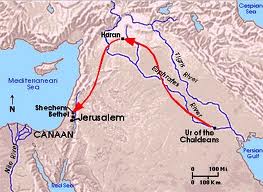
    Abram left the country and city with his father and his family. The journey of over 500 miles to another land along the Euphrates. Terah may have lived in Haran over 100 years, but Haran was no great city as had been Ur. The fertile land around Haran was called Aram-naharaim, which is translated “Mesopotamia”, and refers to the land between the Balikh and Habor rivers. [source]

    Genesis 12:

    Now the Lord said to Abram, “Go from your country and your kindred and your father’s house to the land that I will show you. 2 And I will make of you a great nation, and I will bless you and make your name great, so that you will be a blessing. 3 I will bless those who bless you, and him who dishonors you I will curse, and in you all the families of the earth shall be blessed.”

    4 So Abram went, as the Lord had told him, and Lot went with him. Abram was seventy-five years old when he departed from Haran. 5 And Abram took Sarai his wife, and Lot his brother’s son, and all their possessions that they had gathered, and the people that they had acquired in Haran, and they set out to go to the land of Canaan.

    To be continued…