Tag: agape

  • agapē a fruit of Love from a Higher Branch

    agapē a fruit of Love from a Higher Branch

    Charity (agape)

    This is our chief aim, the unconditional love of the Father given to us through his Son. Affection, friendship and romantic love are each the training ground for charity to grow. It’s also a rival to the three.

    C.S. Lewis – Four Types of Love

    Even with a half-dozen mentions of the agape love including definitions last time, as you can see from Lewis’ quote this is a fruit of a higher UNCONDITIONAL LOVE – a gift of God the Father through Jesus Christ.

    ἀγάπη – agapē

    feminine noun

    The KJV translates Strong’s G26 in the following manner: love (86x), charity (28x), dear (1x), charitably (with G2596) (1x), feasts of charity (1x).

    From ἀγαπάω (G25)


    We also followed a relational connection between some of ‘The 4 Loves’ last time, but let’s see some of the connecting branches of the love agape as well.

    ἀγαπάω (G25) – agapaō

    verb

    The KJV translates Strong’s G25 in the following manner: love (135x), beloved (7x).

    You may say, ‘God is love,’ a use of agape as a noun; but the relational verb for loveagapaō requires an action of personal relationship.

    The one who does not love does not know God, because God is love.

    First Letter of the Apostle John 4:8 LSB


    a LOVE of persons OR of things

    • of persons
      • to welcome, to entertain, to be fond of, to love dearly
    • of things
      • to be well pleased, to be contented at or with a thing
    Lewis also cautions that these could become idolatry as well, rather than the intended love of God the Father through His only Son Jesus Christ. 

    Root Word (Etymology)
    Perhaps from agan (much) [or cf φιλέω (G5368) phileō, also a verb to love or to kiss ]

    Greet all the brothers with a holy kiss.

    the Apostle Paul writing to the churches

    or

    Greet one another with a kiss of love.

    the Apostle Peter writing to the churches

    The KJV translates Strong’s G5384 in the following manner: friend (29x).

    Greater love hath no man than this, that a man lay down his life for his friends.

    Gospel of John 15:13 KJV

    How would you describe your LOVE for a friend?

    Agape embraces another with affection like no other love.


    ἀγαπητός – agapētos

    the adjective from From ἀγαπάω (G25) agape

    Strong's Number G27 matches the Greek ἀγαπητός (agapētos), which occurs 61 times in 60 verses in the MGNT Greek.

    Outline of Biblical Usage

    beloved, esteemed, dear, favourite, worthy of love

    God the Father, Jesus and all the Apostles use it. 

    Peter, for example:

    Therefore, beloved G27, since you are looking for these things, be diligent to be found by Him in peace, spotless and blameless, and consider the patience of our Lord as salvation, just as also our beloved G27 brother Paul, according to the wisdom given him, wrote to you, \

    2 Peter:3:14-15 LSB

    And the Apostle Paul in several epistles: 

    I do not write these things to shame you, but to admonish you as my beloved G27 children.

    Therefore, my beloved G27, flee from idolatry.

    Therefore, my beloved G27 brothers, be steadfast, immovable, always abounding in the work of the Lord, knowing that your labor is not in vain in the Lord.

    1 Corinthians 4:14, 10:14, 15:58 LSB

    For the Love of God [O.T.]

    And recalling love from the Scriptural roots of Jesus and the Apostles in the Hebrew Bible: 

    A song. A psalm of David.

    (WLC 108:5)כִּי־גָדוֹל מֵעַל־שָׁמַיִם חַסְדֶּךָ וְעַד־שְׁחָקִים אֲמִתֶּךָ׃

    For your faithful love is higher than the heavens,

    and your faithfulness reaches to the clouds.

    Psalm 108:6 CSB

    Yet from the root word חֶסֶד
    ḥeseḏ:

    For Your lovingkindness is great above the heavens,
    And Your truth reaches to the skies.

    Ps 108:6 NASB95

    For Your mercy is great above the heavens,
    And Your truth reaches to the clouds.

    Ps 108:6 NKJV

    Do you see the high relational LOVE between God the Father, Jesus the Son and those who in and by the Spirit love the Lord?

    Mercy, Lovingkindness and agape love cannot be simply jargon among those saints saved in Christ Jesus.


    agapētos agapaō .. agapē

    Finally, your search for LOVE in New Testament Greek will draw you to one holy Scripture penned in a letter of the one Jesus loved. 

    ἀγαπητοί ἀγαπῶμεν ἀλλήλους ὅτι ἡ ἀγάπη ἐκ τοῦ θεοῦ ἐστιν καὶ πᾶς ὁ ἀγαπῶν ἐκ τοῦ θεοῦ γεγέννηται καὶ γινώσκει τὸν θεόν

    Α΄ Ιωάννη (1 John) 4 :: Morphological Greek New Testament (MGNT)

    It's all Greek to me too, so let me help you out. 

    Beloved

    Strong’s G27agapētos From ἀγαπάω agapaō (G25)

    let us love

    g25 agapaō

    one another,

    allēlōn

    for love

    hoti agapē (G26)

    is from God;

    eimi ek θεός theos

    and everyone who loves

    kai pas ho agapaō (G25)

    has been [begotten] born of God

    gennaō ek θεός theos

    and knows God.

    kai ginōskō θεός theos

    1 John 4:7 LSB

    INTERLINEAR MORPHOLOGICAL Greek New Testament


    Questions of Agape Love

    source: BibleHub.com STUDY Questions

    Beloved,

    In what ways can you demonstrate “agape” love to those in your church community this week?

    And, dear friend, here's one to make it yet more personal

    How does the command to love one another serve as evidence of being “born of God” in your personal spiritual journey?

    more from 1 John 4:7 study


    Talk of JESUS . com

    Comment on Scripture – Share the Gospel

  • All you need is Love Love Love

    All you need is Love Love Love

    Or should I say, Love, love, love, love perhaps four times?

    (As just a bit earlier than the Beatles another Englishman, Clive Staples, pointed out 4 loves — each at least somewhat different from the others?)

    Christians throw around the LOVE jargon rather vaguely and with much overlap (as does the world).

    For God so loved the world, that he gave his only begotten Son, that whosoever believeth in him should not perish, but have everlasting life. JOHN 3:16 green man
    For God so loved the world.. John 3:16
    • The word, “Love” occurs over 500 times in the Bible
    • translated more than 200 times from New Testament Greek into the English Standard Version

    Let’s have some Biblical intercourse about the real definitions of the Biblical loves to which C.S. Lewis referred.

    The Four Loves

    C.S. Lewis, born just a couple of years before my grandfathers, capitalized on this in his popular RADIO program and published a book called THE FOUR LOVES in A..D. 1960 (when I was only ten and John Lennon was just twenty).


    To outline Lewis’ approach briefly:

    The Four Loves was Lewis’ look at some of the different loves described in Greek thought: familial or affectionate love (storge); friendship (philia); romantic love (eros); and spiritual love (agape) in the light of Christian commentary on ordinate loves.

    Source: C.S. Lewis.org

    Although in A.D. 1960 Lewis began elsewhere, today let’s start with the world’s contemporary favorite:

    Eros – ἔρως

    Eros is the Greek term for romantic or passionate love. While the word itself is not used in the New Testament, the concept is present in the biblical understanding of marriage and the intimate relationship between husband and wife. Eros is seen as a gift from God, intended to be expressed within the covenant of marriage.

    The Song of Solomon [O.T.] is often cited as a biblical celebration of eros, highlighting the beauty and intensity of romantic love.

    Source: Biblehub.com

    Affection (storge)

    Affection covers an array of loves. Like animals, the care of mother to babe is a picture of affection. It relies on the expected and the familiar. Lewis describes it as humble.

    It’s the familiarity of, “the people with whom you are thrown together in the family, the college, the mess, the ship, the religious house,” says Lewis.

    Source: Biblehub.com

    My long search for affection in the Bible

    I do not mean affection literally (in English), but a Greek word for affection, STORGE.

    God blessed me with an additional embrace of His Personal and mysterious, complex love for us through searching aimlessly for love in the Bible. Only after researching further in other commentaries did I connect this word of affection with the Lord’s additional loves we experience so personally.

    God’s affection in the Person of His only Son JESUS was there all along and I had missed it.

    Roger@TalkofJesus.com

    ..says Lewis. The affection for the people always around us, in the normal day-to-day of life, is the majority of the love we experience, even if we don’t label it.

    ‘Be devoted to one another in love. Honor one another above yourselves.’
    had jumped out to me in the NIV

    But in addition to our affection meaning devoted, when Paul writes to the Romans, the word the Apostle uses here for love obviously applies to brotherly love – philadelphia.

    I also liked his mention to ‘honor‘ each other above your SELF.

    Seems familiar to JESUS’ second summary point from the Commandments. LOVE actually appears in BOTH of these commandments cited by our Lord:

    Jesus said to him,

    “‘You shall love the Lord your God with all your heart, with all your soul, and with all your mind.’ This is the first and great commandment.
    And the second is like it:
    You shall love your neighbor as yourself.’
    On these two commandments hang all the Law and the Prophets.”

    Matthew 22:37-40 NKJV

    What is the greatest love?

    ἀγαπάω – agapaō

    *Thou shalt love kyrios thy theos.

    pillar of fire in the midst of Moses and the Hebrews

    Do we not hold FEAR rather than embrace the LORD our theos as a pillar of fire?

    But what about the Lord Jesus’ second commandment (which we often claim as our ‘GOLDEN RULE?’

    And the second is like unto it, Thou shalt love thy neighbour as thyself.

    Gospel of Matthew 22:39 KJV

    ἀγαπάω – agapaō

    *Thou shalt love thy plēsion [neighbour]…

    The Lord seems to mention others as at least equal to our need for self-love, if not more honor as Paul suggests in writing to the Church in Rome. 

    This LOVE is the SAME Love, that is: agapaō !

    Storge – Other Loves plus Devotion

    Although the specific term storge is not used in the New Testament, the concept is evident in passages that emphasize family relationships and responsibilities. Romans 12:10 


    φιλόστοργος – philostorgos – adjective

    a Greek conjunction PHILO plus STORGOS - Do you see both LOVES?

    And look at its definition:

    1. the mutual love of parents and children and wives and husbands
    2. loving affection, prone to love, loving tenderly
      • chiefly of the reciprocal tenderness of parents and children
    Which brings us to a third love C.S. Lewis highlights:

    Philia (φιλία)

    Friendship is the love dismissed.

    “To the Ancients, Friendship seemed the happiest and most fully human of all loves,”

    says Lewis,

    “the crown of life and the school of virtue.

    And at this writing in ~ A.D. 1958 or 1960 Lewis laments of such philos friendships: 

    The modern world, in comparison, ignores it.” Why?

    Perhaps we know it’s the most time consuming, the least celebrated, the one we could live without.

    Can we?

    Even in 2025 Common Era time-crunching christian church gatherings pressed to entertain all sinners in these last days?


    Discovering Phila-Delphia

    philadelphosStrong’s G5361

    a Christian loving Christians

    YES, it’s a great adjective describing the relational fruit of Biblical Christians.

    From φίλος (G5384) and ἀδελφός (G80)

    φίλος – Strong’s G5384philos

    Adjective

    Here's HALF of the Phila Delphia ANSWER. Read on and I'll get to the other HALF later. 

    †φίλος phílos, fee’-los; properly, dear, i.e. a friend; actively, fond, i.e. friendly (still as a noun, an associate, neighbor, etc.):—friend.

    “Greater love has no one than this, that one lay down his life for his friends  G5384.

    “You are My friends  G5384 if you do what I command you.

    Jesus Christ, from the Good News of John 15:13-14 LSB

    JESUS, the Son of Man and Son of God EMBRACES His disciples as close friends.

    And you may have guessed it: 
    The relational word the beloved Apostle John uses here for LOVE is agapē.

    φιλέω – Strong’s G5368 – phileō

    a verb with similar meaning that we won’t want to miss

    1. to love
      • to approve of
      • to like
      • sanction
      • to treat affectionately or kindly, to welcome, befriend
    2. to show signs of love
      • to kiss
    3. to be fond of doing
      • be wont [an accustomed familiarity], use to do

    Perhaps the most convicting encounter with JESUS using this word phileō for LOVE occurs in His most personal encounter with the Apostle Peter after our Lord’s resurrection.

    Here’s an excerpt:

    “Simon, son of John, do you love Me more than these?”

    He said to Him, “Yes, Lord; You know that I love G5368 You.”

    “Simon, son of John, do you love Me?”

    He said to Him, “Yes, Lord; You know that I love G5368 You.”

    He said to him the third time, “Simon, son of John, do you love G5368 Me?”


    Now returning to our compound Greek word for Philadelphia we must consider one additional connection of LOVE:

    • philadelphosStrong’s G5361
      • From φίλος (G5384) and ἀδελφός (G80)

    ἀδελφός – Strong’s G80 – adelphos

    masculine noun — From ἄλφα (G1) (as a connective particle) and delphus (the womb)

    1. a brother, whether born of the same two parents or only of the same father or mother
    2. having the same national ancestor, belonging to the same people, or countryman
    3. any fellow or man
    4. a fellow believer, united to another by the bond of affection
    5. an associate in employment or office
    6. brethren in Christ
      • his brothers by blood
      • all men
      • apostles
      • Christians, as those who are exalted to the same heavenly place

    ἄλφαStrong’s G1 – alpha

    You've probably already guessed it and why this Greek word was designated as 'G1' in the Strong's concordance. 

    indeclinable noun – Of Hebrew origin


    “I am the Alpha G1 and the Omega,” says the Lord God, “who is and who was and who is to come, the Almighty.”

    The Revelation of Jesus Christ to John 1:8

    “I am the Alpha G1 and the Omega, THE FIRST AND THE LAST, the beginning and the end.”

    The Revelation of Jesus Christ to John 22:13 LSB


    Talk of JESUS . com

    Comment on Scripture – Share the Gospel


  • A First Letter to the Corinthians Intro

    A First Letter to the Corinthians Intro

    in the year of our Lord ano Domini 55 [A.D. 55]

    & in the context of the culture of Corinth


    Intro

    PREVIOUSLY in this Talk of Jesus series from CHURCH LETTERS - IS HE WRITING TO ME? we have glanced at a few of Paul's LETTERS (Epistles) to the Church written during his just completed missionary journeys. 

    TODAY we continue with a brief look back at more letters already sent to the churches.
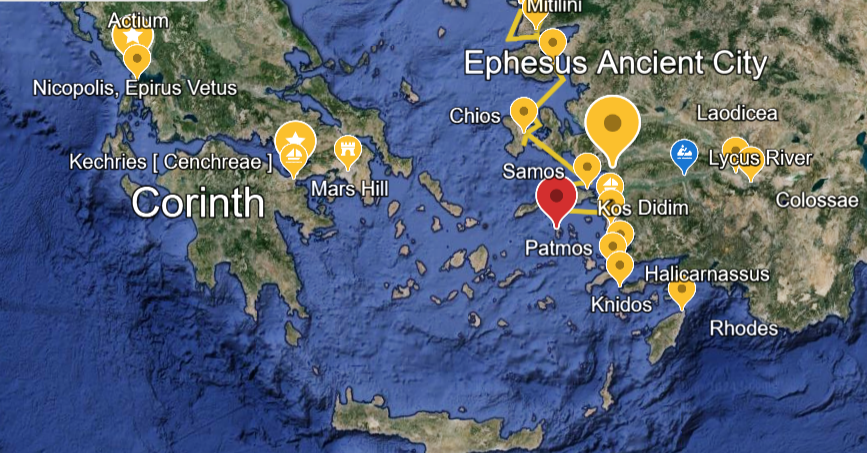
    And God wrought special miracles by the hands of Paul: Acts 19:11 ASV graphic map of Third Missionary Journey of Paul

    WHAT THE CHURCH HAS READ SO FAR:

    Just a reminder that all dates from reliable sources may vary but are used for chronological context only.
    • A.D. 49 – JAMES, the half-brother of Jesus and leader of the church in Jerusalem writes his LETTER
      • James also sends out a letter to the churches concerning gentiles from the Council in Jerusalem.
    • A.D. 49 – Paul writes his letter to the Galatians (actually, several new churches in Galatia)
    • A.D. 50 – 1 THESSALONIANS
    • A.D. 51 – 2 THESSALONIANS

    • during the A.D. 50’s or A.D. 60’s (actual date unknown) – The GOSPEL OF MARK

    1:1 Ἀρχὴ τοῦ εὐαγγελίου Ἰησοῦ Χριστοῦ υἱοῦ τοῦ θεοῦ

    The beginning of the gospel of Jesus Christ, the Son of God – Mark 1:1

    Consider the possibility that parts of the Gospel of John Mark, who had accompanied his uncle Barnabas and the Apostle Paul to Cypress, MAY HAVE been known even in Corinth where Paul has already travelled and whose FIRST LETTER we are about to examine.

    The GREAT COMMISSION of JESUS CHRIST to the CHURCH is recorded in the Gospel of Mark 16:15

    view of earth from moon

    1 Corinthians:

    This epistle was most likely written in the first half of A.D. 55 from Ephesus (16:8, 9, 19) while Paul was on his third missionary journey. The apostle intended to remain on at Ephesus to complete his 3 year stay (Acts 20:31) until Pentecost (May/June) A.D. 55 (16:8). Then he hoped to winter (A.D. 55–56) at Corinth (16:6; Acts 20:2). His departure for Corinth was anticipated even as he wrote (4:19; 11:34; 16:8).

    John MacArthur :: Bible Introductions – 1 Corinthians

    Paulus vocatus apostolus Christi Iesu per voluntatem Dei et Sosthenes frater

    1 Corinthios (1 Corinthians) 1 :: Latin Vulgate (VUL)

    in the context of the culture of Corinth

    CORINTH, ACHAIA is ROMAN; not Macedonian (as in the former Empire of Alexander the Great).

    Neither is the large city of Corinth simply Greek, as in ‘ancient Greece’ with ancient Athens whose glory had long ago been reduced to ruins.

    In 146 BC, the battle of Corinth signified a defining moment in the history of ancient Greece. Situated on the narrow strip of land connecting the Peloponnese to the mainland of Greece, Corinth was a city-state with a significant strategic and economic position.

    source:

    The language of Greek (thanks to the Great Macedonian Alexander) has become the international language of the Roman Empire.

    So in Corinth, Philippi, Ephesus, Antioch and even in Jerusalem the GOOD NEWS and Epistles [Letters] typically were written and read in GREEK.

    Παῦλος κλητὸς ἀπόστολος Ἰησοῦ Χριστοῦ διὰ θελήματος θεοῦ καὶ Σωσθένης ὁ ἀδελφός

    Α΄ Κορινθίους (1 Corinthians) 1 :: Textus Receptus (TR)

    Paulos klētos apostolos Jēsous Christos dia thelēma theos kai Sōsthenēs ho adelphos;

    To the church of God which is at Corinth,

    to those who are sanctified in Christ Jesus, called to be saints,

    with all who in every place call on the name of Jesus Christ our Lord, both theirs and ours:

    1 Corinthians 1:2 NKJV

    Here in CORINTH we immediately read the opening of Paul’s Epistle written in Greek to the CHURCH, beginning with the Apostle’s universal greeting to ALL and specifically to the saints separated to the calling of Christ Jesus our Lord.

    Paul had been there and wrote back to encourage these Christians in Corinth.

    See if this A.D. first century city of CORINTH sounds vaguely familiar to any city of destruction in our 21st century the Common Era.


    Once again, the commentary of John Macarthur on the culture of Corinth.

    Even by the pagan standards of its own culture, Corinth became so morally corrupt that its very name became synonymous with debauchery and moral depravity.

    To “corinthianize” came to represent gross immorality and drunken debauchery. In 6:9, 10, Paul lists some of the specific sins for which the city was noted and which formerly had characterized many believers in the church there.

    Tragically, some of the worst sins were still found among some church members.

    John Macarthur Commentary – the Background and Setting of Corinth

    Here the Apostle writes to a chosen few SAVED from the surrounding sinful culture of CORINTH (and most every other city in their culturally correct Roman Empire) in a CHURCH separated in worship yet living and working with all of those destined to the wrath of God’s punishment.

    These Corinthian Christians were taught and sought to live in complete contrast to sinful lifestyles hopefully left behind. 

    Later in his letter Paul will describe their love [ ἀγάπη ] more fully.

    1 Corinthians 13:4-8a on LOVE of the Christian who follows Jesus Christ

    Although some contemporary Christians include parts of Paul’s list of LOVE in ceremonies of Christian marriage, the love of which Paul writes is not romantic or specifically marital in any way.

    These CORINTHIANS were recognized in the city for their uniquely personal LOVE –

    ἀγάπη – agapē love,

    sometimes translated as CHARITY for each other and for others.


    Their agapē LOVE stood against a CULTURE OF SIN characterized in acorinthianizedcity, fallen nation or evil empire.


    Paul later writes what he knows of their Corinthian challenges warning:

    Or do you not know that the unrighteous will not inherit the kingdom of God?

    Do not be deceived; 

    .. neither the sexually immoral, nor idolaters, nor adulterers, nor effeminate, nor homosexuals, nor thieves, nor the greedy, nor drunkards, nor revilers, nor swindlers, will inherit the kingdom of God.

    And such were some of you…

    1 Corinthians 6:9-11 excerpt LSB

    Starting with Encouragement

    Paul begins his Epistle with an agape-rooted encouragement.

    Grace to you and peace from God our Father and the Lord Jesus Christ.

    Grace, for which Christians should be so well recognized, written χάρις in Greek charis is:

    • that which affords joy, pleasure, delight, sweetness, charm, loveliness: grace of speech
    • good will, loving-kindness, favour
    • of the merciful kindness by which God, exerting his holy influence upon souls, turns them to Christ, keeps, strengthens, increases them in Christian faith, knowledge, affection, and kindles them to the exercise of the Christian virtues
    CAN YOU THINK OF ANY GREETING WHICH ENCOURAGES MORE THAN 'GRACE?'

    I thank my God always concerning you for the grace of God which was given you in Christ Jesus, that in everything you were enriched in Him, in all word and all knowledge,
    even as the witness about Christ was confirmed in you, so that you are not lacking in any gift, eagerly awaiting the revelation of our Lord Jesus Christ, who will also confirm you to the end, beyond reproach in the day of our Lord Jesus Christ.

    Paul practically embraces these Corinthian believers in a personal prayer written for them.

    Could any introduction of LOVE and Grace be more encouraging?

    God is faithful, through whom you were called into fellowship with His Son, Jesus Christ our Lord.

    Paul’s first letter to the Corinthians 1:9 LSB [in context of 1:3-9]
    Theos is faithful, through Whom you were kaleō into koinōnia with His Son Ἰησοῦς Χριστός [iēsous christos] our kyrios.

    *Linked definitions of GREEK words from 1 Corinthians 1:9 from BlueLetterBible.org

    Reintroducing our Lord

    Paul begins his letter to a beloved church in a city caught-up in the sins of SELF and worshipping multiple gods of ME with encouragement in the Lord Jesus Christ.

    In the Apostle Paul’s two Epistles to the Corinthians he uses:

    • iēsous – 45x
    • christos – 111x
    • kyrios – 95x
    • θεόςtheos – an amazing 185x
    - king - only once in his second letter & not referring to Jesus
    - prophet - prophētēs - only once but referring to gifts of the saints
    - priest not at all in writing to the Corinthians

    TO:

    THOSE WHO HAVE BEEN SANCTIFIED ἁγιάζω – hagiazō – Paul uses this four times in this letter.

    Are YOU sanctified?

    ἅγιοςagios – sacred (physically, pure, morally blameless or religious, ceremonially, consecrated):—(most) holy (one, thing), saint.

    That’s what the apostle of Jesus Christ by the will of God asks the church of God which is at Corinth.

    (It's a good question for those claiming Jesus Christ facing a refining and sanctification of our sinful mortal flesh.)

    The Apostle Paul refers to the church as SAINTS, a most holy thing, TWENTY TIMES in his epistles to the Corinthians including his encouragement of the church in this introduction.

    To the church of God in Corinth, to those sanctified in Christ Jesus and called to be his holy people, together with all those everywhere who call on the name of our Lord Jesus Christ—their Lord and ours:

    τῇ ἐκκλησίᾳ τοῦ θεοῦ τῇ οὔσῃ ἐν Κορίνθῳ ἡγιασμένοις ἐν Χριστῷ Ἰησοῦ κλητοῖς ἁγίοις σὺν πᾶσιν τοῖς ἐπικαλουμένοις τὸ ὄνομα τοῦ κυρίου ἡμῶν Ἰησοῦ Χριστοῦ ἐν παντὶ τόπῳ αὐτῶν τε καὶ ἡμῶν·
    1 Corinthians 1:2 NIV, TR –

    The Apostle Paul has many more things to write to the Corinthians (and to you, God-willing).

    To be continued…

    Talk of JESUS . com

    Comment on Scripture – Share the Gospel