Tag: angel

  • Gardener, Shepherd and Hunter: 7 Scenes Unseen by Man

    Gardener, Shepherd and Hunter: 7 Scenes Unseen by Man

    ACT 2 – Scene 1 – in an unseen place


    Where am I?

    I have brought you to a place unseen by man.

    You showed me a scene I had never seen of the death of Abel.. and Eve mourning the loss of her son murdered by her other son… and about sin in Eden. Was this story of Moses true?

    I have shown you scenes revealed to Moses from near the beginning of time. His story was true, though Moses was not there.

    Tell me, why did Moses leave Egypt?

     By faith Moses, when he had grown up, refused to be called the son of Pharaoh’s daughter..

    [Click here to read NASB in context]

    Hebrews 11:24

    By faith he left Egypt, not fearing the wrath of the king; for he persevered, as though seeing Him who is unseen.

    Hebrews 11:27 NASB

    Moses was sort of a shepherd then, wasn’t he?

    Yes, in a sense.. But a later shepherd led his followers to the right answer from Scripture to your question. Do you recall what David said?

    מִזְמוֹר לְדָוִד יְהוָה רֹעִי לֹא אֶחְסָֽר׃

    The LORD is my shepherd; I shall not want.

    Moses followed the unseen Shepherd as he led the Hebrews from slavery in Egypt.

    So is this place like when you showed me what happened east of Eden?

    These scenes take place in the unseen places above the heavens — or beneath the earth — places connected to the timeline of man yet separate from the mortal life of any one man or woman.

    I don’t think I understand, I thought as my Guide explained unseen places where He has evidently led me.

    Allow me to show you one such unseen scene from around the time of Moses. The actions here impact a righteous man who lived in a different land. But this scene does not take place there.

    Unseen in Uz

    One day the angels [sons of God] came to present themselves before the LORD, and Satan [the adversary] also came with them.

    The LORD said to Satan, “Where have you come from?”

    Satan answered the LORD, “From roaming throughout the earth, going back and forth on it.”

    Job 1:6-7 NIV

    Do you know this story?

    Yes. It’s about Job, who suffers all kinds of evil without knowing why.

    Is Job part of this conversation with the LORD in the unseen place? So who is the main character in this story of Job?

    I knew the obvious answer. Job was clueless about God allowing him to suffer severely for some time.

    Satan.. And didn’t you also say that Moses called him the Serpent?

    You yourself recognized the Serpent as the hunter. And what prey does he hunt?

    Souls! The soul of Cain.. the soul of Eve.. the soul of Adam..

    So too is Satan hissing at God when he calls for evil to tempt Job’s soul toward the pit of darkness.

    So the Serpent’s name is really Satan.

    שָׂטָן

    śāṭānnoun

    superhuman adversary, הַשּׂ׳ :
    a. of Job, one of בְּנֵי אֱלֹהִים Job 1:6, 7 (twice in verse); Job 1:8, 9, 12 (twice in verse); Job 2:1, 2(twice in verse); Job 2:3, 4 (twice in verse); Job 2:6, 7.
    b. of high priest of Israel before י׳, Zechariah 3:1, 2(twice in verse); Greek Version of the LXX. ὁ διάβολος.
    c. as proper name שׂ׳ Satan 1 Chronicles 21:1 (interpret 2 Samuel 24:1), Greek Version of the LXX διάβολος (Greek Version of the LXX σατάν 1 Kings 11:14, 23; Σατανᾶς Matthew 4:10; Mark 1:13; Luke 10:18 + 33 times NT).

    Source- [Lexicon :: Strong’s H7854 – śāṭān

    And as Moses said, this Tempter is cunning; and as a spirit shepherding evil in the unseen places he has many names, sometimes even appearing as a wolf in sheep’s clothing.

    שָׂטַן

    śāṭan – verb

    Outline of Biblical Usage
    (Qal) to be or act as an adversary, resist, oppose

    Strong’s Definitions
    שָׂטַן sâṭan, saw-tan’; a primitive root; to attack, (figuratively) accuse:—(be an) adversary, resist.

    Strong’s Number H7853 matches the Hebrew שָׂטַן (śāṭan), which occurs 6 times in 6 verses in the WLC Hebrew.

    Job seemed helpless; not able to do anything about the evil.

    Satan requested permission from God to contend with him on earth.

    My thoughts and countenance were really quite dejected by now..

    Remember what David said about the valley of the shadow of death? .. It is the place of evil.

    I recalled briefly the Lord’s words to Cain before he murdered Abel.. The LORD cautioned Able BEFORE he turned against his brother and against the LORD who was with him and leading him along the valley of the shadow…

    So how can any man resist evil from these unseen places and remain faithful to the LORD?

    Do you know how David petitioned the LORD when God was angry at him for his sin?

    Just like Moses, I thought, David had murdered a man. He had blood on his hands.. NO LESS THAN CAIN!

    A psalm of David. A petition. NIV

    LORD, do not rebuke me in your anger or discipline me in your wrath.

    Psalm 38:1 NIV

    Some prayers are praises to God who we cannot see, while others are petitions from our place near the valley of the shadow to the unseen place — a place above time and circumstance where the Lord sits on the Throne of justice and the Mercy Seat of redemption.

    Psalm 38 NASB, KJ21, OJB, WLC

    Yᵊhōvâ

    Hashem, rebuke me not in Thy wrath; neither chasten me in Thy hot displeasure.

    2 (3) For Thine khitzim (arrows) pierce me, Thy hand presseth me sorely.

    3 There is no soundness in my flesh, because of Thine anger; neither is there any rest in my bones, because of my sin.

    4 For mine iniquities have gone over mine head; as a heavy burden, they are too heavy for me.

    5 My wounds are foul and corrupt because of my foolishness.

    6 (7) I am bent down; I am brought low

    I go in mourning all day long.
    7 For my sides are filled with burning,
    And there is no healthy part in my flesh.

    8 I am feeble and sorely broken; I have groaned because of the disquiet of my heart.

    David pleads for mercy, confessing his guilty deeds by which he deserves the WRATH OF GOD.. He then bows down to God acknowledging:

    Lord, all my desire is before You;
    And my sighing is not hidden from You.

    I know now after seeing these unseen places that I have NO right to expect anything from God…

    David is quiet before the LORD, then pleaing:

    Yes, I am like a person who does not hear,
    And in whose mouth are no arguments.
    15 For I wait for You, Lord;
    You will answer, Lord my God.

    AND listen to David’s plea to the Judge of all men. Read it:

    (WLC 38:21) וּמְשַׁלְּמֵי רָעָה תַּחַת טוֹבָה יִשְׂטְנוּנִי תַּחַת רדופי־ טֽוֹב׃

    They also that render evil for good are mine adversaries; because I follow the thing that good is.

    Psalm 38:20 KJV

    Eve encountered an adversary opposed to God! As did the first adam and the sons of adam.. Job.. and David.. And yes, so have you. And WHY? David tells us.

    Because those who follow God and do what is good suffer evil by the hand of the adversary of the LORD God lurking in the unseen places. For Satan is an enemy of all Light which overcomes the darkness.

    21 Do not abandon me, Lord;
    My God, do not be far from me!
    22 Hurry to help me,
    Lord, my salvation!


    The light shines in the darkness, and the darkness has not overcome it.

    Gospel of John 1:5 NIV

    The Gardener the Shepherd and the Hunter - Introduction to a story by Roger Harned

    To be continued…

  • He distinctly saw an angel of God

    He distinctly saw an angel of God

     “Cornelius!” the angel said.

    Cornelius stared at him in terror.

    “What is it, sir?” he asked the angel.

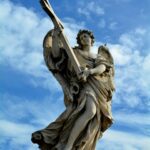
    ACTS 10:4 of angels

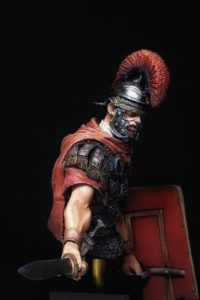
    roman centurion

    Sir, yes Sir!?!

    ACTS 10: of an angel & a Roman warrior

    What an unlikely scene in this new missionary journey of Twelve Jewish Apostles of JESUS the Messiah of Israel.

    Luke records an encounter of a Roman soldier, Cornelius, with an angel of God!

    Previously, we left Peter in Joppa, where the Apostle has just performed another resurrection.

    We will get to Cornelius and then Peter; but TODAY I would like us to consider the role of an angel of God in the mission of the Church.

    A missionary moment with a timeless messenger

    Man, even a prophet or an Apostle, is mortal – spirit adorned in flesh with beating heart tirelessly churning the blood of life from limb to limb.

    We know the nature of a fellow being of dust whom we meet in the street.

    But what of an angel?

    How would you and I react to such an encounter with that which is unlike us – an angel – a living being created of spirit without flesh and bone, an eternal messenger who may appear to mankind only once in many lifetimes?

    What do we really know about angels?

    Angels in art have blurred our view of truth, eternity and the messengers of the Lord our God.

    Roger@TalkofJESUS.com
    • What do YOU think?

    We cannot take time here for an exhaustive quest for God-sent angels or an unveiling of messengers veiled in darkness, but let’s glance at the evidence of angels in the Bible.

    What do you know about them?

    Angels in a Biblical Context

    • Question: What book of the Bible makes the most mentions of an angel (or angels)?
    If you guessed: The Revelation of Jesus Christ to John [51x in the KJV]
    you would be correct. (But that's a scene somewhat challenging for any to get a clear picture of an angel in its usual mission for the Lord.)
    • What about all the angels in Luke’s Gospel announcing Jesus’ birth?
      • Pretty good guess. [15x KJV] But it comes in fifth.
      • Two Old Testament Books come in at #3 and #4.
        • Any guesses? [hint: one is a Prophet]
        • CLICK HERE for that answer [19x]

    • TWO books of the Bible, one in the Old Testament and one in the New Testament, contain the most references (second only to Revelation) to an angel or angels).

    • DO YOU KNOW WHAT THESE TWO BOOKS REFERRING TO ANGELS HAVE IN COMMON?

    Answer:

    History.

    • #3 is Judges
      • & you have probably guessed..
    • #2 is ACTS of the Apostles.
    So before we proceed with our look at an angel bringing messages to Cornelius, Peter and others, let's take a brief glance at what the Bible reveals about these messengers of God.

    מַלְאָךְ

    mal’āḵ – From an unused root meaning to despatch as a deputy

    1. messenger
    2. angel
    3. the theophanic angel

    a messenger; specifically, of God, i.e. an angel (also a prophet, priest or teacher):—ambassador, angel, king, messenger.

    Strong’s H4397 – mal’āḵ

    An angel may be a heavenly being with a message from God.

    BUT a man such as Zechariah (or the Apostle John) may also bring a commanded message and/or a prophetic message of the future from the Lord.

    We see this many times:

    • And the angel H4397 of God spake unto me in a dream, saying, Jacob: And I said, Here am I.
    • And Jacob went on his way, and the angels H4397 of God met him.
    • And Jacob sent messengers H4397 before him to Esau his brother unto the land of Seir, the country of Edom.

    We needn’t debate if these angels of specific instances were men or heavenly beings; the point is that these angels bring a message of God to men and women for whom He cares.

    וַיַּעַל מַלְאַךְ־יְהוָה מִן־הַגִּלְגָּל אֶל־הַבֹּכִים פ וַיֹּאמֶר אַעֲלֶה אֶתְכֶם מִמִּצְרַיִם וָאָבִיא אֶתְכֶם אֶל־הָאָרֶץ אֲשֶׁר נִשְׁבַּעְתִּי לַאֲבֹתֵיכֶם וָאֹמַר לֹֽא־אָפֵר בְּרִיתִי אִתְּכֶם לְעוֹלָֽם׃

    CLICK FOR ENGLISH TRANSLATION FROM HEBREW: Shoftim (Judges) 2:1 :: Westminster Leningrad Codex (WLC)
    Would you like to READ an encounter from the Old Testament between an angel and the parents of Samson?
    CLICK HERE FOR JUDGES 13 CSB with ten references to this angel.

    Angel in the New Testament

    ἄγγελος – angelos

    • The KJV translates Strong’s G32 in the following manner:
      • angel (179x),
      • messenger (7x).

    Thayer’s Greek Lexicon

    STRONGS G32:
    ἄγγελος, -ου, ὁ,

    1. a messenger, envoy, one who is sent: Matthew 11:10; Luke 7:24, 27; Luke 9:52; Mark 1:2; James 2:25. [From Homer down.]
    2. In the Scriptures, both of the Old Testament and of the New Testament, one of that host of heavenly spirits that, according alike to Jewish and Christian opinion, wait upon the monarch of the universe, and are sent by him to earth, now to execute his purposes (Matthew 4:6, 11; Matthew 28:2; Mark 1:13; Luke 16:22; Luke 22:43

    ἄγγελος θεός – angelos theos

    AN ANGEL OF GOD

    Acts 10:3 (and other passages) referenced by Thayer’s Greek Lexicon [above]

    He saw in a vision evidently about the ninth hour of the day an angel of God coming in to him, and saying unto him, Cornelius.

    sent by him to earth, now to execute his purposes

    hence, the frequent expressions ἄγγελος (angel, messenger of God, מַלְאָך) and ἄγγελοι κυρίου or ἄγγελοι τοῦ Θεοῦ.


    They are subject not only to God but also to Christ (Hebrews 1:4ff; 1 Peter 3:22, cf. Ephesians 1:21; Galatians 4:14), who is described as hereafter to return to judgment surrounded by a multitude of them as servants and attendants: Matthew 13:41, 49; Matthew 16:27; Matthew 24:31; Matthew 25:31; 2 Thessalonians 1:7, cf. Jude 1:14.


    Up until now, we have encountered an angel seven times in Acts of the Apostles.

    What is your COMMENT about any similarities and differences between these seven angels we have met so far in ACTS of the Apostles?


    NEXT: Cornelius and the Angel of God

    in ACTS 10: [click for NASB]

  • Philip: Evangelizing Christ’s Sheep Beyond Gaza

    Philip: Evangelizing Christ’s Sheep Beyond Gaza

    How important is Gaza to Philip’s Evangelizing Mission?

    What does Gaza have to do with,

    “Go into all the world and preach the gospel to all creation.” and evangelizing Christ Jesus?

    Quote of Jesus from the Gospel of Mark 16:15

    We’ll talk of JESUS’ evangelism model begun in the Apostles and now a command to Philip, one of Jerusalem’s first seven deacons in a moment. But first let’s review the setting of this semi-familiar scene of Philip baptizing an Ethiopian eunuch in (of all places), Gaza.

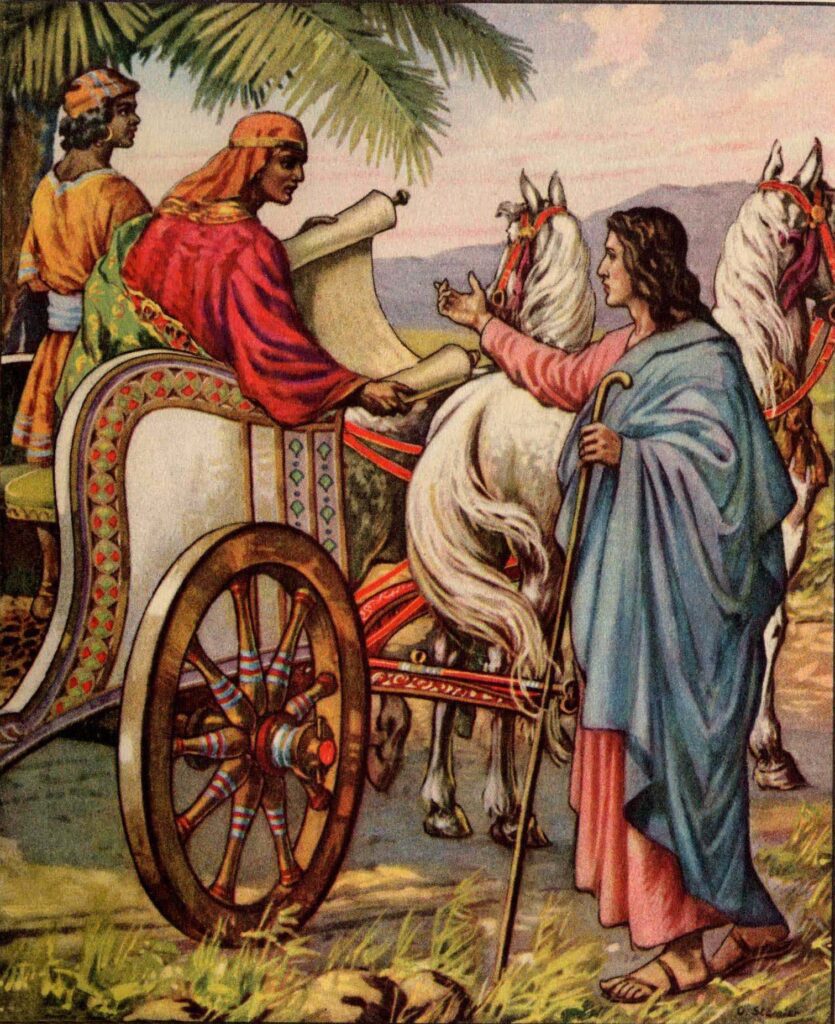
    Philip and the Ethiopian official in his chariot on the road from Jerusalem in Gaza, reading the scroll of Isaiah

    Acts of Evangelism by Christ’s disciples from Jerusalem’s Church

    8: At that time a great persecution arose against the church which was at Jerusalem; and they were all scattered throughout the regions of Judea and Samaria, except the apostles.

    This is Philip who served with Stephen in Jerusalem
    • 4 Therefore those who were scattered went everywhere preaching the word.
    • 5 Then Philip went down to the city of Samaria and preached Christ to them. And the multitudes with one accord heeded the things spoken by Philip, hearing and seeing the miracles which he did.
      • (We will get back to the contrast between Samaria and Gaza in a moment.)
    • The Apostles in Jerusalem sent Peter and John to those evangelizing the towns of Samaria.
    • .. they [Peter & John] returned to Jerusalem, preaching the gospel in many villages of the Samaritans.

    An Angel of the Lord commands Philip: GO to Gaza

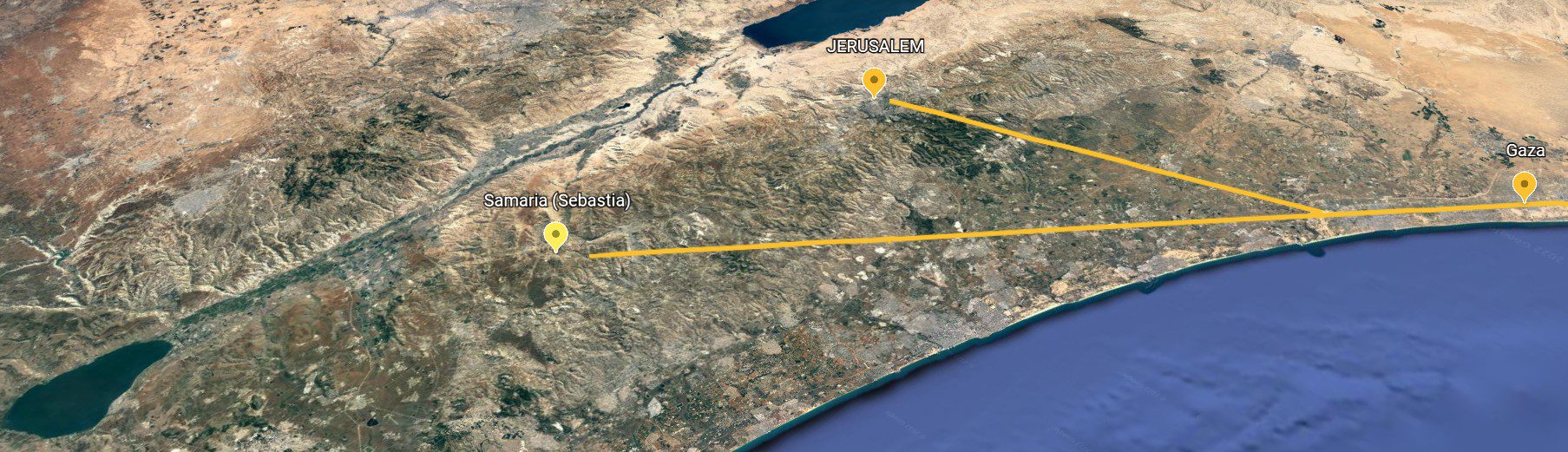
    We don’t want to dismiss too quickly who sends Philip on his way from the big city of Samaria (then called, Sebastia (when rebuilt by Herod the Great) with its six thousand souls, to an uninhabited Gaza along the road from Jerusalem.

    Google Earth view of Gaza and terrain from the mountains of Judea and Jerusalem
    Two routes to the Gaza road along the Mediterranean shore

    Luke does not use this description of just anyone.

    • Now an angel of the Lord appeared to him, standing to the right of the altar of incense. Zechariah [Priest of the LORD and father of John the Baptist] was troubled when he saw the angel, and fear gripped him. – Gospel of Luke 1:11-12
    • And an angel of the Lord suddenly stood near them, and the glory of the Lord shone around them; and they were terribly frightened. – Gospel of Luke 2:9 – from the nativity of the shepherds near Bethlehem .. (also not too far from here)

    We know these instances well; however in Luke’s second account of the Acts of the Apostles the Angel of the Lord initiates some important ACTS of disciples of the Risen Christ Jesus.

    Previously, our history of the Apostles imprisoned in Jerusalem has already witnessed one of these appearances of the Angel of the Lord. A praying church is astounded to see Peter and John released from prison and then returning to the Temple to preach the Gospel.

    They laid hands on the apostles and put them in a public prison. But during the night an angel of the Lord opened the gates of the prison, and leading them out, he said, “Go, stand and speak to the people in the temple area the whole message of this Life.”

    Acts of the Apostles 5:18-20 NASB20

    Philip Goes to Gaza – ACTS 8

    But an angel of the Lord spoke to Philip, saying,

    “Get ready and go south to the road that descends from Jerusalem to Gaza.” (This is a desert road.)

    Acts of Philip, disciple of the Apostles, 8:26 NASB20

    27 So he started out, and he met the treasurer of Ethiopia, a eunuch of great authority under the Kandake, the queen of Ethiopia. The eunuch had gone to Jerusalem to worship, and he was now returning.

    Seated in his carriage, he was reading aloud from the book of the prophet Isaiah.

    The Kandake, Queen of Ethiopia

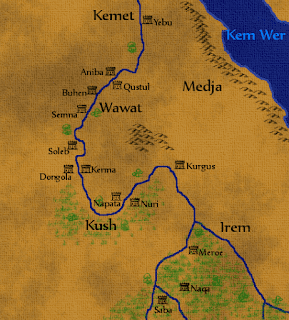
    Nubia is a region along the Nile river encompassing the area between Aswan in southern Egypt and Khartoum in central Sudan. It was the seat of one of the earliest civilizations of ancient Africa, with a history that can be traced from at least 2500 BC onward, Kerma culture, and was home to several empires, most prominently the kingdom of Kush, which for a while even ruled over Egypt.

    Amanitaraqide appears to be the subject of a brief reference in the New Testament (Acts 8:27)

    Amanitaraqide held the title of Kandake in the Kingdom of Kush during the years 21-41

    Source – Wikipedia

    Nubia is a region along the Nile river encompassing the area between Aswan in southern Egypt and Khartoum in central Sudan. It was the seat of one of the earliest civilizations of ancient Africa, with a history that can be traced from at least 2500 BC onward, Kerma culture, and was home to several empires, most prominently the kingdom of Kush, which for a while even ruled over Egypt. 
    
    Before the 4th century, and throughout classical antiquity, Nubia was known as Kush, or, in Classical Greek usage, included under the name Ethiopia (Aithiopia).
    
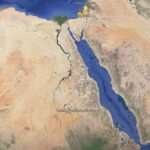
    [MAP above of this region along the Nile & descriptions: Source] 

    Αἰθίοψ – Ethiopian = “black”


    The eunuch, wearing expensive robes of a court official, rides in a royal chariot (reserved for only the highest officials of Rome and independent powerful kingdoms), would seem unapproachable by an ordinary man like Philip. For it seems this royal official would have been in Jerusalem on some important diplomatic mission as the queen’s personal representative.

    If you think back to the status of Daniel in Babylon or even further back to this region of the Nile and the earned status of Joseph serving Pharaoh, you will get a good picture of the importance of this man to the highest leaders of his country.

    Even in this A.D. 21st century most men like Philip (and you) would know very little about this distant country in Africa far from Jerusalem and further from Rome and the new world beyond the great ocean.

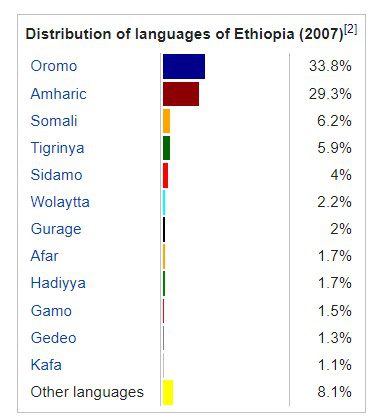
    Ethiopia, like many lands, must hear the Gospel in many languages.

    Graphic source: Oromo Bible Society
    O land, land, land, hear the word of the LORD!


    No, the Ethiopian court official is not like Philip.

    As a diplomat with power to travel the world on behalf of his queen, he will play an important role in the spreading of the Gospel. So after Philip obediently travels to Gaza, he discovers that this man is a brother, a Jew who studies Scripture! And here in Gaza he is returning home to Kush from worship of the LORD in Jerusalem.

    (That’s right, the same Jerusalem from which Philip has fled; initially north to the city of Samaria, but now southwest of Jerusalem into the desert lands of Gaza.)

    Studying Isaiah with a ‘missionary’ to Gaza

    ACTS 8:

    29 Then the Spirit said to Philip, “Go near and overtake this chariot.”

    (Philip is on foot and has walked this distance from Samaria, but this is now a second command of the Spirit as he reaches the Gaza road.)

    30 So Philip ran to him, and heard him reading the prophet Isaiah

    30 وَعِنْدَمَا رَكَضَ فِيلِبُّسُ إلَى العَرَبَةِ، سَمِعَ الرَّجُلَ يَقْرَأُ كِتَابَ النَّبِيِّ إشَعْيَاءَ. فَقَالَ لَهُ فِيلِبُّسُ:

    ﻋﻤﺎﻝ ﺍﻟﺮﺳﻞ 8:30
    Arabic Bible: Easy-to-Read Version

    “Do you understand what you are reading?”

    31 The man replied, “How can I, unless someone instructs me?” And he urged Philip to come up into the carriage and sit with him.

    Negev in southern Israel, Gaza and some areas near the Dead Sea are very barren places away from the towns and settlements

    Philip traveled in style for a while as they read.

    Now the passage of Scripture which he was reading was this:

    Isaiah

    נִגַּשׂ וְהוּא נַעֲנֶה וְלֹא יִפְתַּח־פִּיו כַּשֶּׂה לַטֶּבַח יוּבָל וּכְרָחֵל לִפְנֵי גֹזְזֶיהָ נֶאֱלָמָה וְלֹא יִפְתַּח פִּֽיו׃

    מֵעֹצֶר וּמִמִּשְׁפָּט לֻקָּח וְאֶת־דּוֹרוֹ מִי יְשׂוֹחֵחַ כִּי נִגְזַר מֵאֶרֶץ חַיִּים מִפֶּשַׁע עַמִּי נֶגַע לָֽמוֹ׃

    Masoretic Text Isaiah 53:7-8, quoted in ACTS 8:32-33
    Or perhaps the Ethiopian official traveling from Jerusalem through Gaza back to Egypt would have held a Septuagint translation of the Hebrew Bible into Greek. ..dated to the reign of Ptolemy II of Egypt (285-246 BC).. 
    (READ more about ancient Egypt and Ethiopia from Source link: biblearchaeology.org)

    πάντες ὡς πρόβατα ἐπλανήθημεν ἄνθρωπος τῇ ὁδῷ αὐτοῦ ἐπλανήθη καὶ κύριος παρέδωκεν αὐτὸν ταῗς ἁμαρτίαις ἡμῶν

    Yeshaiya (Isaiah) 53:6 :: Septuagint (LXX)

    In reading all of Isaiah 53 he would have just read in verse 6:

    All we like sheep have gone astray; 
    we have turned every one to his own way; 
    and the LORD hath laid on him the iniquity of us all. [KJV]

    34 So the eunuch answered Philip and said, “I ask you, of whom does the prophet say this, of himself or of some other man?”

    35 Then Philip opened his mouth, and beginning at this Scripture, preached Jesus to him.


    Our chariot journey with Philip and the Ethiopian eunuch, to be continued..