Tag: antichrist

  • 2 John – the Doctrine of Christ

    2 John – the Doctrine of Christ

    The Shortest Book in the Bible

    Today we are going to READ the New Testament’s shortest letter. It is written by the beloved Apostle John near the end of the first century A.D.

    Once you have read it, we will then take a look at WHY the Elder wrote it and how to heed John’s warnings to those joined to Christ’s Church.

    2 John


    I rejoiced greatly that I found of thy children walking in truth, as we have received a commandment from the Father. And now I beseech thee, lady, not as though I wrote a new commandment unto thee, but that which we had from the beginning, that we love one another. And this is love, that we walk after his commandments.

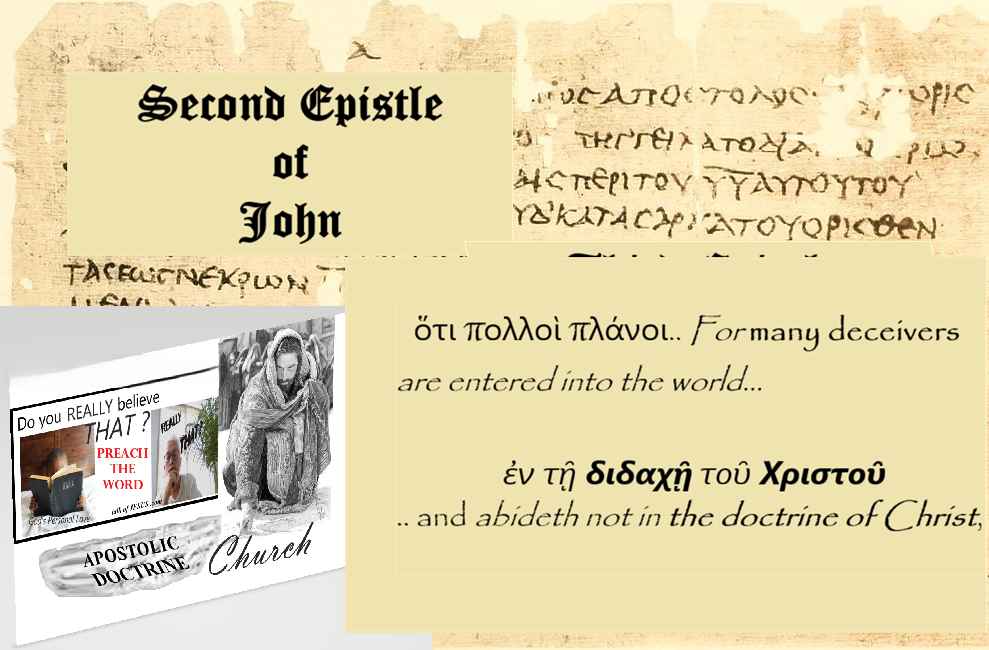
    This is the commandment That, as ye have heard from the beginning, ye should walk in it. For many deceivers are entered into the world, who confess not that Jesus Christ is come in the flesh.

    This is a deceiver and an antichrist.

    Look to yourselves, that we lose not those things which we have wrought, but that we receive a full reward. Whosoever transgresseth, and abideth not in the doctrine of Christ, hath not God.

    He that abideth in the doctrine of Christ, he hath both the Father and the Son.

    If there come any unto you, and bring not this doctrine, receive him not into your house, neither bid him God speed: for he that biddeth him God speed is partaker of his evil deeds.

    Having many things to write unto you, I would not write with paper and ink: but I trust to come unto you, and speak face to face, that our joy may be full.

    The children of thy elect sister greet thee. Amen.

    2 John

    Authorized King James Version


    The DOCTRINE of CHRIST – a line in the sand

    John writes a brief note of less than 300 words in the common Greek of the first century Roman Empire on a single piece of papyrus sometime near the year of our Lord ninety-five (A.D. 90-95) in lieu of a personal visit the aging Apostle intends.

    It appears that the great purpose of II John was to warn the believers not to give indiscriminate hospitality to strangers or traveling evangelist-teachers. Those who did not meet the sure test of sound doctrine were to be refused hastily.

    King James Bible commentary 2-3 John p.1763

    Do you REALLY believe THAT? PREACH THE WORD APOSTOLIC DOCTRINE Church

    He who abides in the doctrine of Christ has both the Father and the Son.

    2 John v.9

    The URGENT WARNING of this last living Apostle of Jesus Christ is both clear and relevant to leaders of the Church up to this day.

    The Second Epistle of John cautions against hospitality or the receiving of heretics.

    As the Apostle emphasized in his earlier letter to the Church, the mystical approach of some antichrists, namely Gnostics, opposed the truth of Scripture and the incarnation of God in the Person of JESUS Christ, His suffering and crucifixion and especially the Lord’s resurrection IN THE BODY and ascension into heaven until Jesus’ return at the last day.

    The Elder’s purpose in writing is to urge the faithful to REJECT false gospels, false philosophies cloaked in christian garments and especially to send away FALSE teachers.

    3 Letters from the Apostle John


    The Elect Lady

    Theologians may debate a small point of who ‘the elect lady’ is.

    The “elect lady and her children,” addressed in verse 1, are taken by most interpreters to mean a church and her members.

    There is.. deep concern for truth (vv. 4-6) and the warning against false doctrine (7-11) are there as in all John’s writings.

    Authorized King James Version intro 2 JOHN

    Lady (Gr kyria) is the same word as “Lord” in the New Testament, except that it is feminine here (and in vs. 5) and refers not to a literal “lady” but to the “congregation” or “church’ in a figurative sense.

    King James Bible Commentary into 2 JOHN

    “The children of thy elect sister greet thee” ( 2Jo 1:13 ).

    the word “Church” comes from a Greek word (kyriake) cognate to the Greek for “lady” (kyria; “belonging to the Lord,” kyrios)

    Jamieson, Fausset & Brown
    Introduction to 2 John

    John, an elder or bishop of churches would in person certainly apply his warning to the body of believers as a whole and especially to any pastor, host or hostess of a home church.

    House Churches

    Some theologians would point out that many early churches were ‘house churches’ and that the “lady” and “her children” may well have been an actual unnamed woman (such as John will name an addressee of his third and final epistle to “Gaius.”

    Since inns in the first century were notoriously flea-infested and rapacious, where would a Christian stay while traveling? The answer was in the home of another Christian.

    KJ Bible Commentary ibid.

    I had to look up this definition and it is culturally worth noting for Christians of the first century or 21st. Some synonyms for Rapacious - greedy, insatiable, gluttonous, materialistic selfish, devouring, savage, preying... Get the idea? 

    So some theologians believe that John wrote to warn a woman hosting a house church against welcoming such heretical predators, let alone let any teaching of such men or women be heard by the saints she welcomes into her home for worship.

    Think of these as evangelists of the antichrist. John also calls them antichrists. The danger of false teaching became so prevalent that by the second century AD other Elders (Bishops) wrote about them.


    Elder Successors to John

    Without digging into early writings of the early church, note one well-documented warning from the 2nd century AD.

    Irenaeus of Lyons, born in Asia Minor ~AD 125 and ‘mentioned as a hearer of Polycarp, the bishop of Smyrna, who in turn was traditionally associated with the Apostle John’ writes a major theological book:

    “Against Heresies” (Adversus Haereses), composed around AD 180.

    He systematically refuted Gnostic teachings, which challenged the reliability of Scripture and the nature of Christ’s Incarnation. By reinforcing the unity of God as Creator, as well as the integral unity of Scripture, Irenaeus defended fundamental Christian doctrines, including the bodily resurrection of Jesus.

    Source: BibleHub.com

    A Caution against Hospitality

    Christians (especially women) can be ‘too nice’ — we’ve all witnessed that. But the Elder John and others caution against it (until the true character of one is tested).

    CLEMENT OF ALEXANDRIA (A.D. 192) [Miscellanies, 2.66].. says, “John’s Second Epistle which was written to the virgins (Greek, “parthenous”; perhaps Parthos is what was meant) is the simplest; but it was written to a certain Babylonian named the Elect lady.”

    Source: BlueLetterBible.org – Jamieson, Fausset & Brown
    Introduction to 2 John

    John MacArthur also suggests that John writes to an individual lady and that the whole purpose of the Elder’s brief epistle is focused on truth.

    Truth

    John writes of her and her children (whether specific individuals or all those of a house church he plans to visit):

    “whom I love in the truth” — agapaō en alētheia

    .. but also all they that have known the truth;

    Pretty inclusive of true believers already established as part of her household of saints separated to Christ.

    for the truth’s sake… — again, alētheia

    AND then John adds to his greeting:

    which abides in us [NKJV] or

    which lives in us [NIV and others]


    because of the truth that remains in us and will be with us forever. [CSB]

    2 John 1:2


    Is the Apostle reminding here of the Holy Spirit whom we may consult in our discernment of truth — ἀλήθεια – alētheia?

    A reminder from John's introduction in his Gospel: 

    For the Law was given through Moses; grace and truth came through Jesus Christ.

    John 1:17 LSB

    MacArthur’s commentary outlines this brief second epistle of John as follows:

    1. The Basis of Christian Hospitality
      • vs 1-3, with truth mentioned 4X
    2. The Behavior of Christian Hospitality
      • vs 4-6, with truth mentioned in v.4
    3. The Bounds of Christian Hospitality
      • vs 7-11, with a test of truth in v. 9
    4. The Blessings of Christian Hospitality
      • vs. 12-13, the Elder will come to her in person

    Recognizing that all the readers of his letter faced and always would face a world of lies and deceit, he wrote to call them to live in God’s truth… John reveals four features of living in the truth: the truth unites, indwells, blesses and controls believers.

    MACARTHUR COMMENTARY 1-3 JOHN, p. 215


    Overcoming the World

    In his first Epistle which we studied earlier, John writes:

    Everyone who believes that Jesus is the Christ has been born of God, and everyone who loves the Father loves whoever has been born of him.

    1 John 5:1 ESV

    MacArthur applies the Apostle’s test specifically to John’s second letter.

    John’s statement encapsulates the main their of this brief epistle, that truth must always govern the exercise of love. Christians’ deep, mutual affection flows out of their shared commitment to the truth.

    ibid. p.217


    John emphasized Christ’s identity as God’s Son because the false teachers were denying that truth.

    ibid. p. 220


    MANY deceivers have gone out into the world.

    WATCH YOURSELVES!

    2 John v.7a,8a

    Do you, beloved lady of this 21st century of the common era, imagine that anything in the life of a Christian has changed one iota?


    Next: 3 John


    Comment on Scripture – Share the Gospel