
Saul’s defense of himself and the Gospel
ἀπολογέομαι – apologeomai
To the Greeks the Apostle to the gentiles is Παῦλος – Paulos or Paul. And to Romans encountering this fellow Roman citizen from Tarsus certainly fluent in the Latin of their heritage, the Apostle would be called Paulus.
But to the Aramaic Jews of Jerusalem and Judea this illusive convert to Jesus of Nazareth is well-known as Sha’ul, the same name as Saul, Israel’s first king.
It is now about A.D. 59 or 60. Some thirty years ago JESUS had fore-warned the Twelve:
“Now when they bring you before the synagogues and the rulers and the authorities, do not worry about how or what you are to speak in your defense, or what you are to say..
Gospel of Luke 12:11 LSB
Two years later the Jews had stoned Stephen to death for proclaiming the risen Christ Jesus. Saul had been a young witness to this unjust execution and a leading authority in bringing many followers of The Way to justice for five years – that is, until the Lord met him on a road to Damascus.
Saul disappears for a time and then makes his own defense to Peter and those in Jerusalem.
And he was talking and arguing with the Hellenistic Jews, but they were attempting to put him to death.
Acts 9:29 LSB
All this prior to the Apostle being sent out to all the world of the gentiles on three missionary journeys for ten years.
So now back in Jerusalem by intention, the Apostle has already been detained by the Jews and held by the Romans.
And when the governor [Felix] had nodded for him to speak, Paul answered:
“Knowing that for many years you have been a judge to this nation, I cheerfully make G626 [apologeomai] my defense G626
Acts of the Apostles 24
“.. while Paul said G626 in G626 his own defense G626 [to Festus {who is also present here}], “I have committed no sin either against the Law of the Jews or against the temple or against Caesar.”
Acts of the Apostles 25
Saul’s third apologeomai before Herod Agrippa
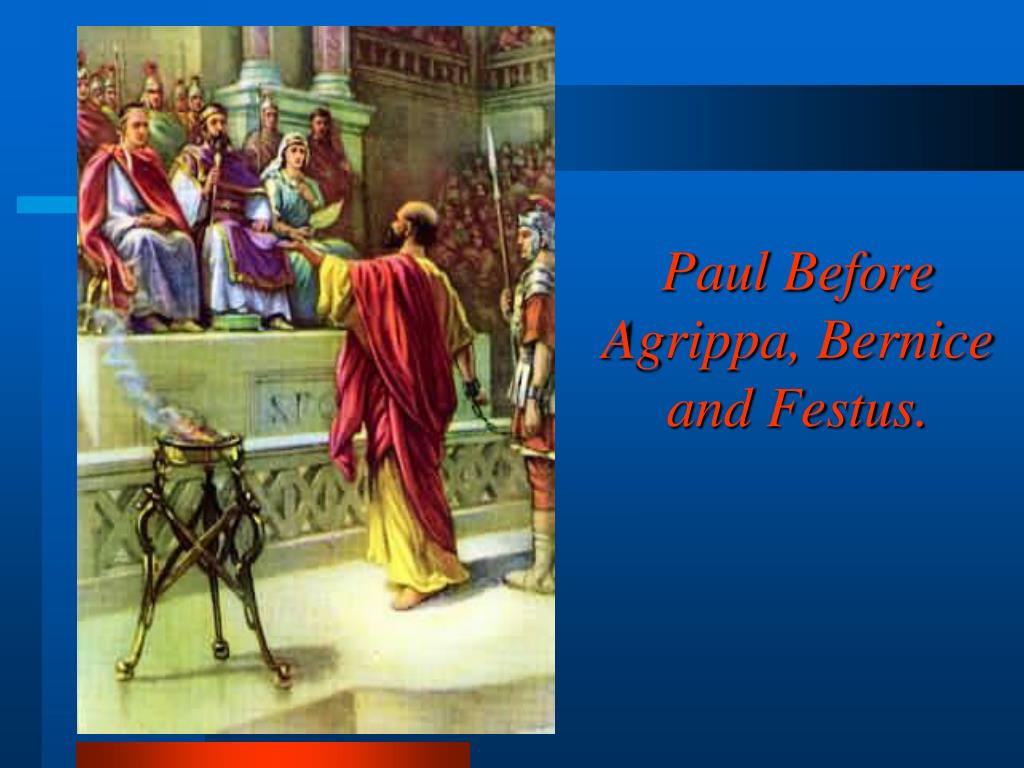
Agrippa said to Sha’ul,
“You may speak for yourself.”Then Sha’ul stretched out his hand, and made his defense.
Acts of the Apostles 26:1 Hebrew Names Bible
Saul addressing King Herod Agrippa –
Jew to fellow Jew
continuing in his complimentary introduction:
Especially because I know thee to be expert in all customs and questions which are among the Jews: wherefore I beseech thee to hear me patiently.
Acts 26:3 KJV
Remember, Paul is speaking of events beginning some twenty years ago.
My manner of life from my youth, which was at the first among mine own nation at Jerusalem, know all the Jews;
Which knew me from the beginning, if they would testify, that after the most straitest sect of our religion I lived a Pharisee.
And now I stand and am judged for the hope of the promise made of God unto our fathers: Unto which promise our twelve tribes, instantly serving God day and night, hope to come. For which hope’s sake, king Agrippa, I am accused of the Jews.
Acts 26:4-7 KJV
Paul addresses the "Jewish" king caught in the middle of controversaries between the Saduccees, Pharasees and pagan Romans not part of the promise of the One God to Abraham.
Testimony of the Resurrection
The Apostle now confronts Herod Agrippa with the politically divisive question concerning the Messiah Jesus.
Why should it be thought a thing incredible with you, that God should raise the dead?
Acts of the Apostles 26:8 KJV
“Indeed, I myself thought I must do many things contrary to the name of Jesus of Nazareth. This I also did in Jerusalem, and many of the saints I shut up in prison, having received authority from the chief priests; and when they were put to death, I cast my vote against them.
And I punished them often in every synagogue and compelled them to blaspheme; and being exceedingly enraged against them, I persecuted them even to foreign cities.
Acts 26:9-11 NKJV
What’s Paul doing here?
The Apostle is confessing that as a leading Pharisee he was one of them – agreed with them – as zealous to put to death these blasphemers of Yahweh as now they seek to have Paul killed for his witness of the risen Messiah Yeshua.
Herod Agrippa knows the Jesus controversy well. And Paul’s defense now presents evidence of why he has turned from his former disbelief (in the resurrection of the Messiah Jesus of Nazareth). So šā’ûl of Tarsus recounts his journey to Damascus and life-changing encounter with the risen Lord Jesus, the crucified Messiah.
Saul sent out as the Apostle Paul
Luke has previously recorded Paul's account (Acts 9:1–19; 22:6–16).
- I journeyed to Damascus with authority and commission from the chief priests,
- At midday I saw a light from heaven, brighter than the sun,
- We all fell to the ground
- I heard a voice speaking to me in the Hebrew dialect:
‘Sha’ul, Sha’ul, why are you persecuting me? It is hard for you to kick against the goads.’
Acts 26:14b Hebrew Names Version
Herod Agrippa would understand the significance of the Voice from heaven Who communicates with Paul in Hebrew. Sha’ul asks what any man might ask of an unknown person speaking:
Τίς εἶ κύριε
(tis ei Kyrios) Who are you, Lord?
And He said (in the Greek of Luke’s account of Acts of the Apostles)
egō eimi iēsous
Or in the Hebrew šā'ûl likely heard from the Lord:
ănî yᵊhôšûaʿ
“He said,
‘I am Yeshua, whom you are persecuting.
Acts 26:15 b Hebrew Names Version
Yeshua, the risen Son of God, commissions Paul
As Paul knows, Herod Agrippa II, with his Roman and Jewish cultural upbringing, will full-well know and understand the implication of what he is about to say. (And note that this Voice from heaven commands Saul as a King (like Herod Agrippa) would command any subject.
And He said,
‘I am Jesus, whom you are persecuting.
But rise and stand on your feet;
for I have appeared to you for this purpose, to make you a minister and a witness both of the things which you have seen and of the things which I will yet reveal to you.
Acts 26:14-15 NKJV
Remember, Paul has already been witnessing Christ crucified and risen on three missionary journeys since about AD 47 (more than ten years after Christ's crucifixion in Jerusaalem) until now (~AD 59) for some twelve years.
‘I will deliver you from the Jewish people, as well as from the Gentiles, to whom I now send you, to open their eyes, in order to turn them from darkness to light, and from the power of Satan to God, that they may receive forgiveness of sins and an inheritance among those who are sanctified by faith in Me.’
Acts 26:17-18 NKJV – account to Agrippa of the commissioning of Paul by the risen Christ Jesus
It is significant that in sending Saul to the Gentiles that the Lord mentions their redemption – Gospel Good News!
The Lord Jesus also points to our deliverance from original sin and Satan.
And do not overlook His mention of holiness and how Jew and Gentile will now receive sanctification.
Sanctification
Just a reminder of God's HOLINESS and that of CHRIST JESUS
ἁγιάζω – hagiazō –
- to render or acknowledge, or to be venerable or hallow
- to separate from profane things and dedicate to God
- consecrate things to God
- dedicate people to God
- to purify
From hagos G40 (an awful thing) – sacred (physically, pure, morally blameless or religious, ceremonially, consecrated):—(most) holy (one, thing), saint.
Source: Lexicon :: Strong’s G37 – hagiazō – BlueLetterBible.org
21st century Common Era christians tend to overlook Jesus’ role in sanctification of the redeemed saints of Christ, therefore missing the mark of showing ourselves saved from the sin so common in all of us.
Roger@TalkofJesus.com
OPEN YOUR EYES – SEE the implication of what the Lord says to Saul of Tarsus that changed him for all eternity:
to open their eyes, that they may turn from darkness to light and from the power of Satan to God,
that they may receive forgiveness of sins
and a place among
those who are sanctified by faith in me.’
Acts 26:18 RSV
Are YOU, like Saul, a SAINT — a most HOLY thing —
by FAITH in the LORD CHRIST JESUS?
Paul asks the Lord’s question of Agrippa and of Portus Festus.
The Apostle asks JESUS’ question of you who seek forgiveness of your sins somewhere else than by faith in the Person of Him – the risen Christ Jesus.
Next: Agrippa and Festus reject Christ

Comment on Scripture – Share the Gospel