Tag: apostles

  • The Elder John and Leadership of the Church

    The Elder John and Leadership of the Church

    The A.D. First Century Church

    I tend to look at the Acts of the Apostles and oversimplify the History of the Church,

    STARRING THE APOSTLES — Peter and Paul.


    Although Jesus says of Peter, “Upon this Rock I will build My Church,” we tend to miss the frequency of John at Peter’s side throughout the early acts of all of the Apostles in Jerusalem.
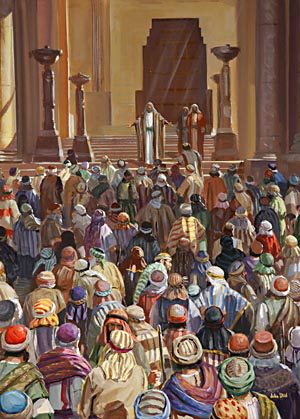
    Peter preaching from Solomon's Porch
    Peter, John and the healed lame beggar

    Epistles from Apostles to Elders

    Even while reading the Epistles of Paul outlining a developing leadership structure of the A.D. 1st century Church, Elders seem to get lost somewhere between Apostolic authority (at the top) and dynamic Deacons (such as Stephen).
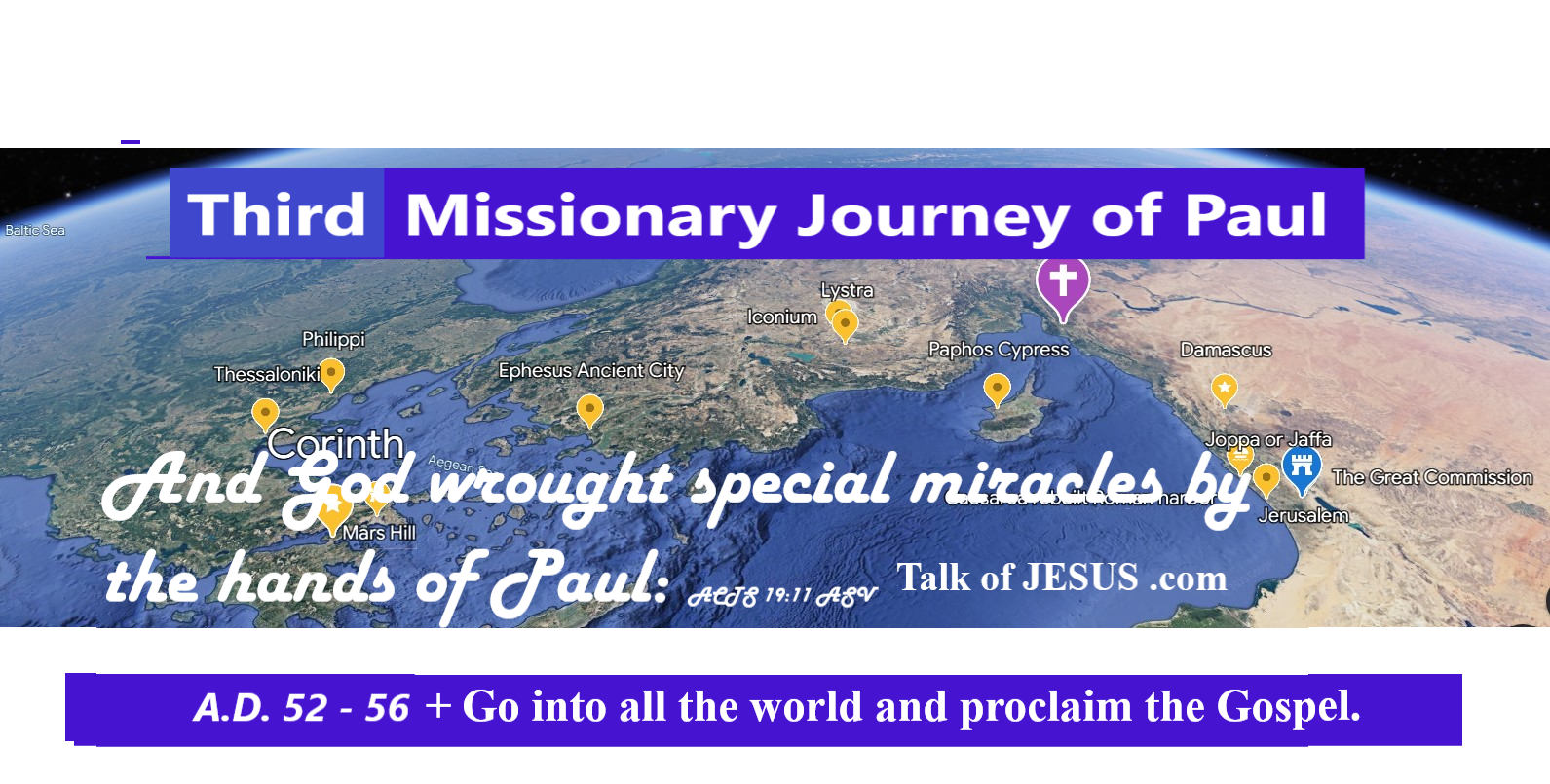
    And God wrought special miracles by the hands of Paul: Acts 19:11 ASV graphic map of Third Missionary Journey of Paul
    Elders, Deacons and other Apostolic leadership 

    Paul writes in his first pastoral letter to Timothy:

    Let the elders who rule well be counted worthy of double honor, especially those who labor in the word and doctrine.

    1 Timothy 5:17 NKJV


    Other English translations help us apply the same Scripture into responsibilities 21st century C.E. churches consider as leadership jobs.

    The elders who are good leaders are to be considered worthy of double honor, especially those who work hard at preaching and teaching.

    1 Timothy 5:17 CSB

    We need to think of the Apostles John, Peter, Paul and others in these dual roles in relation to the developing churches they establish.

    Mediterranean Sea near Phoenix Cypress

    Paul offers a precedent and example of which churches need elders in a pastoral epistle to (the pastor) Titus.

    The reason I left you in Crete was to set right what was left undone and, as I directed you, to appoint elders in every town.

    Epistle of Paul to Titus 1:5 CSB

    Timothy, Titus, Barnabas, Silas and especially the Apostles often deserved double honor for serving as pastor and teacher of a specific local church for a time, in addition to their commission and titles as apostles, disciples, deacons and elders.

    JOHN, during his long years of Apostolic ministry to many churches served as an Elder (probably in several towns) in addition to his chosen commission by Christ as an Apostle.
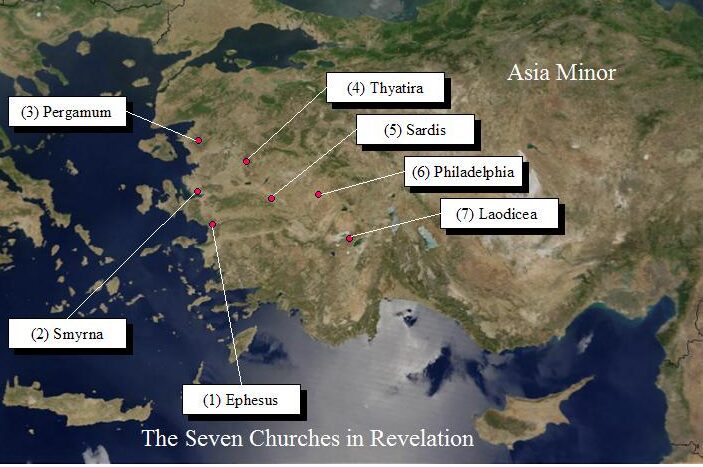
    map of the seven churches of revelation
    John to the seven churches that are in Asia: Grace to you and peace from Him who is, and who was, and who is to come, and from the seven spirits who are before His throne,

    Elders Leading the Family of God

    Before we look at letters from John the Elder or the role of an Elder in the New Testament families of God and Christ, let’s honor the tradition into which James and John, Sons of Zebedee, Andrew and Simon Peter and other first century Jews were born.

    Elders of Jewish Scripture (the Old Testament)

    “You stand today, all of you, before Yahweh your God [יְהוָה אֱלֹהֵיכֶם]:

    your heads, your tribes, your elders, and your officers, even all the men of Israel, your little ones, your wives, and the sojourner who is within your camps..

    Deuteronomy 29:10-11a KJV

    Included with the elders [the old men, some leaders of clans or families] yᵊhōvâ ĕlōhîm includes officers [foremen] and many others.
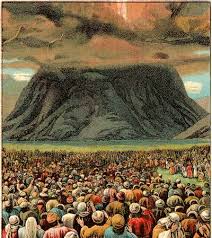

    The LORD Visits Sinai Exodus 19 congregation of the Hebrews at Mount Sinai

    Assemble to me all the elders of your tribes and your officers, that I may speak these words in their ears and call heaven and earth to witness against them.

    Deuteronomy 31:28 ESV


    Then all the elders H2205 of Israel gathered together and came to Samuel at Ramah

    1 Samuel 8:4 LSB

    So Samuel did what Yahweh said and came to Bethlehem. And the elders H2205 of the city came trembling to meet him and said, “Do you come in peace?”

    1 Samuel 16:4 LSB

    Princes are hanged up by their hand: 
    the faces of elders were not honoured.
    They took the young men to grind,
    and the children fell under the wood.
    The elders have ceased from the gate,
    the young men from their musick.
    The joy of our heart is ceased;
    our dance is turned into mourning.
    The crown is fallen from our head:
    woe unto us, that we have sinned!

    Lamentations of the Prophet Jeremiah 5:12-16 KJV

    “But you shall select excellent men out of all the people, those who fear God, men of truth, those who hate greedy gain; and you shall place these men over them as leaders of thousands, of hundreds, of fifties, and of tens.

    Exodus 18 & Deuteronomy 1 LSB

    Elders lead the thousands, the hundreds, the fifties and the tens..


    Elders of a developing or disintegrating church

    Before we breeze through the years of the ACTS OF THE APOSTLE JOHN, let’s recall the chronology mentioned previously in a look at John’s Gospel — a timeline taking the young Disciple at the foot of the Cross, past his proclaiming the Gospel with Peter on Pentecost and up to the time the Elder writes his Gospel.

    An account of ACTS in the life of John

    All dates and ages of John are approximate
    • ~A.D. 30 – Jesus’ ascension, Pentecost, Peter & John preaching in the Temple
      • The Apostle John is only about 25 years old.
    • ~A.D. 44 –
      • John is now in his upper 30’s

    About that time King Herod violently attacked some who belonged to the church, and he executed James, John’s brother, with the sword.

    Acts of the Apostles 12:1-2 CSB

    • ~A.D. 49 – Council at Jerusalem (Acts 15)
      • The Apostle John, ~ age 43
      • Peter, who an angel released at the time James was execution, would have been present, along with James, half-brother of Jesus and leader of the Jerusalem church.
      • Paul and other Elders present to decide how Jews and Gentiles will worship Jesus the Lord as one body of Christ

    Then it seemed good to the apostles and the elders, with the whole church, to choose men from among them—Judas called Barsabbas, and Silas, leading men among the brothers—to send to Antioch with Paul and Barnabas, and they sent this letter by them,

    “The apostles and the brothers who are elders, to the brothers in Antioch and Syria and Cilicia who are from the Gentiles, greetings.

    Acts 15:22-23 LSB

    • ~ A.D. 55 – Mark, (John Mark, gentile nephew of Barnabas who had accompanied his uncle and Paul on Cypress & became a scribe to Peter) – writes his Gospel.
      • The Apostle John is about 50 years old
      • Paul and others write Epistles to various churches
    • ~ A.D. 61 – Luke, gentile physician of Paul, writes his Gospel and Jesus’ Apostle Matthew Levi writes his Gospel
      • The Apostle John is now in his upper 50’s
      • The Apostles Peter and Paul continue to write Epistles
    • ~ A.D. 62 – James, half-brother of Jesus and leader of the Jerusalem church is martyred
    • ~ A.D. 66
      • John is now 60 years old
      • The Jews revolt against Rome
        • Christians flee Jerusalem
      • The Apostles Paul and Peter are Martyred in Rome
        • Jude (Jesus’ half-brother) writes an Epistle
        • Epistle “to the Hebrews” written (anonymously)
    • ~ A.D. 86
      • The Elder John is now 80 years old
      • ALL of the other Apostles are dead and as Jesus had told Simon Peter, is the only one remaining.
      • The Lord has saved John even from torture, exiled on a Greek island of Patmos.
      • John will now write three Epistles…
        • ten, if you count brief greetings to seven in his apocalypse from the Lord Jesus Christ.

    Elders of the New Testament

    In the New Testament, the role of elders becomes more defined within the structure of the early church. Elders, also known as overseers or bishops, are responsible for shepherding the flock, teaching sound doctrine, and maintaining church discipline.

    Plurality and Accountability:
    The New Testament model for church leadership often emphasizes a plurality of elders, suggesting that multiple elders should lead each congregation. This plurality provides a system of accountability and shared responsibility, ensuring that no single individual holds excessive power. The collective wisdom and diverse gifts of multiple elders contribute to the health and growth of the church.

    Conclusion:
    The biblical concept of elders encompasses a rich tradition of leadership and service, rooted in both the Old and New Testaments. Elders are called to be shepherds, teachers, and examples, guiding the people of God with wisdom, humility, and integrity.

    Their role is vital to the spiritual well-being and doctrinal soundness of the church, as they seek to honor God and serve His people faithfully.

    source: BibleHub.com


    NO man was more directly accountable to our risen Lord Jesus Christ, with a lasting impact on the saints of an expanding second century church who had met him, than the ELDER JOHN.


    Comment on Scripture – Share the Gospel

  • a Roman Conclusion – Acts of the Apostles

    a Roman Conclusion – Acts of the Apostles

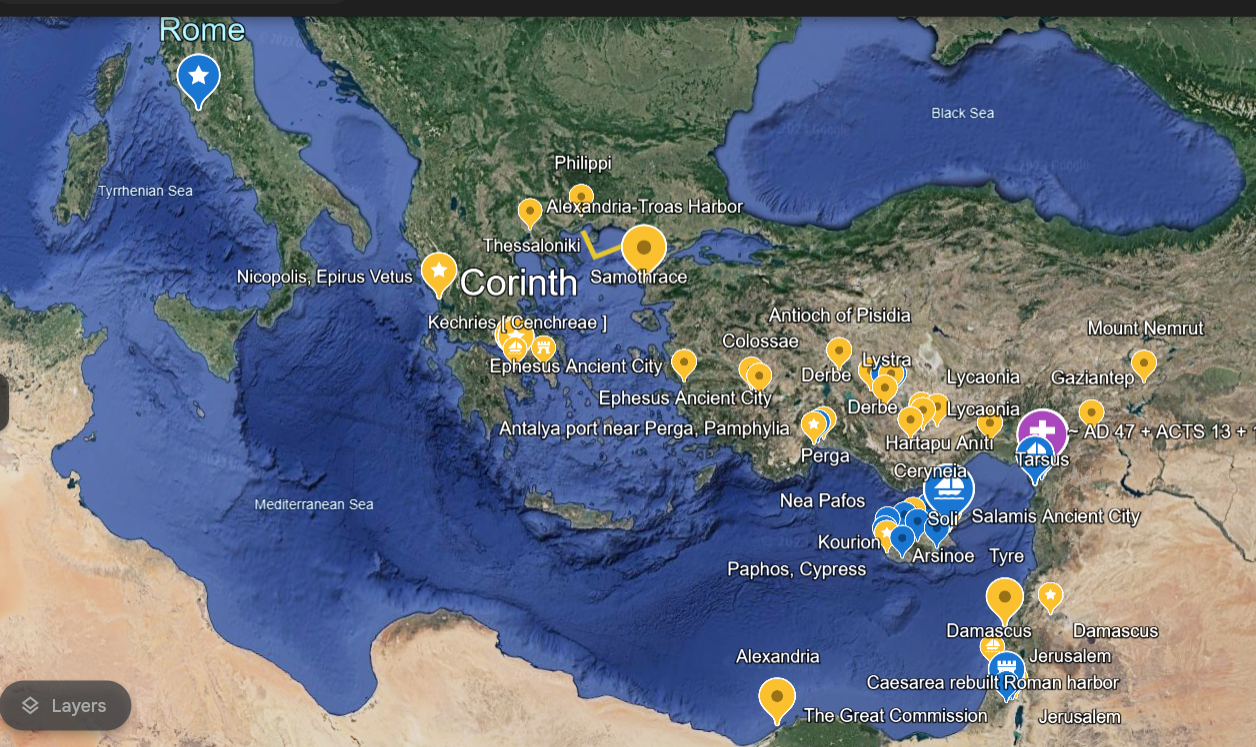
    Several missionary stops of the apostle Paul before going to Rome - Acts of the Apostles

    All roads lead to Rome

    Who has not heard the expression recalling a time of glory for the Roman Empire of the A.D. first century?

    But this second account of the Hellenist physician Luke records that the Gospel is sent out from Jerusalem and then Antioch.

    “But you will receive power when the Holy Spirit has come on you, and you will be my witnesses in Jerusalem, in all Judea and Samaria, and to the ends of the earth.”

    Acts of the Apostles 1:8 CSB – words of the risen Jesus to His disciples

    The apostles and the brothers and sisters who were throughout Judea heard that the Gentiles had also received the word of God.

    Acts 11:1 CSB

    For a whole year they [Barnabas and Paul] met with the church and taught large numbers. The disciples were first called Christians at Antioch.

    Acts of the Apostles 11:26 CSB

    Paul’s Previous 3 Missionary Journeys

    READ MORE about the timeline of Paul's missions with numerous maps of the Roman world of the A.D. 1st century. 

    An Apostle known by his Letters

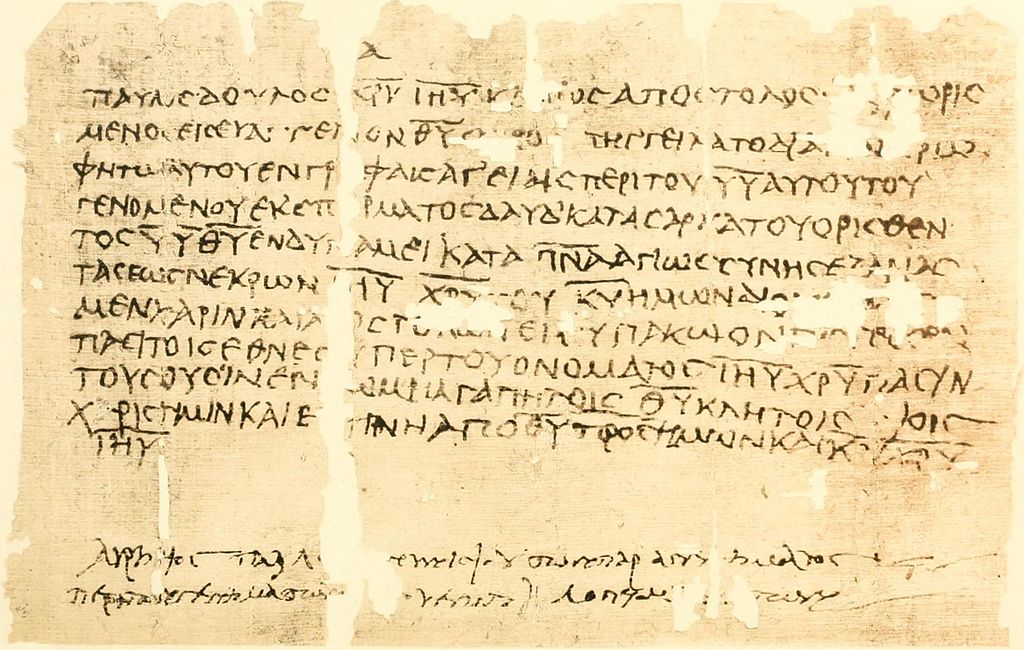
    Epistle of Paul to the Romans 1 - the Apostles sends a church letter to Rome and the local saints of area churches
    Epistle of Paul to the Romans

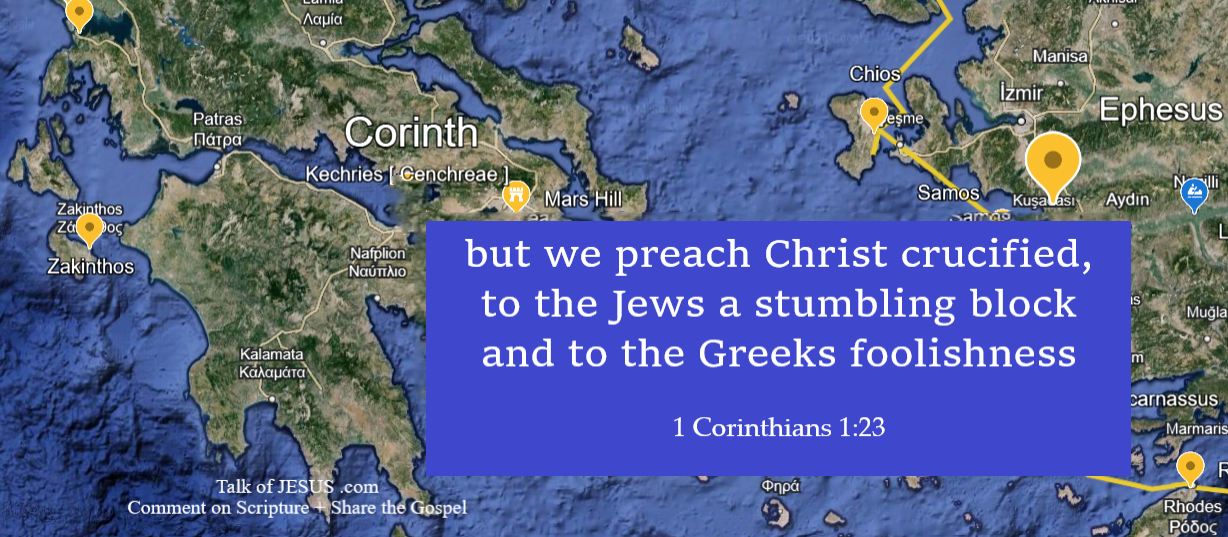
    As did Peter, John, James and others, the Apostle Paul communicates with converts to Christ frequently by letter, in addition to their Apostolic missions to live and worship with these believers for a time.

    but we preach Christ crucified, to the Jews a stumbling block and to the Greeks foolishness - 1 Corinthians 1:23a

    • AD 57

    Two years BEFORE Paul is brought to Rome on spurious charges of the Jews and the Apostle’s appeal to Caesar Nero (as a Roman citizen), Paul writes his masterful theological Epistle to the Romans, instructing his fellow Roman citizens in the Gospel of Jesus Christ.

    We will read more of the Apostle's personal joy in meeting these Romans shortly. 
    • AD 60-62
      • From Rome (and possibly other cities away from Rome) the Apostle to the Gentiles writes to the church in:
        • Ephesus, Philppi and Colossae
        • a letter concerning Philemon
    • AD 62-66
      • Paul writes a first pastoral letter to Timothy
      • and also to Titus
    • July 19, AD 64 – Caesar Nero burns Rome, blames and persecutes the Christians, Apostle’s under house arrest face execution at Nero’s command
    • AD 66-67 – Facing imminent execution (as does the Apostle Paul, now in Rome), Peter writes a second and final pastoral epistle to Timothy to encourage and guide the Church.

    Paul brought to Rome

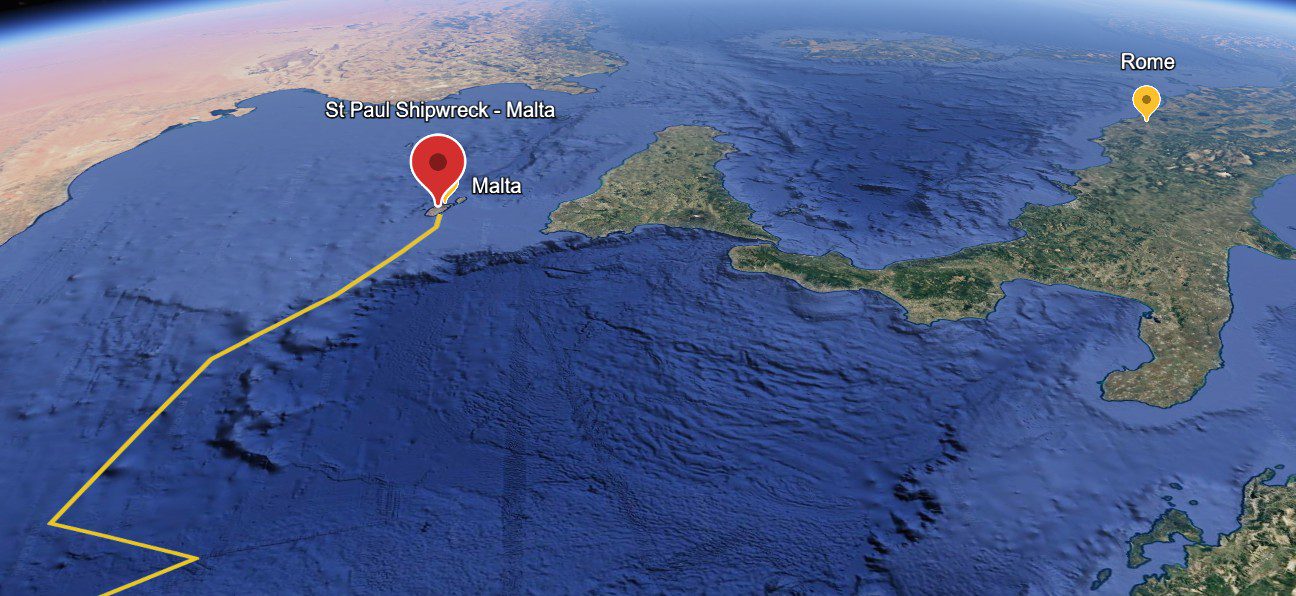
    Malta - Earth view of Malta in the Mediterranean Sea

    Previously, we left the Apostle having survived a shipwreck in Malta.

    The Centurion Julius, the Apostle Paul and now more than 300 men witness the power of God in Christ’s Apostle to the gentiles delayed in a violent storm on his way to Rome.

    In these few verses THREE MONTHS PASS.


    ACTS of the Apostles 28 – Conclusion

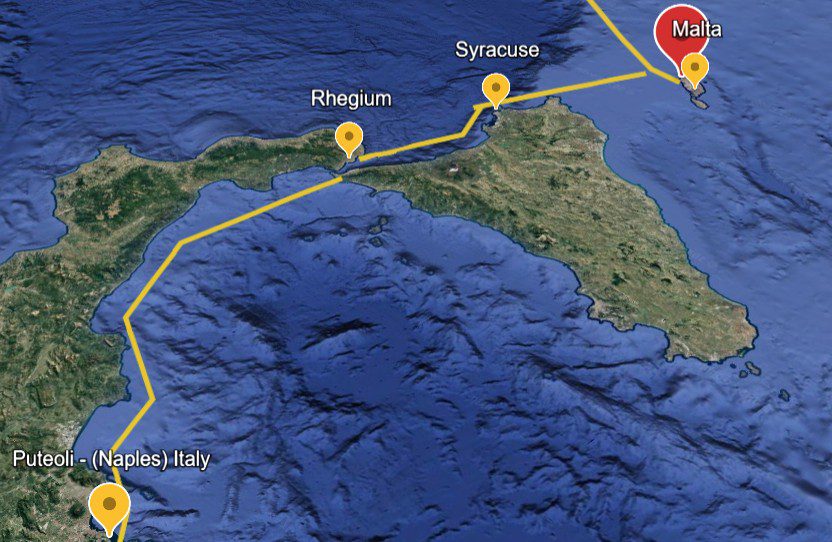
    After three months we set sail in an Alexandrian ship that had wintered at the island, with the Twin Gods as its figurehead.

    12 Putting in at Syracuse, we stayed three days.

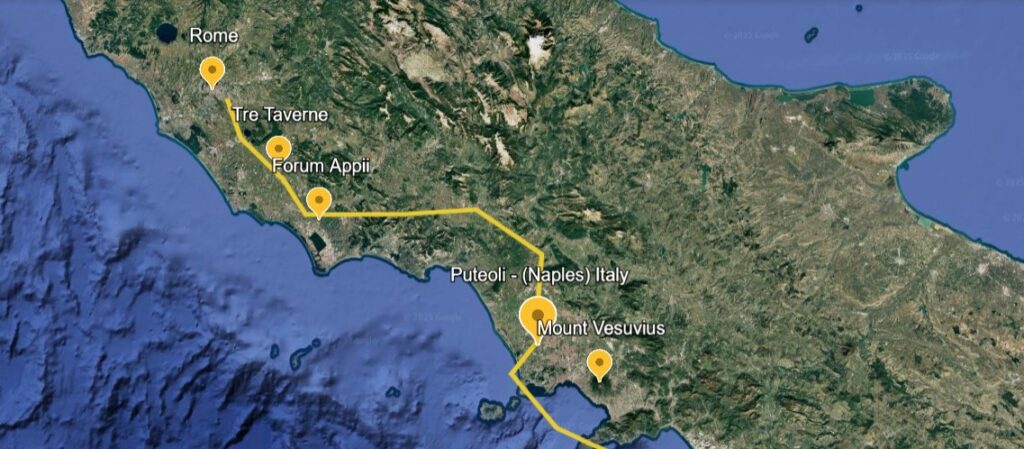
    13 From there, after making a circuit along the coast, we reached Rhegium. After one day a south wind sprang up, and the second day we came to Puteoli.

    CSB

    Where we found brethren, and were desired to tarry with them seven days: and so we went toward Rome.

    Acts 28:14 KJV

    140 miles (225 kilometers) southeast of Rome. “Puteoli” literally means “little wells” in reference to the many hydrothermal wells that were in the city, which was well-known as a large port that could accommodate big ships.

    In fact, adjacent to Puteoli was Misenum, the Roman naval base that housed the largest naval fleet in the ancient world. Earthquakes have since sunk most of Puteoli under water.

    Source: Bibleversestudy.com


    And the brothers, when they heard about us, came from there as far as the Market of Appius and Three Inns to meet us.

    When Paul saw them, he thanked God and took courage.

    Paul escorted to Rome along the Appian Way

    And when we entered Rome,

    Paul was allowed to stay by himself,

    with the soldier who was guarding him.

    Acts 28:16 LSB

    Paul Addresses Prominent Jews of Rome

    And it happened that after three days Paul called together those who were the leading men of the Jews,

    and when they came together, he began saying to them,

    Brothers, though I had done nothing against our people or the customs of our fathers, yet I was delivered as a prisoner from Jerusalem into the hands of the Romans.

    And when they had examined me, they were willing to release me because there was no ground for putting me to death. But when the Jews [spoke against me], I was forced to appeal to Caesar, not that I had any accusation against my nation.

    Acts 28:17-19


    Note two points from Paul's self-introduction to the Roman Jews: 

    The Apostle refers to himself as a brother of these Jews, also referring to OUR people, customs and fathers [patrōos].

    Paul had identified with the fathers of the faith in defense of the Gospel before:

    “I am a Jew, born in Tarsus of Cilicia.. instructed .. according to the strictness of the law of our fathers, being zealous for God just as you all are today,

    Acts 22:3 excerpt LSB

    And hear Paul’s defense in his first Trial Before Felix:

    “But this I confess to you, that according to the Way which they call a sect,

    so I worship the God of my fathers, believing all things which are written in the Law and in the Prophets.

    Acts 24:14 NKJV

    Ethnos

    The APOSTLE and ROMAN CITIZEN parenthetically adds:

    .. not that I had anything of which to accuse my nation.

    Acts 28:19b NKJV

    Paul has NO extra-judicial accusation against his accusers with whom he identifies by calling them: ‘MY NATION” — ἔθνος – ethnos

    • a multitude [together]
    • the human family
    • tribe, nation, people group
    • Gentiles [OT]
    • Paul uses the term for Gentile Christians

    Source: BlueLetterBible.org Strong’s G1484 – ethnos

    HERE in his defense to the Jews, Paul uses ethnos to describe OTHER Jews including his Jewish accusers in Jerusalem AND those in Rome whom the Apostle has summoned.

    Luke opens Acts of the Apostles telling readers: 

    Now there were Jews living in Jerusalem, devout men from every nation G1484ethnos – under heaven.

    Acts of the Apostles 2:5 LSB


    מִקְוֵה יִשְׂרָאֵל מוֹשִׁיעוֹ

    Jeremiah 14:8a -yirmᵊyâ יִרְמְיָהוּ

    Understanding you (Paul) for ourselves

    These leading Jews of Rome of course know Scripture and realize that Paul preaches about the Messiah.

    And they said to him,

    “We have neither received letters from Judea concerning you, nor have any of the brothers come here and reported or spoken anything bad about you. But we desire to hear from you what you think;

    for concerning this sect, it is known to us that it is spoken against everywhere.”

    Acts 28:21-22 LSB

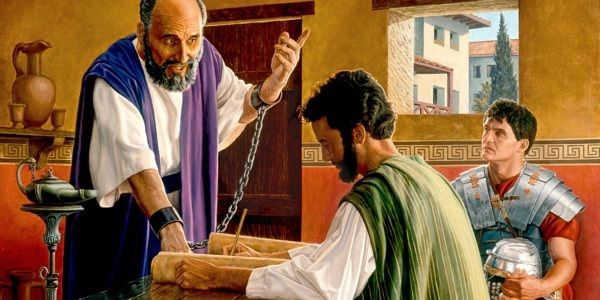
    Paul under house arrest with Luke, his scribe and physician and a Roman Centurian responsible for his prisoner

    And when they had set a day for Paul, they came to him at his lodging in large numbers..

    and he was explaining to them by solemnly bearing witness about the kingdom of God and trying to persuade them concerning Jesus, from both the Law of Moses and from the Prophets,

    from morning until evening.

    And some were being persuaded by the things spoken, but others were not believing.

    And when they disagreed with one another, they began leaving after Paul had spoken one word,

    Acts 28:23-25a LSB

    “The Holy Spirit rightly spoke

    through Isaiah the prophet to your fathers, saying,

    And He said, “Go, and tell this people:
    ‘Keep on hearing, but do not understand;
    Keep on seeing, but do not perceive.’

    “Make the heart of this people dull,
    And their ears heavy,
    And shut their eyes;

    Lest they see with their eyes,
    And hear with their ears,
    And understand with their heart,

    And return and be healed.”

    Isaiah 6:9-10 (quoted by Paul) NKJV

    Paul’s final word for the Roman Jews

    And when he had said these words, the Jews departed and had a great dispute among themselves.

    Then Paul dwelt two whole years in his own rented house, and received all who came to him,

    preaching the kingdom of God

    and teaching the things which concern the Lord Jesus Christ with all confidence, no one forbidding him.

    Acts 28:30-31 NKJV


    Acts Apostolos - Acts of the Apostles - the chronicles of Christ's Apostles - a history of Christ's Church including early leaders like Stephen, Philip the Evangelist, Paul, Barnabas and many others

    second account of Luke, the physician .


    Comment on Scripture – Share the Gospel

  • The Clarity and Connections of Apostolic Faith

    The Clarity and Connections of Apostolic Faith

    How do WE respond after hearing a letter from an Apostle of Jesus Christ written to our Church?

    We are about to take a look at the faith of three Apostles through Epistles they sent to many churches.

    But more than that:

    The Gospel of Jesus Christ proclaims connections — relationships that matter.

    We receive the same love evident through these connections to God and the Apostles, who continue to mean much to 21st century Christians who believe with Apostolic faith.


    Apostolic Unity in the Gospels

    When someone asks us about our faith, their questions may boil down to a single foundational question:

    “Faith in what?”

    or perhaps, “faith in whom?”

    Let’s begin with what the Lord says about these connections. Jesus actually presents His clarifying question to the Apostles.

    And out of all the possibilities of their answers, one stands out in every Gospel.


    Peter’s answer to Jesus

    • Gospel of Luke

    9: And calling the twelve together, He gave them power and authority over all the demons and to heal diseases. And He sent them out to preach the kingdom of God and to heal the sick…

    And departing, they were going from village to village, proclaiming the gospel and healing everywhere.


    Peter Confesses Jesus Is the Christ

    (Mat 16:13–20Mar 8:27–30 )

    .. and He questioned them, saying, “Who do the crowds say that I am?”

    .. And He said to them, “But who do you say that I am?”

    Luke 9:18b,20a BSB

    Jesus Christ Lord God with cross

    “The Christ of God.”


    • Gospel of Matthew

    And Simon Peter answered and said,

    “You are the Christ, the Son of the living God.”

    Mat 16:16 LSB

    • Gospel of Mark

    And He continued asking them, “But who do you say that I am?”

    Peter answered and said to Him, “You are the Christ.”

    Mark 8:29 LSB


    Peter provided an answer communited to him by the Holy Spirit of God. And the Apostle John through the same Spirit says the same more fully and in mysterious revealed detail.

    Gospel of John

    Nearly all of us are familiar with John’s introduction of Jesus in his Gospel:

    IN THE BEGINNING was the Word [logos]

    (We will come to discover that John refers to JESUS as the Word in the flesh.)

    and the Word

    was with God [Theos]

    [but now, in John 1:1, the Apostle clearly states:]

    And the Word was God.

    1:1 ἐν ἀρχῇ ἦν ὁ λόγος καὶ ὁ λόγος ἦν πρὸς τὸν θεόν καὶ θεὸς ἦν ὁ λόγος

    John 1:1 LSB – English translation from Greek New Testament


    The Gospels all record that the twelve Apostles witness God’s power personally MANY TIMES in JESUS.

    “I and the Father are [in essence] one,” John records later in his Gospel [John 10:30].

    The Apostle’s Gospel of connection to the Living God revealingly becomes even stronger and more forward-facing after Jesus’ resurrection.

    We see this first in Peter and John, but with an additional absolute faith in Christ later proclaimed to all the world by the Apostle Paul.


    John 20 – Apostolic Authority from God

    ἐμφυσάω

    emphysáō – John 20:22, where Jesus, after the manner of the Hebrew prophets, expresses by the symbolic act of breathing upon the apostles the communication of the Holy Spirit to them

    He breathed on them and *said to them,

    “Receive the Holy Spirit.

    Gospel of John 20:22b LSB

    Christ’s communication from the One GodFather, Son and now the Holy Spirit given — to His Apostles sent into all the world with Gospel Good News!


    What is Apostolic Faith?

    πίστις – faith, assurance,believe, belief,them that believe, fidelity occurs 244 times in 228 verses in the TR Greek.

    conviction of the truth of anything, belief; in the NT of a conviction or belief respecting man’s relationship to God and divine things, generally with the included idea of trust and holy fervour born of faith and joined with it

    • the conviction that God exists and is the creator and ruler of all things, the provider and bestower of eternal salvation through Christ
    • a strong and welcome conviction or belief that Jesus is the Messiah, through whom we obtain eternal salvation in the kingdom of God
    • the religious beliefs of Christians
    • belief with the predominate idea of trust (or confidence) whether in God or in Christ, springing from faith in the same
    • fidelity, faithfulness
    • the character of one who can be relied on

    Source: Lexicon :: Strong’s G4102 – pistis – faith

    This is Apostolic faith,

    which finds its roots in the eternal truth that GOD IS — the Person of JESUS IS God — and Christ chose Apostles to continue God’s work of redemption of sinners by proclaiming the Gospel to all mankind.


    Who are Apostles?

    Acts Petros - Acts 0f Peter - Jesus' Rock and Apostle of the 1st c. church. What happened to the Apostle Peter? Acts 1-15
    ACTS on Mission

    Tens of Thousands of men, women and children witnessed the Son of God, JESUS, born as a man to a virgin.

    Many followed JESUS as DISCIPLES, listening to His teachings and commands. Sometimes Jesus taught thousands. At other times hundreds would follow their Master (Lord) as a Rabbi sent from God. Jesus would teach a houseful of guests or sometimes just one chosen by Him even without witness of the Twelve.

    More than five hundred witnessed Jesus AFTER the Lord’s crucifixion and resurrection from the grave (even as several had seen Him raise Lazarus and others).

    .. He called His disciples to Him and chose twelve of them, whom He also named as apostles:

    Luke 6:13, also Matthew 10 & Mark 3

    Disciples followed their itinerant Rabbi from mountainside to village to city over three years, hearing the Messiah Jesus teach true faith. Yet even one of the Twelve had been chosen before time to betray the Lamb of God, our Savior redeeming our sins on a Cross in Jerusalem.

    The APOSTLE’S sent out by Jesus were all chosen as witnesses to the Son of Man — an itinerant Teacher who was not of this world, but IS before all time — with God and was God.

    Three Apostles nearer to Jesus

    And He allowed no one to accompany Him, except Peter and James and John the brother of James.

    And six days later, Jesus took with Him Peter and James and John, and brought them up on a high mountain alone by themselves. And He was transfigured before them;

    Gospel of Mark 5:37, 9:2, additional references

    James, the older brother of John, became the first Apostle martyred for his faith in Jesus just fourteen years into the establishing of the Church. Another would later replace him, as Matthias would replace Judas Iscariot.

    It would be James the half-brother of Jesus who would later lead the church in Jerusalem, writing epistles to followers of The Way and conferring with the Apostles including Peter and John. 

    We witness these three Apostles nearest to Jesus on several occasions, both before and after the Lord’s resurrection.

    Many witness the boldness of Simeon Peter and John in the Temple after Jesus is risen. It’s just once instance where Apostles proclaim the Gospel of Jesus Christ in the face of imprisonment, persecution and even death.


    Σίμων Πέτρος – Simon Peter

    So Jesus said to the twelve, “Do you also want to go?”

    Simon Peter answered Him, “Lord, to whom shall we go? You have words of eternal life. And we have believed and have come to know that You are the Holy One of God.”

    Gospel of John 6:68-69 LSB

    “Blessed are you, Simon Bar-Jonah, because flesh and blood did not reveal this to you, but My Father who is in heaven.

    And I also say to you that you are Peter,
    and upon this rock
    I will build My church; and the gates of Hades will not overpower it.

    Gospel of Matthew 16:17b-18 LSB

    what happened to Peter
    a Fisher of Men

    Ἰωάννην Βοανηργές – John son of thunder

    Jesus called these two brothers and close friends of His inner-circle of Apostles, “sons of thunder,” and more than once James and John had caused a commotion among his disciples.

    And they [James and John] said to Him, “Grant that we may sit, one on Your right and one on Your left, in Your glory.”

    .. And hearing this, the ten began to feel indignant with James and John.

    Gospel of Mark 10:37,41 LSB

    And nearer the time of their journey to Jerusalem for Jesus’ crucifixion:

    And when His disciples James and John saw this, they said, “Lord, do You want us to command fire to come down from heaven and consume them?”

    But He turned and rebuked them..

    Luke 9:54-55a LSB

    THEN on a hideous hill outside Jerusalem, as Peter and the other Apostles hid distanced from the iniquitous crucifixion of Christ, the youngest of these dared a nearby witness of this most ironic Sacrifice of all time — the Son of God, their friend, hanging and pierced on a cursed Cross.

    When Jesus then saw His mother, and the disciple whom He loved standing nearby, He said to His mother,

    “Woman, behold, your son!”

    Then He said to the disciple,

    “Behold, your mother!”

    From that hour the disciple took her into his home.

    Gospel of John 19:26-27 LSB + Witness of the Disciple Jesus loved – youngest of the Twelve


    The Lord Jesus entrusted His own mother Mary to the beloved Disciple John, who so often would cling to Him and His every word.

    Christ would also restore Peter as the Rock upon which He would build His church.

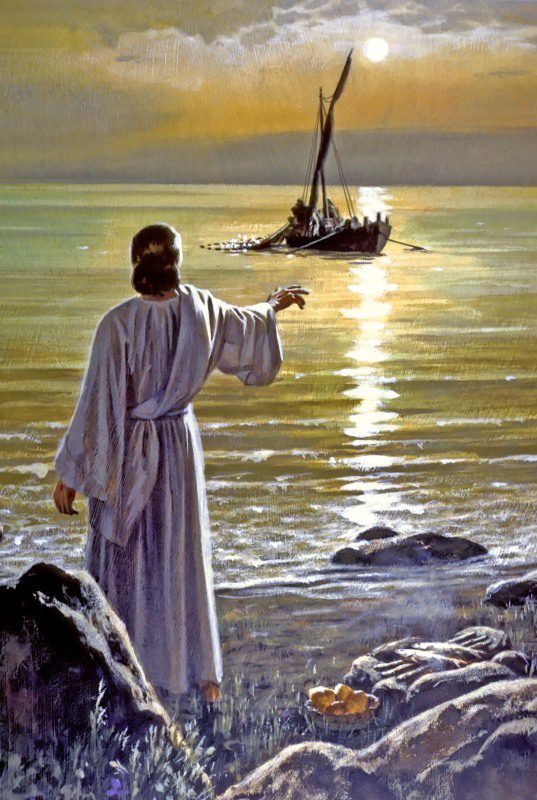
    Jesus standing on shore as fishing boat approaches at dawn
    “Children, have you any fish?”

    Jesus’ love and connection to these two Apostles cannot be disputed.


    Σαῦλος – Saûlos – Ῥωμαῖος Ταρσέα

    After His resurrection the Lord will also embrace an arch-enemy who had not only denied a connection of the Son to God the Father, but even worse had persecuted and killed followers of The Way.

    - Saul, Roman Citizen of Tarsus and Leading Jew of the Pharisees 

    And when Saul had come to Jerusalem, he tried to join the disciples; but they were all afraid of him, and did not believe that he was a disciple.

    Acts of the Apostles 9:26 NKJV

    Παῦλος – Paulos – ἀπόστολος ἐθνῶν

    apostolos ethnos  
    Acts of the Apostles Missions trips of Paul, Barnabas, Silas and several others
    ACTS on Mission

    But I say unto you, Love your enemies,

    bless them that curse you,

    do good to them that hate you,

    and pray for them which despitefully use you,

    and persecute you..

    Gospel of Matthew 5:44 KJV – from Jesus’ sermon on the mount

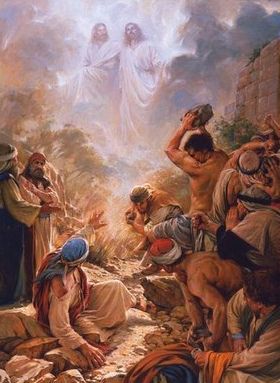
    the acts of Saul begin as witness of the stoning of Stephen in Jerusalem .. and a young man Saul of Tarsus held the cloaks of the men who stoned him

    .. and the witnesses laid down their clothes at a young man’s feet, whose name was Saul. And they stoned Stephen…

    ‘Lord, lay not this sin to their charge.’

    And when he had said this, he fell asleep.

    Acts of the Apostles 7:58-60 excerpt KJV


    APOSTOLIC FAITH 2 Peter 2 Timothy from Paul 2 John & 3 John

    Next: Introduction to the letters of Peter

    Talk of JESUS . com

    Comment on Scripture – Share the Gospel