The Apostles’ Creed is foundational to our Apostolic Christian faith (even though Jesus’ Twelve Apostles didn’t write it).
TalkofJESUS.com has previously examined and defined creeds and Trinity, but today we’ll briefly connect this fundamental of the faith to authority and truth of Apostolic faith from Scripture.
Talk of JESUS .com
Creeds and Credo
How do we know if our fellow worshipers also believe what we do?
Although creeds were originally individual (credo from the Latin, I believe), they shortly became statements of doctrine in which groups set forth their essential beliefs.
Zondervan Pictorial Encyclopedia of the Bible, Tenney, v.1,p.1025
We believe in…
That’s how (regardless of the frequency and regularity of our corporate affirmations) the Apostle’s Creed and other affirmations of faith came about.
Therefore, as part of weekly worship, baptism and other corporate gatherings of believers WE sometimes affirm our CREED together:
YOU witness publicly in worship of the LORD GOD that WE believe in this.
So, DO YOU?
Do YOU really believe this? It's a fair question — a foundational question of WHAT YOU BELIEVE concerning God and Jesus Christ (regardless of recitation as ritual or perhaps never having confessed your faith pubically at all).
Structure of Christian CREEDS
Here’s a brief outline of the fundamental objects of our faith found in The Creed:
I BELIEVE or WE BELIEVE IN:
God
Jesus Christ
the Holy Spirit
and the Virgin Mary
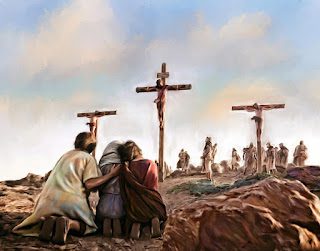
Jesus was crucified
and was buried
He rose from the dead
He ascended to heaven
He sits in the favored place of God the Father
He will judge the living and the dead.
Here, the weightiness of what we have just confessed must certainly convict the faithful soul. Then follows a reiteration and underlining of the same fundamental faith:
The early church taught what is basically in the Apostles creed, yet, they never had a written form of their teaching and called it “The Apostles Creed.” It was not till heresies and divisions in the church that any creeds were established.
The very first established creed that was accepted throughout the church as a whole was the Nicene Creed. The Nicene Creed was established by the Ecumenical church in 325 A.D.. The Apostles creed was established shortly after.
Our outline above used for this SERIES taken from the Old Roman Creed (vide ante) from which the Apostles’ Creed was adapted and possibly in use before the mid-2nd century.
Christians proclaiming Apostolic faith adhere to the narrow path of Scriptural orthodoxy. (I am not the first to have said so.)
Roger@TalkofJesus.com
These essays are concerned only to discuss the actual fact that the central Christian theology (sufficiently summarized in the Apostles’ Creed) is the best root of energy and sound ethics.
G.K. CHESTERTON – ORTHODOXY (pub. AD 1908)
Chesterton also quipped:
There is only one unanswerable argument against Christianity: Christians.
ORTHODOXY (pub. 1994), forward by Philip Yancy, p.xii
The Apostles’ Creed and other affirmations of faith were adopted corporately by the Church to refute permeating heresies plaguing believers since the time of the Apostles.
Catechism – Teaching Church Doctrine summarized by Questions & Answers, formal teaching of Doctrines to members of a Church utilizing verbal recitation of questions and answers.
Creed – I believe this.. Confession of Faith – We (the church) believe this.. & Catechism – Our church teaches these Doctrines: 1.. 2.. 3.. etc.
Last week in our series on Doctrine I defined and shared a brief look at Creeds. We discovered that a Creed is simply a brief statement of what you(supposedly) believe. And while some churches ritually repeat these as part of worship, every church has an underlying defined set of beliefs preached to the masses and taught to the uninitiated.
Confession that Jesus is κύριος – Lord would have been a first Creed of the Way (Christians).
What does your church believe?
After glancing at a few Creeds and Confessions of faith do you now know more about what you believe and what your church believes and preaches?
New believers and children are far more likely to have heard the catechism of your church than a casual weekly ‘worshiper’ gathering for its music and preaching. YES, every church has a catechism (whether veiled, indoctrinated or responsibly taught to its members).
You likely have a few questions of your own (& please do not hesitate to share your question via a comment to this post).
Christian Catechism 100
Allow me to ask you just a few questions you might have heard and can answer from a catechism of your church.
Some will recognize that a 100 series in teaching addresses pre-requisite knowledge; therefore your answers may come more readily to these selective catechism questions than from a 'Catechism 803'theology course.
Note that your children may be taught more than these in their second or third year of 'Sunday School' or a Christian Academy you have chosen for them in lieu of a 'public' school indoctrinating ALL with world-class 'education.'
Do YOU know the answers to your children’s’ catechism questions?
What is the Trinity?
Who is the Holy Spirit?
What is the Law of God and what does it require?
What is sin?
What is idolatry?
What happens when we die?
Will all be saved to eternal life?
Who is Christ?
What is the resurrection?
How does Christ redeem me from sin?
Bonus Question: What makes the Bible Holy?
What do YOU believe?
Catechism? You get the idea from these sample questions above.
Catechism is teaching.
Even when he grows older he will not abandon it.
Preaching and Teaching
Christians hold to and teach a reasoned faith.
Through our study of the Holy Bible, Christians Creeds and Confessions of Faith we grow in our confidence in the Lord God and Jesus Christ, and by the Holy Spirit we continue in the confidence of our salvation God has predestined for those faithful followers of Christ Jesus.
But before we look at Catechisms, let’s briefly define preaching and teaching, comparing their distinct yet parallel roles in the lives of the Church.
Preaching
The Spirit of the Lord GOD is upon me; because the LORD hath anointed me to preach good tidings unto the meek; he hath sent me to bind up the brokenhearted, to proclaim H7121 liberty to the captives, and the opening of the prison to them that are bound;
To proclaim H7121 the acceptable year of the LORD, and the day of vengeance of our God; to comfort all that mourn;
from קָרָאqârâʼ, kaw-raw’; a primitive root (rather identical with H7122 through the idea of accosting a person (metaphor); to call out to
but we preachG2784 Christ crucified, to Jews a stumbling block, and to Gentiles foolishness,
Strong’s G2784 – κηρύσσωkērýssō, kay-roos’-so; of uncertain affinity; to herald (as a public crier), especially divine truth (the gospel):—preacher(-er), proclaim, publish. – 1 Corinthians 1:20 NASB20
Greek definition used of the public proclamation of the gospel and matters pertaining to it, made by John the Baptist, by Jesus, by the apostles and other Christian teachers
Teaching
Now note from this New Testament letter of Paul to Timothy (written in Greek) some particular similarities and differences between preachers and teachers. (We will not dig into the many doctrines covered in these few verses.)
.. For God has not given us a spirit of timidity, but of power and love and discipline. Therefore do not be ashamed of the testimony of our Lord or of me His prisoner, but join with me in suffering for the gospel according to the power of God, who saved us and called us with a holy calling, not according to our works, but according to His own purpose and grace, which was granted to us in Christ Jesus from all eternity, but has now been revealed by the appearing of our Savior Christ Jesus, who abolished death and brought life and immortality to light through the gospel,
for which I was appointed a preacher, an apostle, and a teacher.
κῆρυξ – a preacher – a herald, i.e. of divine truth (especially of the gospel):—preacher.
ἀπόστολος – an apostle – a delegate, messenger, one sent forth with orders
διδάσκαλος – a teacher – in the NT one who teaches concerning the things of God, and the duties of man
From διδάσκω (G1321) – .. to hold discourse with others in order to instruct them, to impart instruction,
instill doctrine into one.. to explain or expound a thing, to teach one something
Catechism & Teaching Doctrine
The Creeds, Catechisms and Confessions are useful study tools to assist in understanding the Scriptures and in teaching Bible studies to others. These documents help to reaffirm the tenants of the traditional, historic Christian faith.
Why Catechisms MUST reflect Biblical Authority ABOVE all Church authority
The following article and resource originally ran on July 8, 2018. A few weeks later, Pope Francis announced a redaction of the 1992 Catechism of the Catholic Church..
Luther wrote his little catechism for parents to instruct their children in the faith just as he wrote his larger catechism as remedial instruction for pastors. Catechism in its Latin form means “book of instruction.”
From its Greek roots, catechism means literally “sounding down in the ears” or, more pointedly, “indoctrination” in the Christian faith.
For Martin Luther, basic catechesis (doctrinal instruction) in the Christian faith refers to teaching children (and their parents!) the Ten Commandments, the Apostles’ Creed, the Lord’s Prayer, and the biblical basis for Baptism, Eucharist, and Confession.
Although the complete Catechisms may be read on secure links, ONLY a few EXAMPLES of KEY DOCTRINAL TEACHING can be included in this brief post. - RH
128 questions & answers; later,129 questions and answers were divided into 52 “Lord’s Days” with a view to the Catechism’s being explained in one of the services on the Lord’s Day.
Here is the typical Q & A format with Scriptural references supporting the Authority of each answer:
Question 1. What is thy only comfort in life and death?
PAUSE: IF you yourself have never heard this or considered this life and death question,
NOW might be a good time to pray for an answer (prior to reading the Scripturally supported ANSWER below). - RH
Answer:
That I with body and soul, both in life and death,a am not my own,b but belong unto my faithful Saviour Jesus Christ;c who, with his precious blood, has fully satisfied for all my sins,d and delivered me from all the power of the devil;e and so preserves mef that without the will of my heavenly Father, not a hair can fall from my head;g yea, that all things must be subservient to my salvation,h and therefore, by his Holy Spirit, He also assures me of eternal life,i and makes me sincerely willing and ready, henceforth, to live unto him.j
You should know this, Timothy, that in the last days there will be very difficult times. For people will love only themselves and their money.
They will be boastful and proud, scoffing at God, disobedient to their parents, and ungrateful.
They will consider nothing sacred.
They will be unloving and unforgiving;
they will slander others and have no self-control.
They will be cruel and hate what is good.
They will betray their friends, be reckless, be puffed up with pride, and love pleasure rather than God.
They will act religious, but they will reject the power that could make them godly.
Stay away from people like that!
Heidelberg Catechism of 1563: The Second Part – Of Man’s Deliverance
Trinity and the true faith of Scripture as expressed in Creeds caution the church (or the saints {small ‘s’} in these life and death matters. For these are matters concerning ETERNAL LIFE with the Lord or the God-given punishment of Hell and Death deserved by ALL.
Question 12: Answer: God will have his justice satisfied: and therefore we must make this full satisfaction, either by ourselves, or by another.
Question 16. Why must he be very man, and also perfectly righteous?
Question 17. Why must he in one person be also very God?
Here (among other doctrines) is where false teachers DENY TRINITY & refuse to teach the Very Truth of Scripture.
If You are the Christ, tell us plainly.”
Gospel of John 10: Question of the Jews as Jesus was walking in the temple area, in the portico of Solomon.
Question 22. What is then necessary for a christian to believe?
Answer: All things promised us in the gospel,a which the articles of our catholic undoubted christian faith briefly teach us.
References: (a) Jhn 20:31; Mat 28:19; Mar 1:15
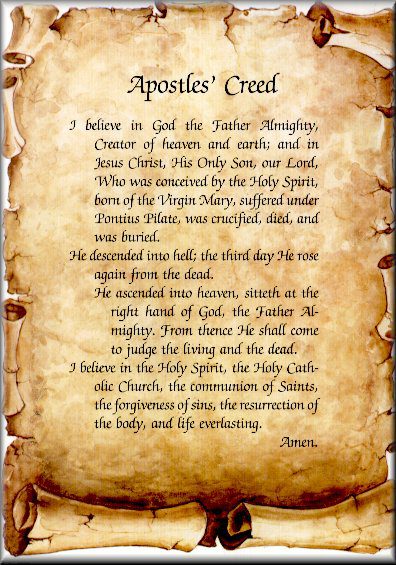
What follows as the answer to Question 23 is THE APOSTLES CREED.
I believe in God the Father, Almighty, Maker of heaven and earth:
And in Jesus Christ, his only begotten Son, our Lord:
Who was conceived by the Holy Ghost, born of the Virgin Mary:
TRINITY, from the beginning – Father, begotten Son and Holy Ghost [or Holy Spirit].
Question 25. Since there is but one only divine essence,(a) why speakest thou of Father, Son, and Holy Ghost?
Answer: Because God has so revealed himself in his word,(b) that these three distinct persons are the one only true and eternal God.
References:
(a) Deu 6:4; Eph 4:6; Isa 44:6; Isa 45:5; 1Co 8:4; 1Co 8:6
(b) Isa 61:1; Luk 4:18; Gen 1:2; Gen 1:3; Psa 33:6; Isa 48:16; Psa 110:1; Mat 3:16; Mat 3:17; Mat 28:19; 1Jo 5:7; Isa 6:1; Isa 6:3; Jhn 14:26; John 15:26; 2Co 13:13; Gal 4:6; Eph 2:18; Tts 3:5; Tts 3:6
Heidelberg Catechism of 1563: The Second Part – Of God the Son
Question 29. Why is the Son of God called “Jesus”, that is a Saviour?
Answer: Because he saveth us, and delivereth us from our sins;(a) and likewise, because we ought not to seek, neither can find salvation in any other.(b)
References: (a) Mat 1:21; Hbr 7:24-25 (b) Act 4:12; Jhn 15:4-5; 1Ti 2:5; Isa 43:11; 1Jo 5:11
Now the birth of Jesus the [From Gr Christos, which means Messiah (Heb for Anointed One)]Messiah was as follows: .. an angel of the Lord appeared to him in a dream, saying, “Joseph.. that which has been conceived in her is of the Holy Spirit. “She will give birth to a Son; and you shall name Him Jesus, for He himself will save His people from their sins.”
The Gospel of Matthew excerpt from 1:18a,20b,d,v.21
This section of the Heidelberg Catechism of the 16th century asks students of true faith a question still relevant to you, to me and to every 21st century Christian:
(I'll paraphrase question 32 to update the translation from German into the King's English used in the KJV.)
[Time to PAUSE & think through your reasoned Christian faith before you answer the KEY QUESTION below.]
Do YOU, my 21st century brother (or sister) in Christ have an answer of your Christian witness?
Is the Doctrine (teaching or catechism) from which you learned your answer based on Holy Scripture?
As a Christian with a free and good conscience I may fight against sin and Satan in this life;
References: (f) 1Pe 2:11 Rom 6:12-13; Gal 5:16-17; Eph 6:11; 1Ti 1:18-19
and after this mortal life, Christ may choose me to reign with him eternally, over all creatures.
References: (g) 2Ti 2:12; Mat 24:34
*Complete Scripture will open in BlueLetterBible.org as you read each Question, Answer & Reference. I recommend it for your further prayer and study. RH
The statement is trustworthy: For if we died with Him, we will also live with Him;
If we endure, we will also reign with Him; If we will deny Him, He will also deny us;
Why Creeds, Confessions of Faith & Catechisms still matter to Christians
Today I invite you to examine what you believe through the eyes of centuries old teachings of the Christian faith. Maybe your worship service includes one of the obligatory Creeds or other Confession of faith ALL must recite. And by repetition these words flow from the tongue trippingly with little or no thought.
And what is a Catechism, anyway? (Isn’t that some old Catholic thing that no longer applies?)
Perhaps your contemporary gathering of ‘christians‘ has no need to follow the applause for your inspiring praise band with any such serious declarations (or perhaps even scripture beyond what your Pastor will paraphrase for our brief understanding).
ALL Christians in past more authoritarian days heard Creeds, Confessions of faith in Christ and even studied these clearly defined Doctrines of the Church.
I’ll answer your questions and for our mutual understanding of misunderstood terms, we will define each of these mostly affirmations of historical, Biblical Christian faith.
We will also READ what each of several Creeds and Confessions have to say. You can decide for yourself what you believe – what is relevant to your Christian faith.
Creeds
What is a Creed?
The word creed comes from the Latin word credo, meaning, “I believe.”
WHAT do you believe? Do you know? Can you verbalize your Christian faith?
Do you know what your ‘church’ community believes, preaches and witnesses to others?
Creed, also called confession of faith, an authoritative formulation of the beliefs of a religious community (or, by transference, of individuals). The terms “creed” and “confession of faith” are sometimes used interchangeably, but when distinguished “creed” refers to a brief affirmation of faith employed in public worship or initiation rites, while “confession of faith” is generally used to refer to a longer, more detailed, and systematic doctrinal declaration.
Lindbeck, George Arthur. “Creed”. Encyclopedia Britannica, 2 Jan. 2020, https://www.britannica.com/topic/creed. Accessed 25 August 2021.
Confessions
A Creed – Your stated faith, basically brief enough to reaffirm in a worship service (whether weekly or occasionally)
Confession of Faith – A longer extension of a creed more suited for the study of the Doctrines behind our foundational Christian beliefs stated in a creed.
Dismiss any notion that your confession of faith is private ONLY, i.e. your confession of sin may be private, but your Confession of Faith is PUBLIC, not only to your church but especially as witness to Christ in the presence of unbelievers (some sitting among you ‘in church’).
And as you can see below, some Confessions have both Short & Long Catechisms
* Jews generally agreed by the time of Jesus Christ what Books to include in Scripture.
* New Testament Books, ALL written by the end of the first century [A.D. 100], became generally accepted by the Church as the Authoritative Word of God.
*Some ‘Extra-Biblical,’ writings after A.D. 100 were written as heretical opposition to the Lord Christ Jesus, even as most of the Apostles had warned in the decades after Christ’s teachings and Ascension.
(Reminder:} The Church initially divided into Orthodox (Eastern) and Roman (Catholic, meaning ‘universal’) at the time of the political division of the fallen Roman Empire, then formally after several (7) unified Church councils until A.D. 787 and finally at the Great Schism in A.D. 1084.
(Additional DEFINITION of Orthodox: conforming to established doctrine.., conventional..)
Chronology of Creeds, Confessions, & more
Of course Christians do NOT agree on everything, but MOST will not DENY the historical and Biblical basic beliefs of Christian faith.
By looking at some of the foundational creeds and confessions of Christian faith chronologically, you may better understand their role in keeping false teaching out of the Church in the more than two millennia since Christ died for our sins and rose from death on a Cross.
Used to monitor number of Google Analytics server requests
10 minutes
__utmb
Used to distinguish new sessions and visits. This cookie is set when the GA.js javascript library is loaded and there is no existing __utmb cookie. The cookie is updated every time data is sent to the Google Analytics server.
30 minutes after last activity
__utmc
Used only with old Urchin versions of Google Analytics and not with GA.js. Was used to distinguish between new sessions and visits at the end of a session.
End of session (browser)
__utmz
Contains information about the traffic source or campaign that directed user to the website. The cookie is set when the GA.js javascript is loaded and updated when data is sent to the Google Anaytics server
6 months after last activity
__utmv
Contains custom information set by the web developer via the _setCustomVar method in Google Analytics. This cookie is updated every time new data is sent to the Google Analytics server.
2 years after last activity
__utmx
Used to determine whether a user is included in an A / B or Multivariate test.
18 months
_ga
ID used to identify users
2 years
_gali
Used by Google Analytics to determine which links on a page are being clicked
30 seconds
_ga_
ID used to identify users
2 years
_gid
ID used to identify users for 24 hours after last activity
24 hours
_gat
Used to monitor number of Google Analytics server requests when using Google Tag Manager
1 minute
_gac_
Contains information related to marketing campaigns of the user. These are shared with Google AdWords / Google Ads when the Google Ads and Google Analytics accounts are linked together.