Tag: apostles

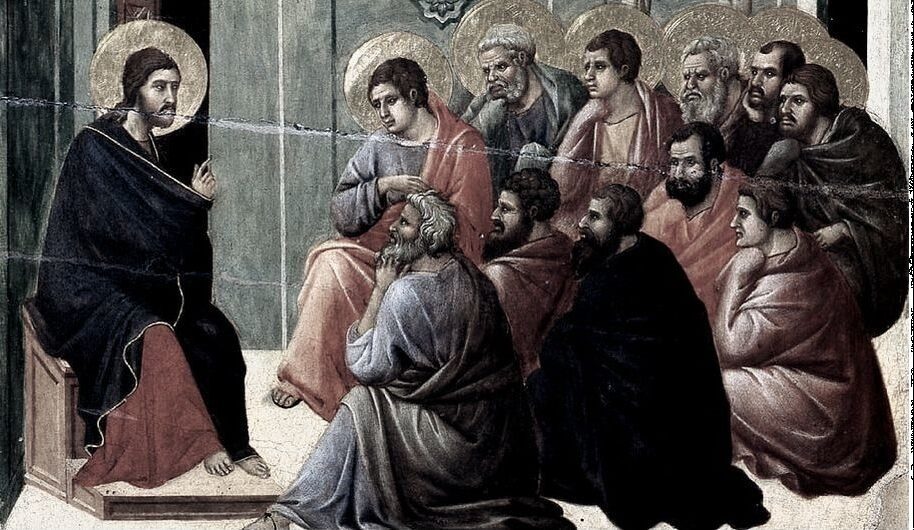
  • 11 Witnesses to Jesus Risen! –  the Eleven

    11 Witnesses to Jesus Risen! – the Eleven

    HE IS RISEN!

    ‘HE IS RISEN, INDEED,’ goes a traditional response.

    Christ Born & Witnessed, Crucified, Risen, Ascended..

    If you haven’t been following this series you will likely ask, “Why is he talking of Easter during this Advent season of Christmas in the year of our Lord, 2020?”

    My dear brother or sister in Christ,

    Allow me to ask you a question:

    manger with shadow of cross falling across

    Do you talk of Jesus OR ‘christmas’?

    Christians and non-Christians alike will focus on the ‘.COMmercial‘ obligations of this ‘holiday’ season so much more than the CHRIST of ‘christmas.’ And in fact, (in case you haven’t heard) Jesus, Emmanuel or God With Us was most likely NOT born DECEMBER 25.

    (Forget the .com technical choice of my Christian Social Witness – talkofJesus.com for my personal & shared talk of Jesus Christ.)

    Has Christmas not become MORE important than EASTER in the witness of the 21st c. Church?

    How like the world we have become.

    Many 21st c. ‘christians’ also witness the risen JESUS of the resurrection, celebrated by eggs and bunnies impersonalized and separated from the Person of God, without witness of the Person symbolized, He who died for sinners and defeated death!

    Yes, JESUS IS born as a man-child like no other. Yet our witness must remember the shadow of the Cross on a newborn’s manger and the glory and hope through CHRIST’s resurrection.

    Continuing Witness to Jesus’ Resurrection!

    Our journey through Scripture in this year of our Lord 2020, continues in the Good News of John. We have just begun to revisit the personal witness of many who testify to the resurrection of Jesus Christ.

    As a reminder to contemporary readers of John’s Gospel:

    • Jesus was crucified around the year AD 30
    • John writes his Gospel to the churches in about AD 85

    Witnesses to Jesus Risen! – Mary Magdalene

    Some who witnessed the risen Jesus fifty years earlier still lived!

    As we continue in John’s Good News and Mary’s announcement of Jesus’ resurrection, we begin to hear his Gospel through the ears of others. See Jesus with their eyes and experience the risen Christ through their personal touch and interaction with the risen Lord Jesus.

    Mary Magdalene came and announced to the disciples, “I have seen the Lord,” and that He had said these things to her.

    John 20:18 NASB

    What command had the risen Lord given Mary?

    “..go to My brothers and say to them, ‘I am ascending to My Father and your Father, and My God and your God.’”

    John and Simon Peter have already run to the empty tomb where the crucified Body of Jesus had been placed prior to celebration of the feast of the Passover and observing of the Sabbath. Then they returned not yet having seen the Lord.

    John 20 continued

    It had been morning when the women had first seen the empty tomb before summoning John and Peter.

    19 Now when it was evening on that day, the first day of the week..

    .. and when the doors were shut where the disciples were together due to fear of the Jews, Jesus came and stood in their midst, and said to them, “Peace be to you.”

    20 Having said this, he showed them his hands and his side.

    So the disciples rejoiced when they saw the Lord.
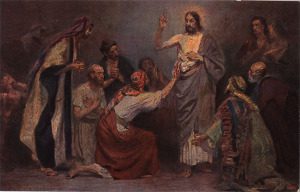
    (Not Twelve, but the Eleven – one)

    We mentioned previously that Judas Iscariot, Jesus’ betrayer has hanged himself. John will mention shortly that Thomas also is not present.

    And just one additional reminder: 
    the eleven Disciples, Jesus and His family are all Jews.
    Though their common language is Greek or locally Arabic,
    the Complete Jewish Bible [CJB] (used here occasionally) gives flavor of Jesus as the Messiah of Israel.

    21 “Shalom aleikhem!” Yeshua repeated.

    “Just as the Father sent me, I myself am also sending you.”

    22 Having said this, he breathed on them and said to them,

    “Receive the Ruach HaKodesh!

    The Holy Spirit & Forgiven Sins

    “Receive ye the Holy Ghost,” translates the King James and most versions read, “the Holy Spirit.”

    What follows should sound familiar if you have followed the great commission of Jesus to the Twelve Disciples given earlier in His earthly ministry and all returned to Jesus amazed.

    23 If you forgive the sins of any, their sins have been forgiven them; if you retain the sins of any, they have been retained.”

    What an astounding authority Jesus has given to the Apostles through the Holy Spirit!

    Many Jewish disciples will know it well from the Psalms of David. Gentile Christians to whom John now also witnesses may know it from Paul’s letter [ca. AD 56.] to the Romans [4:7].

    לְדָוִד מַשְׂכִּיל אַשְׁרֵי נְֽשׂוּי־פֶּשַׁע כְּסוּי חֲטָאָֽה׃

    אַשְֽׁרֵי אָדָם לֹא יַחְשֹׁב יְהוָה לֹו עָוֹן וְאֵין בְּרוּחֹו רְמִיָּה׃

    Blessed is he whose transgression is forgiven, whose sin is covered.

    Blessed is the man unto whom the LORD imputeth not iniquity, and in whose spirit there is no guile.

    Psalm 32:1-2 WLC, KJV

    The Lord has instructed His Disciples on how they must judge their fellow saints and others with unfailing grace and mercy in His Name, especially forgiving those who also follow Jesus as their Lord and their God.

    Ministry of the Twelve (then Eleven)

    Eleven now and again Twelve Apostles after Mathias replaces Judas Iscariot

    Although John reveals much of the Holy Spirit, he does not reiterate what is already well known of the ministry of the Twelve prior to Jesus’ Crucifixion and Resurrection. (Remember John writes this decades later to his beloved fellow saints of the church.)

    Jesus had previously given the Twelve a taste of this awesome power over sin in the lives of others.

    Some eight days after these sayings, He took along Peter and John and James, and went up on the mountain to pray. And while He was praying, the appearance of His face became different, and His clothing became white and gleaming.

    Luke 9:28-29
    Most of the following is also witnessed in Luke's Gospel Chapter 9:

    Matthew 10:

    Jesus summoned His twelve disciples and gave them authority over unclean spirits, to cast them out, and to heal every kind of disease and every kind of sickness.

    Now the names of the twelve apostles are these:

    1. The first, Simon, who is called Peter,
    2. and Andrew his brother;
    3. and James the son of Zebedee,
    4. and John his brother;
    5. Philip
    6. and Bartholomew [son of Talmai];
    7. Thomas [not present for Jesus’ first appearance]
    8. and Matthew the tax collector;
    9. James the son of Alphaeus,
    10. and Thaddaeus;
    11. Simon the Zealot,
    12. and Judas Iscariot, the one who betrayed Him [who hanged himself].

    Matthew 10:5 continues:

    These twelve Jesus sent out after instructing them:

    “Do not go in the way of the Gentiles, and do not enter any city of the Samaritans; but rather go to the lost sheep of the house of Israel.

    (Of course Christ commissioned these to go to all of these after His resurrection.)

    “And as you go, preach, saying, ‘The kingdom of heaven is at hand.’

    It is Jesus’ urgent appeal to the Jews through the Twelve – Matthew 10:7 NASB
    Matthew 10: continued Complete Jewish Bible [CJB]

    7 As you go, proclaim, ‘The Kingdom of Heaven is near,’ 8 heal the sick, raise the dead, cleanse those afflicted with tzara’at, expel demons…

    12 When you enter someone’s household, say, ‘Shalom aleikhem!’ If the home deserves it, let your shalom rest on it; if not, let your shalom return to you. But if the people of a house or town will not welcome you or listen to you, leave it and shake its dust from your feet!

    Yes, I tell you, it will be more tolerable on the Day of Judgment for the people of S’dom and ‘Amora than for that town!

    16 “Pay attention! I am sending you out like sheep among wolves, so be as prudent as snakes and as harmless as doves.

    Be on guard, for there will be people who will hand you over to the local Sanhedrins and flog you in their synagogues. On my account you will be brought before governors and kings as a testimony to them and to the Goyim.

    19 But when they bring you to trial, do not worry about what to say or how to say it; when the time comes, you will be given what you should say. For it will not be just you speaking, but the Spirit of your heavenly Father speaking through you.

    Therefore when Jesus appears in Person to the eleven Apostles after His resurrection from the grave, He had already taught them what He is about to say.

    John 20 continued

    If you forgive the sins of any, they are forgiven them;

    if you retain the sins of any, they are retained.”

    John 20:23 CSB – Jesus’ authority given to the Apostles through the Holy Spirit

    Next:

    John is not making a list of miracles so that the Eleven (who will soon add Mathias as replacement to Judas Iscariot) can convince their first century A.D. followers that Christ IS Risen indeed!

    You will find many of these miracles of the Holy Spirit witnessed in the Acts of the Apostles.

    (Again, when John wrote his Gospel these had already taken place.)

    If you have been following John’s Gospel closely you may have noticed my intentional oversight of some detail about the Disciples. Thomas, who was not present with the other eleven will appears next [vs. 24-29].

    We will begin with Thomas next time.

    Also, John has much more to say about Peter and we will once again want to add more detail about other Apostles and especially John.

    30 Jesus performed many other signs in the presence of his disciples that are not written in this book.

    To be continued...
  • God’s Love Through John: Disciples

    “If anyone serves me, he must follow me. Where I am, there my servant also will be. If anyone serves me, the Father will honor him.

    John 12:26

    Preachers, Teachers & Disciples

    We’ve all seen them, the up and coming preachers who gain a public following. Of course appointed religious officials would like to be the superstars of their mega-temples in Jerusalem or cathedrals of later times, but this was not the style of Jesus or of his populist predecessor, John the Baptist.

    Some men have the gift of preaching a message to which others will respond and follow. As we pointed out in our previous post, John the Baptist was one such gifted preacher and like Jesus after him, he also had gained a following of disciples.

    How is a Disciple different from other hearers of preaching?

    To be clear, Jesus was not the only teacher or Rabbi with disciples, so let’s begin with a definition.

    μαθητής – mathētēs – a learner, pupil, disciple – from μανθάνω manthanō – to learn (in any way):—learn, understand.

    Certain followers of rabbis of the same school of teaching, as in the party of the Pharisees, were also called disciples. These disciples often were loyal to a particular teaching in a certain place, often Jerusalem. Popular Pharisees and popular Sadducees competed for prominent disciples with influence.

    Iterate teachers like Jesus or teachers in the wilderness like John also developed a following. Their crowds of disciples wanted to learn more about what they were preaching, but had to travel to a distant place to hear more teaching from this rabbi or prophet.

    The question of truth always goes to what are they preaching and why does their message connect to their followers?

    John’s Disciples

    John’s message is ‘repent and be baptized,’ but it is more than that. Note these references to the disciples of John, men who followed John the Baptist as he cried out to sinners to repent and be baptized. 

    John 1:

    “I baptize with water,” 

    “Someone stands among you, but you don’t know him. He is the one coming after me, whose sandal strap I’m not worthy to untie.”

    35 The next day, John was standing with two of his disciples. 36 When he saw Jesus passing by, he said, “Look, the Lamb of God!”

    37 The two disciples heard him say this and followed Jesus.

    What a pivotal moment it must have been in their lives! These two men were disciples of the brash baptist, John, the Prophet of the wilderness.

    And what had John witnessed to his disciples about Jesus?

    “Here is the Lamb of God, who takes away the sin of the world!

    30 This is the one I told you about:

    ‘After me comes a man who ranks ahead of me, because he existed before me.’

    31 I didn’t know him, but I came baptizing with water so he might be revealed to Israel.”

    He confessed, and did not deny, but confessed, “I am not the Christ.” – John 1:20 ESV

    Therefore, these two disciples of John the Baptist now turn to follow Jesus.

    Disciples of John follow the Messiah

    Where are you staying?
    38 When Jesus turned and noticed them following him, he asked them, “What are you looking for?”


    They said to him, “Rabbi” (which means “Teacher”), “where are you staying?”

    39 “Come and you’ll see,” he replied. So they went and saw where he was staying, and they stayed with him that day. It was about four in the afternoon.

    40 Andrew, Simon Peter’s brother, was one of the two who heard John and followed him. 

    Who was this unnamed disciple with Andrew who heard John and followed Jesus? No doubt, the young evangelist, John, who will also introduce his older brother to the Messiah of Israel.

    James and John, along with Andrew’s brother, Simon Peter, will become Jesus’ inner circle of Disciples.

    Disciples and Apostles

    A preacher or teacher may have many listeners who do not hear, but men like John the Baptist had followers or disciples. John’s message was more weighty than the politically correct preaching of any particular religious party (like the Pharisees), with the authority of the LORD in Scripture.

    Disciples are followers of a certain teacher, Rabbi or other preacher. Some now use the terms disciple and apostle interchangeably, but is there a difference?

    Preachers need an audience of listeners. Disciples may follow some teachers of Scripture or other philosophy, yet an apostle is different. The apostle is a man with a different function than merely following a teacher.

    Apostle

    ἀπόστολος – apostolos – a delegate, messenger, one sent forth with orders; specifically applied to the twelve apostles of Christ, in a broader sense applied to other eminent Christian teachers, i.e. of Barnabas, of Timothy and Silvanus. – from ἀποστέλλω – apostellō – to order (one) to go to a place appointed or to send away, dismiss.

    The Apostle John does not refer to himself as an Apostle in his Gospel or three letters, even though clearly he is sent by Jesus after His resurrection. John makes only a single reference in the words of Jesus at the time of their preparation for the Sacrifice of the Lamb of God for the atonement of Israel.

    Nearly three years after having been disciples of John the Baptist Jesus will send them out as Apostles. John witnesses a story of their mission pointing to his own love and humility learned from Jesus.

    The Meaning of Foot Washing

    John 13:

    12 When Jesus had washed their feet and put on his outer clothing, he reclined again and said to them, “Do you know what I have done for you? 13 You call me Teacher and Lord—and you are speaking rightly, since that is what I am. 14 So if I, your Lord and Teacher, have washed your feet, you also ought to wash one another’s feet. 15 For I have given you an example, that you also should do just as I have done for you.

    16 “Truly I tell you, a servant is not greater than his master, and a messenger is not greater than the one who sent him. 17 If you know these things, you are blessed if you do them.

    You may find the terminology of the King James Version helpful to understanding the root relationship between a master teacher and a follower sent out.

    Verily, verily, I say unto you, The servant is not greater than his lord; neither he that is sent greater than he that sent him.

    John 13:16 KJV

    Amen, amen,’ begins the Greek. The servant is δοῦλος doulos, the same word used for slave. (I know we have difficulty relating to this relationship.)

    The slave, therefore, says Jesus to His Disciples, is not greater than the lord (a term used for the master responsible for slaves). And ‘he that is sent,’ ἀπόστολος apostolos or apostle, is not greater than the one who sends (his lord who commands him with the message).

    John the Baptist did not send his own disciples to Jesus, but witnessed the Lord of all Authority.

    I have seen and testified that this is the Son of God.”

    John 1:34

    Early Disciples of The Twelve

    35 The next day, John was standing with two of his disciples. 36 When he saw Jesus passing by, he said, “Look, the Lamb of God!”

    John and Andrew, disciples of John the Baptist follow Jesus. They may not have been the only ones and other disciples no doubt followed Jesus later.

    Their brothers, Peter and James then follow.

    41 He [Andrew] first found his own brother Simon and told him, “We have found the Messiah” (which is translated “the Christ”), 42 and he brought Simon to Jesus.

    When Jesus saw him, he said, “You are Simon, son of John. You will be called Cephas” (which is translated “Peter”).

    43 The next day Jesus decided to leave for Galilee. He found Philip and told him, “Follow me.”
    Galilee to the north of Judea is of course not only the place where Jesus stayed, but also the place of business for Simon and Andrew, sons of Zebedee, and others.

    Beginning in Galilee

    44 Now Philip was from Bethsaida, the hometown of Andrew and Peter. 45 Philip found Nathanael and told him, “We have found the one Moses wrote about in the law (and so did the prophets): Jesus the son of Joseph, from Nazareth.”

    46 “Can anything good come out of Nazareth?” Nathanael asked him.

    “Come and see,” Philip answered.

    John, Andrew, Peter and then Philip, (John’s older brother James is not yet mentioned); the an addition of Nathanael. 

    47 Then Jesus saw Nathanael coming toward him and said about him, “Here truly is an Israelite in whom there is no deceit.”

    48 “How do you know me?” Nathanael asked.

    “Before Philip called you, when you were under the fig tree, I saw you,” Jesus answered.

    49 “Rabbi,” Nathanael replied, “You are the Son of God; you are the King of Israel!”

    “Teacher, you are the Messiah and King of Israel,” says Nathaniel (נְתַנְאֵל which means, “God/El has given”), who other Gospel writers refer to as, ‘Bartholomew.’ He is likely also a fisherman from Cana, near Nazareth, where Jesus grew up as a child after returning from Egypt.

    John does not introduce the other Disciples of Jesus here, but continues with witness of Jesus’ first miracle at a wedding in Cana, where John and other local Disciples were no doubt present.

    50 Jesus responded to him [Nathanael], “Do you believe because I told you I saw you under the fig tree? You will see greater things than this.”

    51 Then he said, “Truly I tell you, you will see heaven opened and the angels of God ascending and descending on the Son of Man.”

    To be continued...
  • You are my Son

    You are my Son

    Acts 13:

    “‘You are my Son,
        today I have begotten you.’

    34 And as for the fact that he raised him from the dead, no more to return to corruption, he has spoken in this way,

    “‘I will give you the holy and sure blessings of David.’

    35 Therefore he says also in another psalm,

    “‘You will not let your Holy One see corruption.’

    What do you think: When you run to the place where the body should be, do you have faith in the resurrection?

    The dramatic events and turn of expectations at that last celebration of the Passover in Jerusalem must have been traumatic for the Apostles, dear friends and followers of Jesus of Nazareth. The turn of the triumphal entrance with crowds of believers and followers digressing into the stealth of an arrest in the night, trial away from the crowds and manipulative sentence of cruel punishment and humiliation of bloody death on a cross must have terrorized the hearts of all who believed that Jesus is the Christ, the Messiah, the King promised by scripture.

    What had happened? (No disciple could have imagined that it would have turned out like this.) He said so many things during those three years, but it is inconceivable to even the faithful mind that the Son of God would not now win back the Kingdom promised by God the Father of our Lord Jesus Christ. What happened?

    “You will surely die,” says scripture.

    Yes. We will all surely die and so did Jesus! Even Lazarus, who Jesus raised from the dead and the young daughter of Jairus and son of the widow at Nain – those Christ raised from death – even they will die once again. The disciples of Jesus all knew this; yet in considering the resurrection they never considered the consequence of death which precedes. Eternal life! (What will it be like?) Yet first, death – even death on a Cross.

    The women had seen His tomb empty. The Apostles had raced to the empty tomb only to find the wrappings of death left in the darkness, as if removed like a change of clothes. Then Jesus appeared, alive, in many forms and at many times! He IS risen and the Lord sends us to witness to the world this great love of God our Father. The Kingdom has come.

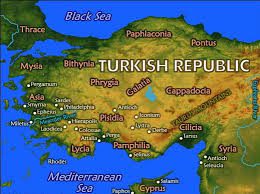
    Turkey 1st c Roman provencesEven a once skeptical unbelieving leading teacher of Scripture met Jesus on a road to Damascus. In fact, Saul of Tarsus not only teaches Jews of the dispersion throughout the Roman Empire some thought Jesus would overthrow; Paul (his new God-given name) is an Apostle to the gentiles.

    Paul, who travels at great risk even of his own death if caught by those who pursue him, comes to city after city preaching the gospel of the love of Christ Jesus for Jew, Greek and Roman. Paul, confirmed by the Apostles and Barnabas in Pisidia, the town of Antioch, later preached what the Apostles did not understand until after the risen Christ opened up the scriptures for them.

    +

     Acts 13

    And on the Sabbath day they went into the synagogue and sat down. 15 After the reading from the Law and the Prophets, the rulers of the synagogue sent a message to them, saying, “Brothers, if you have any word of encouragement for the people, say it.” 16 So Paul stood up, and motioning with his hand said:

    “Men of Israel and you who fear God, listen. 17 The God of this people Israel chose our fathers and made the people great during their stay in the land of Egypt, and with uplifted arm he led them out of it. 18 And for about forty years he put up with them in the wilderness. 19 And after destroying seven nations in the land of Canaan, he gave them their land as an inheritance. 20 All this took about 450 years. And after that he gave them judges until Samuel the prophet.

    21 Then they asked for a king, and God gave them Saul the son of Kish, a man of the tribe of Benjamin, for forty years. 22 And when he had removed him, he raised up David to be their king, of whom he testified and said, ‘I have found in David the son of Jesse a man after my heart, who will do all my will.’ 23 Of this man’s offspring God has brought to Israel a Savior, Jesus, as he promised.

    24 Before his coming, John had proclaimed a baptism of repentance to all the people of Israel. 25 And as John was finishing his course, he said, ‘What do you suppose that I am? I am not he. No, but behold, after me one is coming, the sandals of whose feet I am not worthy to untie.’

    26 “Brothers, sons of the family of Abraham, and those among you who fear God, to us has been sent the message of this salvation. 27 For those who live in Jerusalem and their rulers, because they did not recognize him nor understand the utterances of the prophets, which are read every Sabbath, fulfilled them by condemning him. 28 And though they found in him no guilt worthy of death,they asked Pilate to have him executed. 29 And when they had carried out all that was written of him, they took him down from the tree and laid him in a tomb.

    30 But God raised him from the dead, 31 and for many days he appeared to those who had come up with him from Galilee to Jerusalem, who are now his witnesses to the people.

    32 And we bring you the good news that what God promised to the fathers, 33 this he has fulfilled to us their children by raising Jesus, as also it is written in the second Psalm,

    “‘You are my Son,
        today I have begotten you.’

    34 And as for the fact that he raised him from the dead, no more to return to corruption, he has spoken in this way,

    “‘I will give you the holy and sure blessings of David.’

    35 Therefore he says also in another psalm,

    “‘You will not let your Holy One see corruption.’

    36 For David, after he had served the purpose of God in his own generation, fell asleep and was laid with his fathers and saw corruption, 37 but he whom God raised up did not see corruption.

    38 Let it be known to you therefore, brothers,that through this man forgiveness of sins is proclaimed to you, 39 and by him everyone who believes is freed from everything from which you could not be freed by the law of Moses. 40 Beware, therefore, lest what is said in the Prophets should come about:

    41 “‘Look, you scoffers,
        be astounded and perish;
    for I am doing a work in your days,
        a work that you will not believe, even if one tells it to you.’”

    42 As they went out, the people begged that these things might be told them the next Sabbath.

    43 And after the meeting of the synagogue broke up, many Jews and devout converts to Judaism followed Paul and Barnabas, who, as they spoke with them, urged them to continue in the grace of God.

    44 The next Sabbath almost the whole city gathered to hear the word of the Lord. 45 But when the Jews saw the crowds, they were filled with jealousy and began to contradict what was spoken by Paul, reviling him. 46 And Paul and Barnabas spoke out boldly, saying, “It was necessary that the word of God be spoken first to you. Since you thrust it aside and judge yourselves unworthy of eternal life, behold, we are turning to the Gentiles. 47 For so the Lord has commanded us, saying,

    “‘I have made you a light for the Gentiles,
        that you may bring salvation to the ends of the earth.’”

    48 And when the Gentiles heard this, they began rejoicing and glorifying the word of the Lord, and as many as were appointed to eternal life believed.49 And the word of the Lord was spreading throughout the whole region. 50 But the Jews incited the devout women of high standing and the leading men of the city, stirred up persecution against Paul and Barnabas, and drove them out of their district. 51 But they shook off the dust from their feet against them and went to Iconium. 52 And the disciples were filled with joy and with the Holy Spirit.

    +

    It’s all there in the Bible. The disciples of Jesus knew these scriptures. Yet like us, they wanted to understand God’s word applied in their lives in a way less painful and more victorious.

    “Son of David,” they shouted. Surely God would establish a Kingdom even more glorious than that of David and Solomon. And imagine: a Son of God who would rule forever – a Son of Man like us. (Could He die?) God the Father will put the Son in charge. All will be resurrected to the Kingdom of the Son of God! He will be judge of all souls and rule with the righteousness of the Father.

    We will surely die. Even the Apostles died. Paul died. All died. Your loved ones and your ancestors have died. You will die. I will die. Yet, finally we see a light from the darkness of death – a resurrection of the soul and a redemption for our sin.

    This is the gospel of Jesus Christ, that all who believe in him will be forgiven our sins. By grace we are given life eternal, which we do not deserve. Yet because of God’s love for us, the victory of the Cross changes everything.

    Has your faith in the Son changed your life, knowing your hope after death?

    John 14:6  Jesus said to him, “I am the way, and the truth, and the life. No one comes to the Father except through me.”

    The risen Christ; Jesus, their crucified friend, had to explain scripture and the victory of His resurrection over sin and death to His beloved and amazed Apostles. (It’s all there in the Bible for you to read even to this day.)

    Do you believe it? While it is yet today, why not live for Christ? For to die is gain.