From familiar Scripture as a young man near Jesus,
or an old man on Patmos;
or do you see a faithful man following Jesus on an extraordinary journey lasting many years?
INTRODUCTION to JOHN’s Apostolic Faith
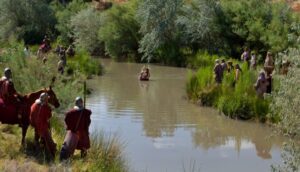
late A.D. 20’s at the Jordan river near Bethany
John was there again with two of his disciples. When he saw Jesus walking by, he said, “Look, the Lamb of God!” And when the two disciples heard him say this, they followed Jesus.
Jesus turned and saw them following.
“What do you want?”
“Rabbi”
“where are You staying?”
“Come and see,”
So they went and saw where He was staying, and spent that day with Him.
Gospel of John 1:35-39 excerpt, BSB
James and his young brother John were not sleeping when the Messiah of Israel came to their Rabbi, John the Baptist.
In fact, these two sons of Zebedee had sought the savior of Israel, and then found and followed John the Baptist (who many Jews believed could be the one).
Then they would join the Master of whom John spoke, and follow Him when the Lord sought His own disciples from their own little fishing village far removed from Jerusalem.
Introduction to Jesus’ Disciple John
John is a familiar and beloved Disciple of Jesus, well-known to Christians and unbelievers alike through the Gospels, as well as numerous illustrations and paintings often commissioned by the Roman or OrthodoxChurch many centuries later.
~ in the year of our Lord 30
He and others likely didn't have a visible halo over their heads. And art such as DaVinci's, 'The Last Supper,' — with young John clinging to Jesus, which illustrates John's actual devotion — shows a long table and chairs never used in upper rooms of the A.D. first century.
A.D. 30’s – A.D. 50’s
Perhaps Christians will recall that prior to His crucifixion, JESUS sent the Twelve out to some cities to proclaim the Gospel.
And some may recall that the APOSTLE John was with Peter when both Apostles had been sent to preach in the Temple after Pentecost (~A.D. 30), were witnessed to work miracles.
“How is it that each of us can hear them in our own native language?
Followers of Jesus Christ in these last days will generally picture the Apostle Jesus loved as he began his faithful path of life in the early years of John’s life (when he was only in his twenties).
Even in Acts of the Apostles, our early focus turns from Peter (and John, somewhat) primarily to Paul.
Although John’s Gospel details key witness of the Lord Jesus Christ prior to the Lord’s death, resurrection and ascension, the Apostle wrote his Gospel for the Church many years later, around the year of our Lord (A.D.) 85 – fifty some years after Pentecost.
~ A.D. 50 – ~ A.D. 100
The Apostle John wrote his final letters near the end of the A.D. First Century!
Written between a mid-first century Council in Jerusalem and his own natural death near the end of the A.D. First Century, the Epistles of John reveal a familiar festering of indignancy between Jerusalem’s Jews and occupying Roman legions.
Christians were caught in a new light leading them to dangerous intersections of worldly clashes affecting the lives of Jews, Romans, Greeks and every saint seeking Christ.
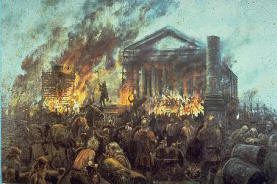
Pictured: A.D. 70 burning of the Temple in Jerusalem by the occupying Roman army.
Writing to the Jews, the saints and the Romans
The saints of the Church witnessed Apostolic faith in a Roman governed world with diminished Jewish influence throughout Syria, Asia, and Europe (including Rome) — and even in Rome’ s local Herodian tetrarchies which included Galilee and Judea, with the city of Jerusalem.
The Apostle John wrote to saints who came to Christ from all of these varied backgrounds — saints and their Elders new to the Gospel, in need of sound teaching and vulnerable to temptations of false teaching.
Introduction to John’s Epistles
In order to further understand a turbulent historic setting for this SERIES on the final LETTERS of JOHN, we will first take a brief look at the first century Church and also look ahead to John’s other well-quoted book, Revelation.
FINALLY — with God’s help and that of theologians more studied than me —I hope to tie it all together by studying the two briefest letters in the New Testament: the Epistles of Second John and Third John.
COMMMENT with your QUESTIONS and observations about the THREE Letters of John at anytime.
Your input may be important to our understanding of John's letters.
NEXT: Reintroducing John, the man, disciple, Apostle and Elder
God and Christ became incarnate in order to restore Their personal relationship with sinful man.
Roger@TallkofJesus.com
God and Apostles, Disciples of men
Our purpose in introducing Paul’s final epistle to a pastor is:
1. to reintroduce you to the Apostle Paul and
2. to reacquaint you with Timothy, a disciple of Paul who served him in varying roles,
BOTH whom we’ve met in Acts of the Apostles and other epistles.
Let us begin with God
(says the teacher to his class).
God — YHWH the LORD — Is One.
One in Being. One in Essence. One in Substance.
There IS no other god.
God IS the Creator of all things and of all mankind.
He had a relationship in the beginning of time — before which He Exists and after which He Exists — the LORD’s relationships are perfectly personal.
God IS: Father, Son — Jesus Christ, and the Holy Spirit.
Christ, Apostles and Disciples
The Apostle Paul writes to Timothy in his first epistle:
This is a faithful saying and worthy of all acceptance, that Christ Jesus came into the world to save sinners, of whom I am chief.
First letter of the Apostle Paul to Timothy
Jesus, the incarnate Son of God the Father, taught the Gospel with all perfection to men for three years.
The Twelve Disciples (which included neither Paul nor Timothy) followed the Lord, ate and slept with Jesus — they all knew the incarnate Son of God personally.
Consider the interpersonal relationships connecting each of these roles as defined by Scripture and what the Lord Jesus, our Teacher, instructs:
Disciple (follower), Master (teacher), Servant (slave) and Lord
The Disciples Matthew, John and Peter were all present with the incarnate Christ Jesus personally when the Lord said this:
The disciple is not above his master, nor the servant above his lord.
Gospel of Matthew 24:14 – Jesus’ to The Twelve Disciples; Instructions for Service & meaning of discipleship – KJV
The Twelve followed JESUS for three years, discipleship at its most personal.
Furthermore, many others would follow JESUS’s teachings as ‘Christians’ chosen by God for the Way of eternal life.
Apostles to the Jews and Gentiles
Of course from the beginning Jesus knew that Judas would betray Him and that a disciple Mathias would be chosen to replace the betrayer of Christ as a twelfth Apostle to the Jews.
Christ had taught and trained the Twelve how they would become Apostles — primarily, but not exclusively, to their fellow Jews —after His death, resurrection and ascension.
Simon Peter, a servant and an apostle of Jesus Christ, to them that have obtained like precious faith with us through the righteousness of God and our Saviour Jesus Christ:
2 Peter 1:1 KJV
Paul also refers to himself as an Apostle, greeting his disciples (followers) in his first epistle and this final letter.
Paul, an apostle of Jesus Christ by the will of God, according to the promise of life which is in Christ Jesus,
To Timothy, my dearly beloved son:
2 Timothy 1:1-2a KJV
So who are apostles?
Apostolos – a delegate, messenger, one sent forth with orders
specifically applied to the twelve apostles of Christ
in a broader sense applied to other eminent Christian teachers
– of Barnabas of Timothy and Silvanus
Apostles are ‘sent out’ by Christ.
As in the case of the Twelve and the Apostle Paul, the Lord himself instructed them Personally — that is, the Person of Jesus sent these Apostles out into the world personally.
Other apostles continued to be ‘sent out into all the world’ by the Holy Spirit after Jesus’ ascension, as Luke records for us of the day of Pentecost in ACTS 1.
As we learned from Acts of the Apostles that after the AD 49 Council in Jerusalem, Peter, Paul, John and all others were sent out ‘first to the Jews,’ but also into gentile areas of the Roman Empire (mostly Hellenist or Greek provinces) to include ALL as follows of Christ as part of each local church.
Jesus is Lord
Note that Jesus Christ refers to the Father as Lord (Kyrios in their common Greek language of the Roman Empire) with an authority and meaning no different than the original Hebrew scripture (Yahweh).
“Teacher, which is the great commandment in the Law?”
And He said to him,
“‘YOU SHALL LOVE THE LORD YOUR GOD WITH ALL YOUR HEART, AND WITH ALL YOUR SOUL, AND WITH ALL YOUR MIND.’
Matthew 22:36-37 LSB
Saul, a Jew of Jews, sent out by a Master crucified and risen!
About five years after the Jews of Jerusalem had crucified Jesus, a young disciple of Gamaliel witnessed the stoning of a follower of The Way.
They went on stoning Stephen as he was calling out and saying, “Lord Jesus, receive my spirit!” Then falling on his knees, he cried out with a loud voice, “Lord, do not hold this sin against them!” And having said this, he fell asleep.
Acts of the Apostles 7:59-60 LSB
Stephen, even in his dying breath, called JESUS, “Lord” – twice.
And this young disciple of the rabbi Gamaliel had witnessed it personally.
Saul of Tarsus would become an apostle of the Sanhedrin specifically sent out to continue persecuting Christians.
But then, as we know, Christ appeared to Saul and instructed this new and unwilling (at first) Apostle to go to the Gentiles.
Paul frequently writes that He is a slave (doulos) of JESUS or God(or of the gospel). The Lord Jesus himself points to the service required of this most personal relationship.
Many translations prefer servant to slave, but it is the same Greek word: doulos.
The disciple is not above his master, nor the servant above his lord.
The Apostle Paul describes himself in another pastoral epistle written about the same time as his two letters to Timothy:
Paul, a servantG1401of God, and an apostle of Jesus Christ, according to the faith of God’s elect, and the acknowledging of the truth which is after godliness;
Epistle of Paul to Titus 1:1
Timothy – Paul enlists a disciple of The Way
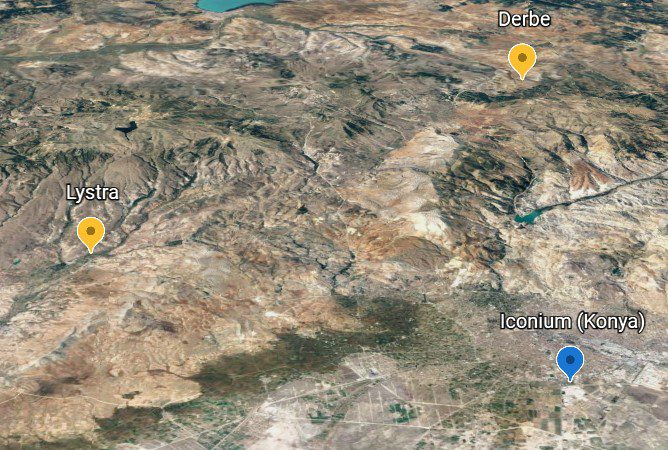
Now Paul also arrived at Derbe and at Lystra.
And behold, a disciple was there, named Timothy,
the son of a Jewish woman who was a believer,
but his father was a Greek,
Acts of the Apostles 16:1
During Paul’s second missionary journey, which had begun inland through the mountains northwest of Tarsus in rural Galatia. While visiting churches established by Barnabas and him on a first missionary journey, the Apostle meets a young Timothy — a Greek, because of his father, but brought up as a Christ-follower by his mother(a Jew, as Paul had been) and Timothy’s grandmother.
A brief introduction of Timothy (Τιμόθεος – Timotheos)
Timothy joined Paul and Silas on mission, staying behind at Berea for a time with Silas. Paul, later commands the two by the Spirit to join him in Athens from where the trio proceed to Macedonia.
Paul then ‘sent into Macedonia two of them that ministered unto him, Timotheus and Erastus; but he himself stayed in Asia for a season.
Acts 19:22 KJV
We observe how personal all of the mentoring relations of the Apostle remain to Paul as Luke records those with the Apostle when once again the Jews laid wait to capture and kill him.
Paul was accompanied by Sopater son of Pyrrhus from Berea,
We will mention more of Timothy's crucial later pastoral roles later in this epistle.
Timothy wrote other epistles with Paul :
It is important for us to note that these Pastoral Epistles make known the Spirit-directed teaching of the Apostle Paul we must study, rather than focus on any pastors or saints to whom Paul writes, such as Timothy.
But there were false prophets also among the people, even as there shall be false teachers among you..
2 Peter 2:1a – King James Version
Accepting Apostolic Testimony OR Following False Prophets
After presenting his Apostolic testimony to wavering preachers, elders, and marginal followers of “The Way,” Simon Peter now alerts the church to dangerous heresies taught by some seeking to undermine the true Gospel of the Lord Jesus Christ.
The Trustworthy Prophetic Word, reads the heading in this section of 2 Peter 1 of the Christian Standard Bible, also citing testimony from all the synoptic Gospels [Matthew, Mark & Luke].
For we have not followed cunningly devised fables, when we made known unto you the power and coming of our Lord Jesus Christ, but were eyewitnesses of his majesty.
We have also a more sure word of prophecy; where unto ye do well that ye take heed..
For the prophecy came not in old time by the will of man: but holy men of God spake as they were moved by the Holy Ghost.
2 Peter 1:17-21 excerpt KJV
The Apostle now warns of pernicious perils of false prophets and false teaching of those who deny Apostolic testimony.
2 Peter 2:
There were indeed false prophets among the people, just as there will be false teachers among you.
2 Peter 2:1a – Christian Standard Bible
Peter, Apostle of Jesus, provides familiar examples from the Jewish Bible (Old Testament):
and if he didn’t spare the ancient world, but protected Noah v.5a
and if he reduced the cities of Sodom and Gomorrah to ashes v.6a
and if he rescued righteous Lot, v.7a
Compare yourself to Noah. Or compare yourself to Lot, Paul suggests, a righteous man living in Sodom surrounded by every wickedness conceived by evil men in charge of his community.
Are Sodom and Gomorrah not the cities of our home churches to whom Simon Peter writes once again?
And doesn’t our world reminiscingly resemble that near to destruction in the time of Noah?
Take heed that we have survived thus far only be saved from the final judgment of fire by Christ’s righteousness!
How do the Apostle’s examples from Genesis apply to us?
The believers to whom Peter writes live in Asian and Roman and new worldly cities not unlike Sodom — as do we in our towns and churches susceptible to every evil tolerated and encouraged by leaders of every gathering in our home community.
Destructive Doctrines
HEADING from the New King James Version
WATCH OUT! warns the Apostle in his second epistle.
.. even as there will be false teachers among you, – v.1b – NKJV
You know these preachers and elders who CLAIM JESUS.
Some saints succumb to their subtle sweet tolerance. For their deceptive doctrine suggests Christ while discounting His lordship over our saved SELF’s still flourishing in the flesh of this life.
Pernicious Preachers of Their Own Doctrines
ψευδοδιδάσκαλος – pseudodidáskalos, psyoo-dod-id-as’-kal-os; from G5571 and G1320; a spurious teacher, i.e. propagator of erroneous Christian doctrine:—false teacher.
No, it isn't only the preacher in the pulpit who purveys false doctrine, though some succumb at times as the Apostle fears.
They will bring in destructive heresies, even denying the Master who bought them, and will bring swift destruction on themselves.
– 2:1c CSB
.. who privily shall bring in damnable heresies, even denying the Lord that bought them.
2 Peter 2:1c King James Version
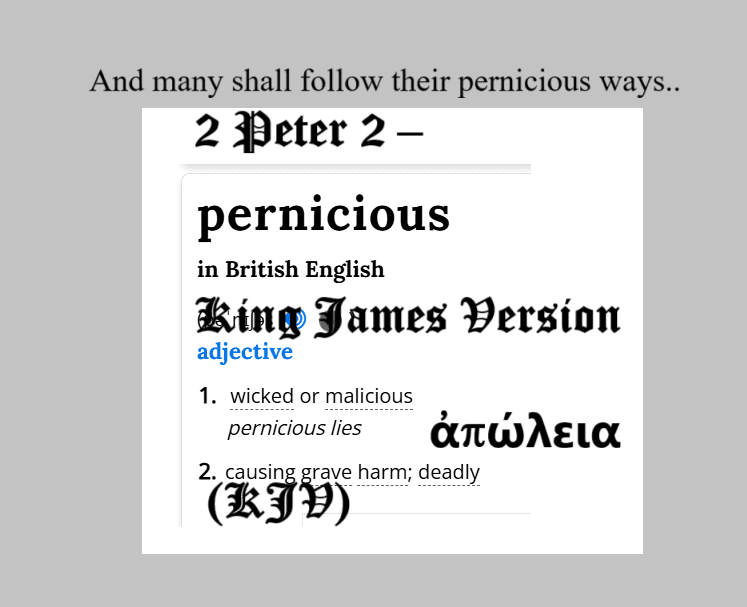
And many shall follow their pernicious ways
Time to define a key word Paul uses FIVE TIMES in his Second Epistle (translated in 2 Peter 2:2 KJV as "pernicious ways").
ἀπώλεια – apōleia –
The KJV translates Strong‘s G684 in the following manner: perdition (8x), destruction (5x), waste (2x), damnable (1x), to die (with G1519) (1x), perish (with G1498) (with G1519) (1x), pernicious (1x).
The Apostle Peter chooses STRONG language to describe these sins against the Lord.
And in fact, Jesus had spoken the same to describe Judas Iscariot!
While I was with them in the world, I kept them in thy name: those that thou gavest me I have kept, and none of them is lost, but the son of perdition;G684 that the scripture might be fulfilled.
Gospel of John 17:12 KJV – the words of Jesus
What must Peter — one of the Twelve — have thought when Judas took the cup the Lord shared at their last Passover meal?
The Lure of their Depravity
Common Era preachers may draw in the multitudes to gatherings of those seeking an advantage in the life of proclaiming Jesus.
(Judas, who minded their money, was like that.)
Peter continues in his second epistle warning the faithful:
And in their greed they will exploit you with false words, their judgment from long ago is not idle, and their destruction is not asleep.
2 Peter 2:3 LSB
The Apostle describes how to spot false teachers scemingly opposed to all Truth:
Bold, arrogant people!
They are not afraid to slander the glorious ones [2:10b LSB]
go after the flesh in its corrupt lust
and despise authority.
(even that of the Lord’s Apostles, Peter implies)
Daring,
self-willed,
they do not tremble when they blaspheme [angels] glorious ones 2:10 LSB
(We’ll continue Peter’s mention of angels momentarily.)
They brag about themselves with empty, foolish boasting.
With an appeal to twisted sexual desires, they lure back into sin those who have barely escaped from a lifestyle of deception.
2 Peter 2:18 LSB
The APOSTLE’S WARNING!
These people are springs without water, mists driven by a storm. The gloom of darkness has been reserved for them.
For by uttering boastful, empty words, they seduce, with fleshly desires and debauchery, people who are actually escaping from those who live in error.
2 Peter 17-18 CSB
Peter has already presented his powerful case of his authority as an Apostle of Jesus Christ — who IS the only Son of GOD the Father and One with the Holy Spirit.
Won’t you obey an Apostle of the Lord Jesus Christ?
“For when he received honor and glory from God the Father, and the voice was borne to him by the Majestic Glory, “This is my beloved Son,with whom I am well pleased,”
2 Peter 1:17 ESV
OR
Will you subtly slide back into the vomit of your former overindulgence in every sin of this world?
What the true proverb says has happened to them:
“The dog returns to its own vomit, and the sow, after washing herself, returns to wallow in the mire.”
2 Peter 2:22 ESV
Like a dog that returns to his vomit is a fool who repeats his folly.
Do you see a man who is wise in his own eyes? There is more hope for a fool than for him.
Proverbs 26:11,12 ESV
GOD, Angels, Men, Apostles, creatures & authority
FOLLOW PETER'S LOGIC:
In the beginning, God [ĕlōhîm] created the heavens and the earth. – Genesis 1:1
The apostle of Jesus Christ.. stands [in] the righteousness of our God and Savior Jesus Christ: – 2 Peter 1:1
Jesus is associated with righteousness, highlighting His sinless nature and the moral perfection that He imparts to believers.
2 Peter 2:1 The term “Master” is used in the context of false teachers denying “the Master who bought them.” It underscores Jesus’ ownership and authority over believers, as well as the cost of redemption.
ibid.
Peter introduces himself as a servant [doulos] of Jesus
2 Peter 1:1
and in his first epistle the Apostle instructs those chosen in Christ:
The Apostle Peter, as servant of the Lord and witness to God in the flesh embraces great responsibility for the faith of those chosen as elect saints in Jesus Christ.
Creation, its creatures and Angels
For if God spared not the angels that sinned, but cast them down to hell, and delivered them into chains of darkness, to be reserved unto judgment;
… The Lord knoweth how to deliver the godly out of temptations, and to reserve the unjust unto the day of judgment to be punished:
2 Peter 2:4,9 KJV
The Apostle connects evil men affecting the righteous like Noah and Lot within a lengthy tirade citing angels that sinned. Though we know little of the unseen messengers (evil or good), Peter reminds us of a comparison of Jesus to Adam, who was tempted into our fall by a most-powerful angel.
.. and his angels he charged with folly: – Job 4:18b KJV
.. but cast them into hell..
“How you are fallen from heaven,
O Lucifer,[lit. Day Star] son of the morning!
How you are cut down to the ground,
You who weakened the nations!

For you have said in your heart:
‘I will ascend into heaven,
I will exalt my throne above the stars of God;
..
Yet you shall be brought down to Sheol,
To the lowest depths of the Pit.
and committed them to pits of darkness, held for judgment…
[2 Peter 2:4b NASB]
These cunning false teachers speaking against Apostolic Authority — granted through the same Holy Spirit of God by which the Prophets spoke — do not tremble when they revile angelic majesties [Doxa] – ‘they blaspheme the glorious ones’ – v.10
FALSE TEACHERS, who are no better than evil men who refused to listen to GOD’s Prophets speaking by the Holy Spirit and less powerful than angels, will also suffer the judgment of angels who turned against the Creator.
.. whereas angels, though greater in might and power,
do not pronounce a blasphemous judgment against them before the Lord.
2 Peter 11 ESV
Balaam, False Prophets and Pernicious Popes!
YES, we are still addressing the warning of the Apostle Peter in his second epistle to the 1st century church.
If you have noted in 2 Peter 2 that I quoted Scripture including men the Apostle lists as negative examples, but I missed a false prophet mentioned only once, you would be right.
Peter’s full list (chronologically) includes:
Angels – vs.4 & 11
mankind, except Noah – v.5
community of mankind in Sodom and Gomorrah, except Lot – v.6
the Prophet Balaam – vs. 15-16
ALL these are WARNING SIGNS from the LAW of Moses — cited by the Apostle Peter, servant of God and JESUS Christ, sent by true direction of the Holy Spirit — to BELIEVERS in the first century churches AND those including a Lot from Common Era elect yet to be born into the body of Christ before the Day of Judgment.
I have nearly bogged down in the mire of Moses’ serious warning in the book of Numbers concerning Balaam.
Moses, Prophet and Lawgiver of Israel, sheds light enough on such men and women who cunningly lead communities of the faithful away from the Lord our God — from then nearer the Beginning until the Day of Jesus Christ.
What Popes, you may ask?
Which false prophets since Jesus, you may wonder?
AND what do these have to do with the Apostle’s example of Balaam in 2 Peter 2?
NEXT – We will examine the timeless application of Balaam to Peter’s prophesies of false teachers and HERESIES already evident to the Common Era church.
Used to monitor number of Google Analytics server requests
10 minutes
__utmb
Used to distinguish new sessions and visits. This cookie is set when the GA.js javascript library is loaded and there is no existing __utmb cookie. The cookie is updated every time data is sent to the Google Analytics server.
30 minutes after last activity
__utmc
Used only with old Urchin versions of Google Analytics and not with GA.js. Was used to distinguish between new sessions and visits at the end of a session.
End of session (browser)
__utmz
Contains information about the traffic source or campaign that directed user to the website. The cookie is set when the GA.js javascript is loaded and updated when data is sent to the Google Anaytics server
6 months after last activity
__utmv
Contains custom information set by the web developer via the _setCustomVar method in Google Analytics. This cookie is updated every time new data is sent to the Google Analytics server.
2 years after last activity
__utmx
Used to determine whether a user is included in an A / B or Multivariate test.
18 months
_ga
ID used to identify users
2 years
_gali
Used by Google Analytics to determine which links on a page are being clicked
30 seconds
_ga_
ID used to identify users
2 years
_gid
ID used to identify users for 24 hours after last activity
24 hours
_gat
Used to monitor number of Google Analytics server requests when using Google Tag Manager
1 minute
_gac_
Contains information related to marketing campaigns of the user. These are shared with Google AdWords / Google Ads when the Google Ads and Google Analytics accounts are linked together.