Tag: asia

  • 7 Epistles of John with the same Revelation

    7 Epistles of John with the same Revelation

    ~ A.D. 95 – from Patmos:

    John, Pastor and Elder of the Church at Ephesus

    As we observed in our chronology of ACTS of the Apostles, the Disciple John was a young man when he followed Jesus.

    Now, the Apostle has outlived the other Eleven, Paul, beloved family and many other first generation Christians.

    The Elder John wrote the three short Epistles we are studying about ten years ago, but today we are looking ahead at John’s brief revelation to seven churches.

    I suppose you may not have thought of the introduction to 'The Revelation of Jesus Christ to John' as — SEVEN pointed epistles to 7 different churches. 

    ~ A.D. 80’s – 90’s – a Cultural context for JOHN’s 10 Epistles

    The Greco-Roman world at the close of the first century A.D. was in a state of cultural, philosophical, and religious ferment. Religious syncretism and inclusivism.. ‘the combination of various ideas and beliefs from different sources to form new or aberrant religions. This was the age of developing mystery religions, the age of the occult, the age of the proliferation of Gnostic sects.’

    The MacArthur New Testament Commentary 1-3 John

    Throughout Italy and the broader empire, new challenges arose: major earthquakes in Campania, famine and pestilence in Rome, and volcanic eruptions ranging from Mount Etna to the cataclysmic destruction of Pompeii and Herculaneum by Vesuvius in AD 79.

    The Julio-Claudian dynasty—embodied by Tiberius, Caligula, Claudius, and Nero—witnessed both grand construction projects (like the amphitheater at Alba Fucens) and notorious episodes of tyranny and scandal. .. After Nero’s fall in AD 68, civil war engulfed the empire until Vespasian founded the Flavian line, ushering in reconstruction efforts (such as the Colosseum) and culminating in the more stable governance of Nerva and Trajan by century’s end.

    source: RomanHistory.net

    an A.D. First Century culture of 7 Asian churches

    Do you remember from back in Acts of the Apostles how the Spirit, at first, had instructed Paul NOT to preach in Asia?

    Macedonia
    Acts on Mission to Macedonia

    And do you recall that Ephesus (in Asia) became a major city for Christian worship where later Paul had appointed Timothy as Pastor of the Ephesian Church?

    Paul preaching in Ephesus

    PLACE AND TIME OF WRITING.

    –The best authorities among the Fathers state that John was exiled under Domitian (IRENAEUS [Against Heresies, 5; 30]; CLEMENT OF ALEXANDRIA; EUSEBIUS [Ecclesiastical History, 3.20]). VICTORINUS says that he had to labor in the mines of Patmos. At Domitian’s death, A.D. 95, he returned to Ephesus under the Emperor Nerva. Probably it was immediately after his return that he wrote, under divine inspiration, the account of the visions vouchsafed to him in Patmos ( Rev 1:2, 9 ). However, Rev 10:4 seems to imply that he wrote the visions immediately after seeing them.

    source: Jamieson, Fausset & Brown
    Introduction to Revelation


    The Revelation of Jesus Christ

    which God gave Him

    The Disciple who knew the Lord best refers to GOD THE FATHER simply, as God.

    to show His servants

    that is, the saints or followers of JESUS, bond-servants redeemed by His blood on the Cross

    —things which must shortly take place.


    The Elder writes this same introduction to ALL seven churches who John has shepherded in the Way of Christ Jesus.

    What he means by ‘shortly‘ is much debated in the immediacy of what these beloved saints have endured through the end of this A.D. first century. — Or perhaps God intends this epistle of revelation more millennially for all saints of every age.

    Christ makes certain that Christians know the cost of faith until the unknown Day of His return.


    He made it known by sending his angel to his servant John, who testifies to everything he saw—that is, the word of God and the testimony of Jesus Christ.

    Revelation 1:1b-2 NIV


    The risen and ascended Lord Jesus Christ sends an apokalypsis via and angelic messenger to John on Patmos — and the Elder to these seven churches consequently, by his apostolic duty, sends out this same ‘disclosure of divine things formerly unknown’ and testifies to the truthfulness of what is to follow.

    It makes little difference if John had opportunity to send it from Patmos with a human messenger much in the way the Apostle Paul sent epistles to his churches OR if the Elder would have written it later upon John's return to Ephesus. 

    scroll with seven seals

    “Who is worthy to open the scroll and to break its seals?” – Question of the angel messenger in Revelation 5:2


    a Book Sealed within: Addressed to 7 mortal Elders

    What does John’s epistle enjoin each Elder to do?

    Set aside for a moment the imagery of the apocalypse with its angels, seven stars and seven candlesticks — the Elder John is FIRST to address issues of his own current church. 

    Most Christians know both exhortation and encouragement offered to the seven churches.

    Which ones speak to YOU with some urgency (and hopefully, perhaps, to any Elder of your local church? (So which church looks like yours?)

    Ἐφεσῖνος – Ephesus

    • “I know your works, your labor, and your endurance,
    • and that you cannot tolerate evil people.

    Of course, John knows all this personally.

    And does the Elder imply that the Ephesians will not be inclusive of those who insist on evil works opposed to Christ’s love?

    You have tested those who call themselves apostles and are not, and you have found them to be liars.

    Revelation 2:2 CSB

    And do your Elders test the theology and witness of your church leaders and members?


    And the pattern of this pointed epistle for each church now turns to exhortation and rebuke demanding repentance. 

    “But I have this against you:

    You have abandoned the love [agapē] you had at first.

    Look it up.. IF you don't quite remember what agape love is.

    “Remember then how far you have fallen;

    repent, and do the works you did at first.


    Do YOU? Do christians ever repent more than once (that time we claim to have come to Christ)?

    OR will He return to say, “I never knew you…?’


    “Yet you do have this: You hate the practices of the *Nicolaitans, which I also hate.

    *Revelation 2:6 CSB

    “Let anyone who has ears to hear listen to what the Spirit says to the churches.
    To the one who conquers,
    I will give the right to eat from the tree of life, which is in the paradise of God.

    Revelation of Jesus Christ to John 2:7 CSB

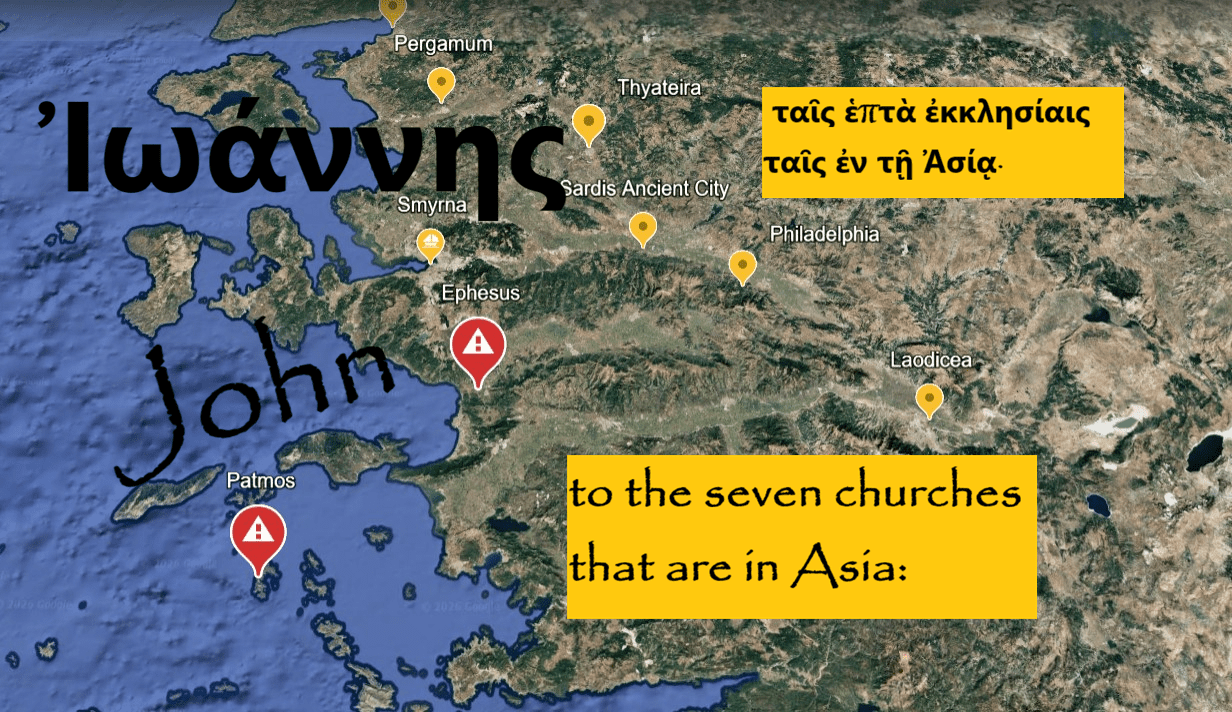
    John to the seven churches which are in Asia: map with cities pictured and the island of Patmos

    Σμύρνῃ – Smyrna

    • “I know your affliction and poverty,
    • but you are rich.
    • I know the slander of those who say they are Jews and are not, but are a synagogue of Satan.

    Do YOU know any who avoid the Name of Christ? Do some swear to be Jew or Christian while afflicting others? Who then, do they truly worship?

    “Don’t be afraid of what you are about to suffer.

    Does your prosperity preacher dare suggest suffering for the Lord Jesus Christ? OR REMIND of the Lord’s Judgment of all?

    The one who conquers will never be harmed by the second death.


    Πέργαμος – Pergamum

    “I know where you live ​— ​where Satan’s throne is.

    .. where Satan lives. [Another mention of the nearby Nicolaitans]

    But I have a few things against you.

    You have some there who hold to the teaching of Balaam, who taught Balak to place a stumbling block in front of the Israelites: to eat meat sacrificed to idols and to commit sexual immorality.

    Again, the common issue *even of this era is worship of idols and fornication. 

    In the same way, you also have those who hold to the teaching of the *Nicolaitans. So repent!

    Otherwise, I will come to you quickly and fight against them with the sword of my mouth.

    Revelation 2:15-16

    “Let anyone who has ears to hear listen to what the Spirit says to the churches.

    Doesn't this even sound like the preaching of JESUS? 
    painting of Hebrews in the wi
    I AM the Bread of Life

    To the one who conquers, I will give some of the hidden manna…

    Revelation 2:27b


    Θυάτειρα – Thyatira

    Just a REMINDER of Who Is speaking:

    Thus says the Son of God,

    the one whose eyes are like a fiery flame and whose feet are like fine bronze:

    Revelation of Jesus Christ to John 2:18b CSB

    • “I know your works ​— ​
    • your love, faithfulness, service, and endurance.
    • I know that your last works are greater than the first.
    Quite an encouragement and blessing to believers.

    “But I have this against you:

    This one thing of importance to the Lord Jesus Christ

    Jezebel

    You tolerate the woman Jezebel, who calls herself a prophetess and teaches and deceives my servants to commit sexual immorality and to eat meat sacrificed to idols. I gave her time to repent, but she does not want to repent of her sexual immorality.

    Revelation 2:20-21 CSB


    WHY is this issue of idolatry so important (in addition to God’s prohibition in the Ten Commandments of worshiping other gods)?

    Ἰεζάβελ – Jezebel – the symbolic name of a woman who pretended to be a prophetess, and who, addicted to antinomianism, claimed Christian liberty of eating things sacrificed to idols.

    Of Hebrew origin אִיזֶבֶל (H348) (used as a synonym of a termagant or false teacher):—Jezabel.

    אִיזֶבֶל

    Jezebel recalls the opposition to the LORD’s prophet Elijah.

    Jezebel = “Baal exalts” or “Baal is husband to” or “unchaste”

    queen of Israel, wife of Ahab, daughter of Ethbaal (King of Tyre)

    It’s a contest of serious consequence between the LORD God and the false gods, false prophetesses, false priestesses — brash and shameless sinners claiming sin as worship of their gods.

    This disaster happened because the people of Israel sinned against the LORD their God who had brought them out of the land of Egypt from the power of Pharaoh king of Egypt and because they worshiped other gods.

    They abandoned all the commands of the LORD their God. They made cast images for themselves, two calves, and an Asherah pole. They bowed in worship to all the stars in the sky and served Baal.

    2 Kings 17:7,16 CSB

    And it all goes back to Ahab and Jezebel in 1 Kings.

    Ahab also made an Asherah pole. Ahab did more to anger the LORD God of Israel than all the kings of Israel who were before him.


    Just one last application from Revelation, the mention of Jezebel, the Nicolaitans and (from a theological definition {above}) - antinomianism.

    Antinomianism is the belief or teaching that since believers are saved by grace through faith, there is no further obligation to follow any moral law or command.

    .. At its core, antinomianism proposes that under the New Covenant, Christians are completely exempt from all moral guidelines because divine grace supersedes any need for abiding by commandments.

    source: Biblehub.com


    John to the seven churches which are in Asia: map with cities pictured and the island of Patmos

    Σάρδεις – Sardis

    I know your works; you have a reputation for being alive, but you are dead.

    Revelation 3:1b CSB

    • “Be alert
    • and strengthen [guard] what remains, which is about to die,
    • for I have not found your works complete before my God.
    • “Remember, then, what you have received and heard;
    • keep it, and repent.
    • If you are not alert, I will come like a thief, and you have no idea at what hour I will come upon you.

    “But you have a few people in Sardis who have not defiled their clothes, and they will walk with me in white, because they are worthy. In the same way, the one who conquers will be dressed in white clothes, and I will never erase his name from the book of life but will acknowledge his name before my Father and before his angels.

    Revelation 3:4-5

    And the Lord Jesus again seals His warning to the Sardinian church calling on the MANY to follow the example of the FEW.

    “Let anyone who has ears to hear listen to what the Spirit says to the churches.

    Revelation 3:5 CSB


    Φιλαδέλφεια – To the Church in Philadelphia

    Permit me first to remind you that simply as the name, Christian, witnesses the Name of Christ; Philadelphia or Philedelphos φιλάδελφος witnesses [From φίλος (G5384) and ἀδελφός (G80)]as a FRIEND and BROTHER.


    “I know your works.

    Look, I have placed before you an open door that no one can close because you have but little power; yet you have kept my word and have not denied my name.

    Quite a compliment of Christian LOVE of these saintly brothers and sisters in Christ.

    “Note this: I will make those from the synagogue of Satan, who claim to be Jews and are not, but are lying ​— ​I will make them come and bow down at your feet, and they will know that I have loved you.

    A.D. first century followers of the Messiah Jesus considered themselves to be true Jews, who have now been redeemed. And the love they hold in Christ will include Romans (like much of the population of this city of Philadelphia) and Hellenists, Greeks or gentiles as they worship God in truth side by side.

    “Because you have kept my command to endure, I will also keep you from the hour of testing that is going to come on the whole world to test those who live on the earth.

    Revelation 3:10 CSB


    Λαοδίκεια – Laodicea

    And to the angel of the church of the Laodiceans write,

    ‘These things says the Amen, the Faithful and True Witness, the Beginning of the creation of God:

    the Revelation of Jesus Christ to John 3:14 NKJV


    an urgent CAUTION, perhaps, for many a 21st century Common Era christian church claiming Jesus in some lesser way than in Truth.

    “I know your works, that you are neither cold nor hot. I could wish you were cold or hot.

    Revelation 3:15 NKJV

    “So then, because you are lukewarm,

    and neither cold nor hot,

    I will vomit you out of My mouth.

    Laodicea: Lukewarm Prosperity

    • Banking hub, black-wool trade, renowned medical school with eye powder.
    • Water arrived by aqueduct, lukewarm by the time it reached town.
    • After the AD 60 quake, the city rebuilt itself without Rome’s help—boastful self-sufficiency reflected in the church.

    Source: BibleHub.com commentary


    Because you say…

    “I am rich

    and have acquired great wealth,

    and need nothing,”

    but do not realize that you are wretched, pitiful, poor, blind, and naked,

    take my advice

    and buy gold from me refined by fire so you can become rich!

    Buy from me white clothing so you can be clothed and your shameful nakedness will not be exposed,

    and buy eye salve to put on your eyes so you can see!

    Revelation 3:17-18 New English Translation


    Do you know of a Common Era Church like this — so in need of taking this advice from the risen and returning Christ Jesus ?


    LISTEN! Hear His Voice. Open the door of your lukewarm heart. Allow the Lord to give you manna and living water of eternal life.

    Sit on His Throne with Him.. just as He too conquered and sat down with His Father on His throne.

    “Let anyone who has ears to hear listen to what the Spirit says to the churches.”

    the Revelation of Jesus Christ to John 3:22 CSB


    Next: INTRO — 3 Letters (10 yrs earlier) from the Apostle John

  • Asia – Let’s Not Go There – Acts 16

    Asia – Let’s Not Go There – Acts 16

    The importance of this juncture in Paul’s journey, now with Silas and Timothy, cannot be overemphasized as these apostles are sent out beyond Asia into all the world of Euro-Asia.

    Asia – the BIG picture

    Growing up geographically-challenged (as my 5th grade teacher surely would have confirmed) in a small village far distant from Paul’s missionary journeys I was CLUELESS when I read Luke’s lists of places in Acts.

    Where were these cities? (Or were they states? Perhaps a province of some kind?)

    And ASIA? (That’s confusing.)


    Continents as I remembered (5? or 7?):

    • North America (That’s US.)
    • South America (Go toward Texas & keep going.)
    • Europe (Cross the Atlantic like Europeans did & founded 13 colonies in America)
    • Africa (everything south of the Mediterranean Sea, Egypt and all those jungle places south where Europeans brought slaves to America.)
    • Antarctica (it’s all ice and nobody lives there.. Is it the one on the South Pole or north?)
    • Asia (Russia, from where Europe ends west to the Pacific & India, China, Japan along the Pacific
    • Australia (How can an English island below Asia be called a continent?)
    C -

    Go into all the world GEOGRAPHY (remedial)

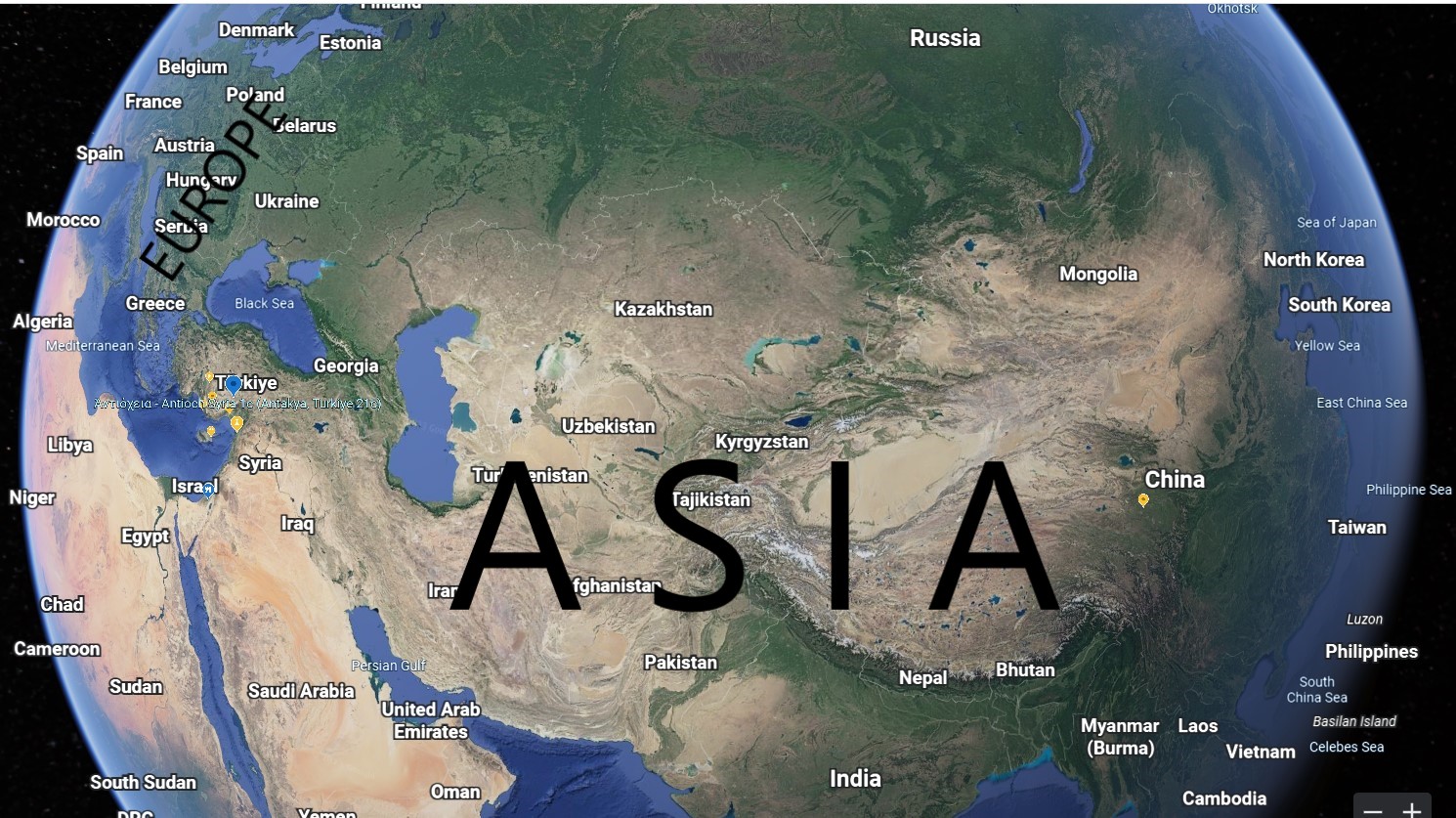
    Asia Europe Africa 21st c. view from Google Earth
    ASIA ~30% of land area of earth, part of Eurasia, ~17 million sq. miles
    Join me as I refresh some of my quite limited knowledge of geography - especially of Asia.

    Asia facts from WorldGeography.com

    • Asia is the largest and most populated continent
    • It shares land borders with Europe, which is not defined and hence share a landmass called Eurasia.
    • Afro-Eurasia is the name given to the landmass between Asia, Europe, and Africa.
    • Asia shares a lot of its extreme points with Europe, especially Russia.

    Cape Dezhnev, 66°4′45″N 169°39′7″W, located on the Chukchi Peninsular, between the Chukchi Sea and the Bering Strait [W. of Alaska] , is the easternmost point of mainland Asia.

    Pamana Island, 11°00′36″S 122°52′37″E, is the southernmost point of Asia, located in the Lesser Sunda Islands, East Nusa Tenggara province of Indonesia.

    The northernmost point on the Asian mainland is Cape Chelyuskin, 77°44′0″N 104°15′0″E. At 1370km from the North Pole, ..located at the Taymyr Peninsula,

    Westernmost Point In Asia
    • Cape Baba, 39°28′47″N 26°03′50″E, located on the Anatolian part of Turkey, is the westernmost part of Asia. Located in Babakale village also known as Father’s Castle in historical Troad. Apostles Luke’s journey around the cape, and Apostle Paul’s journey on land are recorded in the biblical book Acts of the Apostles.
    This image has an empty alt attribute; its file name is Troas-1024x656.jpg
    Troas on Cape Baba in Babakale, Turkey [Turkiye] is the westernmost point in Asia.

    Asia Minor, Roman Remnant of a former Empire

    Zoom in with Roman military eyes toward a vast empire to the east situated on the westernmost shores of Asia, fixing your eyes on adjacent Aegean shores of 21st c. Turkiye.

    This geographical-historical view of the Asia minor region is provided only for its context of culture as it intersects with Paul's missionary journeys 'into all the world' of Eurasia.
    map of 1st century Asia
    Asia Minor

    Follow the southern coastline from nearest to Rome toward the east and riches of former empires.

    Rome’s region of ASIA MINOR

    • conquered via the vast Mediterranean and inland to the Taurus mountains includes [W. to E.]:
    • Pisidia [N. of Perga],
    • Pamphylia [along a coast N. of Cypress],
    • Cilicia [with its port city of Tarsus] and finally
    • Syria (at times including Judea).
    • Further Roman conquests inland to the north included:

    a large Roman province of GALATIA

    • N from Iconium and on its Western edge Antioch Pisidia, all of the central plain to the borders of
    • a more remote Cappadocia in the mountains to the north of Cilicia and Tarsus and Antioch Syria,
    • N to Bithynia and Pontus on the Black Sea and again toward
    • Phrygia along the mountainous borders with Asia Minor toward Mysia and the strategically situated Sea of Marmara between the narrow isthmus connecting the Black and Aegean Seas.

    In Roman times, however, when Paul journeyed there, the country was divided into two parts, one of which was known as Galatian Phrygia, and

    the other as Asian Phrygia, because it was a part of the Roman province of Asia, but the line between them was never sharply drawn.

    Source: BibleAtlas.org
    In ACTS 16 the Holy Spirit forbids Paul from sharing the gospel in Asia Minor on this second missionary journey.
    And they went through the region of Phrygia and Galatia, having been forbidden by the Holy Spirit to speak the word in Asia.
    – ACTS 16:6

    The Empires Before Christ

    Babylon captures Judah and brings its captives to the King of Babylon
    6th century Before Christ
    6th-5th centuries B,C. the Persian Empire (to the East) adds the Babylonian Empire to its captive provinces

    Paul, Silas and Timothy will know these events well from Scripture, but those are no longer the Empires of concern to either the Jews or Rome. In a more recent history of Judea and Eurasia one vast Empire rivals all others.

    356 BC – Macedonia

    Roman bust of Alexander the Great who conquered much of Asia and Europe

    Alexander the Great

    • Tutored by Aristotle
    • trained for battle by his father, Philip II

    Roman bust, 2nd century AD / Creative Commons license

    [Alexander’s] undermanned defeat of the Persian King Darius III at the Battle of Gaugamela is seen as one of the decisive turning points of human history, unseating the Persians as the greatest power in the ancient world and spreading Hellenistic culture across a vast new empire.

    https://www.history.com/news/alexander-the-great-defeat-persian-empire

    332 BC – Tyre: a siege of Hellenism close to home

    The siege of Tyre was orchestrated by Alexander the Great in 332 BC during his campaigns against the Persians.

    source: Wikipedia

    The reign of Alexander the Great was short-lived. After subduing all of the Persian Empire, his army marched east and got as far as India before turning back home to Macedon. But he never made it home.

    At just 32 years old, Alexander died in Persia in the palace of Nebuchadnezzar II in Babylon.

    323 BC – 30BC – a Greek-ish Eurasia

    Click the link below to see a map of the Hellenized 'Greek-ish' world after Alexander the Great where the Apostle Paul now witnesses Christ. READ a detailed lecture on 

    https://brewminate.com/wp-content/uploads/2016/04/Alexander53-768×452.gif


    There were no more city-states. Monarchies prevailed, modeling themselves after Alexander’s empire. He had achieved a divine status in his lifetime, and his successors wanted to as well. They established “ruler cults” in which they were obeyed as kings and worshipped as gods.

    A sense of cosmopolis developed in the Hellenistic Age (“polis” plus “cosmos”). Worldly, experienced, and highly-cultured people used to live in small city-states and not worry about the world beyond, but now they had seen and even ruled this world and began to say they were no longer citizens of Athens, Corinth, and so on, but instead citizens of the cosmic polis (cosmopolis), the world.

    Highly Recommended Source – From a lecture by Dr. Frank Holt, Professor of Ancient History, University of Houston (10.15.2013)

    Paul and the Apostles sent out into all the world live in the crossroads between a culture of Alexander established just a few centuries earlier AND ambitious Roman Caesars reconquering lands and cultures to be absorbed into a new Pax Romana — IF you will surrender your land and its people into one international Empire of their Roman peace.

    Western Eurasia map AD50

    AD 50 – Eurasia

    The year in the middle of Paul’s 2nd Missionary Journey.

    Rome had conquered the Ptolemaic Kingdom of Egypt near Judea some time ago, but the Empire’s military defense of the Eastern front in Syria kept close eye on the Parthian Empire and frequently engaged in battle losing and retaking various land.

    A Greek-ish in culture of the Eurasian world remained reticent of Roman Legions suppressing unwilling rulers in uncooperative localities.


    Politically astute men like a Herod or Saul of Tarsus understood this ever-shifting landscape of living as part of the political leadership and military power of the Roman Empire.

    Paul would have been attuned to recent changes in both Asia and Europe as the Apostle now travels toward a new destination with Silas and Timothy. They seem to be travelling intentionally and slowly (which we might easily miss in these few brief verses of Acts.

    AD 43 – During those years after Paul had witnessed Jesus on the road to Damascus, just four years prior to his first missionary journey here and to Cypress, Rome had invaded Britannia in the West. Legions had also conquered Lycia on the SW coast near Asia Minor where previously they had sailed to and from Perga.

    Lycia Source: Wikipedia

    AD 46 – Just a year prior to Paul’s first missionary journey

    After the death of the Thracian king Rhoemetalces III in 46 AD and an unsuccessful anti-Roman revolt, the kingdom was annexed as the Roman province of Thracia. The new province encompassed .. the north-eastern portion of the province of Macedonia as well as the islands of Thasos, Samothrace and Imbros in the Aegean Sea.

    Source: Wikipedia

    Acts of the Apostles 16:

    Previously:

    As they went on their way through the cities, they delivered to them for observance the decisions that had been reached by the apostles and elders who were in Jerusalem. So the churches were strengthened in the faith, and they increased in numbers daily.


    6 And they went through the region of Phrygia and Galatia, having been forbidden by the Holy Spirit to speak the word in Asia.


    These apostles sent out from Antioch Syria have traveled about half-way on this 2800 mile [4500 km] journey into a Greek-ish Roman-ruled world. Their remaining journey in Euro-Asia will include many more important cities where they will preach the Gospel of Jesus Christ in the upcoming year.


    And when they had come up to Mysia, they attempted to go into Bithynia, but the Spirit of Jesus did not allow them. So, passing by Mysia, they went down to Troas.

    Acts 16: route of the apostles Paul, Silas & Timothy headed toward Troas beyond Asia Minor. source: graceofourlord.com
    Paul’s 2nd Missionary Journey – first half through Asia

    To be continued…