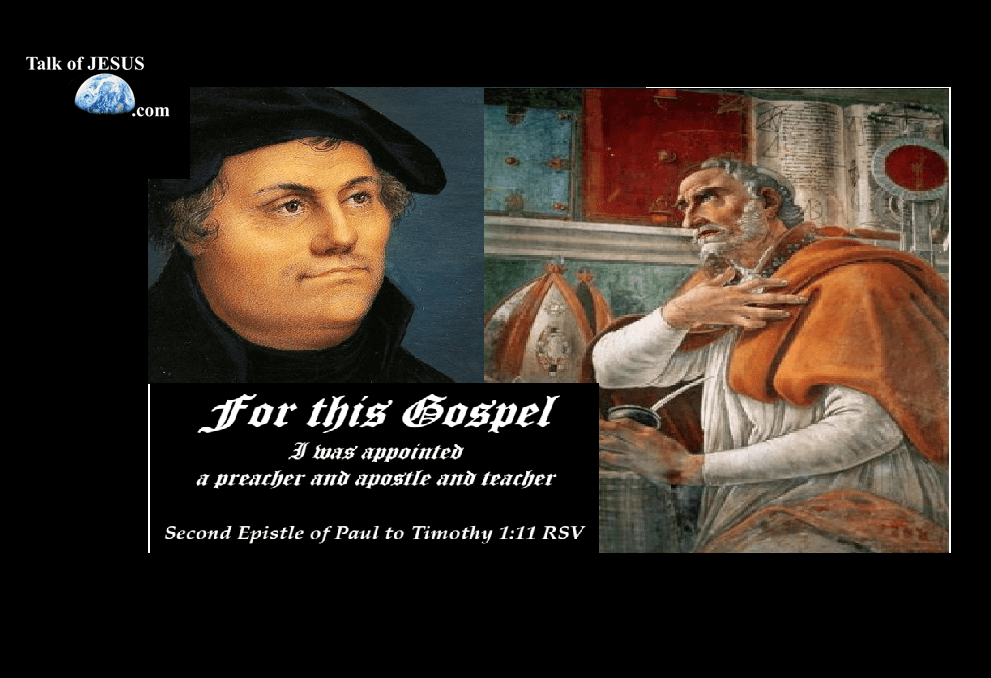

For this gospel I was appointed a preacher and apostle and teacher,
Second Epistle of Paul to Timothy 1:11 RSV
Paul’s Gospel of God and Christ
The Apostle has begun his final pastoral epistle with encouragement of young Timothy as his beloved son appointed to continue in the Gospel of Jesus Christ.
From Personal Sonship to Apostolic Responsibility for the Gospel
Paul also identifies some of who fall away from Christ and others who remain faithful. (It remains a pattern for the ages.)
What is Paul’s Gospel?

εὐαγγέλιον
euangelion
Paul has written to the Romans, faithful saints in the city in which the Apostle is imprisoned and awaiting death:
Paul, a servant of Jesus Christ, called to be an apostle, separated unto the gospel G2098 of God,
Romans 1:1 KJV
To the Corinthian saints Paul writes:
.. for in Christ Jesus I have begotten you through the gospel. G2098
1 Corinthians 4:15b KJV
and
But if our gospel G2098 be hid, it is hid to them that are lost:
2 Corinthians 4:3 KJV
We could point to additional epistles of Paul to the saints of various churches.
Paul refers to the GOSPEL 74 times in 68 verses in ‘The Pauline Epistles.’
God’s Divine plan now revealed in Christ
That’s the Apostles’ NEW Good News!
In Paul’s earlier pastoral letter to Timothy the Apostle had written:
As I urged you when I was going to Macedonia, remain at Ephesus that you may charge certain persons not to teach any different doctrine,
1 Timothy 1:3 RSV
Certain saints supposedly committed to Christ had already wavered away from the Gospel Paul taught.
Now we know that the law is good, if any one uses it lawfully, understanding this, that the law is not laid down for the just but for the lawless and disobedient, for the ungodly and sinners, for the unholy and profane..
and whatever else is contrary to sound doctrine, in accordance with the glorious gospel of the blessed God
with which I have been entrusted.
1 Timothy 1:8-11 excerpt RSV
I charge you to keep the commandment unstained and free from reproach until the appearing of our Lord Jesus Christ; and this will be made manifest at the proper time by the blessed and only Sovereign, the King of kings and Lord of lords,
who alone has immortality and dwells in unapproachable light, whom no man has ever seen or can see.
To him be honor and eternal dominion. Amen.
1 Timothy 6:14-16 RSV – charge of the Apostle Paul to Timothy
Paul worships God and Christ, pointing to the promise of the eternal mystery now revealed in the resurrection and ascension of Jesus.
Paul’s Gospel of SALVATION in JESUS
manifested by the appearing of our Savior
join with me in suffering for the gospel according to the power of God, who has saved us
and called us with a holy calling, not according to our works,
but according to His own purpose and grace
which was given to us in Christ Jesus from all eternity,
but now has been manifested by the appearing of our Savior Christ Jesus,
who abolished death and brought life and immortality to light through the gospel,
2 Timothy 1:8b-10 LSB
Jesus is now revealed as our Savior and it is death from which He has saved us.
This is the gospel of Jesus as our saviour which Paul emphasizes throughout this last pastoral epistle to Timothy and saved saints of the Church.
2 Timothy Commentary
Retain the standard of sound words
Hold to the standard of sound words that you heard from me and do so with the faith and love that are in Christ Jesus
2 Timothy 1:13 New English Translation
Hold fast the form of sound words…
2 Tim 1:13a KJV
Retiens dans la foi..
LS
Retén la forma
SE
1:13 ὑποτύπωσιν ἔχε ὑγιαινόντων λόγων
Retain – echō is the word Paul uses.
The Apostle has used [ὑποτύπωσις]hypotypōsis in his first epistle as well:
Howbeit for this cause I obtained mercy, that in me first Jesus Christ might shew forth all longsuffering, for a pattern G5296 to them which should hereafter believe on him to life everlasting.
1 Tim 1:16 KJV
And again Paul states here:
Hold fast the form G5296 of sound words, which thou hast heard of me, in faith and love which is in Christ Jesus.
2 Tim 1:13 KJV
His outline [or pattern] here is for Timothy and any pastor who will follow in the authority of Christ Jesus — the Apostolic faith which Paul, Peter and others have echoed.
RETAIN THIS, insists Paul.
Preachers, Apostles and Teachers
This self-discipline [v.7] to which the Apostle has already pointed requires preachers and teachers to retain this pattern of Paul.
Therefore do not be ashamed of either the witness about our Lord or me His prisoner..
2 Tim 1:8a LSB
a brief reminder about apostles, preachers and teachers.. and then, saints:
An Apostle is ‘sent out’ or set apart under the Authorithy through God and Christ.
IF you address your preacher standing in a pulpit going nowhere but the stage of their church as Apostle So-and-so, you miss the Apostolic authority Paul calls for preachers and teachers to retain as our pattern in Christ Jesus.
Paul points out that he was appointed [tithēmi ] to all these responsibilities. He is an apostle, a preacher and teacher.
The Church often used a symbolic laying on of hands for such offices, but the true sign is of the indwelling of the Holy Spirit of Almighty God.
Preachers
kēryx is the same word Peter used of Noah calling him, ‘a preacher of righteousness.’ It’s a noun meaning: a herald or messenger vested with public authority.
You’ll recognize Paul’s point from its verb meaning to preach or proclaim.
From that time Jesus began to preach G2784 and say, “Repent, for the kingdom of heaven is at hand.”
Gospel of Matthew 4:17 LSB
and He said to them, “Thus it is written, that the Christ would suffer and rise again from the dead the third day, and that repentance for forgiveness of sins would be proclaimed [ G2784] in His name to all the nations, beginning from Jerusalem.
“You are witnesses of these things.
Gospel of Luke 24:46-48 LSB – Jesus to the Apostles just prior to His ascension
Paul reminds Timothy:
That is why I am suffering here in prison. But I am not ashamed of it, for I know the one in whom I trust, and I am sure that he is able to guard what I have entrusted to him until the day of his return.
2 Timothy 1:12 NLT
Teachers
διδάσκαλος – in the NT one who teaches concerning the things of God, and the duties of man
“A disciple is not above his teacher G1320, nor a slave above his master. It is enough for the disciple that he become like his teacher G1320, and the slave like his master.
Gospel of Matthew 10:24-25a LSB
And a reminder that mathētēs is any student or disciple of a teacher.

Slave is doulos which we often gently translate, servant.

And again the significance of the teacher (whether Paul or Jesus or a teaching Elder of your church) is that relationship —

 of Teacher-Student or Master-Servant — kyrios - the same word often used for the Lord JESUS points to the authority of God.
“You call Me Teacher G1320 and Lord G2962; and you are right, for so I am.
Gospel of John 13:13 LSB – Jesus to His Disciples
a duty of the saints and pastors
Now if any one says that we need not direct men how or what they should teach, since the Holy Spirit makes them teachers, he may as well say that we need not pray, .. or that the Apostle Paul should not have given directions to Timothy and Titus as to how they should teach others.
And these three apostolic epistles ought to be constantly before the eyes of everyone who has obtained the position of a teacher in the Church.
ON CHRISTIAN DOCTRINE – AD 397 & 426 – translated JF Shaw, book IV, ch xxxiii excerpt – ST. AUGUSTINE of Hippo
Augustine, an elevated father of the early Church, presents sound reasons why all saints of Christ ought to dutifully follow their teachers and why all pastors can only lead their sheep of Christ’s pasture in diligence of prayer, obeying the Holy Spirit and keeping in Scripture, including these pastoral epistles.
Guard the Truth
guard the truth that has been entrusted to you by the Holy Spirit who dwells within us.
Second Epistle of the Apostle Paul to Timothy 1:14 RSV
* SUMMARY OF THIS GOSPEL:
Christ alone is the good shepherd...
Christ’s sheep know only Christ’s voice
and follow it.
God knows well who are his as Paul says in 2 Timothy 2:19:
“Howbeit the firm foundation of God standeth, having this seal, The Lord knoweth them that are his.”It is not a congregation of Christ that strives for the honor of this world and desires to be esteemed great in the eyes of the world…
~ AD 1520 – Sermons of MARTIN LUTHER – a theologian, Catholic priest, reformer and former Augustinian friar – Vol 3, Pg 340 [translated Lenker]