Tag: authority

  • A River of Redemption Flowing from Eden – Justice

    A River of Redemption Flowing from Eden – Justice

    Contemplation of Justice by James Earle Fraser – US Supreme Court building

    Justice

    At the beginning of this series I outlined topics which included justice. Here we will explore their linked applications.

    • Commandment
    • Law
    • Justice
    • Judgment
    • Penalty and Sentence
    • Redemption

    Justice – n. 1) fairness. 2) moral rightness. 3) a scheme or system of law in which every person receives his/ her/its due from the system, including all rights, both natural and legal. – source: dictionary.law.com

    The multi-branched tree of the knowledge of good and evil.

    “but you must not eat from the tree of the knowledge of good and evil, for on the day you eat from it, you will certainly die.” – Genesis 2:17 CSB

    Paradise by Lucas Cranach the Elder – painter, draughtsman, printmaker and court painter – 1530

    We move now from relatively calm waters of Adam knowing the difference between good and evil to a more tumultuous current of original sin flowing through the generations.

    Justice, and only justice, you shall follow, that you may live and inherit the land that the LORD your God is giving you. – Deuteronomy 16:20

    Justice in the Egypt of Joseph and Moses

    Recent research from Yale Law, The Representation of Justice in Ancient Egypt, confirms concepts of justice learned by the Hebrews. I have quoted it extensively below.

    The concept of “law” and “justice” are intimately associated with the proper behavior of kings and were embedded in every royal ritual.

    https://www.egyptprivatetourguide.com/egyptian-facts/ancient-egyptian-justice-interesting-facts-law-ancient-egypt/
    Ma’at Ancient Egyptian goddess of justice

    Could common citizens expect an example of morality from their leaders? Even the Pharaoh and King?

    In a word, ‘yes.’ According to research of ancient civilizations predating Rome and Greece, a natural ‘connective justice’ was presumed in law.

    The imperfect branches of connective justice

    Again, the research of J.G. Manning in the Yale Journal of Law & the Humanities:

    Ma’at (“connective justice,”) governed personal moral behavior, as can be seen in religious texts, as well as the proper relationships between gods and men, between kings and society, and between individuals. Thus it literally connected everyone from the gods, through the king, down to the lowliest farmer. It was the mirror of the divine order of the world and also the foundation of private ethical behavior. Ma’at was the most persistent and pervasive idea in ancient Egyptian society.

    Importantly, the most visible and the longest lasting image of Ma’at in
    a private context, at least to the modem observer, is the famous “last
    judgment scene,” in which an individual faced his or her mortality by
    having his or her life deeds weighed in the balance against the symbol of justice, the ostrich feather, in front of all of the gods in Egypt.

    If found wanting, the person’s soul was devoured and his or her existence was extinguished. On the other hand, if found “true of voice,” one gained eternal bliss in the afterlife. This was not the public representation of state justice, but, rather a more intimate depiction of the expectations of private moral behavior.

    Do you recognize this universal connection to the truth in the Law given to Moses on Sinai by the Lord God?

    Delegated authority of the Law

    Application of law ultimately leads back to the same question Adam would have to judge after gaining ‘knowledge of good and evil.’ 

    What is right? Is this good or evil in the eyes of the Lord?

     Basic precedents of law include English Common Law and other fundamental documents.

    https://www.law.berkeley.edu/library/robbins/CommonLawCivilLawTraditions.html
    Sir William Blackstone
    • of the United States, in Order to form a more perfect Union, establish Justice, … and secure the Blessings of Liberty … ordain and establish this Constitution for the United States of America.
      • The Bill of Rights & evolving societal amendments
    • Religious Law 
    Hammurabi a Babylonian code of law

    The contemporary legal systems of the world are generally based on one of four basic systems: civil law, common law, statutory law, religious law or combinations of these. However, the legal system of each country is shaped by its unique history and so incorporates individual variations.[1]

    A Stream Towards Justice

    We have examined the role of authority in the law. It is here that the roles of God, government, family and community all come into play.

    The basis of all law is the authority by which it is given. Justice requires effective application and fair administration of remedies by a righteous and impartial judge. – Roger Harned


    A commandment comes directly from Almighty God. Call it ‘religious law,’ but an absolute over-riding Authority connects God’s word to man’s actions.

    Hebrew followers of Moses heard the Lord speak directly and were afraid. Even so, they disobeyed the direct command of God even before Moses later descended Sinai with the stone tablets – the Law, carved by the finger of God in stone.

    This inviolable Law would be carried in the Ark of the Covenant; not as reference, but as witness to their own promises to God. Yet many would violate (trespass) their solemn covenant promises to God many times and in many places throughout the long history of Israel.

    Penalty of the Law

    Even though prescribed specifically for certain violations in specific contexts of the Law, ‘penalty’ is not mentioned by name in the King James Version of the Bible. The overriding issue, simply, is innocence or guilt and not particularly the punishment.

    A divine sentence is in the lips of the king: his mouth transgresseth not in judgment. – Proverbs 16:10 KJV

    Have you ever considered that the ‘sentence’ of the court is the spoken judgement against the convicted violator of the law?

    Because sentence against an evil work is not executed speedily, therefore the heart of the sons of men is fully set in them to do evil. – Ecclesiastes 8:11 KJV

    Perhaps you have even noted the legal principle of a right to a speedy trial in the wise advise above.

    Now note the usage of the Hebrew root for the consequence of guilt:

    דָּם – dam

    • blood (342x),
    • bloody (15x),
    • person (with H5315) (1x),
    • bloodguiltiness  (1x)
    • bloodthirsty (with H582) (1x),
    • vr blood (1x)

    Again, this goes to the higher authority of Almighty God. Perhaps a good Biblical example of commanded penalty would be ‘capital punishment.’

    “Whoever sheds human blood,
    by humans his blood will be shed,
    for God made humans in his image.

    Genesis 9:6 CSB

    “But you, be fruitful and multiply; spread out over the earth and multiply on it,”[Gen. 9:7] God commanded Noah and his family who were spared by the judgement of the earth. 

    Looking upstream through the generational sins even in the time of Moses, redemption from bloodguilt against God hardly seems attainable. 

    Kings and Nations under God

    And what cause soever shall come to you of your brethren that dwell in their cities, between blood and blood, between law and commandment, statutes and judgments, ye shall even warn them that they trespass not against the LORD, and so wrath come upon you, and upon your brethren: this do, and ye shall not trespass. – 2 Chronicles 19:10 KJV

    reign of Jehoshaphat ~873–849 BC

    From later records of Israel (and Judah after David), we learn of the continued importance of the Law or Commandment of God to this ‘chosen’ nation. The above quote from 2 Chronicles is recorded in the time of Jehoshaphat, in the 9th century Before Christ.

    Note the distribution of authority given by King Jehoshaphat to others from 2 Chronicles 19:

    A King’s delegation of justice

    4 Jehoshaphat lived in Jerusalem, and once again he went out among the people from Beer-sheba to the hill country of Ephraim and brought them back to the Lord, the God of their ancestors. 5 He appointed judges in all the fortified cities of the land of Judah, city by city.

    6 Then he said to the judges, “Consider what you are doing, for you do not judge for a mere mortal, but for the Lord, who is with you in the matter of judgment. 7 And now, may the terror of the Lord be on you. Watch what you do, for there is no injustice or partiality or taking bribes with the Lord our God.”

    8 Jehoshaphat also appointed in Jerusalem…

    • some of the Levites and priests
    • and some of the Israelite family heads…

    Delegated authority from the Lord to the King, then to officials responsible for religion, for community and for family. Even warning of how to manage outsiders (foreigners and servants), all under delegated authority of the Lord through others. Not freedom, as we know it. Certainly not license to choose whether to obey or defy any law or regulation. 

    10 For every dispute that comes to you from your brothers who dwell in their cities—whether it regards differences of bloodguilt, law, commandment, statutes, or judgments—you are to warn them, so they will not incur guilt before the Lord and wrath will not come on you and your brothers. Do this, and you will not incur guilt.

    11 “Note that Amariah, the chief priest, is over you in all matters related to the Lord, and Zebadiah son of Ishmael, the ruler of the house of Judah, in all matters related to the king, and the Levites are officers in your presence. Be strong; may the Lord be with those who do what is good.”

    God will judge

    God is a righteous judge
    and a God who shows his wrath every day. – Psalm 7:11

    He will judge your people with righteousness
    and your afflicted ones with justice. – Psalm 72:2

    Psalm 111:9 Christian Standard Bible (CSB)
    He has sent redemption to his people.
    He has ordained his covenant forever.
    His name is holy and awe-inspiring.

    To be continued…
  • By What Authority? – Leaders, Law, Scriptures, God

    By What Authority? – Leaders, Law, Scriptures, God

    What authority in A.D. 2018?

    Can you come up with a proverb from scripture anymore applicable to leaders of this 21st century?

    They self-appoint a leader with strong-arm authority as Caesar for life. Or perhaps the rich and powerful will poison your opposition, if not literally, at least in the press. The evil ones manipulate the election, anointing and celebrating key world leaders. They imprison, assassinate or remove vocal opponents from the spotlight of the multitudes. All new, right?

    Certainly not. For such political intrigue preceded the entry of Jesus into Jerusalem, not only among its religious authorities, but also across the world in Rome.

    Even though the popularity of Jesus, King of the Jews, threatened local leaders, the criminalization and public execution of Jesus could deter others from opposing the authority of the politically appointed.

    Leaders in the first century

    Israel is not a country; therefore Roman states and authority do not parallel Jewish identification of a former Judah and Israel. 

    As mentioned in previous posts in this lenten series, Rome’s conquest of the Mediterranean led to installment of Jewish leaders with limited power.

    As Rome itself grew from republic to empire a strong military sought alliances with influential kings and leaders, including Herod the Great. Greek influence (Hellenism) gave way to Roman order.

    The scepter shall not depart from Judah,
    Nor a lawgiver from between his feet,
    Until Shiloh comes;
    And to Him shall be the obedience of the people.

    Genesis 49:10

    Leaders during the time of Jesus’ teaching

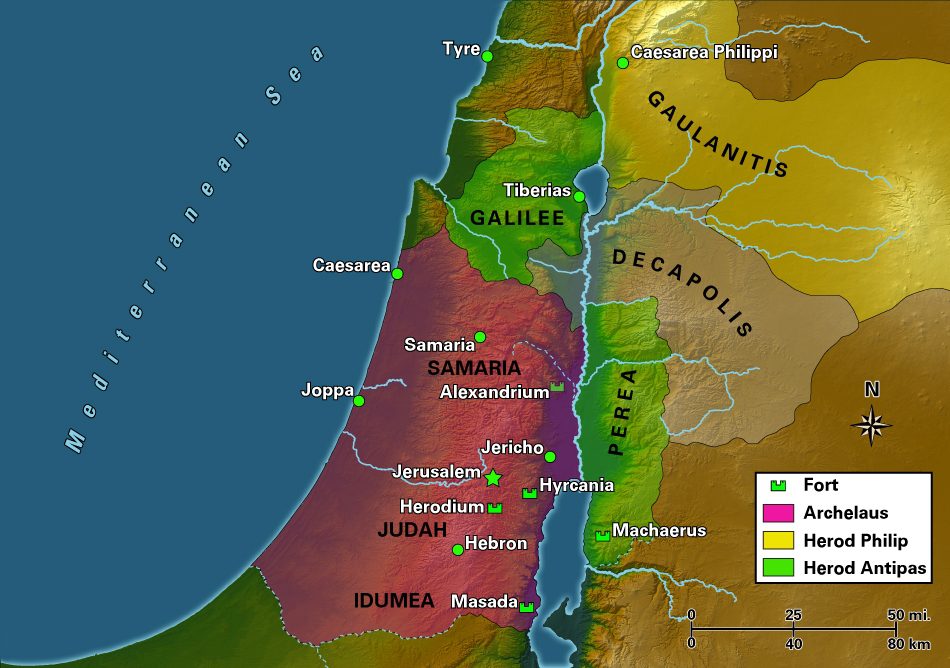
    After Herod’s death, three sons (two named Herod and Philip) administered separate Roman-ruled provinces. Religious divisions and insurrections also sought to weaken Roman rule by selective terrorism.

    The religious/political leaders of Jerusalem divided into three parties, really as much political beliefs as traditional religion. The Lord was not foremost in the philosophies of most of the Jewish elite, which included the Sadducees and Scribes or the more middle class Pharisees. The Essenes were sort of the monks of the day, with limited influence from the wilderness on the religious rule of the cities. (John the Baptist is thought to be one of the Essenes.)

    All of this turmoil preceded the birth of the Messiah Jesus during the reign of Herod the Great and continued even beyond Jesus’ triumphant entry into Jerusalem, ruled by Herod Archelaus. 

    The natural question to Jesus by leaders on all sides of political and religious belief would of course be, “.. who gave you this authority?” – Matthew 21:23

    Leaders of every political persuasion and religious belief had already challenged Jesus frequently in His three years of teaching. Everyone knew of His power, righteousness and positions in matters of Law, the Scriptures and God.

    And they were all amazed, so that they questioned among themselves, saying,
    “What is this? A new teaching with authority! He commands even the unclean spirits, and they obey him.”
    Mark 1:
    For the law was given through Moses; grace and truth came through Jesus Christ. – John 1:17

    Sadducees believed the Law was literal and authority came though the Priests. Jesus challenged their authority, but not that of the Law.

    “Do not think that I have come to abolish the Law or the Prophets; I have not come to abolish them but to fulfill them. For truly, I say to you, until heaven and earth pass away, not an iota, not a dot, will pass from the Law until all is accomplished… – Matthew 5:17-20

    Jesus had explained to his Disciples:

    The Son of Man will send his angels, and they will gather out of his kingdom all causes of sin and all law-breakers, and throw them into the fiery furnace.

    Religious officials hearing him would likely have understood that Jesus identified them as the weeds in the parable of the weeds.

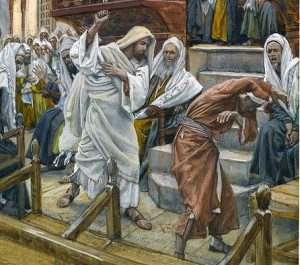
    Pharisees too were far from immune to identification with sin and hypocrisy by Jesus. They had a tendency to impose priestly law and complex interpretation of the Law on the common people. Jesus challenged them.

    “Woe to you, scribes and Pharisees, hypocrites! For you tithe mint and dill and cumin, and have neglected the weightier matters of the law: justice and mercy and faithfulness. These you ought to have done, without neglecting the others. – Matthew 23:23

    This Jesus, arriving at the gate of Jerusalem, worshiped by huge crowds is no stranger to these religious leaders. In fact, the Son of Man, the Messiah of Scripture is a direct challenge to their own future.

    Scriptures

    You study the Scriptures diligently because you think that in them you have eternal life. These are the very Scriptures that testify about me, yet you refuse to come to me to have life. – John 5:39-40 NIV

    Again, even now, no book is so controversial as the Bible.

    Sadducees interpreted the written word of God so literally as to not leave room for the many modes of literary expression. Pharisees loved to spin their own interpretations of God’s word with such complexity as the Lord never intended. They added an oral law of their own making.

    The Essenes actually had it right, using inspired exegesis of the Bible.

    Jesus told Parables, but also quoted scripture to explain why the religious authorities failed in their teaching of scripture. The religious officials of Jerusalem knew what Jesus had previously spoken during the festival of the booths.

    John 7:

    … 2 Now the Jews’ Feast of Booths was at hand. … then he also went up, not publicly but in private. 11 The Jews were looking for him at the feast, and saying, “Where is he?” 12 And there was much muttering about him among the people…

    13 Yet for fear of the Jews no one spoke openly of him.

    Jesus went up into the temple and began teaching… 

    19 Has not Moses given you the law? Yet none of you keeps the law. Why do you seek to kill me?” 

    … 25 Some of the people of Jerusalem therefore said, “Is not this the man whom they seek to kill? 26 And here he is, speaking openly, and they say nothing to him! Can it be that the authorities really know that this is the Christ? …

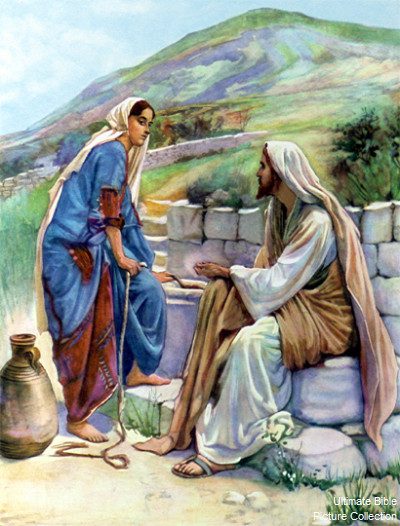
    37 On the last day of the feast, the great day, Jesus stood up and cried out, “If anyone thirsts, let him come to me and drink. 38 Whoever believes in me, as the Scripture has said, ‘Out of his heart will flow rivers of living water.’”

    … 42 Has not the Scripture said that the Christ comes from the offspring of David, and comes from Bethlehem, the village where David was?”

    This Jesus of Nazareth was well known in Jerusalem and controversial as well, even prior to His entry into Jerusalem, even after the resurrection of Lazarus.

    God

    Isaiah 44:22 מָחִיתִי כָעָב פְּשָׁעֶיךָ וְכֶעָנָן חַטֹּאותֶיךָ שׁוּבָה אֵלַי כִּי גְאַלְתִּֽיךָ׃

    John:

    In the beginning was the Word, and the Word was with God, and the Word was God. 2 He was in the beginning with God. 3 All things were made through him, and without him was not any thing made that was made.

    “Behold, the Lamb of God, who takes away the sin of the world! 30 This is he of whom I said, ‘After me comes a man who ranks before me, because he was before me.’

    Jesus Is Equal with God

    5:18 This was why the Jews were seeking all the more to kill him, because not only was he breaking the Sabbath, but he was even calling God his own Father, making himself equal with God.

    The Authority of the Son

    19 So Jesus said to them, “Truly, truly, I say to you, the Son can do nothing of his own accord, but only what he sees the Father doing. For whatever the Father does, that the Son does likewise.

    וְכָל־בָּנַ֖יִךְ לִמּוּדֵ֣י יְהוָ֑ה וְרַ֖ב שְׁלֹ֥ום בָּנָֽיִךְ׃

    6:45 It is written in the Prophets, ‘And they will all be taught by God.’ Everyone who has heard and learned from the Father comes to me—

    John 10:30 “I and the Father are one.” 


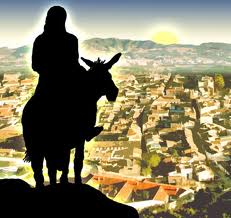
    Zechariah 9:9  גִּילִי מְאֹד בַּת־צִיֹּון הָרִיעִי בַּת יְרוּשָׁלִַם הִנֵּה מַלְכֵּךְ יָבֹוא לָךְ צַדִּיק וְנֹושָׁע הוּא עָנִי וְרֹכֵב עַל־חֲמֹור וְעַל־עַיִר בֶּן־אֲתֹנֹֽות׃

    Rejoice greatly, O daughter of Zion!
    Shout aloud, O daughter of Jerusalem!

    Behold, your king is coming to you;
    righteous and having salvation is he,
    humble and mounted on a donkey,
    on a colt, the foal of a donkey.

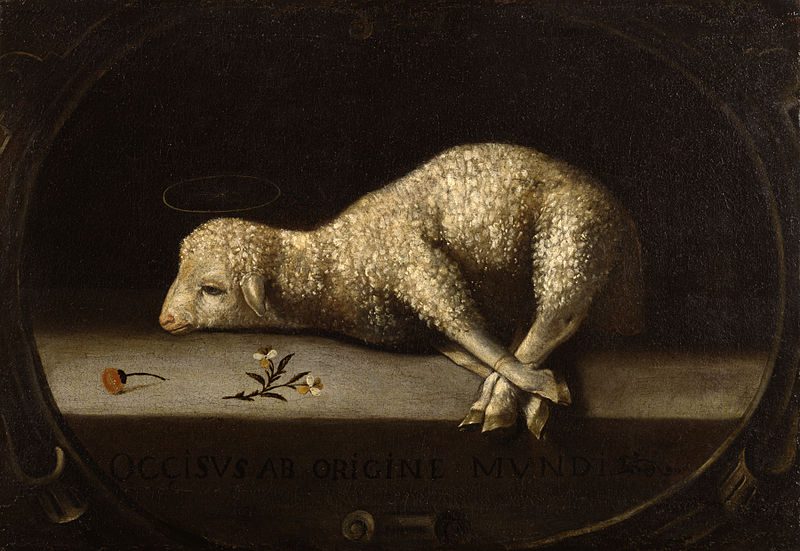
    lamb bound on the altar of sacrifice
    The Passover Lamb

    Matthew 21:23 And when he entered the temple, the chief priests and the elders of the people came up to him as he was teaching, and said,

    “By what authority are you doing these things, and who gave you this authority?”

  • Interrupting Jesus 5 – persistent faith

    Interrupting Jesus 5 – persistent faith

    And the dead man sat up and began to speak, and Jesus gave him to his mother. Fear seized them all, and they glorified God, saying,

    “A great prophet has arisen among us!” and

    “God has visited his people!”

    17 And this report about him spread through the whole of Judea and all the surrounding country. – Luke 7:15-17

    Can you imagine hearing about this? Can you imagine what you would think as you heard other stories about this Jesus of Nazareth (who now lived in Capernaum) healing many in the crowds who now followed this expected Messiah of Israel?

    And dare we wonder how the Good News (Gospel) must have affected those with continued needs of healing. The Good News about Jesus is abuzz in the ears of all Galilee, Judea and even Samaria.

    mark-1-21-28-jesus_rebukes_the_unclean_spirit_in_a_possessed_man_in_the_synagogue_001Mark 1

    21 And they went into Capernaum, and immediately on the Sabbath he entered the synagogue and was teaching. 22 And they were astonished at his teaching,for he taught them as one who had authority, and not as the scribes. 23 And immediately there was in their synagogue a man with an unclean spirit. And he cried out, 24 “What have you to do with us, Jesus of Nazareth? Have you come to destroy us? I know who you are—the Holy One of God.”

    Jesus routinely goes to worship, but is interrupted by a demon who knows He is the Son of God.

    Jesus frees the man from his demon! He goes to the house of Simon Peter and heals his wife’s mother of a fever. He heals many sick as the crowds come to hear the Messiah in Galilee.

    … Jesus could no longer openly enter a town, but was out in desolate places, and people were coming to him from every quarter. – Mark 1:45b

    Jesus’ personal and daily life (normalcy, we might call it) was interrupted in every way. God, in the Person of Christ, in your neighborhood is Headline News… Good News.


    Mark 2

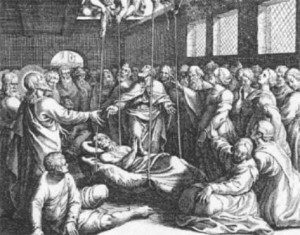
    man lowered through roofAnd when he returned to Capernaum after some days, it was reported that he was at home. And many were gathered together, so that there was no more room, not even at the door. And he was preaching the word to them.And they came, bringing to him a paralytic carried by four men. And when they could not get near him because of the crowd, they removed the roof above him, and when they had made an opening, they let down the bed on which the paralytic lay.

    And when Jesus saw their faith, he said to the paralytic, “Son, your sins are forgiven.”

    I love friends persistent in their love; don’t you? These men had heard all about God With Us, the Christ who heals. They had little chance of getting to Him through the crowds, but by persistence of faith and constancy of love pressed on to reach the unreachable God, interrupting the teaching of this Superstar in their midst.

    It reminds me of the love of the friends of Job.

    Job 2:7-8; 11-13 excerpt

    Now when Job’s three friends heard of all this evil that had come upon him, they came each from his own place…  They made an appointment together to come to show him sympathy and comfort him… And they sat with him on the ground seven days and seven nights, and no one spoke a word to him, for they saw that his suffering was very great.

    These are the quality of friends who would bring a man to the Messiah, boldly interrupting Him, asking the Lord for the mercy of healing.

    And what was the usual reaction of the congregation? What are they thinking as Jesus is teaching to them in this most worshipful setting; that is, until the commotion of men breaking through the roof above them? And how does a compassionate God With Us react to this interruption of His preaching?

    “Son, your sins are forgiven.” (The paralyzed man is healed!) That should be the end of it: another miracle.

    (Now moving on: what was I telling you about God?)

    Yet these witnesses of God’s mercy now receive the rebuke of an even more authoritative teaching:

    “Why do you question these things in your hearts? Which is easier, to say to the paralytic, ‘Your sins are forgiven,’ or to say, ‘Rise, take up your bed and walk’?

    (You, church goer! Are you paying attention here? My sermon about God’s judgement, mercy, love and power is for ALL; not just you.)

    [Well, that’s probably the unkind way I might have said it.] Jesus turns to those of his original faithful audience with the best seats in church:

    10 But that you may know that the Son of Man has authority on earth to forgive sins”

    —he said to the paralytic— 11 “I say to you, rise, pick up your bed, and go home.”

    12 And he rose and immediately picked up his bed and went out before them all, so that they were all amazed and glorified God, saying, “We never saw anything like this!”

    Other eye-witness accounts of the miracles of the Messiah, the Good News of the Gospels might say something like:

    ‘Because of their faith, many believed.’

    Does anyone believe because of your faith in Jesus Christ?


    All were amazed. Some believed.

    The Apostle Matthew in his Gospel reports: And he rose and went home.  When the crowds saw it, they were afraid, and they glorified God, who had given such authority to men. Matthew 9:7-8

    Imagine that you are one in the crowd who pressed against this house in Capernaum where Jesus was surrounded by Scribes and many others – a house where men with a make-shift stretcher had pushed through until visibly climbing onto the roof and relaying the paralyzed man up to each other then lowering him down inside. Out the door walks a group of faithful friends which included the joyous man healed by Christ Jesus! What is your reaction?

    • Does Jesus Christ have authority in your life?
    • Do you believe in the Messiah of Almighty God now?
    • Do you have just a bit more hope and joy like the man walking on legs which were lifeless?
    • Is your soul lifeless without the hope of the forgiveness of sins spoken by Christ Jesus?

    “God has visited his people!”


    “Son [or daughter], your sins are forgiven.”