
Tag: beatitudes

  • The Beatitudes and the Multitudes – Introduction

    The Beatitudes and the Multitudes – Introduction

    You may not have thought of the beatitudes as a teaching related to preparation for Christmas (Advent), but by intention of the Spirit that is exactly what is on my heart.

    The usual Christmas liturgy of church begins just after the following genealogy of Jesus Christ (which we tend to skip over, just like those in Numbers, Kings and other historical Old Testament Books of the Bible).

    After you skip through the generations of Joseph, Jesus’ step-father, we will look back just a little at the historical time preceding the coming of the Messiah to a lowly manger in Bethlehem of Judea, before proceeding to the early teachings of Jesus on true blessings (Beatitudes, as we call them).

    Matthew 1

    English Standard Version (ESV)

    The Genealogy of Jesus Christ

    1 The book of the genealogy of Jesus Christ, the son of David, the son of Abraham.

    2 Abraham was the father of Isaac, and Isaac the father of Jacob, and Jacob the father of Judah and his brothers, 3 and Judah the father of Perez and Zerah by Tamar, and Perez the father of Hezron, and Hezron the father of Ram, 4 and Ram the father of Amminadab, and Amminadab the father of Nahshon, and Nahshon the father of Salmon, 5 and Salmon the father of Boaz by Rahab, and Boaz the father of Obed by Ruth, and Obed the father of Jesse, 6 and Jesse the father of David the king.

    And David was the father of Solomon by the wife of Uriah, 7 and Solomon the father of Rehoboam, and Rehoboam the father of Abijah, and Abijah the father of Asaph, 8 and Asaph the father of Jehoshaphat, and Jehoshaphat the father of Joram, and Joram the father of Uzziah, 9 and Uzziah the father of Jotham, and Jotham the father of Ahaz, and Ahaz the father of Hezekiah, 10 and Hezekiah the father of Manasseh, and Manasseh the father of Amos, and Amos the father of Josiah, 11 and Josiah the father of Jechoniah and his brothers, at the time of the deportation to Babylon.

    12 And after the deportation to Babylon: Jechoniah was the father of Shealtiel, and Shealtiel the father of Zerubbabel, 13 and Zerubbabel the father of Abiud, and Abiud the father of Eliakim, and Eliakim the father of Azor, 14 and Azor the father of Zadok, and Zadok the father of Achim, and Achim the father of Eliud, 15 and Eliud the father of Eleazar, and Eleazar the father of Matthan, and Matthan the father of Jacob, 16 and Jacob the father of Joseph the husband of Mary, of whom Jesus was born, who is called Christ.

    17 So all the generations from Abraham to David were fourteen generations, and from David to the deportation to Babylon fourteen generations, and from the deportation to Babylon to the Christ fourteen generations.

    Now look back some to the generations between the destruction of Solomon’s Temple (9th c. B.C.) and the building of Herod’s Temple.

    David had united Israel and Judah. Solomon’s sons divided the Kingdom of God’s chosen people into Israel (under Jeroboam) and Judah (under Rehoboam, Matthew 1:7). Without going into the many historical details of these nations over the centuries, Israel eventually came under the influence of Samaria, which fell in 721 B.C., and Judah, which fell in 587 B.C. The walls were destroyed my Nebuchadnezzar and rebuilt by Nehemiah in the mid 5th century B.C. Several accounts of these times are recorded in Ezra-Nehemiah and Daniel.

    Alexander the Great conquered much of the known world in the 3rd c. B.C. from Greece west to India, spreading the eventual Greek language of the New Testament throughout the middle east. For some 400 years, Parthia was the largest organized state on the eastern frontier of the Roman Empire until it was later captured by Rome later in A.D. 113 (during the days of early Christianity; but the unifying language of Judea and most of the Roman Empire was Greek (not Latin or local languages).

    Two groups of Jews locked in civil war when Pompey captured Jerusalem (106-48 B.c.) Herod (who was a half-Jew) chose the right side in the Roman conflict and was appointed King of Judea in 40 B.c. Herod conquered ‘his Kingdom’ with the ‘help’ of the Roman army. {Much of the preceding source information from: Historical Atlas of the Bible, by Dr. Ian Barnes}

    Into this often contested arena of Nations and Kings and Emperors and gods of every imagination and evil inclination of man is born Christ Jesus, Son of the Living God, conceived by the Holy Spirit; born of a virgin in Bethlehem of Judea. For thirty years Jesus, Emmanuel (God With Us), lives among the poor and downtrodden men of Galilee.

    Into this scene, Jesus is anointed for His fulfillment of prophesy and sacrifice of the Cross, filled with the Holy Spirit and living a life of sinlessness, teaching man (adam”) how God has intended us to live. Into a difficult time and place, where a people of God thought they lived lives cursed by God, Jesus comes to a mountainside teaching with the Authority of God Almighty and the power of the Holy Spirit.

    To be continued…
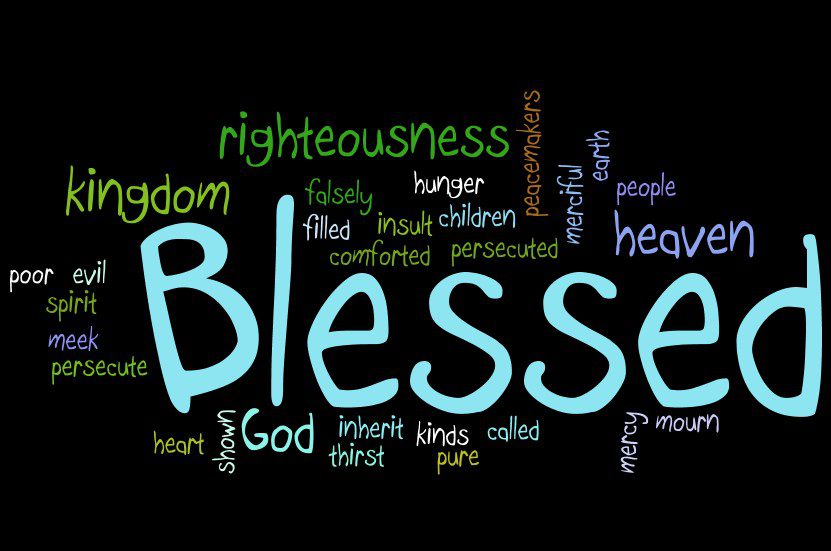
     

  • Happy are you…

    Happy are you…

    Happy Birthday.  Thanks.

    Happy Anniversary.  Thanks.

    Did you have a happy birthday?  … Hmmm… Quite a different question.

    By “Happy,” do you mean “BLESSED?”

    If that is your question, my answer is YES.

    Aren’t happiness and blessedness the same?   How does Jesus measure blessedness?

    Jesus Christ gives us an insight into blessedness and happiness you may not have considered or may hesitate to embrace.

    You will find Jesus’ measure of “blessed” the Beatitudes in two of the Gospels.

    We may see more of Jesus’ paradox of blessedness in the Young’s Literal Translation (or a contemporary rendering like The Message Bible):

    • Happy the poor

    • Happy those hungering now

    • Happy those weeping now

    • Happy are ye when men shall hate you, and when they shall separate you, and shall reproach, and shall cast forth your name as evil, for the Son of Man’s sake

    (In case you seek a little more “blessedness”) Mathew’s Good News adds a little more to the paradox than Luke:

    • `Happy the poor in spirit
    •  `Happy the mourning
    • `Happy the meek
    • `Happy those hungering and thirsting for righteousness
    •  `Happy the kind
    • `Happy the clean in heart
    • `Happy the peacemakers
    • `Happy those persecuted for righteousness’ sake
    • `Happy are ye whenever they may reproach you, and may persecute, and may say any evil thing against you falsely for my sake

    Jesus said to His disciples – His followers: “You are my friends if you do what I command.” – John 15:14

    Is Christ Jesus your friend?  (Take a look at His ‘To Do List’ for “Happiness.”)

    Blessed are we IF we DO these things.

    “And if you do not carry your own cross and follow me, you cannot be my disciple. – Luke 14:27

    Blessed are you: beloved brother, beloved sister in our Lord.

    Have a blessed day. :{)+

  • Is Your Heart Pure?

    Is Your Heart Pure?

    You know the story of Jesus and the Sermon on the Mount.  He preaches to the crowds on a mountainside near Capernaum, beside the Sea of Galilee.

    Jesus begins with nine compassionate proverbs – not the Proverbs of the Old Testament, but wisdom of His own.

    Matthew 5:8  Blessed are the pure in heart: for they shall see God.

    Do you see God? (I don’t.)  What does that tell us?

    Many feel-good sermons have encouraged our hearts in these beatitudes – our hearts which are not even close to pure.  We hear the Gospel of Jesus Christ, but we do not receive it in our hearts which are not pure.  The heart is deceitful, because it is not pure.


    I once inadvertently poked myself in the eye.  I saw a great flash of light with intense distortion of my suddenly excruciating painful poke. I didn’t see God; but I couldn’t see anything else, either.

    Sometimes it takes a sudden poke to get my heart refocused. It takes a pouring off of the dross from my cold hardened heart to purify my soul nearer to the pureness of God.

    Jesus does NOT have fond and ‘happy’ memories of the crowds who sat on the Capernaum hillside.  The Son of God rebukes the “blessed” of Capernaum… those who did not accept his nice little Sermon on the Mount.

    He later delivers these same ‘blessed’ an unexpected poke in the eye.

    Matthew 11: 23 “And you people of Capernaum, will you be honored in heaven?  No, you will go down to the place of the dead.[a] For if the miracles I did for you had been done in wicked Sodom, it would still be here today. 24 I tell you, even Sodom will be better off on judgment day than you.”

    The nice people of Capernaum have not had ears to hear the nine nice proverbs of blessing by Jesus. Here He sounds more like the Prophets who warned of curse which would come on the land and God’s ‘blessed.’

    Zechariah 13:9  And I will bring the third part through the fire, and will refine them as silver is refined, and will try them as gold is tried: they shall call on my name, and I will hear them: I will say, It is my people: and they shall say, The LORD is my God.

     “The choice is clear: BLESSING OR CURSE – Heaven OR Hell – Jesus OR a heart not quite pure enough for Heaven.

    It seems we have two choices: the eternal fire of Hell

    OR a refining fire of the Holy Spirit.

    Look at the picture of God refining the heart:

    Psalm 119:119 NKJV says:

    You put away all the wicked of the earth like dross;
    Therefore I love Your testimonies.

    The wisdom of Proverbs 25:4 tells us:

    Take away the dross from silver,
    And it will go to the silversmith for jewelry.

    “IF you want to see God, allow the Holy Spirit to take away the dross, the impurities of your heart and its cold deceptive hardness.

    Jesus gave us the fire of the Spirit to refine our souls to see God.  By the blood of Jesus and the fire of the Holy Spirit we will be 100% pure.

    John 14: 15 “If you love me, obey[d] my commandments. 16 And I will ask the Father, and he will give you another Advocate,[e] who will never leave you. 17 He is the Holy Spirit, who leads into all truth. The world cannot receive him, because it isn’t looking for him and doesn’t recognize him. But you know him, because he lives with you now and later will be in you.”

    How pure is your heart?

    Pray for the ‘blessed’ refining fire of the Spirit, before the ‘cursed’ punishing fire of Hell.