Tag: caesar

  • Emmanuel -2

    Emmanuel -2

    Christmas according to the Gospel

    Yesterday, in part one of this 3-part Christmas series, I mentioned that ‘Emmanuel’ is a Latin or romanized spelling of “Immanuel” from the Hebrew. I also remind us that Christmas was a minor celebration, actually banned at times by the church.

    We began discussion of the Nativity (the birth of Jesus) with an introduction of the Gospels of Mark and John, discovering that the prophets had already predicted the coming of a Messiah, God With Us, Immanuel.

    Today we continue with the Gospel of Matthew, Disciple to Jesus and a Jew familiar with the Bible (Old Testament).

    The Genealogy of Jesus Christ

    Matthew 1: KJV

    The book of the generation of Jesus Christ, the son of David, the son of Abraham.

    Abraham begat Isaac; and Isaac begat Jacob; and Jacob begat…

    Wait! Why start the story of Jesus with a history of ancestry? It reads a little bit like Genesis 5 to me. Adam begat Seth, who begat Enoch, who begat... (you get the idea). We tend to skip over those little details anyway.

    We see Abraham in there and David on the list. 

    And Josias begat Jechonias and his brethren, about the time they were carried away to Babylon: a clear connection of this Jewish genealogy from Adam through David, then Kings of a divided, defeated and deported Israel.

    If we look at Mathew’s list of the genealogy of Jesus more closely, another question may even come to mind.

    and Jacob fathered Joseph the husband of Mary,
    who gave birth to Jesus who is called the Christ.

    Matthew 1:16 CSB

    Immediately following, Matthew mentions the controversy of the time:

    Now the birth of Jesus Christ was on this wise [in this way]:

    When as his mother Mary was espoused [betrothed] to Joseph, before they came together [physically {or sexually, if we may be so bold}], she was found with child of the Holy Ghost [pregnant, by the Holy Spirit of  God the Father!].

    Matthew 1:18 KJV [with comment]

    Before we address the controversies of verse 18, let’s address the obvious question about Joseph first.

    If Joseph was not the father of Jesus, why include Joseph’s family in the genealogy of Jesus?  

    Here we must first remove the blinders of our twenty-first century biases against practices of other cultures in distant places and former times we do not understand.

    Glance at a First Century Woman

    Our misunderstanding of the place and role of Mary may be helped by this brief glance at life at the time of Jesus’ birth.

    Make no mistake about it, first century life from Rome to Jerusalem and the hills of Syria was hierarchical. Caesar Augustus sought to build a civilized ‘Roman’ culture throughout the captive states of his reign.

    In Rome some women were freeborn citizens, but did not vote. Slaves had no inheritance rights and under Roman law a slave had no father. I mention this because Rome was highly dependent on slaves, including physicians, accountants, along with common laborers. Nearly four of every ten Romans were slaves of a citizen. Romans could actually sell their own children as slaves, property of the buyer with no family association. A woman belonged to her father or husband.

    Captive Israel and Judah were client states of Rome. Kings and others held some authority over the men of these captive states. Romans and Jews held similar views about the value of marriage, stability of families and value of the relationship of a virgin daughter joining herself to a husband and new family (betrothal).

    The light regulation of marriage by the law with regards to minimum age (12) and consent to marriage was designed to leave families, primarily fathers, with much freedom to propel girls into marriage whenever and with whomever they saw fit. [source]

    Mary is no queen, just a common girl, most likely age 13-16, promised to an older man of somewhat better standing.

    Two controversies

    Joseph, a carpenter born to a family from very rural Bethlehem near Jerusalem, by order of Rome, must register (in person) for a census in the city of his family. This, the reason for the genealogies of men in historical documents. Matthew 1:1-17 details Joseph’s ancestry. We will examine more of the details of the event in tomorrow’s concluding story of the Nativity from the Gospel of Luke.

    Mary, a virgin pledged to him as a wife, returns from an extended visit to her relatives – pregnant!

    Matthew clearly states that this is the Child of the Holy Spirit [ἐκ ἅγιος hagios πνεῦμα pneuma].

    Clearly, Joseph knows that the child in the womb of his betrothed is not his – he is not the father, suggesting divorce (rather than stoning her to death), which brings us to our second, even larger controversy.

    An angel of the Lord appeared to Joseph in a dream revealing both the identity and Holy conception of the Child.

    She will give birth to a son, and you are to name him Jesus, because he will save his people from their sins.”

    Matthew 1:21 CSB

    Ἰησοῦς Iēsous יְהוֹשׁוּעַ JESUS – THE LORD SAVES

    bLUElETTERbIBLE.ORG http://blb.sc/000q28
    Behold a virgin shall conceive and bear a son, and shall call his name Immanuel - Isaiah 7-14 = picture of sleeping baby
    Immanuel

    Prophesy

    Joseph and faithful Jews of first Century Judea and other captive Roman provinces would know predictions of a Messiah. Herod, vassal tenant king or tetrarch (one of four local Jewish governors) would have also known or learned the prophesy.

    Isaiah said, “Listen, house of David! Is it not enough for you to try the patience of men? Will you also try the patience of my God? Therefore, the Lord himself will give you a sign: 
    See, the virgin will conceive, have a son, and name him Immanuel.

    24 When Joseph woke up, he did as the Lord’s angel had commanded him. He married her 25 but did not have sexual relations with her until she gave birth to a son. And he named him Jesus.

    One other prophesy

    5:2 וְאַתָּה בֵּֽית־לֶחֶם אֶפְרָתָה צָעִיר לִֽהְיֹות בְּאַלְפֵי יְהוּדָה מִמְּךָ לִי יֵצֵא לִֽהְיֹות מֹושֵׁל בְּיִשְׂרָאֵל וּמֹוצָאֹתָיו מִקֶּדֶם מִימֵי עֹולָֽם׃

    But you, O Bethlehem Ephrathah,
    are only a small village among all the people of Judah.
    Yet a ruler of Israel will come from you,
    one whose origins are from the distant past.

    Micah 5:2 – Hebrew Bible & NLT

    Matthew 2:

    This familiar scene (of Kings following a star to worship Jesus takes place some time after His birth).

    After Jesus was born in Bethlehem of Judea in the days of King Herod, wise men from the east arrived in Jerusalem, 2 saying,

    “Where is he who has been born king of the Jews?

    For we saw his star at its rising and have come to worship him.”
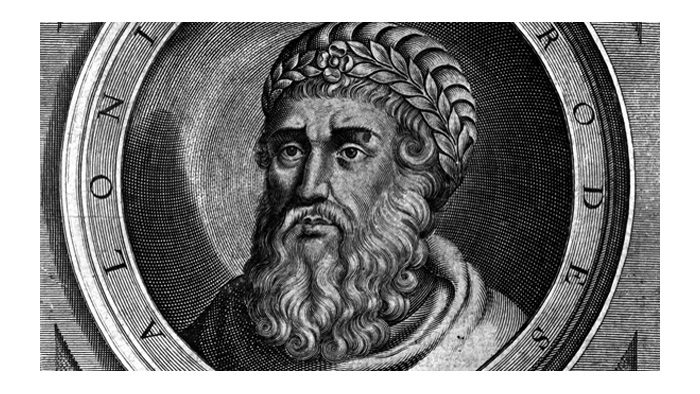
    image of Herod the Great
    Herod the Great

    Traveling kings ask about one born ‘king of the Jews.’ And by protocol they ask the so-called king ruling in Jerusalem under Rome.

    The Herod’s have have held the captive thrones of Judea and surrounding Roman states for just a few decades.

    Where is this new King of the Jews?

    3 When King Herod heard this, he was deeply disturbed, and all Jerusalem with him. 4 So he assembled all the chief priests and scribes of the people and asked them where the Christ would be born.

    5 “In Bethlehem of Judea,” they told him, “because this is what was written by the prophet:

    6 And you, Bethlehem, in the land of Judah,
    are by no means least among the rulers of Judah:
    Because out of you will come a ruler
    who will shepherd my people Israel.”

    9 After hearing the king, they went on their way. And there it was—the star they had seen at its rising. It led them until it came and stopped above the place where the child was. 10 When they saw the star, they were overwhelmed with joy.

    11 Entering the house, they saw the child with Mary his mother, and falling to their knees, they worshiped him. Then they opened their treasures and presented him with gifts: gold, frankincense, and myrrh.

    12 And being warned in a dream not to go back to Herod, they returned to their own country by another route.

    Joseph and Mary take Jesus to Jerusalem, then escape Herod to live in Egypt during the early childhood of Jesus.

    To be continued... (tomorrow, Christmas Day)
    
    
  • Judea of Herod

    Judea of Herod

    (Just a bit more Roman history before we continue in Luke 7)

    Prior to Roman Rule:

    • Judah in path of invading armies crossing eastern Mediterranean shores
    – Judah controlled by Syrians, Greeks, Romans, others over the years
    • Syrians took over in 198 B.C., introduced Greek culture to Jews
    – Jews allowed to keep religion, but some adopted Greek culture, gods
    • In 175 B.C., Syrians insisted Jews worship Greek gods; Jews refused
    – Jewish religion was outlawed; some fled to hills, prepared to fight
    Rebels Fight Syria
    • Jewish priest and five sons led fight to drive out Syrians
    – son Judah Maccabeus led revolt with his force, the Maccabees
    • Tiny Jewish force faced larger, better equipped Syrian army
    – rebels knew countryside and defeated Syrians in many battles
    Maccabees regained Jerusalem by 164 B.C.

    Rome Conquers Judea
    • Romans conquered Judah (Judea) in 63 B.C.
    • Roman rulers kept strict control over Judea
    • Jewish kings, religious leaders appointed by Rome

    Leader(s) of the Maccabees Timeline
    167 BC: Mattathias, the Hasmonean
    166 – 161 BC: Judas Maccabaeus, the Hammer of the LORD
    161 – 143 BC: Jonathan Apphus, the Wary
    143 – 135 BC: Simon Thassi, the Zealous Guide

    Although the Maccabees, and later their descendants, the Hasmoneans, managed to keep Israel free from foreign oppression for almost 150 years, this abruptly ended with King Herod who was not a Hasmonean at all.

    The Hasmonean dynasty, which leaped onto the stage of history with such dramatic heroism, disappeared from that same stage with cruel suddenness. The despot Herod, whose régime was forced upon the unwilling Jewish populace by his Romans overlords, was fully aware that the aura of Hasmonean charisma would constitute a continual threat to his power, and hence he undertook to ruthlessly murder all the remaining descendants of that family, including his beloved wife Mariamne, granddaughter of the Hasmonean ruler Hyrcanus II. Herod executed her on trumped-up charges of disloyalty, as he did afterwards to the two sons she had borne him, Alexander and Aristobulus. – Wikipedia

    Herod builds another Temple in Jerusalem and many buildings throughout Judea with the support of Rome.

    Herod the First of Judaea, known to history as Herod the Great

    • Alexander died in 76 B.C. and Salome ruled alone until her death in 67 B.C. Upon the death of the queen a civil war broke out between her two sons. Herod’s father Antipater II sided with Hyrcanus…
    • Rome had intervened in Syria and ousted their King and posted Legions in Syria.
    • Caesar and Pompey were also in a Roman civil war for power. Herod’s father had supported Caesar and was made Procurator of Judea.
    • Herod loyally supported Antony against Octavian until 31 B.C.  Octavian defeated Antony, but had no one to replace Herod and gave him some of Antony’s territories given by Antony of Rome to Cleopatra of Egypt.
    • Near the time of Herod’s death (just prior to the birth of Jesus) Herod feared a coup from his own sons as more civil unrest broke out in his Kingdom of Judea (given to his family as political compromise by Rome).

    HEROD’S PERSECUTIONS

    Herod’s persecutions were infamous and they even extended to his own family.

    Herod, knowing that his Jewish credentials were suspect, had married Miriam—the granddaughter of Hyrcanus and therefore a Hasmonean princess—largely to gain legitimacy among the Jewish people. But he also loved her madly. As Josephus relates:

    Of the five children which Herod had by Miriam, two of them were daughters and three were sons. The youngest of these sons was educated in Rome and died there but the two eldest he treated as those of royal blood on account of the nobility of their mother and because they were not born until he was king. But what was stronger than all this was his love he bore for Miriam which inflamed him every day to a great degree.

    The problem was that Miriam hated him as much as he loved her, largely because of what he had done to her brother, Aristobulus.

    Herod had made Aristobulus High Priest at the age of 17, and watched with trepidation as the young man became hugely popular. This was not surprising as Aristobulus was a Hasmonean with a legitimate right to be High Priest – a genuine Jew and a genuine cohen.

    But this threatened Herod too much and he had him drowned.

    • Luke does not retell the story of Joseph and Mary fleeing from Bethlehem to Egypt before returning to Nazareth after Herod’s death. We do, however get a flavor of the controversy of the Herod’s vs. the Jews in the story of John the Baptist.

    Although we have looked past the calls of John the Baptist to the people and the King for repentance to the call of Jesus to the multitudes for repentance, Luke also reports more of John’s relationship with Jesus in chapter 7.

    To be continued in Luke 7.

  • Conquered and the Conquerers

    Conquered and the Conquerers

    Jesus, Son of Man, comes among us with a perspective of history of another dimension we can scarcely comprehend: time.

    I am the Alpha and the Omega, the beginning and the end.

    Before Abraham was, I AM.

    Remarkable statements! A perspective of history which can only be viewed outside of our dimension of time.

    Never-the-less, let us view some of the maps of the nations (gentiles) over the times preceding the incarnation of the Son of Man.

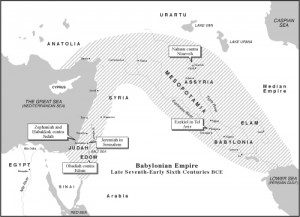
    Babalonian Empire Israel has fallen. God has pronounced judgment on Israel for her unfaithfulness. God sends his Prophets to unfaithful Judah (her sister of whoredom) and to the gentile nations as well.
    Judah is small. Assyria, Babylonia, Mesopotamia, Syria and Egypt are large and powerful, opposing each other with God giving victory to varied enemies of Judah in the times of the Prophets and the times of His silence before a newer map at a later time.

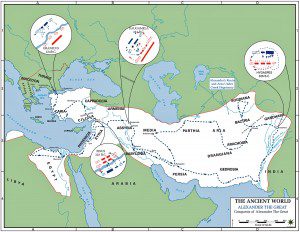
    alexander_the_great_conquestsIn the fourth century B.C. comes another conqueror from the west: Alexander the Great. He defeats the eastern empires and spreads Greek culture throughout the Mediterranean. The map again differs and the language and culture from the time after Alexander’s death is called Hellenism. Greek becomes the common language of the empire, including Jerusalem and the former areas of defeated Israel and fallen Judah (now called Phoenicia). Don’t think of it as small Greece, islands of the Mediterranean, but Empire Greece, as in Asia (or most of what we now call Asia) as far as India in the East.
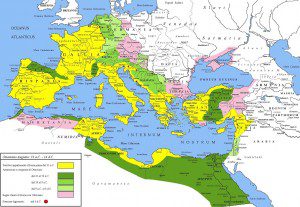
    Now, much nearer the time of Jesus, 62 B.c.- 14 A.D., we read of the Incarnate Son of God in Luke 2. (No doubt all are familiar with the story, yet few are familiar with the map.)

    The Birth of Jesus Christ

    2 In those days a decree went out from Caesar Augustus that all the world should be registered. 2 This was the first registration when Quirinius was governor of Syria. 3 And all went to be registered, each to his own town. 4 And Joseph also went up from Galilee, from the town of Nazareth, to Judea, to the city of David, which is called Bethlehem, because he was of the house and lineage of David, 5 to be registered with Mary, his betrothed, who was with child.

    Augusto_Roman empireAgain in our timeline under Rome, again we must view the map not as a place of Israel or Judah. Rome conquered Jerusalem, Tyre and Sidon (of Syria), Nazareth and all the rest. The map is of Rome and every town in every land is a crossroads that leads to Rome.

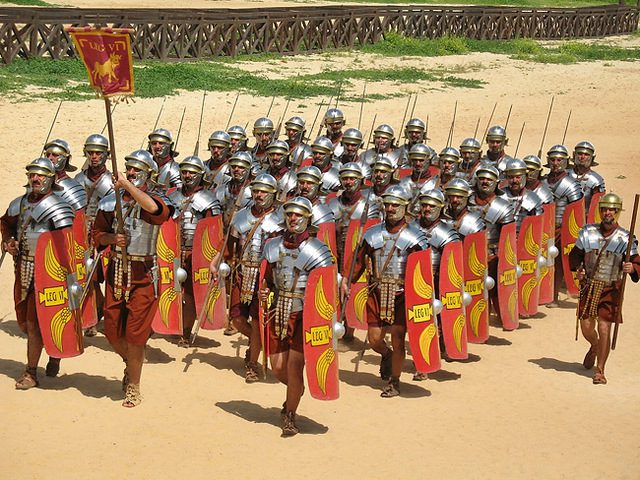
    Judea is nothing more than a minor province in a key expansion of Rome, extending south from Tyre and Damascus beyond Jerusalem. The military control of Rome over the conquered provinces involves an infusion of Roman military control and government and taxes, along with the sharing of a common culture of Hellenistic roots in the Greek language and culture.

    The power of Rome is not its politics or religion, but it’s army. The success of Rome is due, in part, to the integration of a common language (Greek) and culture with the local customs and religions and trade (including taxes to pay the army, administrative costs of Rome). Pay your taxes and keep your local customs.

    The religions of the gentiles of Rome, the gentiles of Greece, and the gentiles of the conquering Babylonians, and other conquering nations like Assyria and Egypt have one thing in common: many gods. The “god of the current time” is often the current ruler, a Pharaoh, a Caesar or worshiped human king.  The Asians worship idols. The Greeks and Romans worship idols. Only the Jews have One God and no idols.

    This same Caesar Augustus of Luke 2 had (for political reasons) declared himself a god. Later, the local Jewish politicians seek to draw Jesus into this controversial debate.

    Want to start a controversy among lovers of Greek mythology (yes, myths as origins of various gods and the ways they serve man)? Just ask how many. Answer? Thousands!

    And Rome cared more for her power and politics than culture. However Rome’s idols and gods also explained which gods served man in which ways. How many?  Again, a countless number of gods to serve the Roman citizen and the slaves of Roman rule.

    Another fact of Roman life overlooked is that the population of Rome had many slaves  It was the culture, discipline organization and administration of the Roman army that best modeled any success of Rome. A conquered people in the days of Jesus, like in the days of the Prophets, could be taken away from their cities and towns and homes to any foreign town or province and sold as slaves. The Roman army used this as leverage to have local leaders do as they wanted under a local administration of Rome.

    Into this environment comes the family of the Herod’s who chose their sides with the right Roman generals and were rewarded for their efforts.

    (Why all this background? NEXT we continue with Jesus’ early encounters with Romans in His travels…)