Tag: Church

  • 2 John – the Doctrine of Christ

    2 John – the Doctrine of Christ

    The Shortest Book in the Bible

    Today we are going to READ the New Testament’s shortest letter. It is written by the beloved Apostle John near the end of the first century A.D.

    Once you have read it, we will then take a look at WHY the Elder wrote it and how to heed John’s warnings to those joined to Christ’s Church.

    2 John


    I rejoiced greatly that I found of thy children walking in truth, as we have received a commandment from the Father. And now I beseech thee, lady, not as though I wrote a new commandment unto thee, but that which we had from the beginning, that we love one another. And this is love, that we walk after his commandments.

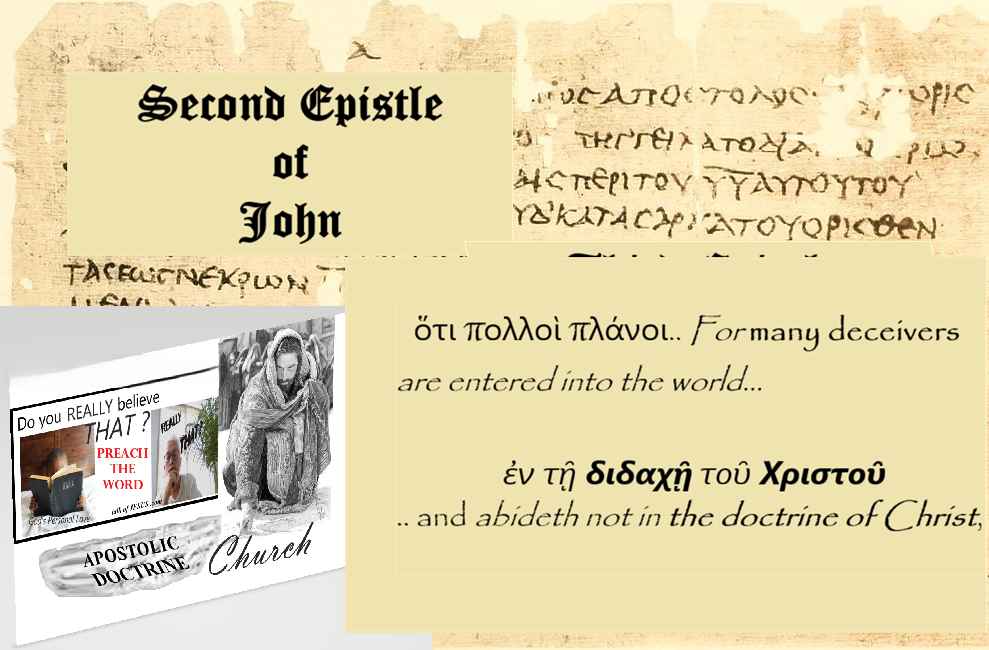
    This is the commandment That, as ye have heard from the beginning, ye should walk in it. For many deceivers are entered into the world, who confess not that Jesus Christ is come in the flesh.

    This is a deceiver and an antichrist.

    Look to yourselves, that we lose not those things which we have wrought, but that we receive a full reward. Whosoever transgresseth, and abideth not in the doctrine of Christ, hath not God.

    He that abideth in the doctrine of Christ, he hath both the Father and the Son.

    If there come any unto you, and bring not this doctrine, receive him not into your house, neither bid him God speed: for he that biddeth him God speed is partaker of his evil deeds.

    Having many things to write unto you, I would not write with paper and ink: but I trust to come unto you, and speak face to face, that our joy may be full.

    The children of thy elect sister greet thee. Amen.

    2 John

    Authorized King James Version


    The DOCTRINE of CHRIST – a line in the sand

    John writes a brief note of less than 300 words in the common Greek of the first century Roman Empire on a single piece of papyrus sometime near the year of our Lord ninety-five (A.D. 90-95) in lieu of a personal visit the aging Apostle intends.

    It appears that the great purpose of II John was to warn the believers not to give indiscriminate hospitality to strangers or traveling evangelist-teachers. Those who did not meet the sure test of sound doctrine were to be refused hastily.

    King James Bible commentary 2-3 John p.1763

    Do you REALLY believe THAT? PREACH THE WORD APOSTOLIC DOCTRINE Church

    He who abides in the doctrine of Christ has both the Father and the Son.

    2 John v.9

    The URGENT WARNING of this last living Apostle of Jesus Christ is both clear and relevant to leaders of the Church up to this day.

    The Second Epistle of John cautions against hospitality or the receiving of heretics.

    As the Apostle emphasized in his earlier letter to the Church, the mystical approach of some antichrists, namely Gnostics, opposed the truth of Scripture and the incarnation of God in the Person of JESUS Christ, His suffering and crucifixion and especially the Lord’s resurrection IN THE BODY and ascension into heaven until Jesus’ return at the last day.

    The Elder’s purpose in writing is to urge the faithful to REJECT false gospels, false philosophies cloaked in christian garments and especially to send away FALSE teachers.

    3 Letters from the Apostle John


    The Elect Lady

    Theologians may debate a small point of who ‘the elect lady’ is.

    The “elect lady and her children,” addressed in verse 1, are taken by most interpreters to mean a church and her members.

    There is.. deep concern for truth (vv. 4-6) and the warning against false doctrine (7-11) are there as in all John’s writings.

    Authorized King James Version intro 2 JOHN

    Lady (Gr kyria) is the same word as “Lord” in the New Testament, except that it is feminine here (and in vs. 5) and refers not to a literal “lady” but to the “congregation” or “church’ in a figurative sense.

    King James Bible Commentary into 2 JOHN

    “The children of thy elect sister greet thee” ( 2Jo 1:13 ).

    the word “Church” comes from a Greek word (kyriake) cognate to the Greek for “lady” (kyria; “belonging to the Lord,” kyrios)

    Jamieson, Fausset & Brown
    Introduction to 2 John

    John, an elder or bishop of churches would in person certainly apply his warning to the body of believers as a whole and especially to any pastor, host or hostess of a home church.

    House Churches

    Some theologians would point out that many early churches were ‘house churches’ and that the “lady” and “her children” may well have been an actual unnamed woman (such as John will name an addressee of his third and final epistle to “Gaius.”

    Since inns in the first century were notoriously flea-infested and rapacious, where would a Christian stay while traveling? The answer was in the home of another Christian.

    KJ Bible Commentary ibid.

    I had to look up this definition and it is culturally worth noting for Christians of the first century or 21st. Some synonyms for Rapacious - greedy, insatiable, gluttonous, materialistic selfish, devouring, savage, preying... Get the idea? 

    So some theologians believe that John wrote to warn a woman hosting a house church against welcoming such heretical predators, let alone let any teaching of such men or women be heard by the saints she welcomes into her home for worship.

    Think of these as evangelists of the antichrist. John also calls them antichrists. The danger of false teaching became so prevalent that by the second century AD other Elders (Bishops) wrote about them.


    Elder Successors to John

    Without digging into early writings of the early church, note one well-documented warning from the 2nd century AD.

    Irenaeus of Lyons, born in Asia Minor ~AD 125 and ‘mentioned as a hearer of Polycarp, the bishop of Smyrna, who in turn was traditionally associated with the Apostle John’ writes a major theological book:

    “Against Heresies” (Adversus Haereses), composed around AD 180.

    He systematically refuted Gnostic teachings, which challenged the reliability of Scripture and the nature of Christ’s Incarnation. By reinforcing the unity of God as Creator, as well as the integral unity of Scripture, Irenaeus defended fundamental Christian doctrines, including the bodily resurrection of Jesus.

    Source: BibleHub.com

    A Caution against Hospitality

    Christians (especially women) can be ‘too nice’ — we’ve all witnessed that. But the Elder John and others caution against it (until the true character of one is tested).

    CLEMENT OF ALEXANDRIA (A.D. 192) [Miscellanies, 2.66].. says, “John’s Second Epistle which was written to the virgins (Greek, “parthenous”; perhaps Parthos is what was meant) is the simplest; but it was written to a certain Babylonian named the Elect lady.”

    Source: BlueLetterBible.org – Jamieson, Fausset & Brown
    Introduction to 2 John

    John MacArthur also suggests that John writes to an individual lady and that the whole purpose of the Elder’s brief epistle is focused on truth.

    Truth

    John writes of her and her children (whether specific individuals or all those of a house church he plans to visit):

    “whom I love in the truth” — agapaō en alētheia

    .. but also all they that have known the truth;

    Pretty inclusive of true believers already established as part of her household of saints separated to Christ.

    for the truth’s sake… — again, alētheia

    AND then John adds to his greeting:

    which abides in us [NKJV] or

    which lives in us [NIV and others]


    because of the truth that remains in us and will be with us forever. [CSB]

    2 John 1:2


    Is the Apostle reminding here of the Holy Spirit whom we may consult in our discernment of truth — ἀλήθεια – alētheia?

    A reminder from John's introduction in his Gospel: 

    For the Law was given through Moses; grace and truth came through Jesus Christ.

    John 1:17 LSB

    MacArthur’s commentary outlines this brief second epistle of John as follows:

    1. The Basis of Christian Hospitality
      • vs 1-3, with truth mentioned 4X
    2. The Behavior of Christian Hospitality
      • vs 4-6, with truth mentioned in v.4
    3. The Bounds of Christian Hospitality
      • vs 7-11, with a test of truth in v. 9
    4. The Blessings of Christian Hospitality
      • vs. 12-13, the Elder will come to her in person

    Recognizing that all the readers of his letter faced and always would face a world of lies and deceit, he wrote to call them to live in God’s truth… John reveals four features of living in the truth: the truth unites, indwells, blesses and controls believers.

    MACARTHUR COMMENTARY 1-3 JOHN, p. 215


    Overcoming the World

    In his first Epistle which we studied earlier, John writes:

    Everyone who believes that Jesus is the Christ has been born of God, and everyone who loves the Father loves whoever has been born of him.

    1 John 5:1 ESV

    MacArthur applies the Apostle’s test specifically to John’s second letter.

    John’s statement encapsulates the main their of this brief epistle, that truth must always govern the exercise of love. Christians’ deep, mutual affection flows out of their shared commitment to the truth.

    ibid. p.217


    John emphasized Christ’s identity as God’s Son because the false teachers were denying that truth.

    ibid. p. 220


    MANY deceivers have gone out into the world.

    WATCH YOURSELVES!

    2 John v.7a,8a

    Do you, beloved lady of this 21st century of the common era, imagine that anything in the life of a Christian has changed one iota?


    Next: 3 John


    Comment on Scripture – Share the Gospel


  • The Elder John and Leadership of the Church

    The Elder John and Leadership of the Church

    The A.D. First Century Church

    I tend to look at the Acts of the Apostles and oversimplify the History of the Church,

    STARRING THE APOSTLES — Peter and Paul.


    Although Jesus says of Peter, “Upon this Rock I will build My Church,” we tend to miss the frequency of John at Peter’s side throughout the early acts of all of the Apostles in Jerusalem.

    Peter preaching from Solomon's Porch
    Peter, John and the healed lame beggar

    Epistles from Apostles to Elders

    Even while reading the Epistles of Paul outlining a developing leadership structure of the A.D. 1st century Church, Elders seem to get lost somewhere between Apostolic authority (at the top) and dynamic Deacons (such as Stephen).

    And God wrought special miracles by the hands of Paul: Acts 19:11 ASV graphic map of Third Missionary Journey of Paul
    Elders, Deacons and other Apostolic leadership 

    Paul writes in his first pastoral letter to Timothy:

    Let the elders who rule well be counted worthy of double honor, especially those who labor in the word and doctrine.

    1 Timothy 5:17 NKJV


    Other English translations help us apply the same Scripture into responsibilities 21st century C.E. churches consider as leadership jobs.

    The elders who are good leaders are to be considered worthy of double honor, especially those who work hard at preaching and teaching.

    1 Timothy 5:17 CSB

    We need to think of the Apostles John, Peter, Paul and others in these dual roles in relation to the developing churches they establish.

    Mediterranean Sea near Phoenix Cypress

    Paul offers a precedent and example of which churches need elders in a pastoral epistle to (the pastor) Titus.

    The reason I left you in Crete was to set right what was left undone and, as I directed you, to appoint elders in every town.

    Epistle of Paul to Titus 1:5 CSB

    Timothy, Titus, Barnabas, Silas and especially the Apostles often deserved double honor for serving as pastor and teacher of a specific local church for a time, in addition to their commission and titles as apostles, disciples, deacons and elders.

    JOHN, during his long years of Apostolic ministry to many churches served as an Elder (probably in several towns) in addition to his chosen commission by Christ as an Apostle.

    map of the seven churches of revelation
    John to the seven churches that are in Asia: Grace to you and peace from Him who is, and who was, and who is to come, and from the seven spirits who are before His throne,

    Elders Leading the Family of God

    Before we look at letters from John the Elder or the role of an Elder in the New Testament families of God and Christ, let’s honor the tradition into which James and John, Sons of Zebedee, Andrew and Simon Peter and other first century Jews were born.

    Elders of Jewish Scripture (the Old Testament)

    “You stand today, all of you, before Yahweh your God [יְהוָה אֱלֹהֵיכֶם]:

    your heads, your tribes, your elders, and your officers, even all the men of Israel, your little ones, your wives, and the sojourner who is within your camps..

    Deuteronomy 29:10-11a KJV

    Included with the elders [the old men, some leaders of clans or families] yᵊhōvâ ĕlōhîm includes officers [foremen] and many others.


    The LORD Visits Sinai Exodus 19 congregation of the Hebrews at Mount Sinai

    Assemble to me all the elders of your tribes and your officers, that I may speak these words in their ears and call heaven and earth to witness against them.

    Deuteronomy 31:28 ESV


    Then all the elders H2205 of Israel gathered together and came to Samuel at Ramah

    1 Samuel 8:4 LSB

    So Samuel did what Yahweh said and came to Bethlehem. And the elders H2205 of the city came trembling to meet him and said, “Do you come in peace?”

    1 Samuel 16:4 LSB

    Princes are hanged up by their hand: 
    the faces of elders were not honoured.
    They took the young men to grind,
    and the children fell under the wood.
    The elders have ceased from the gate,
    the young men from their musick.
    The joy of our heart is ceased;
    our dance is turned into mourning.
    The crown is fallen from our head:
    woe unto us, that we have sinned!

    Lamentations of the Prophet Jeremiah 5:12-16 KJV

    “But you shall select excellent men out of all the people, those who fear God, men of truth, those who hate greedy gain; and you shall place these men over them as leaders of thousands, of hundreds, of fifties, and of tens.

    Exodus 18 & Deuteronomy 1 LSB

    Elders lead the thousands, the hundreds, the fifties and the tens..


    Elders of a developing or disintegrating church

    Before we breeze through the years of the ACTS OF THE APOSTLE JOHN, let’s recall the chronology mentioned previously in a look at John’s Gospel — a timeline taking the young Disciple at the foot of the Cross, past his proclaiming the Gospel with Peter on Pentecost and up to the time the Elder writes his Gospel.

    An account of ACTS in the life of John

    All dates and ages of John are approximate
    • ~A.D. 30 – Jesus’ ascension, Pentecost, Peter & John preaching in the Temple
      • The Apostle John is only about 25 years old.
    • ~A.D. 44 –
      • John is now in his upper 30’s

    About that time King Herod violently attacked some who belonged to the church, and he executed James, John’s brother, with the sword.

    Acts of the Apostles 12:1-2 CSB

    • ~A.D. 49 – Council at Jerusalem (Acts 15)
      • The Apostle John, ~ age 43
      • Peter, who an angel released at the time James was execution, would have been present, along with James, half-brother of Jesus and leader of the Jerusalem church.
      • Paul and other Elders present to decide how Jews and Gentiles will worship Jesus the Lord as one body of Christ

    Then it seemed good to the apostles and the elders, with the whole church, to choose men from among them—Judas called Barsabbas, and Silas, leading men among the brothers—to send to Antioch with Paul and Barnabas, and they sent this letter by them,

    “The apostles and the brothers who are elders, to the brothers in Antioch and Syria and Cilicia who are from the Gentiles, greetings.

    Acts 15:22-23 LSB

    • ~ A.D. 55 – Mark, (John Mark, gentile nephew of Barnabas who had accompanied his uncle and Paul on Cypress & became a scribe to Peter) – writes his Gospel.
      • The Apostle John is about 50 years old
      • Paul and others write Epistles to various churches
    • ~ A.D. 61 – Luke, gentile physician of Paul, writes his Gospel and Jesus’ Apostle Matthew Levi writes his Gospel
      • The Apostle John is now in his upper 50’s
      • The Apostles Peter and Paul continue to write Epistles
    • ~ A.D. 62 – James, half-brother of Jesus and leader of the Jerusalem church is martyred
    • ~ A.D. 66
      • John is now 60 years old
      • The Jews revolt against Rome
        • Christians flee Jerusalem
      • The Apostles Paul and Peter are Martyred in Rome
        • Jude (Jesus’ half-brother) writes an Epistle
        • Epistle “to the Hebrews” written (anonymously)
    • ~ A.D. 86
      • The Elder John is now 80 years old
      • ALL of the other Apostles are dead and as Jesus had told Simon Peter, John is the only one remaining.
      • The Lord has saved John even from torture, exiled on a Greek island of Patmos.
      • John will now write three Epistles…
        • ten, if you count brief greetings to seven in his apocalypse from the Lord Jesus Christ.

    Elders of the New Testament

    In the New Testament, the role of elders becomes more defined within the structure of the early church. Elders, also known as overseers or bishops, are responsible for shepherding the flock, teaching sound doctrine, and maintaining church discipline.

    Plurality and Accountability:
    The New Testament model for church leadership often emphasizes a plurality of elders, suggesting that multiple elders should lead each congregation. This plurality provides a system of accountability and shared responsibility, ensuring that no single individual holds excessive power. The collective wisdom and diverse gifts of multiple elders contribute to the health and growth of the church.

    Conclusion:
    The biblical concept of elders encompasses a rich tradition of leadership and service, rooted in both the Old and New Testaments. Elders are called to be shepherds, teachers, and examples, guiding the people of God with wisdom, humility, and integrity.

    Their role is vital to the spiritual well-being and doctrinal soundness of the church, as they seek to honor God and serve His people faithfully.

    source: BibleHub.com


    NO man was more directly accountable to our risen Lord Jesus Christ, with a lasting impact on the saints of an expanding second century church who had met him, than the ELDER JOHN.


    Comment on Scripture – Share the Gospel


  • The Longest Faithful Apostolic Journey of John

    The Longest Faithful Apostolic Journey of John

    How do you picture the Apostle John?

    • From familiar Scripture as a young man near Jesus,
    • or an old man on Patmos;
    • or do you see a faithful man following Jesus on an extraordinary journey lasting many years?


    INTRODUCTION to JOHN’s Apostolic Faith

    map of Jordan River and Bethany where John baptized Jesus

    late A.D. 20’s at the Jordan river near Bethany

    depiction of John baptizing a man at the Jordan river

    John was there again with two of his disciples. When he saw Jesus walking by, he said, “Look, the Lamb of God!” And when the two disciples heard him say this, they followed Jesus.

    Jesus turned and saw them following.

    “What do you want?”

    “Rabbi”

    “where are You staying?”

    “Come and see,”

    So they went and saw where He was staying, and spent that day with Him.

    Gospel of John 1:35-39 excerpt, BSB


    James and his young brother John were not sleeping when the Messiah of Israel came to their Rabbi, John the Baptist.

    In fact, these two sons of Zebedee had sought the savior of Israel, and then found and followed John the Baptist (who many Jews believed could be the one).

    Then they would join the Master of whom John spoke, and follow Him when the Lord sought His own disciples from their own little fishing village far removed from Jerusalem.

    Introduction to Jesus’ Disciple John

    John is a familiar and beloved Disciple of Jesus, well-known to Christians and unbelievers alike through the Gospels, as well as numerous illustrations and paintings often commissioned by the Roman or Orthodox Church many centuries later.

    the young Apostle John embracing the Cross of Jesus

    ~ in the year of our Lord 30


    He and others likely didn't have a visible halo over their heads. And art such as DaVinci's, 'The Last Supper,' — with young John clinging to Jesus, which illustrates John's actual devotion — shows a long table and chairs never used in upper rooms of the A.D. first century. 

    Acts Apostolos - Acts 1 of the Apostles begins a 28 chapter account of the chronicles of Christ's Apostles - a history of Christ's Church

    A.D. 30’s – A.D. 50’s

    Perhaps Christians will recall that prior to His crucifixion, JESUS sent the Twelve out to some cities to proclaim the Gospel.

    And some may recall that the APOSTLE John was with Peter when both Apostles had been sent to preach in the Temple after Pentecost (~A.D. 30), were witnessed to work miracles.


    “How is it that each of us can hear them in our own native language?

    Acts of the Apostles 2:8 CSB

    • Here is one brief look [October 2021 C.E.] from our TalkofJESUS SERIES from Acts of the Apostles.
      • Perhaps five years later you will still recognize some of the faces.

    Three Score Years of John’s Apostlic Faith

    Followers of Jesus Christ in these last days will generally picture the Apostle Jesus loved as he began his faithful path of life in the early years of John’s life (when he was only in his twenties).

    Even in Acts of the Apostles, our early focus turns from Peter (and John, somewhat) primarily to Paul.

    Although John’s Gospel details key witness of the Lord Jesus Christ prior to the Lord’s death, resurrection and ascension, the Apostle wrote his Gospel for the Church many years later, around the year of our Lord (A.D.) 85 – fifty some years after Pentecost.

    ~ A.D. 50 – ~ A.D. 100

    The Apostle John wrote his final letters near the end of the A.D. First Century!

    Written between a mid-first century Council in Jerusalem and his own natural death near the end of the A.D. First Century, the Epistles of John reveal a familiar festering of indignancy between Jerusalem’s Jews and occupying Roman legions.

    Christians were caught in a new light leading them to dangerous intersections of worldly clashes affecting the lives of Jews, Romans, Greeks and every saint seeking Christ.

    Fall of Jerusalem
    Pictured: A.D. 70 burning of the Temple in Jerusalem by the occupying Roman army.

    Writing to the Jews, the saints and the Romans

    The saints of the Church witnessed Apostolic faith in a Roman governed world with diminished Jewish influence throughout Syria, Asia, and Europe (including Rome) — and even in Rome’ s local Herodian tetrarchies which included Galilee and Judea, with the city of Jerusalem.

    The Apostle John wrote to saints who came to Christ from all of these varied backgrounds — saints and their Elders new to the Gospel, in need of sound teaching and vulnerable to temptations of false teaching.

    Introduction to John’s Epistles

    In order to further understand a turbulent historic setting for this SERIES on the final LETTERS of JOHN, we will first take a brief look at the first century Church and also look ahead to John’s other well-quoted book, Revelation.

    FINALLY — with God’s help and that of theologians more studied than me —I hope to tie it all together by studying the two briefest letters in the New Testament: the Epistles of Second John and Third John.

    COMMMENT with your QUESTIONS and observations about the THREE Letters of John at anytime. 
    Your input may be important to our understanding of John's letters.

    NEXT: Reintroducing John, the man, disciple, Apostle and Elder

    Comment on Scripture – Share the Gospel