Tag: elder

  • PK’s, EK’s, DK’s: Our kids; God’s kids – 2

    PK’s, EK’s, DK’s: Our kids; God’s kids – 2

    What does the Lord require of the leaders of His church?

    My little children, I am writing these things to you so that you may not sin. – from the First Letter of John 2:1

    Beloved, I urge you as sojourners and exiles to abstain from the passions of the flesh, which wage war against your soul. – from the First Letter of Simon Peter 2:11

    Train up a child in the way he should go,
    Even when he is old he will not depart from it. – Proverbs 22:6

    Suppose for a moment, that Jesus had been married (or living in sin as some heretics would claim). Who would we look to for example for a woman? Jesus’ wife! A woman of the flesh, imperfect though joined to our Lord. Again, NOT God’s plan.

    And suppose, further, that Jesus and a wife of the flesh had children in the way all of us have children. To whom would the world and the church look to for establishing and building Jesus’ MEGA-church to go into all the world? Again, in the traditions of ancestry: the PREACHER’S KID. Some responsibility, right? Yet in His omniscient wisdom, God the Father had no such plan.

    Jesus was not married. Jesus had no children of the flesh (as we are born as sons of a sinful man and of a sinful woman born of a sinful mother and father in adam).

    Peter, however, was married. As was the custom, there may have been sons and daughters of Mister and Missus Simon Peter: Preacher’s Kids. Yet we do not hear of these. For that matter, we hear very little about the wives of the Apostles, including Peter’s wife whose mother Jesus healed.

    We hear little of the women of the church (only occasionally of a mother or sister of the church noted for her humble service and faithfulness). For that matter, we hear little of Simon Peter, Christ-appointed successor to unify the Apostles in the Gospel through the Holy Spirit. Without Peter’s approval, without Jesus’ brother James’ approval and without the approval of the risen Christ Himself and the Holy Spirit, Paul (Saul of Tarsus) would not have been preaching to the church and writing letters to the churches, as did the other Apostles.

    Without the leadership of the Spirit, Paul could not have instructed Timothy in the leadership of the church as the Gospel takes root in the adopted souls of the generations.

    Yet understand that some of Paul’s instructions for the church are cultural, while other instructions of leadership point to the most important character of the leadership and members of the body of Christ we call ‘the church’ or the ‘saints.’

    1 Timothy 1
    English Standard Version (ESV)

     … the law is not laid down for the just but for the lawless and disobedient, for the ungodly and sinners, for the unholy and profane, for those who strike their fathers and mothers, for murderers, the sexually immoral, men who practice homosexuality, enslavers, liars, perjurers, and whatever else is contrary to sound doctrine, in accordance with the gospel of the glory of the blessed God with which I have been entrusted.

    PK fishAgainst this contrast of sin and worldliness, Paul lays out examples of leadership and the character REQUIRED of leaders of the church under constant scrutiny by the congregation they lead; a pastor, elder, bishop or deacon watched closely by a world they would lead to Christ.

    Just imagine the lives of Peter’s kids or any Preacher’s Kids in the probing eyes of others as the child of witnesses for the Lord who said, “I will make you fishers of men.”

    We learned in Acts of the Apostles that Peter and the Disciples and appointed Deacons were first and foremost servants of the church and the body of believers. By the instructions of Christ our Lord they did not lord it over one another.

    Our Lord, Christ Jesus does not suggest any arch-Apostle or Bishop over bishops. We are instructed to love and serve one another, even as Christ humbled Himself to serve sinful man.

    Yet Paul emphasizes Christ-like requirements in the leaders of Christ’s church:

     1 Timothy 3

    Therefore an overseer [episkopos or Bishop] must be above reproach,

    the husband of one wife, [Note that an unmarried man would NOT qualify; nor a woman: married or unmarried]

    sober-minded, self-controlled, respectable, hospitable, able to teach,

    • not a drunkard,
    • not violent but gentle,
    • not quarrelsome,
    • not a lover of money. [Preachers of prosperity wouldn’t qualify.]
    • He must manage his own household well…

    [The KJV states: ‘ruleth well his own house.’  We don’t cherish the idea of even a pastor ruling over us, do we?

    However as prerequisite he must rule also over his wife and his children with the love and charity of Christ Jesus. Any leader of Christ’s church must rule over people, priorities, time and money with maturity and discernment of the Spirit.]

    • … with all dignity keeping his children submissive, [Lookout, P.K’s: it means obedience.]

    for if someone does not know how to manage his own household, how will he care for God’s church?

    [An excellent point of the Apostle Paul.

    Do you want a man without such charitable rule over those under his care at home to have authority over your church?

    For that matter, should a ‘father’ with no children instruct you and your wife and your children how to live and witness as a family in Christ Jesus? {Controversial, in these later last centuries of a broken church body.}]

    Paul continues:

    He must not be a recent convert, or he may become puffed up with conceit and fall into the condemnation of the devil.  Moreover, he must be well thought of by outsiders, so that he may not fall into disgrace, into a snare of the devil.

    Quite a list for a leader of the church, is it not?

    Can any Bishop or Elder of the church live up to this perfection without some failing of flesh? Certainly not in his own will; yet it is the standard to which our leaders are held accountable. Certainly the Preacher’s wife and Preacher’s Kids are also viewed in the spotlight of this higher standard. May God help them.

    To this Paul adds requirements for Deacons:

    Deacons likewise must be dignified,

    They must hold the mystery of the faith with a clear conscience.  And let them also be tested first; then let them serve as deacons if they prove themselves blameless.

    And now Paul reiterates requirements for wives of Deacons and requirements for Deacons the same as the high standard for Pastors and for Elders:

    11 Their wives likewise must be dignified, not slanderers, but sober-minded, faithful in all things.

    Let deacons each be the husband of one wife, managing their children and their own households well.

    For those who serve well as deacons gain a good standing for themselves and also great confidence in the faith that is in Christ Jesus.

    To be continued… 

  • PK’s, EK’s, DK’s: Our kids; God’s kids

    PK’s, EK’s, DK’s: Our kids; God’s kids

    The purpose of my instruction is that all believers would be filled with love that comes from a pure heart, a clear conscience, and genuine faith.  – 1 Timothy 1:5 NLT

    If you haven’t guessed, our focus is on ‘Preacher’s Kid’s, Elder’s Kids and Deacon’s kids and the focus of scripture is Paul’s letter to Timothy, Paul’s son in the faith and pastor of a church. So as to not get entangled in particular setting and certain persons, here it is in part.

    1 Timothy 1

    Paul, an apostle of Christ Jesus by command of God our Savior and of Christ Jesus our hope…

    To Timothy, my true child in the faith: Grace, mercy, and peace from God the Father and Christ Jesus our Lord.

    To begin, note Paul’s greeting to this preacher’s kid (of a sort). Note Paul’s endearment of Timothy as not only his colleague in the faith who happens to be the pastor of an important church, but his public building up to the congregation (or gathering of his church) of Timothy as: “my true child in the faith.” Although Timothy was not a biological child of Paul, certainly the church would acknowledge him as a disciple of the Apostle, just as in an earlier time the Prophet Elisha would have been known as a disciple of the Prophet Elijah.

    The church would be watching this ‘preacher’s kid’ to see how he would get about when the preacher was no longer present. He would soon be as a Joshua after Moses in leading the church through the difficult territory of the place of faith after the Apostles were martyred for Christ Jesus.

    Paul continues:

    I urged you… to … remain … so that you may charge certain persons not to teach any different doctrine,  nor to devote themselves to myths… rather than the stewardship from God that is by faith.

    5 The aim of our charge is love that issues from a pure heart and a good conscience and a sincere faith.

    Certain persons, by swerving from these, have wandered away into vain discussion,  desiring to be teachers … without understanding either what they are saying or the things about which they make confident assertions.

    Paul, by this introduction to the church, sets up a structure of leadership and accountability for the leaders chosen by the church. We have many names for these (in our different traditions): Pastor, Reverend, Rector, Father, Bishop, Brother, Elder, Deacon, Minister. 

    Although Paul, Peter, James, leader of the church of Jerusalem in the first century and John, only surviving Apostle to the churches who though not martyred was persecuted, tortured and exiled – although the Preachers of the early church entrusted the Gospel into the hearts of faithful disciples of their teaching; these prescribed neither hierarchy nor anarchy of committee for the direction of the church.

    Rather, the Apostles and early leaders of the church agreed in the Spirit to continue in preaching Christ crucified, died, resurrected in the body and present in the Spirit for continuation of the Gospel to all the ends of the earth. It is never: Peter’s church or Paul’s church, Apollos’ teachings or John’s churches, John Mark’s writings or Timothy’s preaching.

    For no leader or over-seer is of ANY importance in the light of the Gospel of Christ Jesus.

    The church is no longer – in the sense of the Jews being the chosen family of God through Abraham, Isaac, Joseph, Moses, David (and oh, did I mention Jacob, who God renamed: Israel?) – the congregation or gathering of the believers of God to worship is no longer a family in the sense of genealogy and ancestry; but a holy family in the true relational sense of being part of the household of God the Father and a brother of the Son of God, King and heir of the Throne of Glory, of which He IS a part, along with the Father and the Holy Spirit.

    Neither is the church to regard a holy family of Jesus in the worship of earthly ancestry. Worship the LORD only in the light of the Gospel of Christ Jesus, who together with the Father and the HOLY Spirit is glorified. No angel, no departed saint and no ancestry of example of faith is worthy of the worship deserved ONLY by God Incarnate, in the Person of Christ Jesus.

    In a true sense of our family connected by the grace of Christ Jesus and the gospel of our certain hope by faith in the resurrection and our own eternal life, we are children living in witness of the Living God, a preaching member of the Royal Household of our Heavenly King, Christ Jesus, who IS and will return to this temporal earth once more in victory over sin and death.

     To be continued… (Saturday, 28 June, 2014, God-willing)


  • Relationship with a Roman

    Relationship with a Roman


    capernaum map

    Luke 7:1 After he had finished all his sayings in the hearing of the people, he entered Capernaum.

    Jesus has just taught the crowds who were amazed at His teaching (probably under the watchful Roman eyes of their area squad of the Legion).

    Jesus taught His own people with such sayings as:

    • Love your enemies, do good to those who hate you.
    • Be merciful, even as your Father is merciful.
    • The good person out of the good treasure of his heart produces good.
    • “Why do you call me ‘Lord, Lord,’ and not do what I tell you?

    The multitudes followed Jesus from place to place (under watchful Roman eyes, along with ears to hear the true motives of this Jewish teacher who taught in the synagogues of the towns and on the distant hillsides) … waiting to see what their promised Messiah would do. (The Roman authorities and Jewish authorities wanted to know that as well.)

    Jesus has told the crowds, “For no good tree bears bad fruit, nor again does a bad tree bear good fruit, 44 for each tree is known by its own fruit.”

    What is the fruit of Jesus’ ministry? For most of the crowds just watch. Many bear no good fruit.

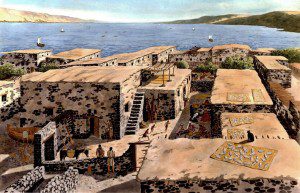
    balage_capernaumJesus returns to his new home, followed by the crowds of onlookers.
    2 Now a centurion had a servant who was sick and at the point of death, who was highly valued by him. 3 When the centurion heard about Jesus, he sent to him elders of the Jews, asking him to come and heal his servant.

    This Roman soldier had a servant, possibly a captured slave from their many battles of the Roman campaign and rule of the region (perhaps even a zealous Jew). We know that the culture of the City of Rome required many slaves (25% of the population). This person (slave or servant) was valuable to the Roman Centurion (a General in charge of many men, in addition to his own servants).

    Propriety and protocol require communication at the proper levels of leadership to approach a common Jew like Jesus; therefore the centurion sends another servant to communicate with the servant of a Jewish elder about dealing with this common Rabbi of the hillsides about possibly helping him in a personal matter of his gentile (Roman) household.

    The Elders themselves (highly esteemed and with the authority of Jewish leadership of their fellow Jews like Jesus) come to the Rabbi Jesus and ask Him a favor. No faithful Jew would refuse such a request directly from an Elder.

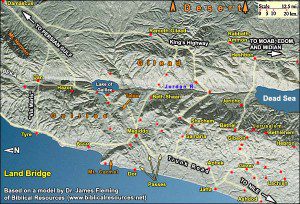
    land-bridge-600_24 And when they came to Jesus, they pleaded with him earnestly, saying, “He (this gentile, Roman centurion) is worthy to have you do this for him, 5 for he loves our nation, and he is the one who built us our synagogue.”

    So the Jews then begin a short journey toward the Roman encampment nearby, but not in Capernaum.

    6 And Jesus went with them. When he was not far from the house, the centurion sent friends, saying to him, “Lord, do not trouble yourself, for I am not worthy to have you come under my roof. 7 Therefore I did not presume to come to you. But say the word, and let my servant be healed.

     Fruit of His teaching! AND from a Roman gentile.

    8 For I too am a man set under authority, with soldiers under me: and I say to one, ‘Go,’ and he goes; and to another, ‘Come,’ and he comes; and to my servant, ‘Do this,’ and he does it.”

    And Jesus had just asked on the hillsides:

    “Why do you call me ‘Lord, Lord,’ and not do what I tell you?”

    Beloved believer, you who this day claim Christ by calling yourself a christian; do you hear now Jesus’ teaching to faithful followers of God?

    It is a further lesson for the ears of skeptical Jews and their local Elders:

     9 When Jesus heard these things, he marveled at him, and turning to the crowd that followed him, said, “I tell you, not even in Israel have I found such faith.” 

    And later report would come back to Capernaum from the gentile Roman camp of this miracle that did not even require the touch or near presence of Jesus:

    10 And when those who had been sent returned to the house, they found the servant well.

     Adoption and mercy for gentiles like most of us. Jesus IS Lord of all.

    We cry out to Christ, “Lord, Lord.”

    Do you have the faith of this centurion?

    Is He your Lord?