Tag: ephesus

  • Apollos and Paul – Apostles crossing paths

    Apollos and Paul – Apostles crossing paths

    Apollos arrives in Ephesus

    21 But on taking leave of them he said, “I will return to you if God wills,” and he set sail from Ephesus.

    [No mention here of Silas, Luke or Timothy also part of this 2nd mission. Email me or comment if you know where these apostles of the church might be as Paul begins his 3rd missionary journey. – Roger@TalkofJesus.com ]

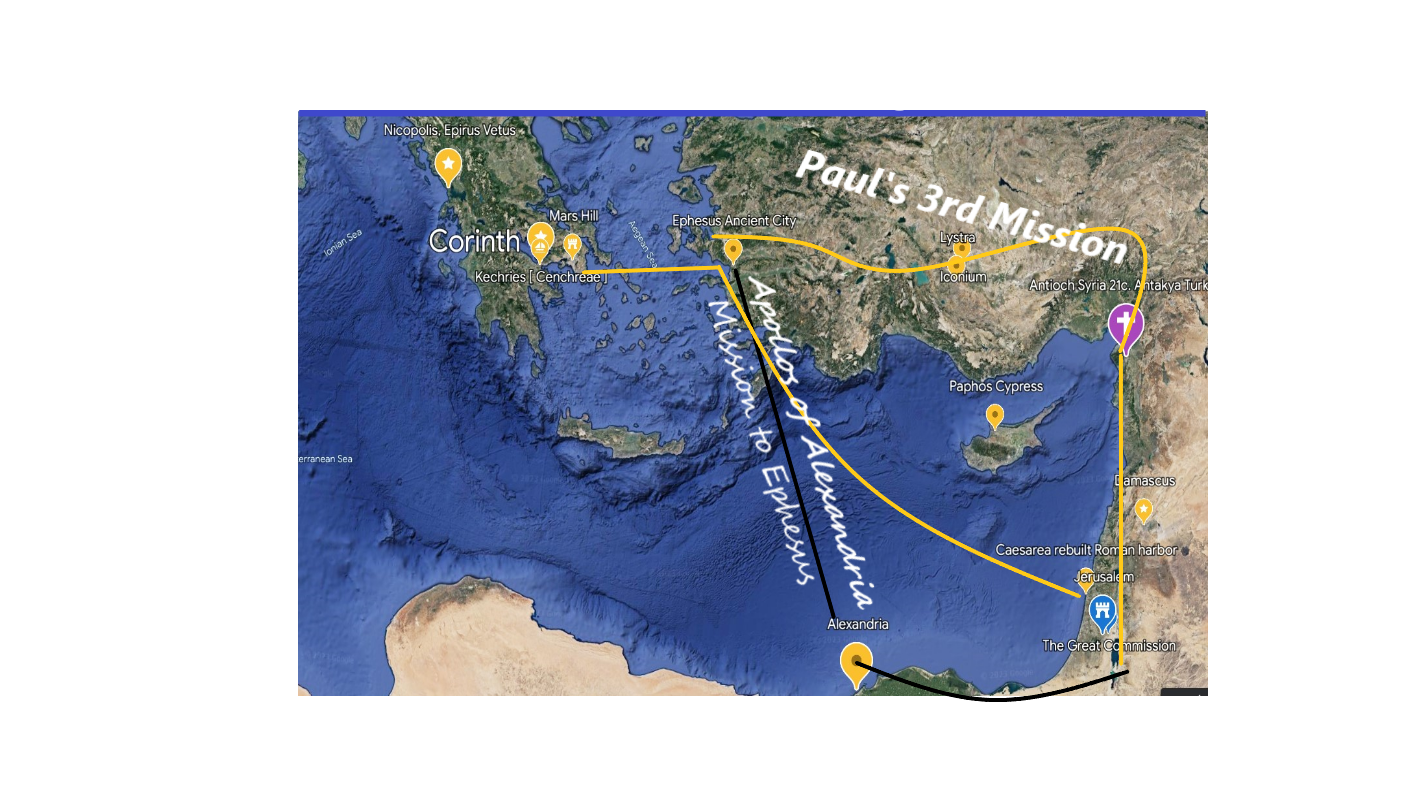
    Notice where Ephesus fits into our A.D. 51-52 timeline as the noted Jewish teacher Saul of Tarsus [Paul] departs and Apollos, another notable Jewish apostle to the gentiles begins working alongside disciples of The Way of the Messiah Jesus.
    
    Priscilla and Aquila (also Jews) remain in Ephesus as Paul sails back to Jerusalem and Antioch, Syria [his home church].
    

    Paul’s Third Missionary Journey Begins

    23 After spending some time there, he departed and went from one place to the next through the region of Galatia and Phrygia, strengthening all the disciples.

    As you can see on a map more familiar to Saul of Tarsus than 21st century christians who simply see modern Turkey, the Apostle Paul has once again set out to visit the churches of his Second Missionary Journey.

    Ephesus is miles ahead where Paul will journey through the mountains to the Aegean coast where Apollos has already arrived and preached.

    Luke continues his detailed account of Acts of the Apostles by way of introduction to Apollos.

    Who is this Messianic Jew Apollos?

    24 Now a Jew named Apollos, a native of Alexandria, came to Ephesus.

    • He was an eloquent man,
    • competent in the Scriptures.
    • 25 He had been instructed in the way of the Lord.
      • (Not by Paul, but by other disciples of the risen Christ.)
    • And being fervent in spirit,
    • he spoke and taught accurately the things concerning Jesus..
    We'll leave it there for the moment. 
    Pretty good credentials for a new Preacher of Jesus to the Jews in Asia Minor (Ephesus).

    Apollos the Baptist

    Now, perhaps, some controversy might arise from calling apollos a ‘Baptist.’ This is no mere division of denomination of an early church in Asia Minor. No, the Baptist moniker in the year of our Lord 52 would have referred to the preaching of John the Baptist.

    MANY would have heard of the Baptist, perhaps even hearing him preach prior to Herod beheading him.


    A.D. 30 - Twenty some years earlier from Luke's Gospel (yet to be published ten years from now along with ACTS of the Apostles sometime between A.D. 60 and A.D. 62.)

    Gospel of Luke 9:

    Verses 18-21 Legacy Standard Bible

    And it happened that while He [JESUS] was praying alone, the disciples were with Him, and He questioned them, saying,

    “Who do the crowds say that I am?”

    And they answered and said,

    “John the Baptist, and others say Elijah, but others, that one of the prophets of old has risen again.” And He said to them,

    “But who do you say that I am?”

    And Peter answered and said, “The Christ of God.”

    But He warned them and directed them not to tell this to anyone..


    • AND suppose that Apollos and other disciples had heard The Baptist preach and yet as must have been the case for many never heard the Christ of God preach in Person?
    • What might these disciples of JESUS recall some twenty years later?

    Luke 3:

    [John] .. came into all the district around the Jordan, preaching a baptism of repentance for the forgiveness of sins;

    Now unlike most 21st century christians, these 1st century Jews knew their SCRIPTURE!

    as it is written in the book of the words of Isaiah the prophet,

    “THE VOICE OF ONE CRYING IN THE WILDERNESS,
    
    ‘MAKE READY THE WAY OF THE LORD,
    
    MAKE HIS PATHS STRAIGHT.
    
    ‘EVERY RAVINE WILL BE FILLED,
    
    AND EVERY MOUNTAIN AND HILL WILL BE BROUGHT LOW;
    
    THE CROOKED WILL BE STRAIGHT,
    
    AND THE ROUGH ROADS SMOOTH.

    AND ALL FLESH WILL SEE THE SALVATION OF GOD.’”

    Luke 3:6 LSB quoting: Isa 40:5; Isa 49:6; Isa 52:10

    a response to Apollos OR The Baptist OR JESUS

    “But indeed the ax is already laid at the root of the trees; therefore, every tree that does not bear good fruit is cut down and thrown into the fire.”

    And the crowds were questioning him, saying, “Then what should we do?”

    Luke 3:9-10 LSB

    John answered, saying to them all,

    “As for me, I baptize you with water, but One is coming who is mightier than I, and I am not fit to untie the strap of His sandals; He will baptize you with the Holy Spirit and fire.

    “His winnowing fork is in His hand to thoroughly clear His threshing floor and to gather the wheat into His barn,

    but He will burn up the chaff with unquenchable fire.”

    So with many other exhortations he proclaimed the gospel to the people.


    Gospel of Luke 3:18 LSB of the preaching of John the Baptist

    Refining the Preaching of Apollos

    Acts 18 continued in Ephesus

    26 He began to speak boldly in the synagogue, but when Priscilla and Aquila heard him, they took him aside and explained to him the way of God more accurately.

    It is expected that mature believers must instruct new followers of JESUS Christ more accurately. 
    
    Even as Aquilla must have given exhortation to Apollos, the Apostle Paul on the way to Ephesus is most like doing the same as he revisits the new churches of previous missionary journeys (some to whom the Apostles has already written an Epistle).

    27 And when he wished to cross to Achaia, the brothers encouraged him and wrote to the disciples to welcome him.


    God-willing, ACTS of the apostles Paul, Apollos, Aquila and many others — To be continued

    Acts of the Apostles records actions of 1st century Christians sent into all the world focusing on the Twelve and 3 missionary journeys of Paul

    Talk of JESUS . com

    Comment on Scripture – Share the Gospel

  • Do not lose heart over tribulations & sufferings – 1

    Faint Not

    Wherefore I desire that ye faint not at my tribulations for you, which is your glory. – Ephesians 3:13 KJV

    The Apostle Paul encourages a church of central importance with a letter written to followers looking toward an uncertain future. His comforting call from one saint to another urges them to not lose heart over his tribulations.

    Ephesians

    Paul writes to believers of perhaps the most important church of the first century, the church at Ephesus. Hearers of Paul’s letter know it is from a leader viewed as defeated, banished and vilified by former power-brokers of the faith. Yet we hold up examples of Paul and the Apostles with little consideration of their tribulations at the time. Paul was once a jew among jews. Saul of Tarsus confesses his conversion by the grace of the Messiah Jesus.

    Who do you follow? What do you hope to hear from your leaders? Do they have concern for your issues? Are you overconcerned for the tribulations of a leader in whom you place your faith?

    When our mortal leaders in faith or politics suffer setbacks or defeats, how quickly we abandon our faith for what we once so zealously affirmed. Such was the plight of Paul, so frequently persecuted, so intentionally discredited, suffering pain, disgraced in the synagogues and the courts of public opinion. The Apostle held dearly to fellowships of the church, those who risked all to stand before an unbelieving world proclaiming Jesus Christ is Lord.

    He lived in nearly three years in Ephesus, capital of its Roman state, home to a half-million people at about AD 53-57 and probably wrote his Letter to the Ephesians from prison, having it delivered to Ephesus as encouragement for believers. Would you listen to a letter from a leader in prison?

    So I ask you not to lose heart over what I am suffering for you, which is your glory. – Ephesians 3:13 ESV

    Ephesus – place of the addressees of Paul’s letter

    Paul’s Letter to the Ephesians would bless you with a wonderful overview of the Christian faith by reading it in its entirety, a brief, letter-length book of just six short chapters. (I might also mention here one of my favorite ways to hear the Bible is to listen to a good reading, this one of Ephesians by Max McLean.)

    ephesus-map-where-is-ephesusThe people of Ephesus live far from Syria, Galilee, Samaria, Judea and Idumea, more than 1000 miles [1600 km] by road and ferry. Ephesus  [pictured above], Roman capital of Asia, overlooks the Aegean Sea and eastern trade routes beyond Asia Minor in modern day Turkey.

    Introduction to Paul’s letter

    Paul begins:

    To the saints who are in Ephesus, and are faithful in Christ Jesus:

    Paul does not send a political proclamation to everyone in this important Roman capital city. He does not ask them to send money for his well-known missionary journeys. Paul does not address those in the city with pagan beliefs where most of them worshiped idols. In fact, Christianity was a small, minority religion, as it is in Turkey even today.

    Paul thanks God for his spiritual blessing in Jesus Christ. He tells these Ephesians,

    Eph. 1:15.. I have heard of your faith in the Lord Jesus and your love toward all the saints, 16 I do not cease to give thanks for you, remembering you in my prayers..

    Do we do that? Do we have faith in Jesus as our Lord, showing His love toward all the saints of the church? Surely we are a church of troubled souls and differing tribulations.

    The church in Ephesus and all churches consist of men, women and children of a multitude of backgrounds and everyday trials. Paul opens his loving letter to those members of the church in Ephesus with praise and confirmation of prayer on their behalf.

    Paul continues to remind us:

    Eph 2: And you were dead in the trespasses and sins in which you once walked, following the course of this world,

    … following the prince of the power of the air, the spirit that is now at work in the sons of disobedience— …

    But God, being rich in mercy, because of the great love with which he loved us, even when we were dead in our trespasses, made us alive together with Christ—

    – by grace you have been saved— Ephesians 2:5b

    God did not have to save everyone.

    God did not have to save foreigners (like Greeks and Romans or like me and you). Paul includes himself with you and me in reminding us that we all sin. If God wants to save us He will, even though we do not deserve it. If God does not choose to save us, no work or sacrifice can redeem us from a single sin or our continual unfaithfulness.

    Paul reveals the mystery that God has chosen him to preach the good news (gospel) to the gentiles (non-jews).

    Eph. 3:10 … so that through the church the manifold wisdom of God might now be made known to the rulers and authorities in the heavenly places. 11 This was according to the eternal purpose that he has realized in Christ Jesus our Lord, in whom we have boldness and access with confidence through our faith in him.

    Paul then states the reason for his letter:

    13 So I ask you not to lose heart over what I am suffering for you, which is your glory.

    He then assures the church members at Ephesus that he prays for those he has led to Christ. His reason:

    “..so that Christ may dwell in your hearts through faith—that you, being rooted and grounded in love, 18 may have strength to comprehend with all the saints.. and to know the love of Christ that surpasses knowledge, that you may be filled with all the fullness of God.

    Unity in the church, love & relationships

    The Apostle outlines God’s plan of love for the church, including our family and social relationships. Paul begins in

    Ephesians 3: I therefore, a prisoner for the Lord, urge you to walk in a manner worthy of the calling to which you have been called, 2 with all humility and gentleness, with patience, bearing with one another in love, 3 eager to maintain the unity of the Spirit in the bond of peace.

    • Humility
    • Gentleness
    • Patience
    • Bearing with one another in love
    • Eager to maintain the unity of the Holy Spirit in the bond of peace.

    Without elaboration on the identifiable characteristics of the saints (Christians), this short list suffices for a start to ‘equip the saints for the work of ministry’ [v.12].

    The Apostle instructs us in the love of Christ as it relates to believers and unbelievers, husband and wife, parent and child, masters and servants. Most importantly Paul tells us how our redeemed lives ought to look:

    Ephesians 4: 31 Let all bitterness and wrath and anger and clamor and slander be put away from you, along with all malice. 32 Be kind to one another, tenderhearted, forgiving one another, as God in Christ forgave you.

    Some questions for the saints

    Have you sweetened the bitterness of your sufferings? Has the wrath of self-righteousness and pressed-down anger of your tribulations been quenched in the love of our Lord?

    I was never kind nor did my heart show tenderness toward those who trampled my fragile esteem. Paul reminds the saints of God that the one who also ascended far above all the heavens, descended to us.

    Who does not have tribulation and suffering? For even Christ suffered for our sakes, that we might be redeemed by the blood of His sacrifice.

    Ephesians 5:

    “Awake, O sleeper,
        and arise from the dead,
    and Christ will shine on you.”

    15 Look carefully then how you walk, not as unwise but as wise,16 making the best use of the time, because the days are evil.

    Paul closes suggesting the whole armor of God for the saints of the church.

    Ephesians 6:12 For we do not wrestle against flesh and blood, but against the rulers, against the authorities, against the cosmic powers over this present darkness, against the spiritual forces of evil in the heavenly places.

    Heed the imagery of righteousness before the Lord. For few events of life turn one so quickly against God as our own tribulations and sufferings.


    To be continued


  • A Flicker of Faith

    A Flicker of Faith

    Proverbs 24:20 For there shall be no reward to the evil man; the candle of the wicked shall be put out.

    Beloved brother; dearly beloved sister:

    I know you have been ‘lukewarm‘ in your belief in Christ. You have been lukewarm in your faith in Jesus. You have been cold in your heart for His church and unthankful in your daily life.

    Your offering has been stingy (if you have even returned any of what is already His).

    And your prayer?  … Probably as infrequent as my prayers so often become.

    The flame of His light dimly flickers in the fruit of your witness. You resist the fire of His Holiness each time the Lord calls you to repentance.

    Yes… at times, we are lukewarm for the risen Lord, Christ Jesus. At times, we fail miserably in our Christian… our christian… our not-so-Christlike mortal life.

    The Light in You

    Luke 11:33 “No one after lighting a lamp puts it in a cellar or under a basket, but on a stand, so that those who enter may see the light.

    34 Your eye is the lamp of your body. When your eye is healthy, your whole body is full of light, but when it is bad, your body is full of darkness. 35 Therefore be careful lest the light in you be darkness.

    36 If then your whole body is full of light, having no part dark, it will be wholly bright, as when a lamp with its rays gives you light.”

    John 1:4 In him was life, and the life was the light of men.

    5 The light shines in the darkness, and the darkness has not overcome it.

    Has the Lord’s light left your heart?

    OR do you answer our risen Lord’s voice at the door of your heart saying: ‘Repent, beloved?’

    Jesus seeks the lost. He welcomes the return of the prodigal christian.

    For to the church at Ephesus, the risen Christ also revealed through John:

    Revelation 2:5 Remember therefore from where you have fallen; repent, and do the works you did at first. If not, I will come to you and remove your lampstand from its place, unless you repent…

    7 He who has an ear, let him hear what the Spirit says to the churches.

    To the one who conquers I will grant to eat of the tree of life, which is in the paradise of God.’