Tag: faith

  • Resurrection Before Jesus

    Resurrection Before Jesus

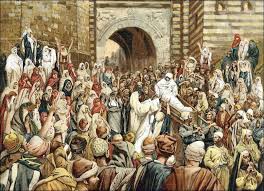
    Jesus Raises a Widow’s Son

    Nain Galileenain mapLuke 7:11 Soon afterward he went to a town called Nain, and his disciples and a great crowd went with him.
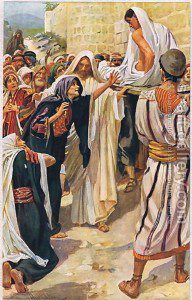
    12 As he drew near to the gate of the town, behold, a man who had died was being carried out, the only son of his mother, and she was a widow, and a considerable crowd from the town was with her.

    (Recall that Jesus had told the people of Nazareth of Elijah being sent to a widow outside of Israel.)

    13 And when the Lord saw her, he had compassion on her and said to her, “Do not weep.” 14 Then he came up and touched the bier, and the bearers stood still.

    The-Widow-Of-Nain,-1927And he said, “Young man, I say to you,arise.” 15 And the dead man sat up and began to speak, and Jesus gave him to his mother.

    Imagine… get the picture. A widow no longer has a husband to support her. A woman cannot (in this culture or most) support even herself. A son becomes responsible for taking care of his mother; but the son himself is sick and dies.

    It is a picture of hopelessness for this widow of Nain.

    Yet as the providence of God would have it, Jesus, God Emmanuel walks into town just as all wail for her great loss at the funeral. Jesus has compassion for her, touches the unclean bier with the unclean dead body of her son. He sits up!

    16 Fear seized them all, and they glorified God, saying, “A great prophet has arisen among us!” and “God has visited his people!”

    17 And this report about him spread through the whole of Judea and all the surrounding country.

    It is the same compassion by which he has fed the multitudes and healed the sick (even from a distance); yet this time Jesus has done that which cannot be done without the Hand of God. He has resurrected a dead man.

    (There is a precedent the Jewish crowds would know well from a town of old nearby.)

    A woman once perceived another Prophet of God.

    2 Kings 4:

    Elisha and the Shunammite Woman

    Shumen map8 One day Elisha went on to Shunem, where a wealthy woman lived, who urged him to eat some food. So whenever he passed that way, he would turn in there to eat food.

    9 And she said to her husband, “Behold now, I know that this is a holy man of God who is continually passing our way. 10 Let us make a small room on the roof with walls and put there for him a bed, a table, a chair, and a lamp, so that whenever he comes to us, he can go in there.”

    11 One day he came there, and he turned into the chamber and rested there. 12 And he said to Gehazi his servant, “Call this Shunammite.” When he had called her, she stood before him. 13 And he said to him, “Say now to her, ‘See, you have taken all this trouble for us; what is to be done for you? Would you have a word spoken on your behalf to the king or to the commander of the army?’” She answered, “I dwell among my own people.”

    (The woman is content to have the blessing of showing hospitality to a true Prophet of God.)

    14 And he said, “What then is to be done for her?” Gehazi answered, “Well, she has no son, and her husband is old.”

    (Again, as we have just seen in the story of Jesus, a widow has great need of a man to take care of her. The woman and old man have no son, considered to be a blessing to a faithful family of God.)

    15 He said, “Call her.” And when he had called her, she stood in the doorway. 16 And he said, “At this season, about this time next year, you shall embrace a son.” And she said, “No, my lord, O man of God; do not lie to your servant.” 17 But the woman conceived, and she bore a son about that time the following spring, as Elisha had said to her.

    What a joy for a woman to conceive a child, especially the miracle of conceiving after the age of traditional childbirth as demonstrated by several important faithful women of God throughout the many generations of the Bible. Such births are always witness to the power of God to bring forth life where there cannot be life (by the world’s ordinary standards).

    It seems like a conclusion of God’s story of witness; but like Jesus, Elisha travels from place to place as God instructs and this chapter of Elisha’s miracles is more like a conclusion of ‘Act One’ for this couple blessed by the Prophet. Elisha’s room is always ready for his unannounced return.

    18 When the child had grown, he went out one day to his father among the reapers. 19 And he said to his father, “Oh, my head, my head!” The father said to his servant, “Carry him to his mother.” 20 And when he had lifted him and brought him to his mother, the child sat on her lap till noon, and then he died.

    Tragic. Yet a God who can bring life to a lifeless womb can restore life where and when the Lord pleases. We see now a remarkable faith of this woman (similar to that of the Roman centurion).

    21 And she went up and laid him on the bed of the man of God and shut the door behind him and went out. 22 Then she called to her husband and said, “Send me one of the servants and one of the donkeys, that I may quickly go to the man of God and come back again.” 23 And he said, “Why will you go to him today? It is neither new moon nor Sabbath.” She said, “All is well.” 24 Then she saddled the donkey, and she said to her servant, “Urge the animal on; do not slacken the pace for me unless I tell you.” 25 So she set out and came to the man of God at Mount Carmel.

    When the man of God saw her coming, he said to Gehazi his servant, “Look, there is the Shunammite. 26 Run at once to meet her and say to her, ‘Is all well with you? Is all well with your husband? Is all well with the child?’” And she answered, “All is well.”

    ‘All is well,’ answers the woman whose only son has just died in her arms?

    27 And when she came to the mountain to the man of God, she caught hold of his feet. And Gehazi came to push her away. But the man of God said, “Leave her alone, for she is in bitter distress, and the Lord has hidden it from me and has not told me.”

    Now, the grieving mother pleads to the Prophet:

    28 Then she said, “Did I ask my lord for a son? Did I not say, ‘Do not deceive me?’”

    Like Jesus did in Nain, Elisha shows compassion for the woman.

    29 He said to Gehazi, “Tie up your garment and take my staff in your hand and go. If you meet anyone, do not greet him, and if anyone greets you, do not reply. And lay my staff on the face of the child.” 30 Then the mother of the child said, “As the Lord lives and as you yourself live, I will not leave you.” So he arose and followed her. 31 Gehazi went on ahead and laid the staff on the face of the child, but there was no sound or sign of life. Therefore he returned to meet him and told him, “The child has not awakened.”

    32 When Elisha came into the house, he saw the child lying dead on his bed. 33 So he went in andshut the door behind the two of them and prayed to the Lord. 34 Then he went up and lay on the child, putting his mouth on his mouth, his eyes on his eyes, and his hands on his hands. And as he stretched himself upon him, the flesh of the child became warm. 35 Then he got up again and walked once back and forth in the house, and went up and stretched himself upon him. The child sneezed seven times, and the child opened his eyes. 36 Then he summoned Gehazi and said, “Call this Shunammite.” So he called her. And when she came to him, he said, “Pick up your son.” 37 She came and fell at his feet, bowing to the ground. Then she picked up her son and went out.

    This is but one demonstration of God’s power over life and death (the only one through the great Prophet Elisha). It is one of many demonstrations of God’s miraculous power to heal, even unto life. Jesus would, in addition to His own later resurrection after three days, raise a man from the dead as beloved to Him as this woman’s family must have been to Elisha: Lazarus.

    Later, Jesus is challenged by the Sadducees of the Temple of Herod about the resurrection. The witness of the Shunammite family at the time of Elisha was certainly recorded in their own Bibles! The evidence of Jesus’ miracles must certainly have been in evidence by many witnesses to all; yet they did not believe.

    Oh, you of little faith…

    Jesus said: “I am the resurrection and the life. Whoever believes in me, though he die, yet shall he live.

    How is your faith? Do you believe in life through Christ Jesus? Is He your Lord by faith?

    Blessed be the God and Father of our Lord Jesus Christ! According to his great mercy, he has caused us to be born again to a living hope through the resurrection of Jesus Christ from the dead. –

    1 Peter 1:3-4


  • Relationship with a Roman

    Relationship with a Roman


    capernaum map

    Luke 7:1 After he had finished all his sayings in the hearing of the people, he entered Capernaum.

    Jesus has just taught the crowds who were amazed at His teaching (probably under the watchful Roman eyes of their area squad of the Legion).

    Jesus taught His own people with such sayings as:

    • Love your enemies, do good to those who hate you.
    • Be merciful, even as your Father is merciful.
    • The good person out of the good treasure of his heart produces good.
    • “Why do you call me ‘Lord, Lord,’ and not do what I tell you?

    The multitudes followed Jesus from place to place (under watchful Roman eyes, along with ears to hear the true motives of this Jewish teacher who taught in the synagogues of the towns and on the distant hillsides) … waiting to see what their promised Messiah would do. (The Roman authorities and Jewish authorities wanted to know that as well.)

    Jesus has told the crowds, “For no good tree bears bad fruit, nor again does a bad tree bear good fruit, 44 for each tree is known by its own fruit.”

    What is the fruit of Jesus’ ministry? For most of the crowds just watch. Many bear no good fruit.

    balage_capernaumJesus returns to his new home, followed by the crowds of onlookers.

    2 Now a centurion had a servant who was sick and at the point of death, who was highly valued by him. 3 When the centurion heard about Jesus, he sent to him elders of the Jews, asking him to come and heal his servant.

    This Roman soldier had a servant, possibly a captured slave from their many battles of the Roman campaign and rule of the region (perhaps even a zealous Jew). We know that the culture of the City of Rome required many slaves (25% of the population). This person (slave or servant) was valuable to the Roman Centurion (a General in charge of many men, in addition to his own servants).

    Propriety and protocol require communication at the proper levels of leadership to approach a common Jew like Jesus; therefore the centurion sends another servant to communicate with the servant of a Jewish elder about dealing with this common Rabbi of the hillsides about possibly helping him in a personal matter of his gentile (Roman) household.

    The Elders themselves (highly esteemed and with the authority of Jewish leadership of their fellow Jews like Jesus) come to the Rabbi Jesus and ask Him a favor. No faithful Jew would refuse such a request directly from an Elder.

    land-bridge-600_24 And when they came to Jesus, they pleaded with him earnestly, saying, “He (this gentile, Roman centurion) is worthy to have you do this for him, 5 for he loves our nation, and he is the one who built us our synagogue.”

    So the Jews then begin a short journey toward the Roman encampment nearby, but not in Capernaum.

    6 And Jesus went with them. When he was not far from the house, the centurion sent friends, saying to him, “Lord, do not trouble yourself, for I am not worthy to have you come under my roof. 7 Therefore I did not presume to come to you. But say the word, and let my servant be healed.

     Fruit of His teaching! AND from a Roman gentile.

    8 For I too am a man set under authority, with soldiers under me: and I say to one, ‘Go,’ and he goes; and to another, ‘Come,’ and he comes; and to my servant, ‘Do this,’ and he does it.”

    And Jesus had just asked on the hillsides:

    “Why do you call me ‘Lord, Lord,’ and not do what I tell you?”

    Beloved believer, you who this day claim Christ by calling yourself a christian; do you hear now Jesus’ teaching to faithful followers of God?

    It is a further lesson for the ears of skeptical Jews and their local Elders:

     9 When Jesus heard these things, he marveled at him, and turning to the crowd that followed him, said, “I tell you, not even in Israel have I found such faith.” 

    And later report would come back to Capernaum from the gentile Roman camp of this miracle that did not even require the touch or near presence of Jesus:

    10 And when those who had been sent returned to the house, they found the servant well.

     Adoption and mercy for gentiles like most of us. Jesus IS Lord of all.

    We cry out to Christ, “Lord, Lord.”

    Do you have the faith of this centurion?

    Is He your Lord?


  • Hansel and Gretel – 1

    Hansel and Gretel – 1

    You may think this children’s story title an odd  title for a post of Christian Social Witness on a blog for sharing our “Biblical” faith in Christ Jesus as Lord.

    Bear with me; I’ll get to ‘the rest of the story’ (as a favorite commentator once put it) in another chapter.

    IF you have NOT already taken time to watch the Hosea Movie of a previous post, it is related to this series and I recommend it. Watch it as a family, if possible (80 min.); especially your teens.

    Roger Harned

    HANSEL & GRETEL – Chapter 1 

    When I was a young child my mom would often read bedtime stories to us. We had illustrated children’s story books and lots of imagination for wandering little minds about to embark into the unseen lands of sleep.

    Aesop and Grimm were not names uncommon as now are these to children. Neither were the Old Testament Heroes of another Book.

    One of my favorite stories of childhood was Hansel and Gretel. I’m not certain why.

    It had all the intrigue of good and evil for unfamiliar tender souls so secure in the love of both parents, which showed two young children able to outwit adults, as often we three thought that we had.

    Most certainly, as to the important things, we had not outwitted either parent.

    Perhaps by their inattentiveness (an ever-increasing parental inattentiveness of these last days), we had, on occasion, been neglected by our parents in some matter of our childish cleverness. Yet we could comfortably fall asleep knowing our mischief, while secure in the watchful loving oversight of a mommy’s bedtime story.

    This is no longer the scene of our homes where now both parent and child fall into lonely sleep to separate television-depicted evils.

    I introduce my thoughts on parent-child relationships in this way because of the great brokenness of our twenty-first century families.

    We can be certain that the wickedness of Satan has achieved victory in many battles of the family. Broken homes, broken marriages, broken husbands, broken wives and many broken children…grown-up into broken youth, and then they become broken young men and broken young women still lost in the woods of life… then again, broken moms and broken dads with generationally broken homes.

    I am most thankful for the faithfulness of my dad and mom to have been examples of God’s faithfulness to His children by their own marriage of over sixty years. I grieve (as do many parents) over that lesson not learned by so many children of two-parent marriages.

    How many children (even of a faithful Christian parent) have compared their ‘step-mother’ to a wicked witch?

    How many children of a father who wandered into a wood far from their home or had a father escorted from the home of his children have bought the fairy-tale fiction that he does not love them? How many children of broken homes have lived the hopelessness of Hansel and Gretel? (It’s an all-too-familiar story they do NOT want to hear.)

    I will survive by my own cleverness, they conclude.

    I do not need my mom or my dad.

    Deuteronomy 5:12 “‘Honor your father and your mother, as the LORD your God commanded you, that your days may be long, and that it may go well with you in the land that the LORD your God is giving you.

    How sad the children who are caged in their own cleverness.

    How sad the ‘single-moms’ (really, divorced-moms) who must rule their fabled gingerbread house that they now own as neglectful witches who fatten up their children for worldly dreams and destine them for the slavery of serving only their self.

    How sad the ‘single dads’ (really, divorced-dads) who must neglect the bringing up of their children in the broken homes.

    How sad their broken marriages in the broken places throughout our broken lands.

    How sad the great brokenness of rebellion against a loving God, a faithful Father.

    How sad the broken relationships with a Son of our redemption, the Namesake of our Christian Faith.

    Is Jesus Christ Lord of your home?

    Is Jesus Christ Lord over you, beloved husband?

    Is Jesus Christ Lord over you, dearly beloved wife?

    Is Jesus Christ Lord over the children of your marriage?

    To be continued…