In a visual word about works. James entreats us, “let everyone see your works,” in this proverb of James, ‘be doers of the word.’
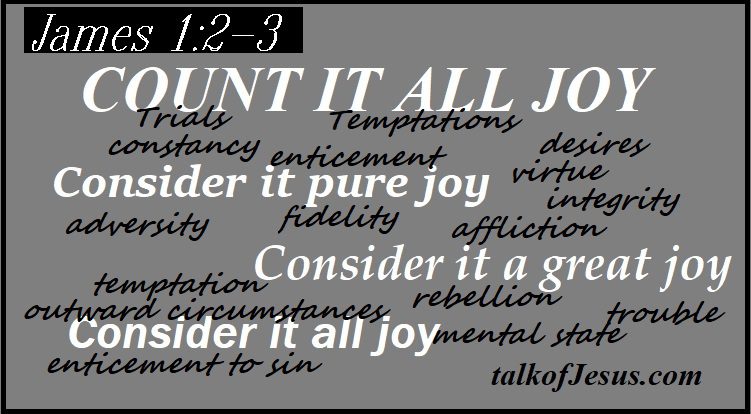
What does it have to do with his initial advice, “Consider it a great joy, my brothers and sisters, whenever you experience various trials?”
James details the connection as he continues his pastoral letter to the church (actually, several churches). He makes a case that our works refine our faith and prove our faith to other potential followers of the Lord.
But be doers of the word and not hearers only, deceiving yourselves.
James 1:22 CSB
Hearing and Doing the Word
Did you ever hear the rebuke as a child, “You have two ears and one mouth?” It’s advice from this section of the letter of James to the church. Perhaps you haven’t read it in a while, but allow your heart to listen well to the Spirit.
James 1:19-2:26
19 My dear brothers and sisters, understand this:
Everyone should be quick to listen, slow to speak, and slow to anger, for human anger does not accomplish God’s righteousness.
James 1:19b-20 CSB
Think about what we see and hear everyday. The world has this upside down. Doubtless the world of the first century encountered the same.
People are angry about this, angry about that. They speak first and frequently. We can see it on television or online, and social media thrives on the polarized opinions of those who speak without understanding.
We are quick to anger, impulsive to speak, and slow fo listen.
How we reflect the world, dear claimants of Christ!
Sadly, our works in this area of speaking boldly to others out of our zeal for the Lord likely needs the most work.
Listen
It takes humility to listen to another before speaking your heart.
Do you converse with a brother or a sister in Christ? Our conversation with and unbeliever should be different, but the same principles apply. Before we answer do we understand the heart of the one speaking or if they oppose Christ possibly, but have interest because of something they ask about?
“Swift to hear,” say some translations. Certainly not swift to react, as is our tendency. But to whom must we listen? What does the Apostle want the church to hear?
Perhaps the most telling use of the Greek word here is found in a familiar teaching from Jesus.
“You have heard that it was said, An eye for an eye and a tooth for a tooth. – Matthew 5:38
It’s the traditional measured response of justice, seek no more from someone who has sinned against you than what he has taken by his trespass. Of course what follows is the Lord’s command for us to love our enemies.
Though we all want “justice” for our enemy, we also seek “mercy” for our transgressions of the law. So let’s skip to the issue of anger, source of our own reactive speech, for the wisdom of James’ suggestion.
Anger
Everyone should be quick to listen … and slow to anger, 20 for human anger does not accomplish God’s righteousness.
This is the only place James uses this word, which points to our reaction to the anger of others. The root verb suggests a stretching out in order to understand another. James continues:
21 Therefore, ridding yourselves of all moral filth and the evil that is so prevalent, humbly receive the implanted word, which is able to save your souls.
Don’t react, but receive the implanted word. (We’ll get to that in a moment.)
Favoritism
2:1 My brothers and sisters, do not show favoritism as you hold on to the faith in our glorious Lord Jesus Christ.
… and yet you say to the poor person, “Stand over there,” or “Sit here on the floor by my footstool,” 4 haven’t you made distinctions among yourselves and become judges with evil thoughts?
James cautions the church against certain worshipers who expect special treatment. The ‘hearers’ to whom he writes must guard against men and women actively provoking the saints of the church to react with anger.
Yet he reminds us that those souls provoking us to anger ought to see the love of Christ Jesus in our response.
Fellow ‘church member,’ allow me to restate in an excerpt from a different version. James addresses us:
A Warning against Prejudice
James 2: My dear brothers and sisters, how can you claim to have faith in our glorious Lord Jesus Christ if you favor some people over others?
2 For example, suppose someone comes into your meeting dressed in fancy clothes and expensive jewelry… 3 If you give special attention… to the rich person, but you say to the poor one, “You can stand over there…”—well, 4 doesn’t this discrimination show that your judgments are guided by evil motives?
5 Listen to me, dear brothers and sisters. Hasn’t God chosen the poor in this world to be rich in faith? Aren’t they the ones who will inherit the Kingdom he promised to those who love him? 6 But you dishonor the poor!
Isn’t it the rich who oppress you and drag you into court? 7 Aren’t they the ones who slander Jesus Christ, whose noble name you bear?
8 Yes indeed, it is good when you obey the royal law as found in the Scriptures: “Love your neighbor as yourself.”
9 But if you favor some people over others, you are committing a sin. You are guilty of breaking the law.
James 2 excerpt from NLT (preaching emphasis my own)
This very favoritism provokes my anger this very moment!
Yet James asks us to keep silent, listen, do not speak first and remember that “Human anger does not produce the righteousness God desires. 1:20
Convicted!
The Lord holds all authority to punish or pardon. Leave it to His will.
Slow to speak
Whenever we face ‘various trials,’ inevitably they will come from the actions and words of others. How difficult for us to show the same humble temperament as our Lord Jesus.
James reminds us (in verse 8), ‘If you love your neighbor as yourself,’ as Jesus taught, ‘you are doing well.’ Then (in verse 9) he applies the challenge of favoritism. Now apply this to your own reactions.
Were you slow to speak before you judged your neighbor?
Did you listen first, before you answered?
James addresses real issues of the church, like anger and favoritism.
Therefore put away all filthiness and rank growth of wickedness and receive with meekness the implanted word, which is able to save your souls.
James 1:21 RSV
Quick to hear, slow to speak, slow to anger; for our own moral filthiness and wickedness must not arrogantly replace the word of God.
Mirror of our Hypocrisy
James illustrates our brief partial glances at self in this way:
If you are a hearer of the word and not a doer of the word (in other words, if you have not works), then you are like one observing your own face in the mirror. You then go away, forgetting what you are like.
Isn’t this our false image of our own righteousness?
James urges you and me to stand in front of the mirror for a while. (I hate to do that.) Worse, for those of us who quickly walk away, he asks us to look into the reflection of what God wants to see.
But the one who looks intently into the perfect law of freedom and perseveres in it, and is not a forgetful hearer but a doer who works—this person will be blessed in what he does.
James 1:25 CSB
Royal Law vs Law of Freedom
See the freedom Christ gives us. Persevere in the perfect law and don’t forget to work out your salvation with fear and trembling. Be blessed in your trials for the Lord.
All of the Apostles, including James in this letter, encourage the new church.
Christ redeemed slaves of the Law, awaiting our sentence of death, to the grace of the law of freedom.
The Royal Law
A good reason for true followers of Jesus to be slow to speak lies in our varying opinions of how to apply the Commandments. Most of us have a great need to consider how to act as one under authority. Here many disagreements begin as anger simmers below the surface.
Your opponent asks, “By whose authority do you tell me what I must do?
Paul tells us in one instance illustrating such authority.
“I was traveling to Damascus under these circumstances with authority and a commission from the chief priests. – Acts 26:12
Saul (Paul) testifies that his mission and authority came directly from the chief priests (bound by the Authority of Almighty God).
His court case before King Herod Agrippa, the last reigning King of Judea with the royal title [AD 41-44], takes place about the same time as the letter of James. Agrippa’s royal authority (as opposed to a priestly commission) was his appointment of succession as king, confirmed by the authority of Rome.
Authority
ἐξουσία – power, authority, right, liberty, jurisdiction, strength – power of choice, liberty of doing as one pleases
Strong’s G1849 – exousia
Royal authority, religious leadership authority, government authority, military authority – any and all authority remain contentious issues to this day, as they were for the first century church.
Be slow to speak, therefore; that you might hear not only the words, but the authority from where they speak,
Jesus cautions followers to obey all of these authorities, where their law applies to us. Further, the Lord presents a practical example of faith through a Roman centurion.
Luke 7
6 Jesus …was not far from the house, the centurion sent friends to tell him, “Lord, don’t trouble yourself, since I am not worthy to have you come under my roof…
Beloved, here is true humility, true acceptance of Jesus’ Divine Authority. The centurion continues:
But say the word, and my servant will be healed. For I too am a man placed under authority, having soldiers under my command.
I say to this one, ‘Go,’ and he goes; and to another, ‘Come,’ and he comes; and to my servant, ‘Do this,’ and he does it.”
9 Jesus heard this and was amazed at him, and turning to the crowd following him, he said, “I tell you, I have not found so great a faith even in Israel.”
Do you — do the shepherds of your church have such authority?
The Law of Freedom
What should we say if we speak from the Law of Freedom?
The Greek word here is also translated as liberty in some translations. Perhaps it will help to know that in Christ we have the liberty to speak judiciously. James had pointed to this liberty when he warned of looking in the mirror. Later he provides this law for us as judges of our own speech.
[I reverse the order of James description to provoke your thought.]
13 For judgment is without mercy to the one who has not shown mercy.
In Christ we are free to judge, yet will we show mercy?
[Therefore,] 12 Speak and act as those who are to be judged by the law of freedom. 13b Mercy triumphs over judgment.
Jesus’ authority gives us that same grace to show mercy to another, who like us, does not deserve mercy for breaking the Royal Law of Almighty God.
Faith and Works
What good is it, my brothers and sisters, if someone claims to have faith but does not have works? Can such faith save him?
James 2:14 CSB
James immediately goes to examples so familiar of faithlessness and hypocrisy by those of the church. He points to the same partiality and inaction to help the poor where our words only have no impact for Christ.
“Go in peace, stay warm, and be well fed…” Words, empty, fruitless dismissal of a soul in need.
18 But someone will say, “You have faith, and I have works.”
James never argues that we are saved by works (as some misleadingly emphasize). Nor does he dispute that we are saved by faith alone (which some use as excuse for a no-works easy one-time claim to Christ).
20 Senseless person! Are you willing to learn that faith without works is useless?
He continues with the scriptural examples of Abraham and Rahab, then categorically states:
You see that a person is justified by works and not by faith alone… For just as the body without the spirit is dead, so also faith without works is dead.
James 2:24,26 CSB
James tells us, “judge the true faith of one who claims Christ by their works.
Do they show evidence of their faith by how Jesus has become their Lord? Do you?
δικαιόω – Justified
δικαιόω – dikaioō from the root δίκαιος (G1342)
- to render righteous or such he ought to be
- show, exhibit, evince, one to be righteous, such as he is and wishes himself to be considered
- declare, pronounce, one to be just, righteous, or such as he ought to be
The root word of ‘just‘ is more often translated as ‘righteousness.’
- righteous, observing divine laws
- in a wide sense, upright, righteous, virtuous, keeping the commands of God
- in a narrower sense, rendering to each his due and that in a judicial sense, passing just judgment on others, whether expressed in words or shown by the manner of dealing with them
James has much more practical advice for the church.
To be continued...