Tag: fellowship

  • 3 Letters from the Apostle John

    3 Letters from the Apostle John

    The world cannot think of John without a picture of a young man next to JESUS who wrote,“God so loved the world…”

    For God so loved the world, that he gave his only begotten Son, that whosoever believeth in him should not perish, but have everlasting life. JOHN 3:16 green man
    John to the seven churches which are in Asia: map with cities pictured and the island of Patmos

    Or Christians perhaps recall the Revelation of Jesus Christ to John on Patmos with little consideration of his age or the path of the Apostle leading him to this isolated Greek island.

    Three intimate letters to believers

    The A.D. 90's - the END of an era 
    — JOHN's Apostolic love and truth for fidelity in the faith.

    The Elder John writes three letters — along with Jude, the LAST EPISTLES of the New Testament.

    Although our focus will be 2 John and 3 John, I will include 1 John in this overview written about the same time.

    In order to set the cultural stage of the Church enduring beyond the end of the A.D. first century, consider that the Elder writes his 3 Epistles some sixty years after the death, resurrection and ascension of Jesus Christ.


    map of Ephesus near the churches where John was an Elder "an epistle from John - Elder to the Churches 1 John 2 john 3 John

    Introduction to an Era not unlike our own:

    INTRO – MACARTHUR NEW TESTAMENT COMMENTARY 1-3 JOHN

    quoting Donald W Burdick

    Apart from the Judaeo-Christian sphere, the world was religiously inclusivistic. There was always room for a new religion, provided of course that it was not of an exclusive nature. Syncretism[‘s].. characteristic expression was in the combination of various ideas and beliefs from different sources to form new or aberrant religions. This was the age of of the developing mystery religions, the age of the occult, ane age of the proliferation of Gnostic sects.

    MACARTHUR Commentary 1-3 John, p.1

    Recall from Acts how the young Apostle Jesus loved also preached the Gospel of our risen Lord boldly along with Simon Peter in the Temple. But that was about sixty years ago .


    In the year of our Lord 90

    (approximately)

    Keep in mind that ALL dates used for comparison to various 1st c. events are approximate, but reveal a chronology of John's life.
    • John’s own Gospel account of the events of JESUS’s incarnate life had already been written and distributed to the churches some five to ten years ago.
    • Mark, Matthew and Luke had written and sent out their Gospel’s some thirty years before, back in the 50’s and 60’s.
    • Several missionary journeys of the Paul (begun in A.D. 47) along with many others had concluded prior to the Apostle’s death along with Peter in Rome [~ A.D. 66] also some twenty to thirty years before these final epistles of John.
      • Paul had founded this church in Ephesus where John now serves as an Elder.
      • Paul had written to it as well some forty years before, back in the early A.D. 60’s.

    Rome had political problems of its own.

    In addition to putting down a Jewish revolt in Jerusalem [A.D. 66] and destroying the Temple [A.D. 70], the Caesar’s frequently blamed and banished Christians for their political problems in Rome and other cities of the Empire.

    terrors of death of Jerusalem's defenders and destruction temple by Rome in A.D. 70

    An Apostolic Dogma of John

    The 21st c. Common Era church speaks so little of dogma that I must define it. 

    Dogma – 1. A doctrine or a corpus of doctrines relating to matters such as morality and faith, set forth in an authoritative manner by a religion.

    The American Heritage® Dictionary of the English Language


    This is what I refer to as Apostolic Faith, which includes all Apostolic authority continuing through Scripture to this day.

    Referring to the "we" statements of 1 John, the author speaks on behalf of the Twelve." 

    John Stott observes:

    He does not hesitate to call certain classes of people liars, deceivers or antichrists. .. they either have God or have not, know God or do not, have live or abide in death, walk in darkness or in the light, are children of God or children of the devil.

    This dogmatic authority of the writer is seen particularly in his statements and in his commands.

    John Stott commentary, quoted by MacArthur, p.4


    a culture combining aberrant and mystery religions

    Stick with me on some abridged definitions for your understanding of the A.D. 1st century, (again, not so unlike our 21st century of the Common Era).
    • syncretism
      • .. fusion of differing systems of belief, as in philosophy or religion, ..the result is heterogeneous – AHD
    • aberrant
      • 3. straying from the right way – AHD
    • mystery religions – (What typifies them?)
      • any of various secret cults of the Greco-Roman world that offered to individuals religious experiences not provided by the official public religions.
      • .. initiation in Greece became a matter of personal choice.
      • The mystery religions reached their peak of popularity in the first three centuries a.d. Their origin, however, goes back to the earlier centuries of Greek history.
        • Source: Britannica

    The DANGER of gnostics!

    For those of you who really don’t know much about false religions, before we begin John’s three strongly-worded epistles, I need to define this great threat to the Church — gnosticism.

    of a person (25 terms) gnostic 1607–
    Historical. (With capital initial.) Chiefly plural.

    The designation given to certain heretical sects among the early Christians who claimed to…

    source: OED

    Until fairly recently the term was generally applied collectively to the majority of those 2nd cent. movements which called themselves Christian or borrows heavily from Christian sources, but which were rejected by the main stream of Christian tradition.

    more..

    .. Gnostic systems which make testing intellectual demands, others which depend on mumbo-jumbo and sleight of hand.

    .. high-minded ascetic, and others who are licentious charlatans.

    “GNOSTICISM” – Tenney Encyclopedia of the Bible, pub. ZONDERVAN, vol.2, p.736-739


    The gnostic doctrine of God

    Gnostics borrowed from the anti-christian philosophers:

    • that God is so utterly transcendent that He can have no direct contact with the world;
    • and can have no contact with God..’
    • THEREFORE, they conclude:
    • ‘Man is thus a creature of mixed origin, a mixture of incompatibles.
    • Christianity is ‘self-condemned:’

    ..the claim that God became man is impossible, since God and Matter could not mix.

    ibid. p.736

    God is conceived as remote from all material creation..

    If God’s transcendence implies the impossibility of His contact with matter, how could God take a human body —(*that of Christ, whom the gnostics oppose) — still less suffer in one?

    ibid. p.737


    John’s opposition to developing heresies

    Various heresies of the A.D. first century antichrists creeping into the houses of worship in various places led John to write his epistles to the faithful who believed his Gospel of the the Lord Jesus Christ. The Elder’s purpose in writing is to urge the faithful to REJECT false gospels, false philosophies cloaked in christian garments and especially to send away FALSE teachers.

    MacArthur continues in his commentary on 1 John 1-4:

    He [the Elder John] clearly expected his readers to obey his commands unquestioningly. Only an apostle, known and respected by those whom he addressed, could have written such an authoritative letter and not given his name.

    ibid. p.5

    John’s first epistle clearly calls on those under his Apostolic authority to apply the test of faith he puts forth and to obey his commands of how to deal with these liars, deceivers and antichrists bringing false faith into the practices of their gatherings and worship.

    The Elder’s second and third epistles, the shortest of John’s letters (other than the brief tests revealed to the 7 churches in his apocalypse) addresses certain faithful leaders of the Church more personally with specific individual instructions.


    Key Scriptures from Epistles of the Elder

    John will reiterate some of his purpose in writing in his second and third Epistles, the focus of our Apostolic look at his last letters. The partial list from 1 John provides a larger context for the Apostle’s last two letters near the end of the A.D. first century.

    the First Letter of John the Elder and Apostle of Jesus Christ

    Key verses from 1 John

    1 John 1:3-5,9; 2:1,10-11,15,18,26,28-29; 3:5-6,8,18; 4:3-4,10,19; 5:1,13,18-19

    This is the message we have heard from him and proclaim to you, that God is light, and in him is no darkness at all.

    1 Letter of John 1:5 ESV

    Do you want to know IF someone truly believes that JESUS Christ is the Lord — the only Son of God?

    Without introduction, the Elder John writes to the Church in his own Apostolic authority with two tests for the saints of God to know if another has fellowship with God — the Father, Son and Holy Spirit.

    1. Belief in God
      • .. if we walk in the light, as he is in the light, we have fellowship with one another, and the blood of Jesus his Son cleanses us from all sin.
        • 1 John 1:7 (and in Paul’s letter to the Ephesians 5:8)
    2. Certainty of Sin
      • If we say we have no sin, we deceive ourselves, and the truth is not in us.
        • 1 John 8
      • If we confess our sins, he is faithful..
        • 1 John 9a

    If we say we have not sinned, we make him [Jesus Christ] a liar, and his word is not in us.

    1 John 1:10 ESV

    John provides a plumb line to delineate true faith in Christ.

    The beloved Apostle makes clear that those who claim falsely to have no sin, ‘lie and do not practice the truth,’ a direct affront on the claim of some that the body can sin while the spirit separately remains pure.


    Fellowship

    Love and fellowship permeate the Apostle’s larger focus not only in John’s Gospel, but in the 3 Letters from the Elder as well.

    κοινωνία – koinōnia is the share which one has in anything, participation; intercourse (between loved ones, but not eros), fellowship (between near friends), intimacy (as that of family members who live lovingly together with each other).

    BluueLetteBible.org – Strong’s G2842 – koinōnia *with parenthetical clarity added by RH

    What does this mean in relation to God?

    Perfect PERSONAL fellowship of the One Triune GOD in the Persons of the Father, the Son and the Holy Spirit.

    Fellowship between the Father and the Son.

    Fellowship between believers and the Holy Spirit.

    AND within the Church — the Body of Christ — fellowship of personal relationship in the love of the Light of life, our Lord Jesus Christ.

    John, in the authority of Christ, sows the seeds of the Father’s love given in the Person of the Son redeeming us from our sins.


    Do not love [agapaō] the world or the things in the world.

    If anyone loves the world, the love of the Father is not in him. ..the world is passing away along with its desires,

    but whoever does the will of God [theos] abides forever.

    1 John 2:15,17 ESV

    The Apostle urges a fellowship with the loving Person of the Father, not simply an acknowledgment of God, Who IS forever.

    Have fellowship with God.. and fellowship with Light.. fellowship AND love [agapaō  & phileō]…

    Obey God, because of His love for you and His holy ones..


    Propitiation of a Personal God

    Propitiation would seem to be a technical theological term unfamiliar to many Common Era Christians. 
    The concept is important.. and not so difficult.

    ἱλασμός – hilasmos

    from a Greek root word found only in John’s first letter

    English translations: propitiation, the sacrifice that atones, atoning sacrifice, expiation, sacrifice to take away

    Christ’s love for His Church.

    The ‘one Jesus loved’ (the Elder’s own self-identification) instructs believers in how to relate to God as your personal loving God, as John himself had experienced God in Jesus Christ.

    Herein is love [agapē],
    not that we loved God,
    but that he loved us,
    and sent his Son
    to be the propitiation
    for our sins.

    1 John 4:10 KJV

    What human father would do that?

    Is OUR love of God the reason Christ became the propitiation for our sins and the sins of the world? NO!

    It is the LOVE — agapē — of our Father in heaven, the Father of our Lord Jesus Christ, the Father who in His love for us Personally sacrificed Jesus to the Cross for the price of our sins.


    Jesus is The Christ!

    Therefore, in light of the cultural challenges we introduced as an impetus for the Elder’s epistles, John calls on the Church to identify antichrists among us — that is, heretics and gnostics.

    We will not again address end times today as before.

    The Elder addresses his beloved saints in Ephesus (and other churches):

    Little children, it is the last time: and as ye have heard that antichrist shall come,

    even now are there many antichrists; whereby we know that it is the last time.

    I have not written unto you because ye know not the truth, but because ye know it, and that no lie is of the truth.

    Who is a liar but he that denieth that Jesus is the Christ? He is antichrist, that denieth the Father and the Son.

    First Epistle of John 2:19-20.22 King James Version


    Now don't go calling any of your questionable 'christian' colleagues, 'antichrists.' 
    The Elder explains why some saints will sit under Godly teaching while others listen only for a time they hope to influence the body.. and then leave the church.

    ‘Do Not Love the World,’ ‘Beware of Antichrists,’ and ‘Remain in Christ,’ read the subheadings for these.

    Behold what manner of love..

    We recognize this same Apostle once nearest to Jesus as the Elder now embraces his fellow saints with the same concern for their souls as Christ held for His Disciples.

    Behold what manner of love the Father has given to us, that we should be called children of God. And that is what we are!

    The reason the world does not know us is that it did not know Him.

    Beloved, we are now children of God, and what we will be has not yet been revealed.

    1 John 3:1-2a BSB

    ‘You know that he [Jesus] appeared in order to take away sins, and in him there is no sin,’ John reminds [ESV].

    No one who abides in him keeps on sinning..

    1 John 3:6a ESV

    The Elder then continues in his delineation between the saints of Jesus and antichrists of the devil:

    By this it is evident who are the children of God, and who are the children of the devil:

    whoever does not practice righteousness is not of God, nor is the one who does not love his brother.

    1 John 3:10 ESV

    the Elder’s foundational exhortation of his epistle

    My little children,
    let us not love in word, neither in tongue;
    but in deed and in truth.

    1 letter of John 3:18 KJV

    On Denying the Incarnation

    This heading from the NIV addresses John’s concern for the saints holding fast to the truth of the Gospel in the recognition of the false teachers of tolerant gnosticism, inclusivist universalism and other antichrists posing as the godly.

    Dear friends,

    do not believe every spirit, but test the spirits to see whether they are from God, because many false prophets have gone out into the world. This is how you can recognize the Spirit of God:

    Every spirit that acknowledges that Jesus Christ has come in the flesh is from God, but every spirit that does not acknowledge Jesus is not from God.

    This is the spirit of the antichrist, which you have heard is coming and even now is already in the world.

    1 John 4:1-3 NIV

    John comforts: ‘You, dear children, are from God.. [v.4] and warns:

    They are from the world and therefore speak from the viewpoint of the world, and the world listens to them.

    1 John 4:5 NIV

    Of course the world entangled in sin will neither accept the Truth of Christ or His Incarnation and return in a final Judgment.

    Herein is love.. agapaō

    In this is love, not that we have loved God,
    but that He loved us and sent His Son to be the propitiation for our sins...

    We love,
    because He first loved us.

    1 John 4:10,19 LSB

    John the Elder

    John’s Conclusion to his First Letter

    Everyone who believes that Jesus is the Christ has been born of God, and everyone who loves the Father also loves those born of Him.

    We know that anyone born of God does not keep on sinning; the One who was born of God protects him, and the evil one cannot touch him.

    1 John 5:1,19 BSB

    That is, proclaims the Elder: Jesus Christ, the Son of Man and Son of God, protects you, beloved saint and holy one of His, from Satan and the anti-christs of this passing world.


    Next: the last 2 of 3 letters

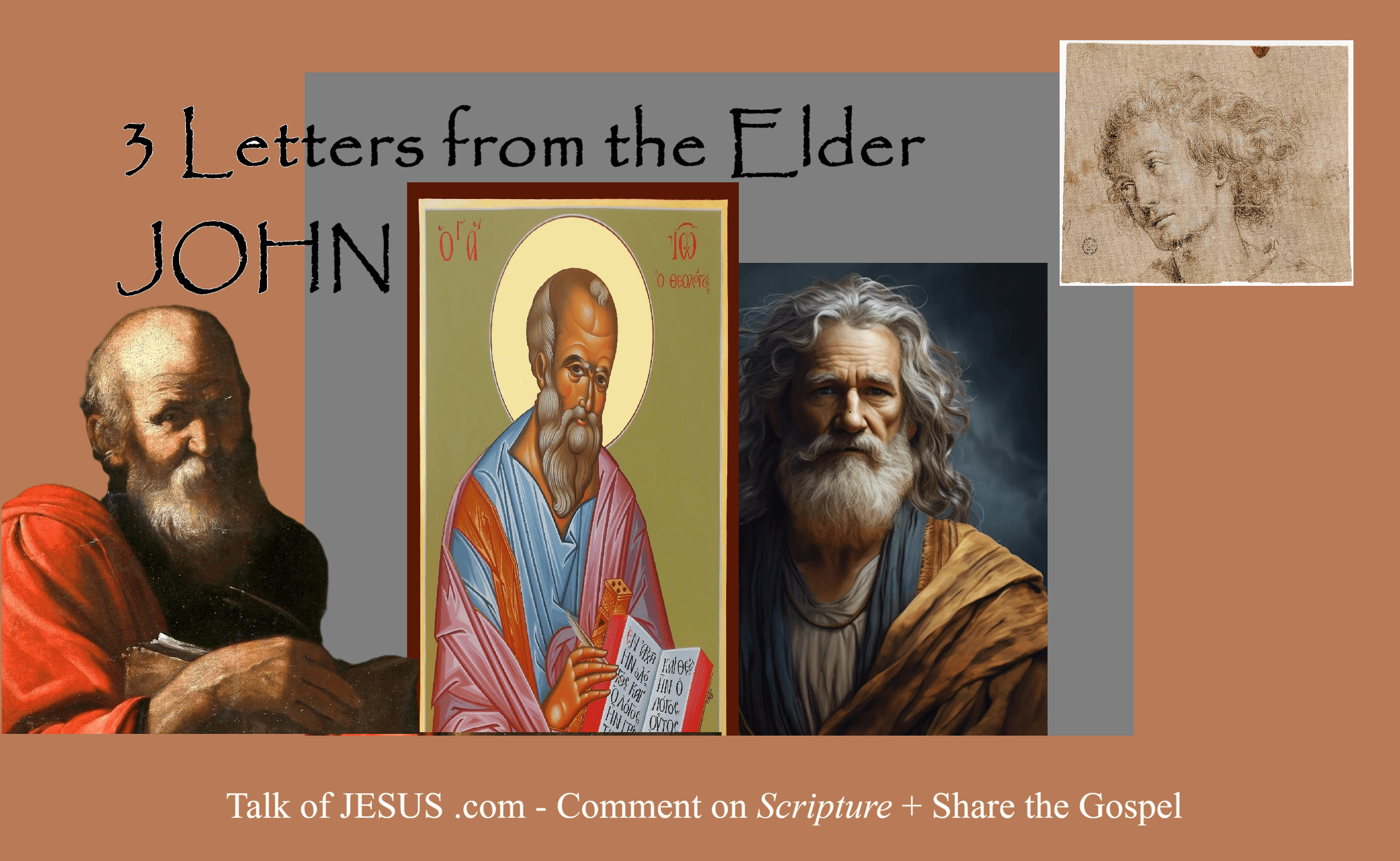
    3 Letters from the Elder John 3 paintings of the Apostle John as the Elder and one as a young Apostle of Jesus Christ

  • The Apostles Creed 10 the Remission (forgiveness) of Sins

    The Apostles Creed 10 the Remission (forgiveness) of Sins

    We believe in ..the communion of saints, the forgiveness of sins…

    The Apostles’ Creed — foundational to our Apostolic Christian faith

    Today we have reached the second to last points of our brief look at the Apostles’ creed, the forgiveness or remission of sins.

    (We’ll also take a brief glance at ‘the communion of saints,’ mentioned in part in our previous look at the Church.)

    For an overview and more instructive view of the outline of our SERIES, take a look at the Roman Creed below:

    Followers of Christ must always expect an attack against Scripture. Church doctrine is a line in the sand. - How will a leader or council of leaders choose what the Church will teach?
    I BELIEVE or WE BELIEVE IN:

    Structure of Christian CREEDS

    Here’s a brief outline found originally in The Roman Creed:

    1. I BELIEVE IN God almighty (or the Father almighty)
    2. And in Jesus Christ, his only Son, our Lord
    3. Who was born of the Holy Spirit and the Virgin Mary
    4. Who was crucified under Pontius Pilate and was buried
    5. And on the third day rose from the dead
    6. Who ascended into heaven
    7. Siteth at the right hand of the Father
    8. Whence He cometh to judge the living and the dead
    9. (I or WE believe in:) The Holy Ghost
    10. The Holy Church
    11. The remission of Sins
    12. The resurrection of the flesh
    • (and life everlasting).

    source: apostles-creed.org


    The early church taught what is basically in the Apostles creed

    It was not till heresies and divisions in the church that any creeds were established.

    source:

    The Apostles’ Creed


    The Apostles Creed

    I believe in

    the communion of the Saints,


    If you haven't read our previous post about the Church you may find helpful definitions not repeated here. 

    Last time we addressed one of the two definitions included in this section of the Apostles Creed:

    • hagios
      • most holy thing, a saint

    Today let’s also take a brief look at what the Creed means by communion.

    (In a sense, it’s not what you think of first.)

    Then they that gladly received his word were baptized..

    Acts of the Apostles 2:41a KJV

    (Now they are the saints or Holy ones of Christ, because of the remission of their sins.) 

    And they continued stedfastly in the apostles’ doctrine

    and fellowship, G2842

    and in breaking of bread,

    and in prayers.

    Acts of the Apostles 2:42 KJV

    Note that communion here is the fellowship of the saints whick follows learning the teaching or doctrine of the Apostles.

    AND that Communion (as we call it) is a corporate breaking of the bread [klasis artos], a symbolic remembrance of Christ’s broken body.


    They devoted themselves to

    (from the CSB) (and in addition to;)

    • the apostles’ teaching,
    • to the fellowship (communion of the saints),
    • to the breaking of bread,
    • and to prayer.

    ALL these together, as Christ’s local church, to keep them holy and separate from the sin and surrounding sinners of whom they once embraced.


    κοινωνία koinōnía, koy-nohn-ee’-ah; from G2844; partnership, i.e. (literally) participation, or (social) intercourse, or (pecuniary) benefaction (giving to the benefit of the church):—(to) communicate(-ation), communion, (contri-)distribution, fellowship.

    Source: BlueLetterBible.org


    I believe in

    the forgiveness of sins

    Nehemiah 9:

    After the Hebrews had abandoned the Law of Moses and their priest Ezra reads it to the people.

    .. the children of Israel were assembled with fasting, and with sackclothes, and earth upon them.

    repentant prayer

    .. And the seed of Israel separated themselves from all strangers,

    sanctification or holiness apart from the sin of their former life

    and stood and confessed their sins, and the iniquities of their fathers.

    Confession to God precedes asking for forgiveness. 

    But they and our fathers dealt proudly, and hardened their necks, and hearkened not to thy commandments,

    And refused to obey, neither were mindful of thy wonders that thou didst among them; but hardened their necks, and in their rebellion appointed a captain to return to their bondage:

    but thou art a God ready to pardon, gracious and merciful, slow to anger, and of great kindness, and forsookest them not.

    Nehamiah 9:16-17 KJV

    the remission of sins,

    Admittedly 'remission from the Creed is a little 'King James' in its sound. But recognize the New Testament application with which you may be able to relate from a familiar prayer and Scripture. 

    Forgive us our debts

    (Which comes from this OT application of the Law)

    “At the end of every seven years you shall grant a remission of debts.

    מִקֵּץ שֶׁבַע־שָׁנִים תַּעֲשֶׂה שְׁמִטָּה׃

    Deuteronomy 18:1 LSB


    ‘And forgive us our debts,
    as we also have forgiven our debtors.

    Gospel of Matthew 6:12 LSB

    “For if you forgive others for their transgressions,

    your heavenly Father will also forgive you.

    “But if you do not forgive others,

    then your Father will not forgive your transgressions.

    Matthew 6:14-15 LSB – the teaching of Jesus, the Son of Man, to followers


    paraptōma – transgressions

    • to fall beside or near something
    • a lapse or deviation from truth and uprightness
      • a sin, misdeed

    And you were dead in your transgressions G3900 and sins..

    Apostle Paul to the Ephesians 2:1

    For the wages of sin is death,
    but the gift of God is eternal life in Christ Jesus our Lord.

    Romans 6:23 NIV

    The remission of Sins through Christ

    • the concept of “wages,” which implies a payment or consequence that is earned. In the biblical context,
    • sin refers to any action, thought, or attitude that falls short of God’s holiness and commands.
    • Death here is both physical and spiritual, indicating separation from God.
      • Theologically, this underscores the seriousness of sin and its inevitable outcome without divine intervention.

    Contrasting with the earned wages of sin, the “gift of God” emphasizes grace, which is unmerited favor. Eternal life is not something humans can earn; it is a gift freely given by God.

    It is only through Jesus Christ, His death, and resurrection, that believers receive this gift. Jesus is seen as the fulfillment of Old Testament types and prophecies, such as the Passover Lamb (Exodus 12) and the Suffering Servant (Isaiah 53).

    Source: BibleHub.org – commentary on Romans 6:23


    In Him we have redemption through His blood,

    the forgiveness of sins, according to the riches of His grace.

    Ephesians 1:7 NKJV


    NEXT: Resurrection!

    Talk of JESUS . com

    Comment on Scripture – Share the Gospel

  • Have you taken time for fellowship with God’s church?

    Have you taken time for fellowship with God’s church?

    Love God’s Church = Fellowship with each other

    As I observed the comings and goings of families to a gathering of the church we call worship it seemed all hurried in from some early morning herding of the young sheep into vehicles and in just an hour herded them out into the parking lot of the world.

    Where were all the sheep going?

    Inside, scheduled fellowship included just two places for worshipers to join – neither appropriate for me (by definition of these limited communities of saints seeking fellowship and teaching in scripture).

    Has the world won over the church or just provided better marketing of how ‘christians’ should invest our time on Sundays?

    Roger@talkofJesus.com

    All that said, it’s a continuing issue for many churches and I have addressed it previously, including most recently in a 2020 series, In Case You Missed It…

    Scripture

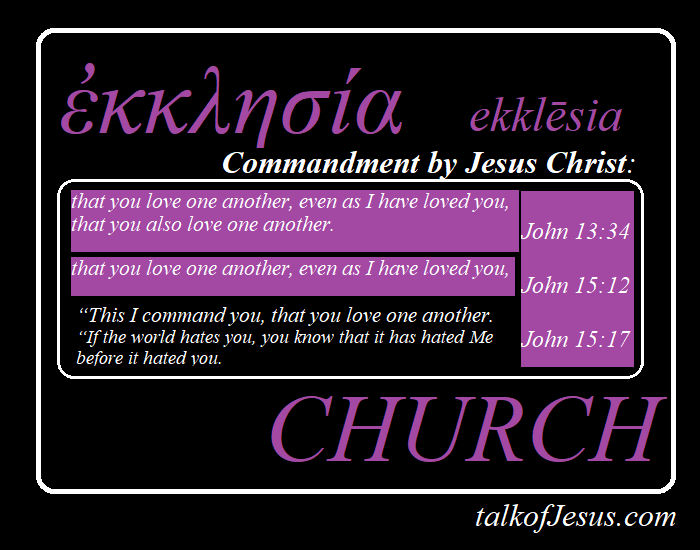
    John 15:12

    Original talkofJesus.com Post

    Original post from October 16, 2013
    Summer Reruns! with picture of sun wearing sunglasses
    Summer 2021 AD {Scriptural} Reruns
    • CLICK “…Continue reading ” above,
    • THEN Ask a question or comment at the end of this post
    • OR email Roger@talkofJesus.com with your reaction, questions & comments.

    Stay tuned from more Summer of 2021 Reruns from talkofJESUS.com

    (ditto: Summer 2022 – more to come)