Tag: Genesis

  • God’s Love Through John: In the Beginning

    God’s Love Through John: In the Beginning

    The Gospel of John

    John 1:1 ESV In the beginning was the Word, and the Word was with God, and the Word was God.

    1:1  ἐν ἀρχῇ ἦν ὁ λόγος καὶ ὁ λόγος ἦν πρὸς τὸν θεόν καὶ θεὸς ἦν ὁ λόγος

    The Apostle John begins his Gospel prologue with inspired, nearly unparalleled words pointing back to Genesis 1. Every Jew who knew God knew the beginning of the the Pentateuch.

    In the beginning God created the heavens and the earth.


    Genesis 1:1  בְּרֵאשִׁית בָּרָא אֱלֹהִים אֵת הַשָּׁמַיִם וְאֵת הָאָֽרֶץ׃

    Bereshit bara Elohim et hashamayim ve’et ha’aretz.

    John connects creation with logos, literally the word for word in the GreekJesus is the Person of the spoken Word of Elohimאֱלֹהִים

    2 He was in the beginning with God.

    In essence John proclaimed:

    Jesus IS in the beginning, Jesus is with Elohim, Jesus IS Elohim!

    Basic Belief: Do you believe in God?

    John begins by categorically stating that Jesus IS the One True God.

    This is Good News to those who believe. Yet even if you do not believe in the One God, John proclaims this Gospel as challenge to our misconceptions of the Creator.

    Every Greek knew the importance of logos. A secondary use of the word logos, familiar to unbelieving Greeks who claimed many gods, is its use as respect to the MIND alone. 

    Think about this, John tells those who do not know God.

    Reason through it and try calculating the logic of this relationship between a Power you cannot measure and a Person whom we have regarded. And again, John points to creation:

    3 All things were made through him, and without him was not any thing made that was made.

    John 1:3 CSB

    The First Letter of John

    In his first letter to the church John begins in a similar fashion when addressing those who already follow Christ Jesus in the first century.

    What was from the beginning, what we have heard, what we have seen with our eyes, what we have observed and have touched with our hands, concerning the word of life …

    1 John 1:1 CSB

    The Disciple Jesus loved gives followers of The Way a testimony of his own witness of ‘God in the flesh’ in the Person of the Messiah of God.

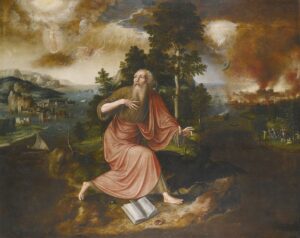
    Orazio Fidani, Saint John the Apostle, c. 1640-56

    John, now a fully mature Elder, tells his churches, gatherings of believers in Christ:

    We know that Jesus IS who He says He IS. We are witnesses to the facts and preach our testimony to you you. 

    Jesus IS God and we have personally seen, heard, observed and touched the Living God!

    Good news for believers.

    4 ‘We are writing these things so that our joy may be complete,’ John writes to believers.

    Jesus, the Christ, a personal Lord who loves and ministers to sinners.

    The Beginning and the End

    John’s Gospel and three letters reveal Jesus as the Christ, Almighty God as One with the eternal Person of the Son of Man.

    The Revelation of Jesus Christ to John speaks to the beginning of Creation, in addition to providing troubling imagery of the apocalypse of the heavens and earth.

     “I am the Alpha and the Omega,” says the Lord God, “the one who is, who was, and who is to come, the Almighty.”

    Revelation 1:8 CSB

    John’s Vision of the Risen Lord

    I, John, your brother and partner in the affliction, kingdom, and endurance that are in Jesus, was on the island called Patmos because of the word of God and the testimony of Jesus.

    The Apostle John, whom we picture as a young man mentored by Jesus, reveals much more about the Lord.

    Almighty God, Creator of the heavens and earth, in whose image man is made, IS; in the Person of Jesus, a Savior to eternal life to those He loves.

    Jesus will also judge rebellious sinners and cleanse creation of all unrighteousness. The LORD will make all things right.

    John, through Christ, reveals the ending:

    Revelation 21:3b Look, God’s dwelling is with humanity, and he will live with them. They will be his peoples, and God himself will be with them and will be their God. 4 He will wipe away every tear from their eyes. Death will be no more; grief, crying, and pain will be no more, because the previous things have passed away.

    John’s Good News

    Jesus loves you. This is John’s message. God is immeasurably more than an understood Power. Jesus shows God as a loving Father who also gives freedom to mankind to choose eternal life or deserved punishment for sin. 

    Do you believe in One God? Can you relate to Almighty God as a loving Father of a chosen family? In Christ Jesus we have seen the Lord!

    John gives us both brief glimpses and detailed accounts of the Logos, the Very Word of God.

    No mere mortal can fully fathom the ever-existent Creator of all things and of all men, even in the personal witness of John. Yet John reveals even more of the completeness of the One True God through consideration of the Spirit of God, the subject of our next look at understanding the Lord through the eyes of the Disciple Jesus loved.

    To be continued...


  • A River of Redemption Flowing from Eden – Justice

    A River of Redemption Flowing from Eden – Justice

    Contemplation of Justice by James Earle Fraser – US Supreme Court building

    Justice

    At the beginning of this series I outlined topics which included justice. Here we will explore their linked applications.

    • Commandment
    • Law
    • Justice
    • Judgment
    • Penalty and Sentence
    • Redemption

    Justice – n. 1) fairness. 2) moral rightness. 3) a scheme or system of law in which every person receives his/ her/its due from the system, including all rights, both natural and legal. – source: dictionary.law.com

    The multi-branched tree of the knowledge of good and evil.

    “but you must not eat from the tree of the knowledge of good and evil, for on the day you eat from it, you will certainly die.” – Genesis 2:17 CSB

    Paradise by Lucas Cranach the Elder – painter, draughtsman, printmaker and court painter – 1530

    We move now from relatively calm waters of Adam knowing the difference between good and evil to a more tumultuous current of original sin flowing through the generations.

    Justice, and only justice, you shall follow, that you may live and inherit the land that the LORD your God is giving you. – Deuteronomy 16:20

    Justice in the Egypt of Joseph and Moses

    Recent research from Yale Law, The Representation of Justice in Ancient Egypt, confirms concepts of justice learned by the Hebrews. I have quoted it extensively below.

    The concept of “law” and “justice” are intimately associated with the proper behavior of kings and were embedded in every royal ritual.

    https://www.egyptprivatetourguide.com/egyptian-facts/ancient-egyptian-justice-interesting-facts-law-ancient-egypt/
    Ma’at Ancient Egyptian goddess of justice

    Could common citizens expect an example of morality from their leaders? Even the Pharaoh and King?

    In a word, ‘yes.’ According to research of ancient civilizations predating Rome and Greece, a natural ‘connective justice’ was presumed in law.

    The imperfect branches of connective justice

    Again, the research of J.G. Manning in the Yale Journal of Law & the Humanities:

    Ma’at (“connective justice,”) governed personal moral behavior, as can be seen in religious texts, as well as the proper relationships between gods and men, between kings and society, and between individuals. Thus it literally connected everyone from the gods, through the king, down to the lowliest farmer. It was the mirror of the divine order of the world and also the foundation of private ethical behavior. Ma’at was the most persistent and pervasive idea in ancient Egyptian society.

    Importantly, the most visible and the longest lasting image of Ma’at in
    a private context, at least to the modem observer, is the famous “last
    judgment scene,” in which an individual faced his or her mortality by
    having his or her life deeds weighed in the balance against the symbol of justice, the ostrich feather, in front of all of the gods in Egypt.

    If found wanting, the person’s soul was devoured and his or her existence was extinguished. On the other hand, if found “true of voice,” one gained eternal bliss in the afterlife. This was not the public representation of state justice, but, rather a more intimate depiction of the expectations of private moral behavior.

    Do you recognize this universal connection to the truth in the Law given to Moses on Sinai by the Lord God?

    Delegated authority of the Law

    Application of law ultimately leads back to the same question Adam would have to judge after gaining ‘knowledge of good and evil.’ 

    What is right? Is this good or evil in the eyes of the Lord?

     Basic precedents of law include English Common Law and other fundamental documents.

    https://www.law.berkeley.edu/library/robbins/CommonLawCivilLawTraditions.html
    Sir William Blackstone
    • of the United States, in Order to form a more perfect Union, establish Justice, … and secure the Blessings of Liberty … ordain and establish this Constitution for the United States of America.
      • The Bill of Rights & evolving societal amendments
    • Religious Law 
    Hammurabi a Babylonian code of law

    The contemporary legal systems of the world are generally based on one of four basic systems: civil law, common law, statutory law, religious law or combinations of these. However, the legal system of each country is shaped by its unique history and so incorporates individual variations.[1]

    A Stream Towards Justice

    We have examined the role of authority in the law. It is here that the roles of God, government, family and community all come into play.

    The basis of all law is the authority by which it is given. Justice requires effective application and fair administration of remedies by a righteous and impartial judge. – Roger Harned


    A commandment comes directly from Almighty God. Call it ‘religious law,’ but an absolute over-riding Authority connects God’s word to man’s actions.

    Hebrew followers of Moses heard the Lord speak directly and were afraid. Even so, they disobeyed the direct command of God even before Moses later descended Sinai with the stone tablets – the Law, carved by the finger of God in stone.

    This inviolable Law would be carried in the Ark of the Covenant; not as reference, but as witness to their own promises to God. Yet many would violate (trespass) their solemn covenant promises to God many times and in many places throughout the long history of Israel.

    Penalty of the Law

    Even though prescribed specifically for certain violations in specific contexts of the Law, ‘penalty’ is not mentioned by name in the King James Version of the Bible. The overriding issue, simply, is innocence or guilt and not particularly the punishment.

    A divine sentence is in the lips of the king: his mouth transgresseth not in judgment. – Proverbs 16:10 KJV

    Have you ever considered that the ‘sentence’ of the court is the spoken judgement against the convicted violator of the law?

    Because sentence against an evil work is not executed speedily, therefore the heart of the sons of men is fully set in them to do evil. – Ecclesiastes 8:11 KJV

    Perhaps you have even noted the legal principle of a right to a speedy trial in the wise advise above.

    Now note the usage of the Hebrew root for the consequence of guilt:

    דָּם – dam

    • blood (342x),
    • bloody (15x),
    • person (with H5315) (1x),
    • bloodguiltiness  (1x)
    • bloodthirsty (with H582) (1x),
    • vr blood (1x)

    Again, this goes to the higher authority of Almighty God. Perhaps a good Biblical example of commanded penalty would be ‘capital punishment.’

    “Whoever sheds human blood,
    by humans his blood will be shed,
    for God made humans in his image.

    Genesis 9:6 CSB

    “But you, be fruitful and multiply; spread out over the earth and multiply on it,”[Gen. 9:7] God commanded Noah and his family who were spared by the judgement of the earth. 

    Looking upstream through the generational sins even in the time of Moses, redemption from bloodguilt against God hardly seems attainable. 

    Kings and Nations under God

    And what cause soever shall come to you of your brethren that dwell in their cities, between blood and blood, between law and commandment, statutes and judgments, ye shall even warn them that they trespass not against the LORD, and so wrath come upon you, and upon your brethren: this do, and ye shall not trespass. – 2 Chronicles 19:10 KJV

    reign of Jehoshaphat ~873–849 BC

    From later records of Israel (and Judah after David), we learn of the continued importance of the Law or Commandment of God to this ‘chosen’ nation. The above quote from 2 Chronicles is recorded in the time of Jehoshaphat, in the 9th century Before Christ.

    Note the distribution of authority given by King Jehoshaphat to others from 2 Chronicles 19:

    A King’s delegation of justice

    4 Jehoshaphat lived in Jerusalem, and once again he went out among the people from Beer-sheba to the hill country of Ephraim and brought them back to the Lord, the God of their ancestors. 5 He appointed judges in all the fortified cities of the land of Judah, city by city.

    6 Then he said to the judges, “Consider what you are doing, for you do not judge for a mere mortal, but for the Lord, who is with you in the matter of judgment. 7 And now, may the terror of the Lord be on you. Watch what you do, for there is no injustice or partiality or taking bribes with the Lord our God.”

    8 Jehoshaphat also appointed in Jerusalem…

    • some of the Levites and priests
    • and some of the Israelite family heads…

    Delegated authority from the Lord to the King, then to officials responsible for religion, for community and for family. Even warning of how to manage outsiders (foreigners and servants), all under delegated authority of the Lord through others. Not freedom, as we know it. Certainly not license to choose whether to obey or defy any law or regulation. 

    10 For every dispute that comes to you from your brothers who dwell in their cities—whether it regards differences of bloodguilt, law, commandment, statutes, or judgments—you are to warn them, so they will not incur guilt before the Lord and wrath will not come on you and your brothers. Do this, and you will not incur guilt.

    11 “Note that Amariah, the chief priest, is over you in all matters related to the Lord, and Zebadiah son of Ishmael, the ruler of the house of Judah, in all matters related to the king, and the Levites are officers in your presence. Be strong; may the Lord be with those who do what is good.”

    God will judge

    God is a righteous judge
    and a God who shows his wrath every day. – Psalm 7:11

    He will judge your people with righteousness
    and your afflicted ones with justice. – Psalm 72:2

    Psalm 111:9 Christian Standard Bible (CSB)
    He has sent redemption to his people.
    He has ordained his covenant forever.
    His name is holy and awe-inspiring.

    To be continued…

  • A River of Redemption Flowing from Eden – 7 – Upstream in History

    A River of Redemption Flowing from Eden – 7 – Upstream in History

    Philip found Nathanael and said to him, “We have found him of whom Moses in the Law and also the prophets wrote, Jesus of Nazareth, the son of Joseph.” – John 1:45 ESV

    What does it mean to look upstream in history? Those seeking eternal truth look back through the eyes of scripture.

    A Basis of Law and Justice

    Looking back on the source of law somewhat resembles our search for Eden and the basis of life. We move from the still waters of a river with visible bottom to swim upstream against torrents of the unseen. How can we see justice and redemption, so distant to our own existence? 

    The answers of justice rest not in the law, but in the Lawgiver and relationship of the redeemed.


    Before the incarnation of the Messiah, yet long after the fall of Jerusalem  the Prophet Isaiah [יְשַׁעְיָה] had proclaimed: 1:27 צִיֹּון בְּמִשְׁפָּט תִּפָּדֶה וְשָׁבֶיהָ בִּצְדָקָֽה׃

    Zion shall be redeemed by justice, and those in her who repent, by righteousness. But rebels and sinners shall be broken together,
    and those who forsake the LORD shall be consumed. – Isaiah 1:27-28


    Even Isaiah had looked back upstream through the torrent of sin, just as Moses had warned in Genesis.

    9 If the Lord of hosts
    had not left us a few survivors,
    we should have been like Sodom,
    and become like Gomorrah.

    10 Hear the word of the Lord,
    you rulers of Sodom!
    Give ear to the teaching of our God,
    you people of Gomorrah!

    These warnings to obedience refer not to the law, but a broken relationship with the Lord and sinful relationships with other men. Law has basis in the relationships of men and women to each other; but above all, law requires a relationship to the commands of the Living God.

    Do godless men and evil women desire judgment?

    Their contempt for authority reflects the darkness of a mortal life lacking fear of The Almighty God. They neglect, trespass and try to circumvent the law. 

    Evil men and godless women rebel against righteousness, without regard of consequence for others or their own inevitable punishment when convicted. Do you rebel against righteousness?

    Justice fails when licentiousness claims all sin as freedom.    

    Though we tend towards lawlessness, we are free to choose obedience to the Lord. A humble sinner desires mercy and the repentant law-breaker wants restoration of relationship with the Lord. And this in addition to redemption with a community of loved-ones.

    Returning to Joseph, further upstream

    Moses, giver of the Law, was educated in Egypt and instructed by the Lord. In our previous look at these two men we learned  that Joseph was educated by Israel in Canaan, but also apprenticed under Potiphar and Pharaoh in Egypt.

    GENESIS 41:

    28 “It is just as I told Pharaoh: God has shown Pharaoh what he is about to do…

    … all the abundance in the land of Egypt will be forgotten. The famine will devastate the land… the matter has been determined by God, and he will carry it out soon.

    34 Let Pharaoh do this: Let him appoint overseers over the land and take a fifth of the harvest of the land of Egypt during the seven years of abundance.


    Does anyone note the 20% tax here? It allows the administration of government to help its citizens in the seven years of struggle ahead. Of course, the tithe (tenth) to the Lord was long established.

    Even in Egypt the King may have just required a double-portion to balance the years ahead when major markets would fail. No crops, therefore no income for the country. In addition, the people would need help or they would perish.

    We cannot think of law separate of its authority, intent and righteousness.

    Joseph, with God’s help, redeems not only Egypt, but also its struggling neighbors (for a small price). These would include his own brothers and father.

    Where there is no vision, the people perish: but he that keepeth the law, happy is he. – Proverbs 29:18 KJV


    Prince Zaphenath-paneah

    41 Pharaoh also said to Joseph, “See, I am placing you over all the land of Egypt.” 

    … 45 Pharaoh gave Joseph the name Zaphenath-paneah and gave him a wife, Asenath daughter of Potiphera, priest at On. [Heliopolis] And Joseph went throughout [Joseph gained authority over] the land of Egypt…

    50 Two sons were born to Joseph before the years of famine arrived. Asenath daughter of Potiphera, priest at On, bore them to him.

    53 Then the seven years of abundance in the land of Egypt came to an end, 54 and the seven years of famine began, just as Joseph had said. There was famine in every land, but in the whole land of Egypt there was food.

    55 When the whole land of Egypt was stricken with famine, the people cried out to Pharaoh for food. Pharaoh told all Egypt, “Go to Joseph and do whatever he tells you.”


    Moses and Pharaoh would have both spoken Egyptian (the language that became Coptic, not modern Egyptian Arabic). Moses would have almost certainly spoken Hebrew too. – source 

    As Moses looks upstream toward this time he reminds the Hebrew people, who have not yet entered the promised land of Joseph. It would be accurate in Hebrew to say this. 

    41:55 וַתִּרְעַב כָּל־אֶרֶץ מִצְרַיִם וַיִּצְעַק הָעָם אֶל־פַּרְעֹה לַלָּחֶם וַיֹּאמֶר פַּרְעֹה לְכָל־מִצְרַיִם לְכוּ אֶל־יֹוסֵף אֲשֶׁר־יֹאמַר לָכֶם תַּעֲשֽׂוּ׃

    Yet in their native Egyptian language, now the fluent first language of Joseph, these God-spoken words through Pharaoh would have been heard and later told in all the land:

    Pharaoh told all Egypt, “Go to Zaphenath-paneah and do whatever he tells you.”

    A familiar Redeemer we do not understand

    Later, Israel will send his other sons to Pharaoh to buy the grain they must have for survival of their animals and for food.

    The ruler of Egypt they hear (actually, Joseph) speaks a different language. He looks different than these poor men who humbly raise sheep and trade for those things they require. This redeemer they hear speaks through others in a foreign language.

    Genesis 42:

    “Where do you come from?” he asked.

    “From the land of Canaan to buy food,” they replied.

    “You are spies. You have come to see the weakness of the land.”

    “No, my lord. Your servants have come to buy food,” they said.

    17 So Joseph imprisoned them together for three days.

    18 On the third day Joseph said to them, “I fear God—do this and you will live.

    Moses’ hearers knew the outcome of redemption as we do; but Israel’s other sons did not.

    Read this reunion story again, as experienced from the fear of these men now humbled, hungry and imprisoned by a rich foreign ruler. 

    Their Redeemer Revealed

    Time passes as Israel’s sons return to him in Canaan, but the famine continues and they again run out of food. No alternative but to return to Egypt, ruled by Zaphenath-paneah, whose word is law of the land.

    Genesis 43:

    But the men were afraid because they were taken to the house of Zaphenath-paneah. (Of course, Moses tells us his true identity even before this redeemer of Israel reveals the Lord’s purpose.)

    … they brought him the gift they had carried into the house, and they bowed to the ground before him.

    27 He asked if they were well, and he said, “How is your elderly father that you told me about? Is he still alive?”

    28 They answered, “Your servant our father is well. He is still alive.” And they knelt low and paid homage to him.

    32 They served him by himself, his brothers by themselves, and the Egyptians who were eating with him by themselves, because Egyptians could not eat with Hebrews, since that is detestable to them.


    Are you, poor sinner, detestable to the rich? Would they choose to disavow you because they do not know the God we serve?


    Everyone leaves and they depart the next morning. Then yet another deceptive plot to bring them back once more.

    Judah pleads: “My lord, please let your servant speak personally to my lord. Do not be angry with your servant, for you are like Pharaoh. [44:18]

    Genesis 45:

    Joseph could no longer keep his composure in front of all his attendants, so he called out, “Send everyone away from me!”

    No one was with him when he revealed his identity to his brothers. 2 But he wept so loudly that the Egyptians heard it, and also Pharaoh’s household heard it.


    You know the rest, but have you weighed justice by the measure of the Lord’s purposes?

    Do you truly believe that God provides a redeemer not only through your own sufferings, but through suffering and injustice to another?

    ‘Why does God allow evil?’ we ask.

    The Redeemer of Israel gives us the Lord’s answer.

    Moses tells a people who have endured forty years in the wilderness after the passing of a generation who turned against the Law, which they both heard from the Lord and read on tablets of stone from the finger of God:

    Listen to Joseph’s words to his brothers of why this evil has happened.


    4 Then Joseph said to his brothers, “Please, come near me,” and they came near. “I am Joseph, your brother,” he said, “the one you sold into Egypt.

    7 God sent me ahead of you to establish you as a remnant within the land and to keep you alive by a great deliverance. 8 Therefore it was not you who sent me here, but God.


    And consider the weight and Authority in Joseph’s next words about Providence:

    He has made me a father to Pharaoh, lord of his entire household, and ruler over all the land of Egypt.

    A ‘father‘ to Pharaoh; not only as Jacob is their father but also in authority, even loving authority, as God IS our Father.

    Later Joseph will give the reason for their redemption:

    As for you, you meant evil against me, but God meant it for good, to bring it about that many people[fn] should be kept alive, as they are today. – Genesis 50:20 ESV

    22 Joseph and his father’s family remained in Egypt. Joseph lived 110 years.


    To be continued…