Tag: Genesis

  • The Commitment of Christian Marriage

    The Commitment of Christian Marriage

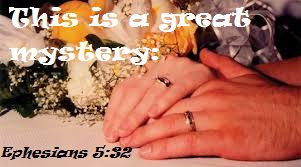
    This is a great mystery: but I speak concerning Christ and the church.

    Did we miss this? I love a good mystery. Don’t you? Especially at the moment you finally get it – the moment you figure out where the story has been headed all along.

    Paul writes a letter to the church (at Ephesus). It is a letter to you and a letter to me, IF we claim Christ as our Lord… IF we are consumed with the promised return of our Lord. But there’s a mystery here you might overlook if you see Ephesians only as a letter with rules and regulations. It is the mystery of relationship.

    Ephesians 5

    English Standard Version (ESV)

    Walk in Love

    Therefore be imitators of God, as beloved children.  2 And walk in love, as Christ loved us and gave himself up for us, a fragrant offering and sacrifice to God.

    Walk in love. We get that, right?

    Walk. Make progress in our faith. Don’t just stay as we were, but become as Christ would want us.

    We are beloved children of the Living God. WOW! We love that. But now, as children we are expected to grow up as a member of the family of God our father. Yet as the rebellious child will often do, we get hung-up on Dad’s rules. (See vs. 5-21)

    Then, it seems (like in all good mysteries) that the author is headed down a different road with just the obvious connection to that ‘sexual immorality’ thing: porneia. We know that marriage should solve all of that. But why is Paul giving marriage so much ink?

    Wives and Husbands

    22 Wives, submit to your own husbands, as to the Lord. 23 For the husband is the head of the wife even as Christ is the head of the church, his body, and is himself its Savior. 24 Now as the church submits to Christ, so also wives should submit in everything to their husbands.

    25 Husbands, love your wives, as Christ loved the church and gave himself up for her, 26 that he might sanctify her, having cleansed her by the washing of water with the word,

    27 so that he might present the church to himself in splendor, without spot or wrinkle or any such thing, that she might be holy and without blemish.

    28 In the same way husbands should love their wives as their own bodies. He who loves his wife loves himself.

    29 For no one ever hated his own flesh, but nourishes and cherishes it, just as Christ does the church, 30 because we are members of his body.

    Lets pause for a moment and look at this from a different perspective. Many a sermon has been preached using Ephesians 5:22 as a reason for husbands to have their wives “submit” to their will. I will point out here that MANY a husband is NOT submitted to Jesus Christ as his Lord. For the text says, “as to the Lord.” Therefore, BOTH the husband and the wife who claim Jesus Christ as their Lord MUST be submitted to Christ as Lord.

    Is your Christian marriage submitted to Christ as your Lord?

    Husbands, love your wives. (Don’t get mixed up on this now.) Love here is not sexual love. (That’s OK and expected, but Paul refers to something bigger here.)

    Love, that is: agapaōis inclusive of the same love expected from all Christians for each other on a most intimate basis.

    Paul adds: as Christ loved the church. (Same word for loved: agapaō). This means that in a sense if you think of Jesus as the Husband and you as the Bride, it’s the love that Jesus has for you IF He were your Husband. It’s the same love that God has for all of us in the sense that ‘adam’ means not only man, but mankind.

    But Paul does not stop there with his example for husbands. He adds: and gave himself up for her.

    What does he mean by, gave himself up?

    Husbands, he means a sacrificial love for your wife. Do you do that? (For you were glad enough to have your wife sacrifice her humility to serve you. Do you sacrifice your being for her?)

    Paul emphasized the sacrifice of the husband even more (in a way that we cannot get around), for he adds to that a purpose: that he might sanctify her, having cleansed her by the washing of water with the word.

    Sanctify her: a husbands duty. A religious term meaning to to separate her from profane things and dedicate a wife to God. My responsibility as her husband. (And I pray in the Lord that she will submit to it.)

    The prodigal wife has returned from the pig sty. She is filthy. She has had an unloving master who has not cared that she has wasted all of her blessing and inheritance from her father on foolish things. She begs to return home, even as a servant with not even the rights of one of the family of the father.

    How will you welcome this filthy prodigal wife?

    (Need direction in this? Read Luke 15.)

    Sanctify her, having cleansed her by the washing of water with the word. 

    Picture the purification of the Bible, a waterfall showering the one sanctified to God until all the filth of the pig sty of the worldly places is gone.

    The water of purification is the word of the Lord.

    Will your wife listen? That is what the Lord wants to know. Will you and she both become sanctified in the Word?

    John 1 In the beginning was the Word, and the Word was with God, and the Word was God. 2 He was in the beginning with God. 3 All things were made through him, and without him was not any thing made that was made. 4 In him was life, and the life was the light of men.

    It all goes back to the beginning, to Eden, to God’s intention of the intimacy of the relationships involved of adam.

    31 “Therefore a man shall leave his father and mother and hold fast to his wife, and the two shall become one flesh.” 

    Paul now refers to the mystery of marriage. The climax, however, is more than you ever expected. (Paul adds that the mystery is profound.) 

    32 This mystery is profound, and I am saying that it refers to Christ and the church.

    JESUS + HIS CHURCH = a Marriage made in Heaven.

    As a member of Christ’s body, the church; Christians are Jesus’ Bride.

    Every prepared and purified soul of the church awaits the coming again of our Bridegroom: Christ Jesus, our Lord and Husband betrothed to each of us.

    It is a very great mystery, Jesus Christ + the Church; Husband + wife. We are by His sacrifice one with Him and will be with Him in His heavenly home for all time.

    Paul adds, as our example of that marriage:

    33 However, let each one of you love his wife as himself, and let the wife see that she respects her husband.

     Why is the witness of Christian marriage so important?

    We are the respect of Christ in this world, until He returns for His faithful Bride.

    Christians must live as Christ and be witness to His love and righteousness.

    Would you (IF you were Jesus) want an unfaithful wife?

    The hypocrisy of failed christian marriages is no mystery to the world.

    WE, by the witness of our divorces are prodigal wives gone off to the pig sty on our own.

    It is because of the hardness of our hearts and not love for Christ Jesus, our Betrothed Bridegroom.

    Will we return to the vows of our faithfulness?

    OR will the Lord return before we purify our church once more?

    They are no longer two, but one.

    Is your marriage one with Christ Jesus our returning Bridegroom?

    For He poured out His sacrifice of love for His Bride on the Cross.

    May we in our Christian marriages once more take up our cross and follow the Bridegroom.


  • Deceived

    Deceived

    L. It is her. I know it is her. She is to be God’s blessing to me. But what of this mystery (a sadder eyes)? How could it not be her; what can it mean? 

    Psalm 116

    10 I believed, even when I spoke:
    “I am greatly afflicted”;
    11 I said in my alarm,
    “All mankind are liars.”

    12 What shall I render to the Lord
    for all his benefits to me?
    13 I will lift up the cup of salvation
    and call on the name of the Lord,
    14 I will pay my vows to the Lord
    in the presence of all his people.

    Genesis 28:20-22 Then Jacob made a vow, saying, “If God will be with me and will keep me in this way that I go, and will give me bread to eat and clothing to wear, so that I come again to my father’s house in peace, then the LORD shall be my God, and this stone, which I have set up for a pillar, shall be God’s house. And of all that you give me I will give a full tenth to you.”

    First, a riddle, then a Psalm; then, a vow of Jacob at Bethel. What does this have to do with marriage?

    See the relationship of truth to vows and covenant and worship and yes, the importance of truth in marriage: a lesson Jacob had to learn as consequence of sin and consequence of deceit. Let’s begin with his blessing by his father, prior to his marriage:

    Genesis 27:22  So Jacob went near to Isaac his father, who felt him and said, “The voice is Jacob’s voice, but the hands are the hands of Esau.” …

    29b Be lord over your brothers,
    and may your mother’s sons bow down to you.
    Cursed be everyone who curses you,
    and blessed be everyone who blesses you!”

    Rebekah deceived her husband; Jacob deceived his father Isaac.

    42 But the words of Esau her older son were told to Rebekah. So she sent and called Jacob her younger son and said to him, “Behold, your brother Esau comforts himself about you by planning to kill you. Now therefore, my son, obey my voice. Arise, flee to Laban my brother in Haran…

     Jacob flees to live under the protection of Laban, his mother’s brother, rather than risk his life in the lands of his father. Isaac confirms it. 

    Genesis 29

    10 Now as soon as Jacob saw Rachel the daughter of Laban his mother’s brother, and the sheep of Laban his mother’s brother, Jacob came near and rolled the stone from the well’s mouth and watered the flock of Laban his mother’s brother. 11 Then Jacob kissed Rachel and wept aloud. 12 And Jacob told Rachel that he was her father’s kinsman, and that he was Rebekah’s son, and she ran and told her father.

    13 As soon as Laban heard the news about Jacob, his sister’s son, he ran to meet him and embraced him and kissed him and brought him to his house. Jacob told Laban all these things, 14 and Laban said to him, “Surely you are my bone and my flesh!” And he stayed with him a month.

    This relationship ‘Surely you are my bone and my flesh’ should sound familiar (even familial): a closeness of husband and wife, a closeness of sister and brother, a closeness of relatives – different, each; but all important relationships.

    Now deceit enters once more into the picture:

    15 Then Laban said to Jacob, “Because you are my kinsman, should you therefore serve me for nothing? Tell me, what shall your wages be?” 16 Now Laban had two daughters. The name of the older was Leah, and the name of the younger was Rachel.

    17 Leah’s eyes were weak, but Rachel was beautiful in form and appearance.

    18 Jacob loved Rachel. And he said, “I will serve you seven years for your younger daughter Rachel.”

    A bargain for love (not arranged by the fathers). A romantic picture… then they should ‘live happily ever after;’ that is, except for sin and lies and deceit.

    Imagine this romantic picture. Jacob has worked for his soon-to-be father-in-law for seven years and not had sexual relations with Rachel, whom he loved. A wedding feast; and then…

    21 Then Jacob said to Laban, “Give me my wife that I may go in to her, for my time is completed.” 22 So Laban gathered together all the people of the place and made a feast. 23 But in the evening he took his daughter Leah and brought her to Jacob, and he went in to her.

    Deceit! Betrayal! As Jacob had lied and betrayed his own father’s trust to receive his blessing.

    Now what? Laban scrambles to make amends and keep the peace. He provides for both daughters and his new son-in-law, married to Leah; and, oh, by the way… if you will work for me another seven years, I will give you Rachel.

    Agreed. Now Jacob has two wives! But just like his Grandfather Abraham, he will reap the double blessings and increased difficulties of marriage even more-so. (We won’t go into that here.)

    First, God will bring Jacob back to truth, before confirming with him covenant.

    Genesis 31:  Now Jacob heard that the sons of Laban were saying, “Jacob has taken all that was our father’s, and from what was our father’s he has gained all this wealth.” 2 And Jacob saw that Laban did not regard him with favor as before. 3 Then the Lord said to Jacob, “Return to the land of your fathers and to your kindred, and I will be with you.”

    Jacob flees Laban with his wives, children, herds and possessions. Laban pursues and catches up. They make a truce.

    48 Laban said, “This heap is a witness between you and me today.” Therefore he named it Galeed, 49 and Mizpah, for he said, “The Lord watch between you and me, when we are out of one another’s sight. 50 If you oppress my daughters, or if you take wives besides my daughters, although no one is with us, see, God is witness between you and me.”

    They become two families at peace, though separated by distance and a border. The wife given by the father to her husband… both wives to their one husband, Jacob; and the servant wives as well (another story) and all the grandchildren.

    Jacob has become a sojourner once more (as was his grandfather, Abraham).

    Genesis 32 Jacob went on his way, and the angels of God met him. 2 And when Jacob saw them he said, “This is God’s camp!” So he called the name of that place Mahanaim…

     Finally, after all these years… after all these lies and consequences of lies: humility, obedience and a confession of repentance of sin before God:

    9 And Jacob said, “O God of my father Abraham and God of my father Isaac, O Lord who said to me, ‘Return to your country and to your kindred, that I may do you good,’ 10 I am not worthy of the least of all the deeds of steadfast love and all the faithfulness that you have shown to your servant, for with only my staff I crossed this Jordan…

    22 The same night he arose and took his two wives, his two female servants, and his eleven children, and crossed the ford of the Jabbok. 23 He took them and sent them across the stream, and everything else that he had.

    24 And Jacob was left alone. And a man wrestled with him until the breaking of the day…

    27 And he said to him, “What is your name?”

    Jacob had clung to Esau’s heal at birth. Jacob had bought Esau’s blessing and fought to keep it by his lie to his father; for when Isaac asked his name, Jacob had replied with a lie: “Esau.” He now wrestles with the Lord.

    But Jacob said, “I will not let you go unless you bless me.”

    And he said, “Jacob.” 28 Then he said, “Your name shall no longer be called Jacob, but Israel, for you have striven with God and with men, and have prevailed.” 

    Do you believe that you can prevail against God, unless it is God’s will?

    We must be humble to become god-like. We must confess truth to reap truth. We must honor our word.

    Israel: God prevails.

    God IS part of a godly marriage and a covenant of promise.

    Relationship requires truth. God knows truth.

    • Is your relationship with God honest?
    • Is your relationship with the husband (wife) of your vows honest?
    • Is your relationship with Christ Jesus honest?

    Is our witness of Christian marriage truthful when Christ asks:

    What is your name? 


    Next: A confession

  • Two Sinful Souls = One Imperfect Marriage

    Two Sinful Souls = One Imperfect Marriage

    Genesis 24:16 KJV And the damsel was very fair to look upon, a virgin, neither had any man known her: and she went down to the well, and filled her pitcher, and came up.

    Looking beyond the ‘ideal marriage,’ suppose at the time and place of your marriage it was said:

    I now pronounce you sinners, husband and wife.”

    Of course, that’s not how we do it.  The marriages and customs of the Old Testament are unfamiliar, yet marriages remain flawed by sin since Eden.

    The sin of the husband impacts his wife and the sin of the wife affects her husband. They are one in the sins of both.

    Women of faith of the Bible have, perhaps, received much grace in that we read little of their sins and failings or their infidelities to their husbands. The leadership and responsibility of marriage falls on the husband. The Biblical model of marriage shows obedience of the woman to her father, followed by obedience to her husband after she is given in marriage.

    Think about this; how different this is from our contemporary practice of ‘equalness,’ rather than completeness.

    Job’s wife and Lot’s wife may come to mind along with others, but for the most part the Bible documents many sinful acts of many sinful men of faith.  We must learn and discern (for both husband and wife) from both their faithfulness and their failings.

    The story of the virgin above is of Rebekah. It is not Isaac’s witness here, but a servant of Abraham. Abraham sends out a servant to arrange a marriage for his son. It is a contract (typically) between two fathers – a joining of two families. Abraham has already had the problems of having more than one wife! Without going into God’s purposes through Hagar (apart from his purposes through Sarah), let’s take an earlier look at the husband: Abram.

    The Call of Abram

    Now the Lord said to Abram, “Go from your country and your kindred and your father’s house to the land that I will show you…

    4 So Abram went, as the Lord had told him, and Lot went with him. Abram was seventy-five years old when he departed from Haran.

    Abram is not a young man when he began his journey with Sarai to an unknown land at the leading of God.

    5 And Abram took Sarai his wife, and Lot his brother’s son, and all their possessions that they had gathered, and the people that they had acquired in Haran, and they set out to go to the land of Canaan…

    7 Then the Lord appeared to Abram and said, “To your offspring I will give this land.” So he built there an altar to the Lord, who had appeared to him…

    10 Now there was a famine in the land. So Abram went down to Egypt to sojourn there, for the famine was severe in the land.11 When he was about to enter Egypt, he said to Sarai his wife, “I know that you are a woman beautiful in appearance, 12 and when the Egyptians see you, they will say, ‘This is his wife.’ Then they will kill me, but they will let you live. 13 Say you are my sister, that it may go well with me because of you, and that my life may be spared for your sake.”

    The beginning of trouble: Abram instructs his wife to lie.

    14 When Abram entered Egypt, the Egyptians saw that the woman was very beautiful. 15 And when the princes of Pharaoh saw her, they praised her to Pharaoh. And the woman was taken into Pharaoh’s house. 16 And for her sake he dealt well with Abram; and he had sheep, oxen, male donkeys, male servants, female servants, female donkeys, and camels.

    17 But the Lord afflicted Pharaoh and his house with great plagues because of Sarai, Abram’s wife. 18 So Pharaoh called Abram and said, “What is this you have done to me? Why did you not tell me that she was your wife? 19 Why did you say, ‘She is my sister,’ so that I took her for my wife?

    Here is a fair question to the liar, Abram, a guest in his land from the Pharaoh of Egypt.  “Why did you not tell me that she was your wife?” 

    19b Now then, here is your wife; take her, and go.” 20 And Pharaoh gave men orders concerning him, and they sent him away with his wife and all that he had.

    God helps to keep their marriage, but Abram is not finished in trying to fulfill God’s promise his way.

    Sarai and Hagar

    Now Sarai, Abram’s wife, had borne him no children. She had a female Egyptian servant whose name was Hagar.

    Pharaoh had treated Sarai as a betrothed of his household (harem, if you will). Sarai had even been given this young slave girl to serve her. As Sarai was to become the wife of Pharaoh (as he supposed),  she was given honor by her husband to be. But it was not to be; for God warned Pharaoh in a dream that Sarai was already the wife of this sojourner in his land, Abram. Therefore, Pharaoh returns his possession, Sarai his betrothed, to Abram, her rightful husband.

    Along with her, Pharaoh gives back to Abram Sarai AND all her possessions, including Hagar.

    "Sarah Leading Hagar to Abraham" Matthias Stomer - 1637
    “Sarah Leading Hagar to Abraham” Matthias Stomer – 1637

    Problem (for this older couple).

    16:2 And Sarai said to Abram, “Behold now, the Lord has prevented me from bearing children. Go in to my servant; it may be that I shall obtain children by her.” And Abram listened to the voice of Sarai.

    Is this not reminiscent to Adam listened to his wife, Eve? (Genesis 3:12)

    3 So, after Abram had lived ten years in the land of Canaan, Sarai, Abram’s wife, took Hagar the Egyptian, her servant, and gave her to Abram her husband as a wife. 4 And he went in to Hagar, and she conceived. And when she saw that she had conceived, she looked with contempt on her mistress.

    5 And Sarai said to Abram, “May the wrong done to me be on you! I gave my servant to your embrace, and when she saw that she had conceived, she looked on me with contempt. May the Lord judge between you and me!” 6 But Abram said to Sarai, “Behold, your servant is in your power; do to her as you please.” Then Sarai dealt harshly with her, and she fled from her.

    “But honey, you told me I could.”

    Blame, not responsibility.

    Now Abraham has two wives and one son, Ishmael, the beginning of much more lasting trouble.  Remember this all started with a lie that resulted in the opportunity for Abram to know a second wife.

    Abraham and Sarah and Hagar: it didn’t work.

    The story of their marriage, with Hagar as the lesser wife (concubine, as later they are called) is not the ideal.  His wife, Hagar and his son Ismael were torn from him, a consequence of his own deceptions and manipulation of his wife’s second person interpretation of God’s direct promise to him.

    So Abraham arranges a marriage for Isaac.


    Coming soon:

    The story of the competition of children for a mother’s and a father’s affections is topic of another dysfunctional family of faith of the next generation.

    Genesis 25:28 Isaac loved Esau because he ate of his game, but Rebekah loved Jacob.

    Next: We will skip a generation to more and multiplied problems of multiple wives in the marriages of Jacob.

    Marriage: To be continued…