Tag: God

  • Christ’s Corporate Community – a Christmas Question

    Christ’s Corporate Community – a Christmas Question

    Isaiah 7

    13 And he said, Hear ye now, O house of David; Is it a small thing for you to weary men, but will ye weary my God also?

    14 Therefore the Lord himself shall give you a sign; Behold, a virgin shall conceive, and bear a son, and shall call his name Immanuel.

    15 Butter and honey shall he eat, that he may know to refuse the evil, and choose the good.


    Will you weary my God also? It is the question of the Prophet.  It is the question of the fervent preacher of the Lord’s convicting word. It is the question of Jesus to the ‘church crowd.’

    Mark 7: 6 He [Jesus] answered and said to them, “Well did Isaiah prophesy of you hypocrites, as it is written:

    ‘This people honors Me with their lips,
    But their heart is far from Me.
    7 And in vain they worship Me,
    Teaching as doctrines the commandments of men.’
    8 For laying aside the commandment of God, you hold the tradition of men…

    9 He said to them, “All too well you reject the commandment of God, that you may keep your tradition….

    … And many such things you do.”

    14 When He had called all the multitude to Himself, He said to them, “Hear Me, everyone, and understand: 15 There is nothing that enters a man from outside which can defile him; but the things which come out of him, those are the things that defile a man. 16 If anyone has ears to hear, let him hear!”

    The fervent preacher asks a church part-full of those who prefer to have their ears tickled with familiar music and familiar ‘worship,’ “WHY do we hold to our Christian ‘traditions?’”

    The challenge of of the prophet Isaiah would be, ‘Does that which makes us feel good weary our Lord God?’

    Isaiah and Jesus were not preaching to the gentiles here, but to those who claim to follow God.

    The fervent question of the preacher is not for the unchurched or occasional visitor, but a challenge to each of us who attend church to listen to teaching from the Bible.

    Answer this, dear brother, dear sister in Christ: WHY do our churches hold to such things for an hour (on most Sundays) and pour defilement from unclean lips the rest of the week?

    Have we become so familiar with Jesus Christ that we do not even know Him?

    “Behold, a virgin shall conceive…” we witness as audience of our annual Christmas pageants. Our “Christian” traditions (like those against which Jesus later warned the Pharisees) have renewed our warm-fuzzy feelings about Christmas. Yes, Christmas is about BABY jesus.

    (‘We say, ‘Merry christmas,’ not ‘happy holidays.’ Everybody knows I’m a good christian who knows what Christmas is all about. I even buy presents for some of my family and sing christmas songs. ‘ I usually go to church on Christmas eve, too.)

    But will you weary my God, also?

    “Fear not,” say the angels in the Christmas pageant, so we do not even fear the LORD GOD!

    Behold, a virgin shall conceive, and bear a son, and shall call his name Immanuel. God with us!

    God is ‘with us’ in Jesus Christ. He was born a man (like you and me) and lived and lives yet! Jesus IS God with us.

    Jesus exuded love. God is love. God so loved the world… (etc. etc.)

    Yet are you so familiar with Jesus that you will not humbly bow down to Him as your Lord?

    If the President of the US, or Prime Minister or King of a country were, in this moment of time, literally in the room with you; would you not at least show some humility and respect to their position and office?

    Would you not at least show a superstar or sporting hero acknowledgement of their greatness of accomplishment by comparison to your own, though for a time they appeared as a mortal person ‘with us’ in your very company?

    If Jesus had shown up in your gathering (for something else) today as ‘God with us, Immanuel,’ would you not listen to what He asked you in Person and consider your answer as if the words of your mouth have eternal consequence?

    If Jesus were in the room, will you weary my God also?

    Why do we not apply the lessons Jesus so often taught us in the Gospels?

    Why do we weary the body of Christ, His church, by our hardheartedness toward one other?

    Are we any better than Ahaz, to whom the Lord sent Isaiah? Are we any better than the Pharisees, to whom the Father sent the Son?

    Consider our ‘traditions’ of Christmas, how by them even christians may have forgotten Christ.

    Isaiah’s continued prophesy would be unfamiliar to us, yet perhaps time is near for Christians and the world to consider it.

    Behold, a virgin shall conceive, and bear a son, and shall call his name Immanuel.

    15 Butter and honey shall he eat, that he may know to refuse the evil, and choose the good.

    Butter and Honey

    We must understand the meaning of the Prophet. It is not butter for bread to which Isaiah refers, but rather, curdled milk, the acid of which is grateful in the heat of the East.

    Isaiah has used a metaphor from the sermon of Zophar on the wicked man, preaching to the righteous man, Job, with the Messiah of God being the antithesis of all things evil.

    Job 20:17 He will not see the streams,
    The rivers flowing with honey and cream.

    Isaiah refers to the sweetness of Jesus, Immanuel, God with us, whom we would know as a humble man like us. Though Israel was the land of milk and honey; though the sweetness of Jesus’ heart spoke kindly of the lost souls of His beloved sheep of the remnant and we of pastures of the Nations – though Jesus is our sweet Redeemer, He IS God Immanuel: Jesus IS Lord, KING over the Kingdom of all creation.

    May we have the acid of gratefulness for Immanuel, the refining fire of our souls.

    Another note of research on this passage from the Prophet Isaiah points out that honey is abundant in Palestine. ‘ Physicians directed that the first food given to a child should be honey, the next milk [BARNABAS, Epistle]. HORSLEY takes this as implying the real humanity of the Immanuel Jesus Christ, about to be fed as other infants ( Luk 2:52 ). Isa 7:22 shows that besides the fitness of milk and honey for children, a state of distress of the inhabitants is also implied, when, by reason of the invaders, milk and honey, things produced spontaneously, shall be the only abundant articles of food [MAURER].

    Did our Lord not eat the sweetness of scripture? Did our Lord Immanuel not refuse and rebuke evil in every instance? Did our Lord Christ Immanuel not instruct us to choose good, do good, speak good and witness the good known only in His Name?

    If all is taken from us, do we not have the butter and honey of Christ’s righteousness?

    If a man take all our earthly goods, if a man take our mortal life; do we not have in Christ Jesus, life eternal?

    Will Christ Jesus Emmanuel not judge all the earth with fire? Will the Lord not bring forth the Kingdom of Heaven and the reward of righteousness for those who obey the Word of the Lord?

    to be continued…
  • Thank Who?

    Thank Who?

    Therefore I will give thanks unto thee, O LORD, among the heathen, and I will sing praises unto thy name. – 2 Samuel 22:50 KJV

    Thanksgiving: celebrated primarily in the United States and Canada as a day of giving thanks for the blessing of the harvest and of the preceding year… Thanksgiving has its historical roots in religious and cultural traditions, and has long been celebrated in a secular manner as well.

     gratitude

    The quality of being thankful; readiness to show appreciation for and to return kindness.

    [Oxford Dictionary]

    Yet why would a ‘heathen’ give thinks ‘in a secular manner,’ as opposed to thanking God?

    Who does the heathen, the unbeliever, thank?

    Do you thank yourself for what you have given yourself this past year… for your successes in this brief moment of your mortal time in human flesh? Do you thank your boss, your neighbors, the leaders of your country and community, your family, your friends?

    Why would you have gratitude to any, if you have not gratitude to God?

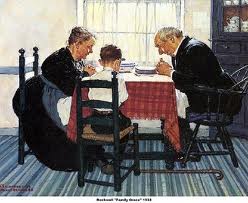
    Family Grace - Norman RockwellLast year at this time I reflected on the well-known Thanksgiving hymn: We Gather Together. Even unbelievers in these places of Thanksgiving tradition may briefly hope for some gathering such as the Rockwellesque images of families (yes families: husband and wife, sons and daughters) gathered together to thank God for one great Turkey dinner (with all the trimmings and treats).

    The traditions of thanking God for our blessings acknowledge by our humility, that we remain in debt daily to a Power higher than ourselves for our very life and existence. God IS and God provides.

    By the higher Authority of God the King is made King (the President is made President and the Prime Minister made Prime Minister). No man or woman, even those in highest authority on earth, is in charge of the blessings of God – and for this we give thanks.

    David, King of Israel, which God would judge and destroy into a remnant for a time, gave thanks to God. (You may be familiar with some of David’s many Psalms of thanksgiving.)

    The Book of Samuel records the thanks given by David to God for delivering him out of the hands of his enemies. We should be so thankful for the same so much more often; for God has many enemies among the heathens, as do the faithful of Christ Jesus.

    2 Samuel 22

    “The Lord is my rock and my fortress and my deliverer,
    3 my God, my rock, in whom I take refuge,
    my shield, and the horn of my salvation,
    my stronghold and my refuge,
    my savior; you save me from violence.
    4 I call upon the Lord, who is worthy to be praised,
    and I am saved from my enemies.

    Is there any question who David is thanking for his life – for his deliverance from Saul? David thanks God. David praises the Lord for saving him. David takes refuge in God. Do you?

    8 “Then the earth reeled and rocked;
    the foundations of the heavens trembled
    and quaked, because he was angry.

    14 The Lord thundered from heaven,
    and the Most High uttered his voice.
    15 And he sent out arrows and scattered them;
    lightning, and routed them.

    Would you want to anger the Living God?

    Would it not behoove us to rather give thanks to the Creator of all the heavens and earth, who is mighty to save the indefensible man of this flesh?

    18 He rescued me from my strong enemy,
    from those who hated me,
    for they were too mighty for me.
    19 They confronted me in the day of my calamity,
    but the Lord was my support.
    20 He brought me out into a broad place;
    he rescued me, because he delighted in me.
    21 “The Lord dealt with me according to my righteousness;
    according to the cleanness of my hands he rewarded me.
    22 For I have kept the ways of the Lord
    and have not wickedly departed from my God.

    Will the Living God not reward the righteousness of His servants – those who give thanks to Him?

    26 “With the merciful you show yourself merciful;
    with the blameless man you show yourself blameless;
    27 with the purified you deal purely,
    and with the crooked you make yourself seem tortuous.
    28 You save a humble people,
    but your eyes are on the haughty to bring them down.

    47 “The Lord lives, and blessed be my rock,
    and exalted be my God, the rock of my salvation,
    48 the God who gave me vengeance
    and brought down peoples under me,
    49 who brought me out from my enemies;
    you exalted me above those who rose against me;
    you delivered me from men of violence.

    50 “For this I will praise you, O Lord, among the nations,

    and sing praises to your name.

    51 Great salvation he brings to his king,
    and shows steadfast love to his anointed,
    to David and his offspring forever.”

    The word, ‘thanks,’ given by David demonstrates an imagery even beyond the scope of our discussion which further explains other verses of this psalm in 2 Samuel. The traditions of giving thanks to God go back as far as Adam and forward beyond the example of Jesus Christ until this day.

    Even many Christians giving thanks at Thanksgiving will not know even the meaning of ‘thanks’ as spoken by our Lord and God, Christ Jesus. In this word you will see the deeper significance of Thanksgiving in the community and family of Christ Jesus.

    eucharisteō – eucharist or communion

    Matthew 26

    NKJV

    26 And as they were eating, Jesus took bread, blessed and broke it, and gave it to the disciples and said, “Take, eat; this is My body.”

    27 Then He took the cup, and gave thanks,

    and gave it to them, saying, “Drink from it, all of you. 28 For this is My blood of the new covenant, which is shed for many for the remission of sins.

    29 But I say to you, I will not drink of this fruit of the vine from now on until that day when I drink it new with you in My Father’s kingdom.”

    30 And when they had sung a hymn, they went out to the Mount of Olives.


    Yes, our Lord and Savior, Christ Jesus, gave thanks to God the Father for His own sacrifice about to take place for your sins and for mine.

    Gratitude – The quality of being thankful; readiness to show appreciation for and to return kindness. Jesus gave thanks to God. Jesus showed His readiness to show appreciation for the kindness of God our Father to save whose God loves from the deserved wrath of sin. This is the new testament, the new covenant of love with God.

    It is God’s love and provision for which we give thanks in communion, in the breaking of the bread, in our daily lives (hopefully), and also as celebration of just one Thursday in one month of one year of one mortal live given to us by God.

    From Adam to Noah to David to Christ Jesus; to you and me, and until the Kingdom is proclaimed in the highest heavens: we will give thanks to God.

    Revelation 11: NKJV

    Seventh Trumpet: The Kingdom Proclaimed

    15 Then the seventh angel sounded: And there were loud voices in heaven, saying, “The kingdoms of this world have become the kingdoms of our Lord and of His Christ, and He shall reign forever and ever!”

    16 And the twenty-four elders who sat before God on their thrones fell on their faces and worshiped God, 17 saying:

    “We give You thanks, O Lord God Almighty,
    The One who is and who was and who is to come,
    Because You have taken Your great power and reigned.

    18 The nations were angry, and Your wrath has come,
    And the time of the dead, that they should be judged,

    And that You should reward Your servants the prophets and the saints,
    And those who fear Your name, small and great,
    And should destroy those who destroy the earth.”

    gloria

     let us give thanks


  • A Vineyard

    A Vineyard

    Now will I sing to my wellbeloved

    a song of my beloved

    touching his vineyard.

    My wellbeloved hath a vineyard

    in a very fruitful hill:

    And he fenced it,

    and gathered out the stones thereof,

    and planted it

    with the choicest vine,

    and built a tower

    in the midst of it,

    and also made

    a winepress therein:

    and he looked

    that it should bring forth grapes,

    and it brought forth

    wild grapes.

    Isaiah 5:1-2 KJV

    ‘Ah, another song’ you say, after having just read the beautiful Song of Songs.

    Perhaps the beautiful bride comes to mind and what she might say in a wedding toast of her beloved bridegroom, her husband. Yet this lyric is more than that – much more.

    The preceding book of the Bible paints a seductive and loving picture of a woman seeking the love of Solomon.

     Song of Songs

    1:2 Let him kiss me with the kisses of his mouth: for thy love is better than wine.

    4:10 How fair is thy love, my sister, my spouse! how much better is thy love than wine! and the smell of thine ointments than all spices!

    5:1 I am come into my garden, my sister, my spouse: I have gathered my myrrh with my spice; I have eaten my honeycomb with my honey; I have drunk my wine with my milk: eat, O friends; drink, yea, drink abundantly, O beloved.

    How the loving wife desires her husband. How the fruit of the wedding becomes the celebration of the bride and of the bridegroom!

    But what has happened here in Isaiah, first of the books of the Prophets?

    Hear first, a young virgin bride praising her husband.

    Isaiah 5 ESV

    Let me sing for my beloved
    my love song concerning his vineyard:

    Yes, well ought the loving bride sing a love song of the anticipation of her beloved.

    My beloved had a vineyard
    on a very fertile hill.
    2 He dug it and cleared it of stones,
    and planted it with choice vines;
    he built a watchtower in the midst of it,
    and hewed out a wine vat in it;

    An idyllic photo of a bridegroom and husband-to-be. He has prepared a place for the woman of his love, the woman of his betrothal. He will live in this place with his a bride-to-be forever (‘until we are parted by death,’ say our solemn vows before witnesses).

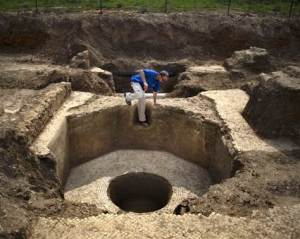
    100215-winepress-hmed-8a.grid-6x2The bridegroom planted a vineyard in the fertile place, digging it out for the day the grapes could be pressed into choice wine. It would take some time, but the bridegroom has done this for his bride. The bridegroom has set a watchtower over what he has claimed for his bride-to-be.

    On the side of a hill where grapevines grow a  wine vat hewn from stone  testifies to the groom preparing a place of permanence for his bride.

    Then (as so often happens in familiar romances) the song of love takes a tragic turn. The perspective of the groom – the bridegroom who has prepared all this for his beloved now laments over the unfaithfulness of his bride.

    and he looked for it to yield grapes,
    but it yielded wild grapes.

    The vineyard is the Lord’s! He has planted it. Jerusalem and Judah and the earth are His – He has planted it.

    Listen now to the Groom:

    3 And now, O inhabitants of Jerusalem
    and men of Judah,
    judge between me and my vineyard.
    4 What more was there to do for my vineyard,
    that I have not done in it?
    When I looked for it to yield grapes,
    why did it yield wild grapes?

    Isaiah continues (later) to tell of the rule of the Lord over the end of the earth.

    I ask you, dear brother, dear sister in the Lord – dear church, Bride of Christ Jesus – have you become a ‘wild grapevine’ in the garden of the Lord?

    Isaiah 24:

    Behold, the Lord will empty the earth and make it desolate,
    and he will twist its surface and scatter its inhabitants…

    7 The wine mourns,
    the vine languishes,
    all the merry-hearted sigh.
    8 The mirth of the tambourines is stilled,
    the noise of the jubilant has ceased,
    the mirth of the lyre is stilled.
    9 No more do they drink wine with singing;
    strong drink is bitter to those who drink it.
    10 The wasted city is broken down;
    every house is shut up so that none can enter.
    11 There is an outcry in the streets for lack of wine;
    all joy has grown dark;
    the gladness of the earth is banished.
    12 Desolation is left in the city;
    the gates are battered into ruins.

    13 For thus it shall be in the midst of the earth
    among the nations,
    as when an olive tree is beaten,
    as at the gleaning when the grape harvest is done.

    Was the righteous olive tree, Christ Jesus, not beaten for your sins?

    Will the Lord of all the earth not give the Son of Righteousness reign and judgement over all the earth?

    Does the Song of the Vineyard of Isaiah, Prophet who so accurately foresaw the life of Christ Jesus as God Incarnate, not seem somewhat familiar from a parable of Jesus?

    Mark 12: And he began to speak to them in parables.

    “A man planted a vineyard and put a fence around it and dug a pit for the winepress and built a tower, and leased it to tenants and went into another country. 2 When the season came, he sent a servant to the tenants to get from them some of the fruit of the vineyard. 3 And they took him and beat him and sent him away empty-handed. 4 Again he sent to them another servant, and they struck him on the head and treated him shamefully. 5 And he sent another, and him they killed. And so with many others: some they beat, and some they killed.

    6 He had still one other, a beloved son. Finally he sent him to them, saying, ‘They will respect my son.’

    7 But those tenants said to one another, ‘This is the heir. Come, let us kill him, and the inheritance will be ours.’

    8 And they took him and killed him and threw him out of the vineyard. 9 What will the owner of the vineyard do? He will come and destroy the tenants and give the vineyard to others.

    O, beloved Bride of Christ:

    Have we thrown the beloved Son out of the vineyard?

    What will the Owner surely do?

    Did our Lord not warn us (wild vines worshiping whatever we would)?

    John 15 KJV

    1 I am the true vine, and my Father is the husbandman.

    2 Every branch in me that beareth not fruit he taketh away: and every branch that beareth fruit, he purgeth it, that it may bring forth more fruit.

    3 Now ye are clean through the word which I have spoken unto you.

    4 Abide in me, and I in you. As the branch cannot bear fruit of itself, except it abide in the vine; no more can ye, except ye abide in me.

    5 I am the vine, ye are the branches: He that abideth in me, and I in him, the same bringeth forth much fruit: for without me ye can do nothing.

    O beloved Bride, vineyard of the Bridegroom, betrothed of the King of Righteousness:

    Do you abide in the life of Christ Jesus?

    Surely He will return to the vineyard. Will the Bridegroom not expect grapes, and not wild grapes? Will the One who has prepared a place for his Bride not throw into the fire the one who would not wait for the Bridegroom’s on the clouds?

    Will the Lord not take with Him only the faithful Bride?