Tag: God

  • Resurrection Before Jesus

    Resurrection Before Jesus

    Jesus Raises a Widow’s Son

    Nain Galileenain mapLuke 7:11 Soon afterward he went to a town called Nain, and his disciples and a great crowd went with him.

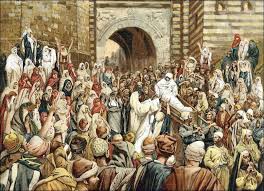
    12 As he drew near to the gate of the town, behold, a man who had died was being carried out, the only son of his mother, and she was a widow, and a considerable crowd from the town was with her.

    (Recall that Jesus had told the people of Nazareth of Elijah being sent to a widow outside of Israel.)

    13 And when the Lord saw her, he had compassion on her and said to her, “Do not weep.” 14 Then he came up and touched the bier, and the bearers stood still.
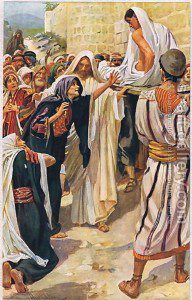
    The-Widow-Of-Nain,-1927And he said, “Young man, I say to you,arise.” 15 And the dead man sat up and began to speak, and Jesus gave him to his mother.

    Imagine… get the picture. A widow no longer has a husband to support her. A woman cannot (in this culture or most) support even herself. A son becomes responsible for taking care of his mother; but the son himself is sick and dies.

    It is a picture of hopelessness for this widow of Nain.

    Yet as the providence of God would have it, Jesus, God Emmanuel walks into town just as all wail for her great loss at the funeral. Jesus has compassion for her, touches the unclean bier with the unclean dead body of her son. He sits up!

    16 Fear seized them all, and they glorified God, saying, “A great prophet has arisen among us!” and “God has visited his people!”

    17 And this report about him spread through the whole of Judea and all the surrounding country.

    It is the same compassion by which he has fed the multitudes and healed the sick (even from a distance); yet this time Jesus has done that which cannot be done without the Hand of God. He has resurrected a dead man.

    (There is a precedent the Jewish crowds would know well from a town of old nearby.)

    A woman once perceived another Prophet of God.

    2 Kings 4:

    Elisha and the Shunammite Woman

    Shumen map8 One day Elisha went on to Shunem, where a wealthy woman lived, who urged him to eat some food. So whenever he passed that way, he would turn in there to eat food.

    9 And she said to her husband, “Behold now, I know that this is a holy man of God who is continually passing our way. 10 Let us make a small room on the roof with walls and put there for him a bed, a table, a chair, and a lamp, so that whenever he comes to us, he can go in there.”

    11 One day he came there, and he turned into the chamber and rested there. 12 And he said to Gehazi his servant, “Call this Shunammite.” When he had called her, she stood before him. 13 And he said to him, “Say now to her, ‘See, you have taken all this trouble for us; what is to be done for you? Would you have a word spoken on your behalf to the king or to the commander of the army?’” She answered, “I dwell among my own people.”

    (The woman is content to have the blessing of showing hospitality to a true Prophet of God.)

    14 And he said, “What then is to be done for her?” Gehazi answered, “Well, she has no son, and her husband is old.”

    (Again, as we have just seen in the story of Jesus, a widow has great need of a man to take care of her. The woman and old man have no son, considered to be a blessing to a faithful family of God.)

    15 He said, “Call her.” And when he had called her, she stood in the doorway. 16 And he said, “At this season, about this time next year, you shall embrace a son.” And she said, “No, my lord, O man of God; do not lie to your servant.” 17 But the woman conceived, and she bore a son about that time the following spring, as Elisha had said to her.

    What a joy for a woman to conceive a child, especially the miracle of conceiving after the age of traditional childbirth as demonstrated by several important faithful women of God throughout the many generations of the Bible. Such births are always witness to the power of God to bring forth life where there cannot be life (by the world’s ordinary standards).

    It seems like a conclusion of God’s story of witness; but like Jesus, Elisha travels from place to place as God instructs and this chapter of Elisha’s miracles is more like a conclusion of ‘Act One’ for this couple blessed by the Prophet. Elisha’s room is always ready for his unannounced return.

    18 When the child had grown, he went out one day to his father among the reapers. 19 And he said to his father, “Oh, my head, my head!” The father said to his servant, “Carry him to his mother.” 20 And when he had lifted him and brought him to his mother, the child sat on her lap till noon, and then he died.

    Tragic. Yet a God who can bring life to a lifeless womb can restore life where and when the Lord pleases. We see now a remarkable faith of this woman (similar to that of the Roman centurion).

    21 And she went up and laid him on the bed of the man of God and shut the door behind him and went out. 22 Then she called to her husband and said, “Send me one of the servants and one of the donkeys, that I may quickly go to the man of God and come back again.” 23 And he said, “Why will you go to him today? It is neither new moon nor Sabbath.” She said, “All is well.” 24 Then she saddled the donkey, and she said to her servant, “Urge the animal on; do not slacken the pace for me unless I tell you.” 25 So she set out and came to the man of God at Mount Carmel.

    When the man of God saw her coming, he said to Gehazi his servant, “Look, there is the Shunammite. 26 Run at once to meet her and say to her, ‘Is all well with you? Is all well with your husband? Is all well with the child?’” And she answered, “All is well.”

    ‘All is well,’ answers the woman whose only son has just died in her arms?

    27 And when she came to the mountain to the man of God, she caught hold of his feet. And Gehazi came to push her away. But the man of God said, “Leave her alone, for she is in bitter distress, and the Lord has hidden it from me and has not told me.”

    Now, the grieving mother pleads to the Prophet:

    28 Then she said, “Did I ask my lord for a son? Did I not say, ‘Do not deceive me?’”

    Like Jesus did in Nain, Elisha shows compassion for the woman.

    29 He said to Gehazi, “Tie up your garment and take my staff in your hand and go. If you meet anyone, do not greet him, and if anyone greets you, do not reply. And lay my staff on the face of the child.” 30 Then the mother of the child said, “As the Lord lives and as you yourself live, I will not leave you.” So he arose and followed her. 31 Gehazi went on ahead and laid the staff on the face of the child, but there was no sound or sign of life. Therefore he returned to meet him and told him, “The child has not awakened.”

    32 When Elisha came into the house, he saw the child lying dead on his bed. 33 So he went in andshut the door behind the two of them and prayed to the Lord. 34 Then he went up and lay on the child, putting his mouth on his mouth, his eyes on his eyes, and his hands on his hands. And as he stretched himself upon him, the flesh of the child became warm. 35 Then he got up again and walked once back and forth in the house, and went up and stretched himself upon him. The child sneezed seven times, and the child opened his eyes. 36 Then he summoned Gehazi and said, “Call this Shunammite.” So he called her. And when she came to him, he said, “Pick up your son.” 37 She came and fell at his feet, bowing to the ground. Then she picked up her son and went out.

    This is but one demonstration of God’s power over life and death (the only one through the great Prophet Elisha). It is one of many demonstrations of God’s miraculous power to heal, even unto life. Jesus would, in addition to His own later resurrection after three days, raise a man from the dead as beloved to Him as this woman’s family must have been to Elisha: Lazarus.

    Later, Jesus is challenged by the Sadducees of the Temple of Herod about the resurrection. The witness of the Shunammite family at the time of Elisha was certainly recorded in their own Bibles! The evidence of Jesus’ miracles must certainly have been in evidence by many witnesses to all; yet they did not believe.

    Oh, you of little faith…

    Jesus said: “I am the resurrection and the life. Whoever believes in me, though he die, yet shall he live.

    How is your faith? Do you believe in life through Christ Jesus? Is He your Lord by faith?

    Blessed be the God and Father of our Lord Jesus Christ! According to his great mercy, he has caused us to be born again to a living hope through the resurrection of Jesus Christ from the dead. –


    1 Peter 1:3-4


  • The Fruit of Good Advice

    The Fruit of Good Advice

    Luke 6:36 KJV Be ye therefore merciful, as your Father also is merciful.

    Jesus has been giving advice to the multitudes, especially those who will hear His advice, overflowing with proverbs and parables for our daily life.

    Will we choose blessing (‘Happy are you…’)? We call them the beatitudes. OR will we choose curse? Jesus gives the multitudes choices (including repentance) which we must make. In fact (as we just read in Luke 6:27-35) Jesus has told us how we must love even our enemies.

    The Apostle John has emphasized so often the love of God through Christ Jesus, as “our Father” that we may have missed in the verse above this first reference of the Gospel of Luke to calling God our Father, as Christ Jesus has just said to the multitudes after giving out all the good advice of the sermon on the mount.

    Therefore, you be merciful, as your Father God is also merciful.

    Yes, the Beatitudes and parables are a call to blessings from God – a call to do good and not evil – a call to receive God’s blessing and not curse; but Jesus points out that His teaching is more than that. Christ Jesus, Son of God and Son of Man teaches with authority that WE have through Him a relationship of family – a relationship of familiarity (as a son or daughter has of their own father) – a relationship of love (capable of both discipline and mercy). What will you choose?

    Before the Son of Man, the Prophets gave advice to God’s people – good advice AND warning. The people did not often listen (or perhaps they feared and listened for a time and then fell away from the Lord). What then, was the advice from God (through the Prophets)? REPENT! Turn back from your evil ways to the LORD your God. He is a God of mercy IF you will repent of your sin and turn back to His blessings.

    Before the Kings and the Prophets, God led His chosen people, His chosen family, Holy to the Lord; the LORD God had a relationship with His faithful family members (though they were a stiff-necked people). The LORD led His chosen ones out of the slavery and evil of Egypt. The LORD led His family through the Sea of Reeds and through the barren wilderness. The LORD saved them and blessed them and gave His chosen family His Law – He IS a personal Father to His people.

    Yet the people feared the Lord and could not stand in His Holy Presence; therefore the LORD appointed Moses as His Prophet and Aaron as His Priest to stand between His Almighty Holiness and the many sins of His people.

    Repentance and Forgiveness

    “And when all these things come upon you, the blessing and the curse, which I have set before you, and you call them to mind among all the nations where the Lord your God has driven you, 2 and return to the Lord your God, you and your children, and obey his voice in all that I command you today, with all your heart and with all your soul, 3 then the Lord your God will restore your fortunes and have mercy on you, and he will gather you again from all the peoples where the Lord your God has scattered you.

    5 “See, I have set before you today life and good, death and evil. 16 If you obey the commandments of the Lord your God that I command you today, by loving the Lord your God, by walking in his ways, and by keeping his commandments and his statutes and his rules, then you shall live and multiply, and the Lord your God will bless you in the land that you are entering to take possession of it.

    17 But if your heart turns away, and you will not hear, but are drawn away to worship other gods and serve them, 18 I declare to you today, that you shall surely perish.

    And though our Father God had shown great mercy to His people and great patience for the generations who opposed His righteous rule over His own family, the people fed by the hand of the Lord in the wilderness often chose curse and not blessing. His stiff-necked self-serving children refused to worship the Lord our God and Father.

    My child, don’t reject the LORD’s discipline,
    and don’t be upset when he corrects you. – 
    Proverbs 3:11 NLT 

    The call of God to His children through Moses, through the Proverbs of His Kings and through the personal teaching of our personal Savior Christ Jesus, the only Son of God is a call to the Perfect love of the Holy Father of all creation. Jesus calls us to relationship through His Authority and love.

    So in concluding His Sermon on the Mount, Jesus in effect asks us (by referring to our Father’s mercy): will you listen to your Father?

    It is with both the Authority and love of the Father that Jesus taught those on the hillsides and in the towns to REPENT.

    An IF NOT, what therefore?

    Certainly hell and damnation; but Jesus has more to say on our free choice of curse over blessing given through His mercy.

    To be continued…


  • The Multitudes He Did Not Serve

    The Multitudes He Did Not Serve

    Sometimes we just don’t get it. We only want to see the nice things Jesus did. We only want to hear the nice things Jesus had say and even now speaks through Scripture and the Spirit.

    In case you missed the beginning of this series, we are following the early days of Jesus’ public ministry. We have looked at His early calling of the people to repentance and followed Jesus to his rejection (and near murder) by the people of Nazareth.

    Doctor Luke records in chapters 5 and 6 a list of some of Jesus’ early miracles. (How we use these all-too-frequently to attract the multitudes to our church buildings! The bigger the blessings for the multitudes, the bigger the building we need.)

    I related an often used part of a favorite teaching of Jesus in an Advent preparation series on The Beatitudes. Oh how we love to point out the miracles of His feeding the 5000 and the feeding the 4000; while we forget that Jesus’ message is to REPENT! Turn back to God, our Father. He sends us the bread from Heaven. Jesus is the Bread of Heaven. His Word is what we MUST digest.

    “Blessed are you… Happy are you: This we want to hear. 🙂

    We turn now to Luke 6.

    Jesus has been preaching repentance. He has performed many miracles. He has shown compassion for many individuals and even compassion for the hungry crowds.

    People will follow Jesus anywhere, IF only He will keep performing miracles for them. (You remember, his own neighbors and friends in Nazareth were angry enough at Jesus to want to throw Jesus off the cliff to His death.) Why? We want to be entertained. We want blessings and not curses. We want proof.  (Forget faith!) He would NOT perform for the multitudes of for even his hometown neighbors and family.

    Jesus of Nazareth - Tyre to the N. - Israel, Judea map
    Jesus of Nazareth – Tyre to the N. – Israel, Judea map


    Jesus Ministers to a Great Multitude

    17 And he came down with them and stood on a level place, with a great crowd of his disciples and a great multitude of people from all Judea and Jerusalem and the seacoast of Tyre and Sidon, 18 who came to hear him and to be healed of their diseases. And those who were troubled with unclean spirits were cured. 19 And all the crowd sought to touch him, for power came out from him and healed them all.

    [Here is the nice part we all love:]

    The Beatitudes

    20 And he lifted up his eyes on his disciples, and said:

    “Blessed are you who are poor, for yours is the kingdom of God.

    21 “Blessed are you who are hungry now, for you shall be satisfied.

    “Blessed are you who weep now, for you shall laugh.

    22 “Blessed are you when people hate you and when they exclude you and revile you and spurn your name as evil, on account of the Son of Man! 23 Rejoice in that day, and leap for joy, for behold, your reward is great in heaven; for so their fathers did to the prophets.

    Amen! Yes, we need this Jesus.

    (Lord bring us a miracle and bring us your reward. Prove you Power to us and we will follow You.)

    Ah, but you with ears to hear, hear what Jesus says next:

    Jesus Pronounces Woes

    24 “But woe to you who are rich, for you have received your consolation.

    25 “Woe to you who are full now, for you shall be hungry.

    “Woe to you who laugh now, for you shall mourn and weep.

    26 “Woe to you, when all people speak well of you, for so their fathers did to the false prophets.

    So you want to be rich, do you? You want Jesus to bless your house with plenty and laughter and good reputation for you and your family… Are you sure? Do you really want it all NOW?

    Dear brothers and sisters of His church, of the multitudes of christians;

    Hear what you do not recall (and I will shorten it for our short memories; but read it all, if you will:)

    Love Your Enemies

    27 “But I say to you who hear, Love your enemies, do good to those who hate you, 28 bless those who curse you, pray for those who abuse you.

    Have you been abused? Sexually? Physically?  Verbally? Financially? Emotionally?

    Do some hate you? (Certainly a fellow believer or sister who claims Christ ought not?)

    LOVE THEM.

    Though they are your enemies, love them. That is what Christ Jesus commands. (Are you still with us, christian of the crowds and multitudes?)

    What is this ‘love’ to which Jesus (IF He IS our Lord) calls us?

    • Welcome them (perhaps into your homes, but certainly into your life. (How else will they see Christ in you?)
    • Entertain them. No, not like TV or a sport or your cell phone; just do not ignore your enemies as if they are not real people created by God, perhaps for a later winning into His Kingdom.
    • Be fond of them. Admit it; you know people who are enemies of Christ Jesus whom you admire and like. Are they not also deserving as you of His love as shown through you?
    • Love them dearly. Yes, your enemy; that the love of Christ Jesus may shine into the darkness of their life.

    Not only, “love them,” do good to them.

    Sure, we all remember the story of the good Samaritan; but Jesus’ point was not so much that a hated man did good for a man, but that men (and women) who claim to be “good” do not often do the good act of mercy, as had the Samaritan unbeliever. Therefore Jesus continues in Luke 6:32

    32 “If you love those who love you, what benefit is that to you? For even sinners love those who love them. 

    33 And if you do good to those who do good to you, what benefit is that to you? For even sinners do the same…  35 But love your enemies, and do good, and lend, expecting nothing in return, and your reward will be great, and you will be sons of the Most High, for he is kind to the ungrateful and the evil. 

    36 Be merciful, even as your Father is merciful.

    Jesus’ personal love is also personal love for the unbeliever and for the unsaved, as you and I were once unsaved and an enemy of God (though our profession may have been false and our faith rebellious).

    REPENT! Show mercy, as our Heavenly Father has shown us mercy.

    and LOVE, as Christ Jesus has loved us.

    For if, when we were enemies, we were reconciled to God by the death of his Son, much more, being reconciled, we shall be saved by his life. – Romans 5:10 KJV

    No, repentance is not such a bad message for each of us; therefore, be reconciled to your brother in Christ. Be reconciled to your sister in Christ. Be reconciled even to your enemy! Love them.

    And just two additional things (from Luke 6:27) added next in v. 28:

    28 bless those who curse you, pray for those who abuse you.

    Abuse (of all kinds and of varying degrees) is a terrible thing, an offense between two human beings, both created by God. The word often translated ‘abused’ by this and other versions of the Bible in the KJV reads: “them which spitefully use (you).” It is a better translation (unencumbered by the world’s spin on the meaning). Listen to the meaning from Jesus’ words:

    Outline of Biblical Usage

    1. to insult

    2. to treat abusively, use despitefully

    3. to revile

    4. in a forensic sense, to accuse falsely

    5. to threaten

    ALL of these are abuses of the enemy; and the enemy is Satan. Do you use these spitefully in retaliation against those who spitefully use you? Do you respond to your enemies (or even a brother or sister in Christ) in a spiteful way?

    Stop it! Jesus commands us: LOVE them. DO good to them. BLESS them. (and here is the hard one for us:) PRAY for them.
    Oh how I pray for enemies who have spitefully used me. One of them may be you… or your loved one.
    I pray that they will repent.
    I pray that they might confess their sin and turn back to God (that’s what repent means, you know; turn back).
    I pray that they might be that lost sheep.
    I pray that they might be that one you never believed would REPENT and hear the word of Jesus over the hatred and ways of the world and the sin of who we also once were before He also saved us.
    Oh, dear one, REPENT of your sin. I pray for you.
    Pray also for me.
    Forgive us our trespasses,
    As we forgive those who trespass against us.
    Are our enemies not our worst offenders?
    Forgive us, for the many times we, too have been an enemy of our Lord, Christ Jesus who teaches us:
    Pray for our enemies.
    +