1 Timothy 5:1 Do not rebuke an older man but encourage him as you would a father…
I recently had an unfortunate experience of misunderstanding at a time when I needed encouragement from a brother or sister in the Lord or anyone else.
If you look closely above my own smile you will see much white hair. 🙂 Yes, in some instances (even if I don’t like to admit to all of my 6+ decades) I am an older man.
Of course, none of us likes rebuke. As parents we have given many rebukes of improper behavior to our children. As husbands, we have heard proper rebuke from our own wife (and they, from us). IN THE LORD, with His love I would hope.
Just yesterday I had to rebuke a young man for a wrong attitude toward Christ. He said, “We go to church, etc., as an excuse of calling themselves ‘christians’ like those faithful to Christ Jesus by the truth of the fruit of our lives. My point to him was that “We are the church, etc.” and must live as Christ commands and live by His higher standards for us.
Paul writes to Timothy of these higher standards for our lives.
Christians are NOT supposed to look and behave like just anybody. We must be a man like Christ or a woman like Christ in our relationships to others — especially other Christians — our new family and His.
Take a look at some of these standards for the church, that is: you and me.
1 Timothy 5
Instructions for the Church
Do not rebuke an older man but encourage him as you would a father, younger men as brothers, 2 older women as mothers, younger women as sisters, in all purity.
3 Honor widows who are truly widows. 4 But if a widow has children or grandchildren, let them first learn to show godliness to their own household and to make some return to their parents, for this is pleasing in the sight of God. 5 She who is truly a widow, left all alone, has set her hope on God and continues in supplications and prayers night and day, 6 but she who is self-indulgent is dead even while she lives. 7 Command these things as well, so that they may be without reproach. 8 But if anyone does not provide for his relatives, and especially for members of his household, he has denied the faith and is worse than an unbeliever.
“Everyone needs compassion, a love that’s never failing…”
During difficult times I nearly weep at the very hearing of those words.
Think of all the deserted older men and older women in nursing homes at this time of the year. Their grown children (even christian children) often abandon them in favor of the hustle and bustle and worldly priorities of their own lives. Once, we took care of our aging moms and dads in our own homes as long as we were physically able. We sacrificed and honored our mother and our father all the days of our lives.
Once, christians honored marriage and would never break up a home for their own ends (let alone continue to call themselves christians); but now christian divorce, hated by God, rebuked by Jesus, and a breaking of our own covenant to God and witnesses “until we are parted by death,” is as prevalent as with those who would never claim Christ as Lord. Our Christian marriages are the very symbol of Christ’s relationship He desires for His bride, the church. [SEE: Ephesians 5: ]
Ephesians 5: 31 “Therefore a man shall leave his father and mother and hold fast to his wife, and the two shall become one flesh.”
32 This mystery is profound, and I am saying that it refers to Christ and the church.
33 However, let each one of you love his wife as himself, and let the wife see that she respects her husband.
As you, dear Christian brother, dear Christian sister, approach this turning of the year from the passing old to the new, consider the nature of how we are called to have changed by our taking up the cross to follow Jesus Christ, to witness His love in our relationships with others and by our own personal shining example to all others.
Colossians 3
Put On the New Self
If then you have been raised with Christ, seek the things that are above, where Christ is, seated at the right hand of God.2 Set your minds on things that are above, not on things that are on earth. 3 For you have died, and your life is hidden with Christ in God. 4 When Christ who is your life appears, then you also will appear with him in glory.
5 Put to death therefore what is earthly in you: sexual immorality, impurity, passion, evil desire, and covetousness, which is idolatry. 6 On account of these the wrath of God is coming.
7 In these you too once walked, when you were living in them. 8 But now you must put them all away: anger, wrath, malice, slander, and obscene talk from your mouth.
9 Do not lie to one another, seeing that you have put off the old self with its practices 10 and have put on the new self, which is being renewed in knowledge after the image of its creator…
12 Put on then, as God’s chosen ones, holy and beloved, compassionate hearts, kindness, humility, meekness, and patience,13 bearing with one another and, if one has a complaint against another, forgiving each other; as the Lord has forgiven you, so you also must forgive.
14 And above all these put on love, which binds everything together in perfect harmony. 15 And letthe peace of Christ rule in your hearts, to which indeed you were called in one body.
And be thankful. 16 Let the word of Christ dwell in you richly, teaching and admonishing one another in all wisdom, singing psalms and hymns and spiritual songs,with thankfulness in your hearts to God. 17 And whatever you do, in word or deed, do everything in the name of the Lord Jesus, giving thanks to God the Father through him.
Rules for Christian Households
18 Wives, submit to your husbands, as is fitting in the Lord.
19 Husbands, love your wives, and do not be harsh with them.
20 Children, obey your parents in everything, for this pleases the Lord.
21 Fathers, do not provoke your children, lest they become discouraged…
23 Whatever you do, work heartily, as for the Lord and not for men, 24 knowing that from the Lord you will receive the inheritance as your reward.
You are serving the Lord Christ. 25 For the wrongdoer will be paid back for the wrong he has done, and there is no partiality.
My dear, beloved family of Christ Jesus,
We live a new life of sacrifice and obedience to scripture, truthfulness of our word, and witness to our Lord and Savior, who offered Himself as acceptable sacrifice for our many sins. Do not live, dear brother, dear sister, in your over-bearing selfishness of your own flesh. Humble yourselves before our Groom, you His church and His Bride.
Be Holy, as our Lord is Holy.
Love one another, as I have loved you. – John 13:34

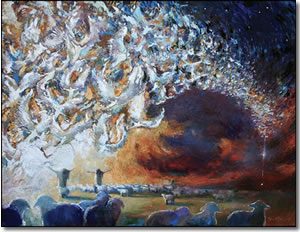 Here is revealed the identity of the babe in the manger: Jesus, heralded by angels and worshiped by shepherds and wise kings; Jesus, the babe smuggled into Egypt by Joseph to escape the sword of Herod; Jesus who would return to Nazareth of Galilee announced by John the Baptist, greatest of all Prophets.