The Gospel is Good News to all who will humbly accept Jesus and listen to His teaching.
We refer to the four books of the Bible which tell the story of Jesus Christ as the Gospels. These books are named for their authors: Matthew, a Jewish Apostle; Mark, a disciple of the first generation who recorded accounts of Peter and the Twelve; Luke, a gentile Physician and disciple of the first century; and John, one of the Twelve Jewish Apostles chosen by Jesus.
Now there was a man in Caesarea named Cornelius, a centurion of what was called the Italian [~600 man] cohort, a devout man and one who feared God with all his household, and made many charitable contributions to the Jewish people and prayed to God continually.
Who do we see here?
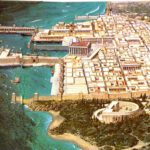
A Roman soldier in a navy town built by Caesar.
A devout humble worshipper of God.
A family man, leader of his household as well.
A generous man who gave to the Jews subjected to Roman rule, taxes and its army.
This is the Italian Centurion Κορνήλιος [Cornelius].
We have already read about the Angel he will encounter in ACTS 10:3
Learn more about angels by clicking on our previous post below.
“Now dispatch some men to Joppa and send for a man named Simon, who is also called Peter; he is staying with a tanner named Simon, whose house is by the sea.”
ACTS 10:5-6 [NASB20] of an Angel of God instructing Cornelius with his gospel message
Obedient immediate response to the gospel
7 The angel who spoke to Cornelius left.
Then Cornelius called two of his servants and a soldier. The soldier was a religious man, one of his close helpers.
8 Cornelius explained everything to these three men and sent them to Joppa.
NEXT: A most unlikely lunch meeting in Joppa
Comment on Scripture in our series from ACTS + Share the Gospelof Jesus Christ our Lord
Even in this 21st century in the year of our Lord, 2022, the Gospel of Jesus Christ has enemies. NO Good News where atheist leaders can prevent it.
But any map of the world will reveal MANY roads – paths for Good News to Damascus or ANY other city in the world where the LORD commands the Gospel to be proclaimed.
SO let’s travel as refugees to places of other languages (even IF it has been coerced by a path to suffer for the sake of Christ).
We’ll talk of JESUS’ evangelism model begun in the Apostles and now a command to Philip, one of Jerusalem’s first seven deacons in a moment. But first let’s review the setting of this semi-familiar scene of Philip baptizing an Ethiopian eunuch in (of all places), Gaza.
Acts of Evangelism by Christ’s disciples from Jerusalem’s Church
8: At that time a great persecution arose against the church which was at Jerusalem; and they were all scattered throughout the regions of Judea and Samaria, except the apostles.
This is Philip who served with Stephen in Jerusalem
4 Therefore those who were scattered went everywhere preaching the word.
5 Then Philip went down to the city of Samaria and preached Christ to them. And the multitudes with one accord heeded the things spoken by Philip, hearing and seeing the miracles which he did.
(We will get back to the contrast between Samaria and Gaza in a moment.)
The Apostles in Jerusalem sent Peter and John to those evangelizing the towns of Samaria.
.. they [Peter & John] returned to Jerusalem, preaching the gospel in many villages of the Samaritans.
An Angel of the Lord commands Philip: GO to Gaza
We don’t want to dismiss too quickly who sends Philip on his way from the big city of Samaria (then called, Sebastia (when rebuilt by Herod the Great) with its six thousand souls, to an uninhabited Gaza along the road from Jerusalem.
Two routes to the Gaza road along the Mediterranean shore
Luke does not use this description of just anyone.
Now an angel of the Lord appeared to him, standing to the right of the altar of incense. Zechariah [Priest of the LORD and father of John the Baptist] was troubled when he saw the angel, and fear gripped him. – Gospel of Luke 1:11-12
And an angel of the Lord suddenly stood near them, and the glory of the Lord shone around them; and they were terribly frightened. – Gospel of Luke 2:9 – from the nativity of the shepherds near Bethlehem .. (also not too far from here)
We know these instances well; however in Luke’s second account of the Acts of the Apostles the Angel of the Lord initiates some important ACTS of disciples of the Risen Christ Jesus.
Previously, our history of the Apostles imprisoned in Jerusalem has already witnessed one of these appearances of the Angel of the Lord. A praying church is astounded to see Peter and John released from prison and then returning to the Temple to preach the Gospel.
They laid hands on the apostles and put them in a public prison. But during the night an angel of the Lord opened the gates of the prison, and leading them out, he said, “Go, stand and speak to the people in the temple area the whole message of this Life.”
“Get ready and go south to the road that descends from Jerusalem to Gaza.” (This is a desert road.)
Acts of Philip, disciple of the Apostles, 8:26 NASB20
27 So he started out, and he met the treasurer of Ethiopia, a eunuch of great authority under the Kandake, the queen of Ethiopia. The eunuch had gone to Jerusalem to worship, and he was now returning.
Seated in his carriage, he was reading aloud from the book of the prophet Isaiah.
The Kandake, Queen of Ethiopia
Amanitaraqide appears to be the subject of a brief reference in the New Testament (Acts 8:27)
Amanitaraqide held the title of Kandake in the Kingdom of Kush during the years 21-41
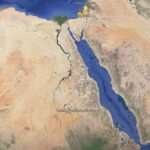
Nubia is a region along the Nile river encompassing the area between Aswan in southern Egypt and Khartoum in central Sudan. It was the seat of one of the earliest civilizations of ancient Africa, with a history that can be traced from at least 2500 BC onward, Kerma culture, and was home to several empires, most prominently the kingdom of Kush, which for a while even ruled over Egypt.
Before the 4th century, and throughout classical antiquity, Nubia was known as Kush, or, in Classical Greek usage, included under the name Ethiopia (Aithiopia).
[MAP above of this region along the Nile & descriptions: Source]
The eunuch, wearing expensive robes of a court official, rides in a royal chariot(reserved for only the highest officials of Rome and independent powerful kingdoms), would seem unapproachable by an ordinary man like Philip. For it seems this royal official would have been in Jerusalem on some important diplomatic mission as the queen’s personal representative.
If you think back to the status of Daniel in Babylon or even further back to this region of the Nile and the earned status of Joseph serving Pharaoh, you will get a good picture of the importance of this man to the highest leaders of his country.
Even in this A.D. 21st century most men like Philip (and you) would know very little about this distant country in Africa far from Jerusalem and further from Rome and the new world beyond the great ocean.
Ethiopia, like many lands, must hear the Gospel in many languages.
Graphic source: Oromo Bible Society O land, land, land, hear the word of the LORD!
No, the Ethiopian court official is not like Philip.
As a diplomat with power to travel the world on behalf of his queen, he will play an important role in the spreading of the Gospel. So after Philip obediently travels to Gaza, he discovers that this man is a brother, a Jew who studies Scripture! And here in Gaza he is returning home to Kush from worship of the LORD in Jerusalem.
(That’s right, the same Jerusalem from which Philip has fled; initially north to the city of Samaria, but now southwest of Jerusalem into the desert lands of Gaza.)
Studying Isaiah with a ‘missionary’ to Gaza
ACTS 8:
29 Then the Spirit said to Philip, “Go near and overtake this chariot.”
(Philip is on foot and has walked this distance from Samaria, but this is now a second command of the Spirit as he reaches the Gaza road.)
30 So Philip ran to him, and heard him reading the prophet Isaiah
Used to monitor number of Google Analytics server requests
10 minutes
__utmb
Used to distinguish new sessions and visits. This cookie is set when the GA.js javascript library is loaded and there is no existing __utmb cookie. The cookie is updated every time data is sent to the Google Analytics server.
30 minutes after last activity
__utmc
Used only with old Urchin versions of Google Analytics and not with GA.js. Was used to distinguish between new sessions and visits at the end of a session.
End of session (browser)
__utmz
Contains information about the traffic source or campaign that directed user to the website. The cookie is set when the GA.js javascript is loaded and updated when data is sent to the Google Anaytics server
6 months after last activity
__utmv
Contains custom information set by the web developer via the _setCustomVar method in Google Analytics. This cookie is updated every time new data is sent to the Google Analytics server.
2 years after last activity
__utmx
Used to determine whether a user is included in an A / B or Multivariate test.
18 months
_ga
ID used to identify users
2 years
_gali
Used by Google Analytics to determine which links on a page are being clicked
30 seconds
_ga_
ID used to identify users
2 years
_gid
ID used to identify users for 24 hours after last activity
24 hours
_gat
Used to monitor number of Google Analytics server requests when using Google Tag Manager
1 minute
_gac_
Contains information related to marketing campaigns of the user. These are shared with Google AdWords / Google Ads when the Google Ads and Google Analytics accounts are linked together.