Tag: Gospel

The Gospel is Good News to all who will humbly accept Jesus and listen to His teaching.

We refer to the four books of the Bible which tell the story of Jesus Christ as the Gospels. These books are named for their authors: Matthew, a Jewish Apostle; Mark, a disciple of the first generation who recorded accounts of Peter and the Twelve; Luke, a gentile Physician and disciple of the first century; and John, one of the Twelve Jewish Apostles chosen by Jesus.

  • The Last Word on Authority – Jesus Son of God

    The Last Word on Authority – Jesus Son of God

    John 19:

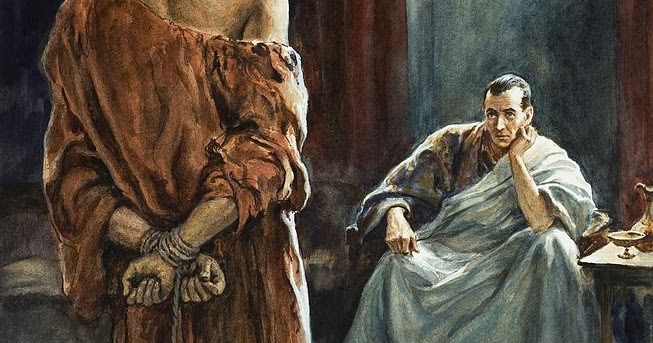
    Yesus facing Pilate

    Previously, Pilate had questioned Jesus apart from the crowds and asked if He is a king. Now, after having had Jesus scourged 39 times and coming out to the barely controlled crowds of Jerusalem, Pilate will question this ‘man’ a second time in his judge’s chambers within the palace.

    What has prompted Pilate’s new interrogation of Jesus?

    1. This ‘man’ kept silent during all 39 lashes, confessing no crimes to receive some mercy from the whip.
    2. When Rome’s Prefect had asked why Jesus should be crucified, the Jews answered Pilate, ‘.. because he made himself the Son of God.’

    Pilate may have also been a religious man, though as we pointed out previously the Romans had many gods.

    Could this man Jesus be one of them?

    In a private appeal

    Pilate said to Jesus, “Where are You from?” But Jesus gave him no answer. 10 So Pilate said to Him, “Are you not speaking to me?

    Do You not know that I have authority to release You, and I have authority to crucify You?”

    John 19:10b Pilate’s claim of authority to ‘the man’ Jesus

    Roman Authority

    Before we hear Jesus breaking the silence of Roman interrogation, let’s consider briefly an earlier encounter of Jesus in Galilee with a Roman officer.

    This healing by Jesus not only illustrates an absolute no questions asked authority of Roman Legions, but by his own high position, Pilate might have heard from this Roman leader who helped build a synagogue in Capernaum.

    Matthew 8:

    When He had come down from the mountain, great multitudes followed Him..

    Now when Jesus had entered Capernaum, a centurion came to Him, pleading with Him, saying, “Lord, my servant is lying at home paralyzed, dreadfully tormented.”

    And Jesus said to him, “I will come and heal him.”

    The centurion answered and said, “Lord, I am not worthy that You should come under my roof. But only speak a word, and my servant will be healed.

    For I also am a man under authority, having soldiers under me.

    And I say to this one, ‘Go,’ and he goes; and to another, ‘Come,’ and he comes; and to my servant, ‘Do this,’ and he does it.”

    When Jesus heard it, He marveled, and said to those who followed, “Assuredly, I say to you, I have not found such great faith, not even in Israel!

    Judean Authority

    Make no mistake about the authority of Rome’s governor Pontius Pilate. Rome revoked the kingdom of Herod Archelaus of Judah just two years after he failed to govern as Rome expected. They renamed the new Roman province Judea and placed a Roman Prefect in charge.

    Pilate governs with political authority similar to Antipas in Galilee to the north. Jesus of Nazareth is technically a subject of Herod Antipas. Pilate, however, may have heard of Jesus from a fellow Roman legion in the region of Galilee.

    Authority – Pilate’s understanding

    Pilate said to Him, .. Do You not know that I have authority to release You, and I have authority to crucify You?”

    ἐξουσία, the Greek word for authority simply means, power. I am in charge. I can do whatever I please.

    It could mean, I have influence and the privilege of judging you. In Pilate’s case, authority means: the power of rule or government (the power of him whose will and commands must be submitted to by others and obeyed). And specifically, the power of judicial decisions and authority to manage domestic affairs.

    And Jesus remains silent, Pilate must have thought? Silent even when scourged 39 times and questioned by the Prefect with authority to sentence the ‘Man’ to a Cross?

    Finally the Lord answers the authority of the governor in charge of this high Judean court.

    The Authority of Christ

    Jesus answered him, “You would have no authority over Me at all, if it had not been given to you from above..

    John 19:11a NASB

    Don’t miss this: Jesus in essence refers to a higher authority (from above).

    Pilate is a religious man with many gods. Rome acknowledges these higher authorities as had Greece. These are gods defined as: the leading and more powerful among created beings superior to man, spiritual potentates (that is, kings and Caesars).

    Again, perhaps Pilate has heard the buzz of the crowds witnessing Jesus healing the sick and even raising the dead. Romans kept close to the everyday happenings in Judea. Had he perhaps heard about the Galilean legion’s servant who Jesus healed?

    Some dilemma, that a human judge should judge a god!

    12 As a result of this, Pilate made efforts to release Him..

    A Greater Sin

    Perhaps, in a sense, Pilate considers or acknowledges the Higher Authority of Jesus. To some extent Jesus’ answer actually exonerates Pilate, but convicts another.

    Listen to the second part of the Lord’s answer to Pilate:

    Jesus answered him, “You would have no authority over Me at all, if it had not been given to you from above; for this reason the one who handed Me over to you has the greater sin.”

    John 19:11 NASB

    A greater sin than Pontius Pilate? For Christ-followers remember by our creeds the the Lord Jesus “was crucified also for us under Pontius Pilate?”

    Yet Jesus says that one who handed Him over to Pilate has the greater sin.

    Does the Lord mean to say that Pilate’s sin is forgivable? Perhaps.

    We assume here that Jesus refers to Judas Iscariot, who betrayed Him to the Jews, is the one with the greater sin.

    • Have you ever considered that Annas or Caiaphas are truly the ones who handed Jesus over to the gentiles?
    • These High Priests of the Jews handed Jesus over to Pilate for crucifixion.
    • Annas, Caiaphas and other Jewish officials of the Sanhedrin, who betray their own Messiah, have greater sins than Pilate!

    Had you have not known of the Highest Authority of Jesus until now, you may be forgiven for not knowing. But now that you know Jesus, you must accept Christ or oppose God Almighty.

    Who will rule over you now?

    Opposition to Authority

    12 As a result of this, Pilate made efforts to release Him; but the Jews shouted, saying,

    “If you release this Man, you are not a friend of Caesar;

    everyone who makes himself out to be a king opposes Caesar!”

    Pilate their Governor rules over those in the crowds and as Judea’s Governor. He appoints their religious authorities (who have consistently incited the crowds against the Authority of their Messiah) and outranks every member of the Sanhedrin in all civil matters.

    But the Jewish authorities cite a technical argument, not a religious reason – a political reason for Pilate to condemn their messianic opponent.

    • Jesus claims to be a king.
    • Caesar, a king and a god to the Romans also commands their loyalty.

    Will Pilate actually oppose the authority of Caesar by releasing a Man who makes claim as a king of the Jew?

    Of course, the Governor cannot allow the crowds to think that. Now he must sentence the Man. Rome’s judge returns Jesus to the public court of crowd justice.

    13 Therefore when Pilate heard these words, he brought Jesus out, and sat down on the judgment seat at a place called The Pavement—but in Hebrew, Gabbatha.

    From the hour of Jesus’ betrayal by Judas under cover of darkness in Gethsemane until now, these trials, interrogations and cruel punishments have all been completed by morning’s end.

    14 Now it was the day of preparation for the Passover; it was about the sixth hour..

    The Jewish Authorities Prevail

    No one likes to see the opposition win — not you, not me — and not even Pilate.

    But in fact, here it would seem that evil prevails. Evil destroys its opponent in the agenda of those religious leaders who have stoked the hatred of the crowds.

    So they shouted, “Away with Him, away with Him, crucify Him!” - John19:15 - collage of Jesus and Pilate with first and 21st century crowds

    Then he told the Jews, “Here is your king!” They shouted, “Take him away! Take him away! Crucify him!” Pilate said to them, “Should I crucify your king?”

    The chief priests answered,

    We have no king but Caesar.

    John 19:15b KJV

    16 Then delivered he him therefore unto them to be crucified. And they took Jesus, and led him away. KJV

    Who are ‘they’ who crucify Christ?

    We will explore the verdict, which would seem to suggest that the majority rules.

    Who crucified the Man of God, Christ Jesus? This we must ask NEXT as we follow Christ with His Cross to the skull where criminals hang from a tree.

    To be continued...

    Please subscribe to our new posts & COMMENT on this one.

  • What is Truth?

    What is Truth?

    Opinion Poll | Vote today:

    Which politician do you believe?

    Who will vote for Truth?

    A vile venom of political and religious rhetoric is nothing new under the sun in the 1st century A.D. or this 21st century.

    If you share any of my political views or religious convictions, you’ve likely been agitated by escalation of accusations in current events.

    We find many parallels in history, but none with more impact that a 1st. century trial of Jesus Christ by Jerusalem’s Roman governor, Pontius Pilate.

    Truth on Trial

    politics and religion - imaginary view of Roman temple of Jupiter
    1st c in the year of our Lord

    Previously in 2020..

    We have been following the Gospel (Good News) of John:

    ALL took place in 1st century Jerusalem in the brief span of one week!

    Continuing Jesus’ trials..

    Yesus facing Pilate

    Jesus said, “My kingdom is not of this world. If it were, my servants would fight to prevent my arrest by the Jewish leaders. But now my kingdom is from another place.”

    “You are a king, then!” said Pilate.

    Jesus answered, “You say that I am a king. In fact, the reason I was born and came into the world is to testify to the truth. Everyone on the side of truth listens to me.”

    “What is truth?” retorted Pilate. With this he went out again to the Jews gathered there…

    John 18:37-38a NIV

    Jesus has already been found guilty and tried by the Jewish leaders Annas and Caiaphas during the wakening hours of this day. Then they brought the Messiah to the governor Pilate, who has just questioned their prisoner in his own judge’s quarters (which the Jews would not enter).

    John 18:

    38 Pilate said to Him, “What is truth?”

    Now Pilate brings Jesus back into the public spotlight.

    And when he had said this, he went out again to the Jews and said to them, “I find no guilt in Him…

    What an amazing statement of truth!

    Prior to questioning Jesus in his Judge’s chambers, Pilate had already acquitted Jesus in public.

    What accusation do you bring against this Man?

    We read previously in Kings, Governors, Politicians & Priests 2 31 So Pilate said to them, “Take Him yourselves, and judge Him according to your law.”

    In effect, the Roman Governor of all the province of Judea acting as High Court Judge of Jerusalem tells them, ‘Case dismissed.’

    Now, after private questioning of Jesus about their accusation, Pilate once again finds Jesus, Not Guilty!

    But now begins the politics of playing the crowds.

    Justice by Public Opinion – a Poll of the people

    Once again, some time passes as the Jerusalem crowds gather for the preparation for the Passover feast. The buzz of the multitudes outside must have reminded Pilate of the great accolades for Jesus as He had approached Jerusalem just five days before.

    As Governor of Judea, Pilate also had to placate officials of the Sanhedrin who Jesus offended in the Temple courts on Monday.

    What’s a politically correct way to please the crowds who followed Jesus AND the Jewish leaders who help Pilate maintain the peace of Jerusalem?

    The Judge of Judea will show mercy to this innocent man.

    So the Prefect likely sent guards to the prison to bring a second previously condemned man to the governor near to Pilate’s position above the crowds. Now the Jews will see the truth of an innocent Man compared to an insurrectionist murderer like this prisoner Barabbas.

    “I find no grounds for charging him. 39 You have a custom that I release one prisoner to you at the Passover. So, do you want me to release to you the king of the Jews?”

    IF you didn’t already know the ending of this Good Friday, you might jump up and applaud Pilate’s political correctness.

    Everybody wins when the governor shows mercy. This powerful Roman governor of Judea seems to judge truth with great fairness.

    BUT, as you know, crowds may be easily swayed from doing what is right.

    40 They shouted back, “Not this man, but Barabbas!”

    Now Barabbas was a revolutionary.

    CSB

    John 19:1 Then Pilate took Jesus and had him flogged.

    To be continued...
    Page TWO - Please click Page 2 below for the questions.

    Yes, it’s a POLL

    Your political opinion about religion

    & politics A.D. 2020

    Pages: 1 2

  • Are You a King?

    Are You a King?

    Therefore Pilate entered again into the Praetorium, and summoned Jesus and said to Him,

    “Are You the King of the Jews?”

    John 18:33 NASB

    The Politically Charged Question

    Pilate interrogates Jesus by beginning privately with a loaded question.

    As Governor AND presiding judge (in chambers), the Prefect questions the defendant already declared guilty by the Jews, local leaders who have no authority in this Roman court of Judea.

    Pilate’s questions (to which he must have had prepared standard answers to usual responses) went to motive.

    • “What is your authority here?”
    • “Are you a threat to true authority, which as Governor I represent?”

    The Gospels do not record these words, but the timing and context of Jesus’ trial suggests to the Governor that he recognizes a political hot potato in dealing with this popular Rabbi during the religious festival of the Jews in Jerusalem.

    For further understanding of Pontius Pilate look back to: 
    1st century Rome – an awkward embrace of RELIGION & politics

    John 18:

    Very early that morning:

    praetorium in Jerusalem
    • As the Jewish officials brought Jesus to the exterior of the Praetorium Pilate came out to them.
    • .. and they themselves did not enter into the Praetorium so that they would not be defiled, but might eat the Passover.

    29 Therefore Pilate went out to them and said, “What accusation do you bring against this Man?”

    They answered and said to him, “If this Man were not an evildoer, we would not have delivered Him to you.”

    31 So Pilate said to them, “Take Him yourselves, and judge Him according to your law.”

    The Jews said to him, “We are not permitted to put anyone to death..”

    Sentenced to death by accusation

    We already know of the deceptive stealth of the Temple officials, ceasing Jesus at night then bringing the Messiah of Israel to trial before them.

    The Jews really had no authority in Judea and regardless of their predetermined verdict of guilt and sentence of death, Pilate dismisses their case. But now the politics come into play.

    These religious emissaries want to execute the man opposed to their religious positions of power, the Man who had ridden victorious into town on a donkey just a few days before, Jesus of Nazareth (a town not even in Pilate’s Judea).

    Although we seldom consider the passage of time within a single verse or two of scripture, consider this possibility in the scene about to take place:

    • Certainly the Jews with their prisoner Jesus on the outside and Pilate with his advisors inside the Praetorium must ponder what to do next.
    • Since Pilate is in charge of Jerusalem and responsible to Rome for any potential trouble, he makes the first move in trying to keep peace between the politics and religion of Jerusalem.

    Questions with political consequences

    33 Therefore Pilate entered again into the Praetorium, and summoned Jesus and said to Him…

    Although the trial of Jesus takes place like all Roman trials in the public square, Pilate begins his questioning of this prisoner of the Jews in private.

    painting of pontius pilate

    “Are You the King of the Jews?”

    Are you the King?

    Questions with political consequences are best asked first in private. Leaders must know the politically correct answer before asking it in public.

    Remember Jesus’ accusers were not present because they would not defile themselves by their self-righteous rule of separation from this gentile Governor responsible for every civic event in Jerusalem. The Jews needed to maintain their white-washed public image before their followers.

    • Pilate summoned Jesus to him.
    • As a result of his summons the Jews had to release Jesus into the governor’s custody.

    βασιλεύς

    What is the root meaning of Pilate’s question to Jesus?

    βασιλεύς basileús, bas-il-yooce’; probably from G939 (through the notion of a foundation of power); a sovereign (abstractly, relatively, or figuratively):—king.

    • leader of the people, prince, commander, lord of the land, king

    What are you, Jesus?

    (It’s a fair question — to which the Governor would have had a standard reply.

    Imagine some of these pre-prepared political answers of Pilate.)

    • We have no kings here. You are not a king of Egypt or even Herod who was once king in Jerusalem. Kings do not matter here.
    • Our king resides in Rome and I am his governor. What I say comes from our king: Tiberius Caesar.
    • Are you a king? It does not matter. Tiberius Caesar is king.

    Rather than being led into a conversation about who He is not, Jesus asks the Governor a question.

    34 Jesus answered,

    “Are you saying this on your own initiative, or did others tell you about Me?”

    • Is this really your question
    • or did someone tell you that I am a King?

    The Governor immediately reminds the accused that in fact he, Pilate, is Roman (and Rome governs Jerusalem).

    Pilate answered, “I am not a Jew, am I?

    Your own nation and the chief priests delivered You to me;

    what have You done?”

    John 18:38 NASB

    Pilate’s response confirms indictment by the chief priests, but the judge’s question, ‘What have you done?” is opportunity for the defendant to appeal His ill-gotten verdict.

    Israel’s Messiah Jesus answers the Governor’s original question about His Authority.

    My Kingdom – βασιλεία

    Jesus answered, “My kingdom is not of this world.

    John 18:36a

    The Accused makes no claim to Jerusalem or to Judea or any Syrian territory governed by Pilate.

    Rather Jesus claims an authority of the gods (in Pilate’s understanding). In this case:

    ‘royal power, kingship, dominion, rule, not to be confused with an actual kingdom but rather the right or authority to rule over a kingdom.’source: blueletterbible.org

    Jesus continues His assurance to Pilate that He is no threat to Rome as other kings and threatening rebels fight to gain influence in places like Jerusalem.

    “… If My kingdom were of this world, then My servants would be fighting so that I would not be handed over to the Jews;

    but as it is, My kingdom is not of this realm.”

    What Realm?

    • “..but as it is, My kingdom is not of this realm.” – John 18:36c NASB
    • “..but now is my kingdom not from hence.” – John 18:36c KJV
    • “..But as it is, my kingdom is not from here.” – John 18:36c CSB

    A King must have a country, a realm to rule here and now. Jesus Christ makes no such claim.

    The Lord Jesus when brought before Pilate confirms, ‘my kingdom is not from here.”

    ἐντεῦθεν

    Outline of Biblical Usage

    1. from this place, hence
    2. on the one side and on the other, on each side

    Luke records an incident from earlier in Jesus ministry describing it with the same Greek word.

    Just at that time some Pharisees approached, saying to Him, “Go away, leave here, G1782 for Herod wants to kill You.” – Luke 13:31

    Herod, of course, is a pawn not only of Jerusalem’s Jewish politics but also of Rome. Jesus continued at that time to prophesy the events of these three days:

    And He [Jesus] said to them [Pharisees who secretly followed Jesus],

    “Go and tell that fox [Herod],

    ‘Behold, I cast out demons and perform cures today and tomorrow, and the third day I reach My goal.’

    “Nevertheless I must journey on today and tomorrow and the next day; for it cannot be that a prophet would perish outside of Jerusalem.

    Luke 13:32-33 NASB

    οὐκοῦν, adverb, not therefore

    This is subtle, as well as a function of speech; but don’t miss it.

    Several translations of the original Greek from this passage read differently in attempts to convey the argument here of Jesus’ judge Pilate.

    37 Therefore Pilate said to Him, “So You are a king?”

    (You are a king, but from where {if not here}?)

    • .. but it is better to write οὐκοῦν, so that Pilate, arguing from the words of Christ, asks, not without irony, art thou not a king then? or in any case, thou art a king, art thou not? cf. Winer’s Grammar, 512 (477).
    • and since a speaker often introduces in this way his own opinion, the particle is used affirmatively, therefore, then, the force of the negative disappearing. Hence, the saying of Pilate οὐκοῦν βασιλεύς εἰ σύ must be taken affirmatively: – Source: Strong’s

    To this end was I born

    Jesus answered, Thou sayest that I am a king. To this end was I born, and for this cause came I into the world, that I should bear witness unto the truth. Every one that is of the truth heareth my voice.

    John 18:37b KJV

    In answer to Pilate’s restatement of his own question, “Art thou a king then?” Jesus clearly states His purpose to which He was born as Son of Man and Son of David, the Christ of Hebrew Scripture.

    John began his Gospel (Good News) of Jesus Christ stating this same purpose. It really has nothing to do with anything kinglike, as the Jews expected of their Messiah that He would be like King David or King Solomon.

    In the beginning was the Word, and the Word was with God, and the Word was God.

    And the Word became flesh, and dwelt among us, and we saw His glory, glory as of the only begotten from the Father, full of grace and truth.

    John 1:1,14 NASB

    Jesus proclaims privately to Pontius Pilate:

    “I was born for this, and I have come into the world for this: to testify to the truth… CSB

    Pilate is about to ask Jesus the question a Judge must ask himself honestly before concluding a trial, but first Christ continues with purpose for all:

    “… Everyone who is of the truth listens to my voice.”

    the words of Jesus Christ to Pontius Pilate – John 18:37c CSB

    Do you with ears to hear listen to the voice of Christ Jesus?

    To be continued...
    Page TWO - Please click Page 2 below for the questions.

    Pages: 1 2