Tag: Gospel

The Gospel is Good News to all who will humbly accept Jesus and listen to His teaching.

We refer to the four books of the Bible which tell the story of Jesus Christ as the Gospels. These books are named for their authors: Matthew, a Jewish Apostle; Mark, a disciple of the first generation who recorded accounts of Peter and the Twelve; Luke, a gentile Physician and disciple of the first century; and John, one of the Twelve Jewish Apostles chosen by Jesus.

  • I Have Seen the Lord!

    I Have Seen the Lord!

    Hear what so many witnesses to the Resurrection have to say about Jesus.

    The following first person accounts of the resurrection of Christ Jesus are not literal, but taken from the testimony of the Holy Gospels.

    The Gospel of John

    This is the disciple who testifies to these things and who wrote them down. We know that his testimony is true.

    John 21:24

    John

    I was not first to see our Lord Jesus risen. She came running to us with the Good News.

    Μαγδαληνή – Mary Magdalene

    We had been at the foot of the Cross where they crucified Jesus; three of us, all named Mary. (They alway called me, Magdalēnē, after my hometown by the seashore of Galilee). I heard the Lord cry out, “teleō (it is finished),” as His Spirit left Him.

    Later we wailed as a centurion pierced His already dead and lifeless torn flesh hanging on the Cross. Other disciples came to the skull beyond the gate where they gathered His body into a clean shroud and gently carried it to a nearby tomb.

    We followed Jesus’ body and the men carrying it to a newly carved tomb. Uniformed guards rolled a stone in front of the cave and they made us leave. As darkness fell upon us we knew it our duty to somehow complete His preparation once the daylight after the Sabbath allowed us to return.

    I returned on the first day of the week even before dawn. When I arrived at the tomb, expecting to ask the Roman guards to remove the stone at the entrance, I was amazed to see it had already been rolled away.

    What could I do? I ran back to tell Peter about the empty tomb.

    Mary returns to the tomb

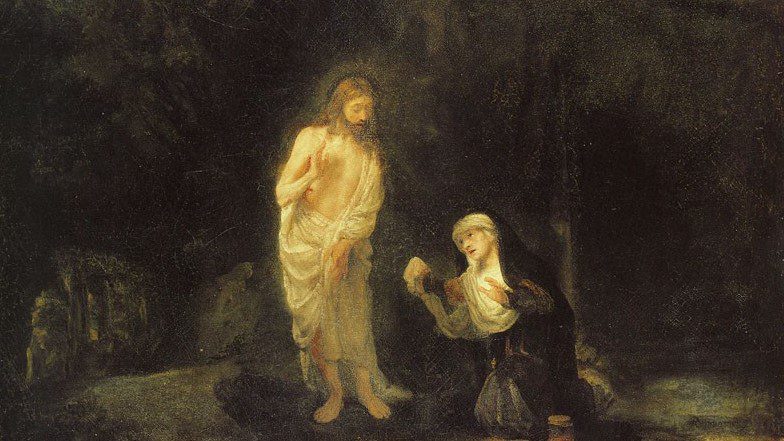
    Peter and John had left after running to the empty tomb and examining it briefly. I returned to find them looking inside. They didn’t know what to make of the empty tomb and went back to town talking to each other. There I was alone, I thought.

    I cried as I fell to my knees. What had happened, I wondered? Then through my tears I looked into the darkness of the tomb and thought I saw the two guards sitting where Jesus’ body had been laid on the day before the Sabbath.

    “Woman, why are you crying,” one of them asked?

    “Because they’ve taken away my Lord,” I told them, “and I don’t know where they’ve put him.” I was about to tell them how I had to prepare His body for burial, how Joseph and Nicodemus had only brought the shroud and the myrrh, but we had to finish the preparation of our Lord for burial.

    The First Witness

    Then I turned to look beyond the door of the cave. It was brighter outside and there stood another man I had not seen before. He spoke to me as men always addressed women with work to do.

    15 “Woman, why are you crying? Who is it that you’re seeking?”

    This man probably also has work to do, I thought. But I continued to plea for my Lord’s body which was not there.

    “Sir, if you’ve carried him away, tell me where you’ve put him, and I will take him away.”

    Then I recognized His gentle smile and loving voice.

    “Mary.”

    I turned to embrace Him as I poured out my joy at the sight of Him:

    ““Rabboni!”

    “Don’t cling to me,” Jesus cautioned after I called Him teacher, “since I have not yet ascended to the Father…”

    It took every bit of obedience to restrain my joy to listen, but not to touch the Lord. As I struggled with my emotions, He continued:

    “… But go to my brothers and tell them that I am ascending to my Father and your Father, to my God and your God.”

    Of course, I ran back to town and announced it to the Disciples. Jesus always called them His brothers and all of us His family.

    “I have seen the Lord!”

    John 20:18b CSB

    As quickly as I could I told them all I had seen, then Peter ran out the door followed by John.

    Σίμων Πέτρος – Simon Peter

    I am Simon, son of John the fisherman, owner of the fishing fleet on the Sea of Tiberias. Jesus calls me Cephas or Peter, but I denied knowing Him when the soldiers took Him away. It was just as He had said.

    The trial was no trial at all and they convicted Him of nothing. But they tortured and killed Him anyway, mocking Him before the crowds. I was afraid. We were all afraid and we hid from the authorities.

    On the first day of the week after His execution Mary Magdalene comes bursting in the door. “They’ve taken the Lord out of the tomb, and we don’t know where they’ve put him!”

    I took the lead, not waiting for anyone, and darted out the door. John followed closely, the young man running a bit quicker than me. When I arrived he was stooping down looking into the empty tomb. He was looking at something.

    I stooped down and went on in and saw the linen cloths lying there. 7 The wrapping that had been on his head was not lying with the linen cloths but was folded up in a separate place by itself.

    This makes no sense, I thought. John stepped in behind me and also saw the neatly folded linen cloths and the wrapping that Joseph had placed around Jesus’ head as we had carefully held His lifeless body.

    We left and went back to town.

    Ἰάκωβος – James, Son of Zebedee

    James, chosen randomly for this post-resurrection witness, represents any of the unnamed Disciples in the locked room where the Lord appeared.

    I am James the elder or the greater, as I am sometimes called so as not to confuse me with Jesus’ younger half-brother, son of Joseph. John, my younger brother and I were followers of John the Baptist until we met the Lord.

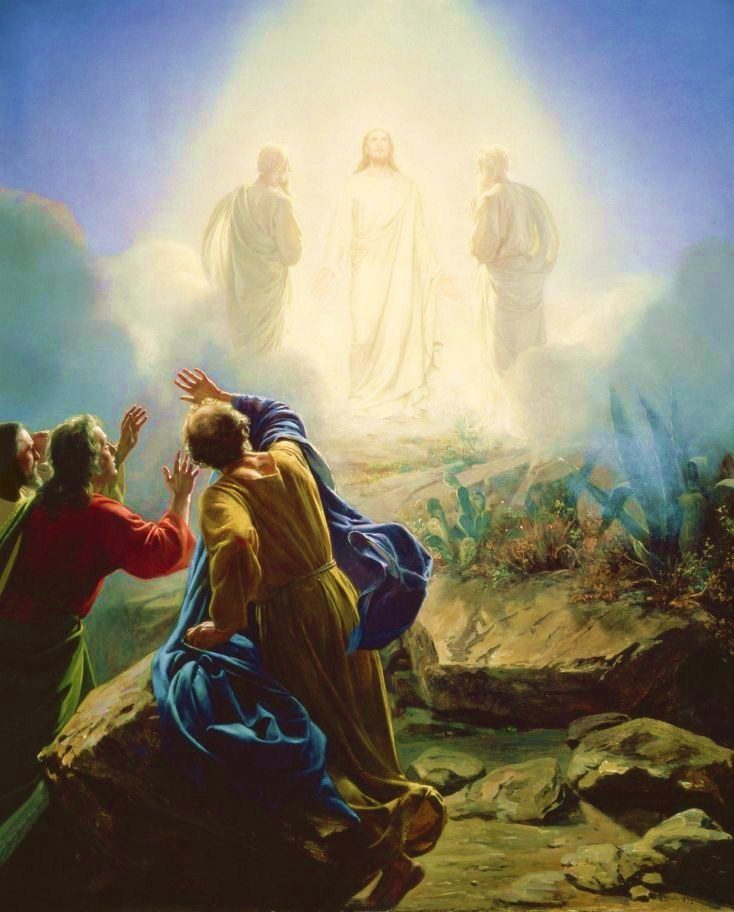
    John, Peter and I had all witnessed the transfiguration of our Lord when He appeared with Moses and Elijah. We knew He IS the Messiah of God.

    But I feared for my own life after Peter cut off the ear of a centurion arresting Jesus in Gethsemane. Even then He healed the man as if it had never happened. It was like so many miracles of Jesus we had witnessed the last three years.

    Most of us had gone back into town to the room where our Lord had washed our feet. And we kept the doors locked.

    On the first day of the week Peter and John had answered an early and urgent knock at the door. They left hastily, following Mary. When they returned my brother John told us he was certain the Lord was alive. Peter agreed and confirmed the evidence of all they had seen at the empty grave.

    We all discussed it, all, that is, except Thomas who was not there. But we once again began to hope and thought hard about scripture Jesus had so often discussed with us. Then in the evening an amazing thing happened, and as I said, the door was locked.

    Jesus came, stood among us and said, shä·lōm, that is, “Peace be with you.”

    Having said this, he showed us his hands and his side. I shed tears of joy, but also of sorrow as I looked upon the Lord’s hands and the place where the nails had been driven through. He also showed us his spear-pierced side. How was it possible? Yet there our Lord stood among us.

    And ever so briefly as we were all still rejoicing the Lord left, disappearing instantly as He had appeared in our room with the locked door.

    Θωμᾶς Δίδυμος – Thomas

    Jesus and the others called me Thomas or Didymos, which means, ‘the twin.’ My given name is Judas, but they call me Thomas so as to not confuse me with Judas, half-brother of Jesus or Judas Iscariot, who betrayed our Lord.

    Word had reached me that Jesus IS alive and had appeared to the others. I hurried back to Jerusalem to the room where we had celebrated the Passover feast before our Lord’s suffering and death. The door was locked, of course. I knocked and announced myself, ‘it is Didymos.’

    ‘Thomas,” Peter replied as he opened the door and quickly locked it once more. “Last week the Lord appeared to us here.” “Thank you for sending the messenger with the good news to me,” I responded.

    “We’ve seen the Lord!” all the Disciples were telling me.

    Yet even though I had come back with my heart full of hope I replied,

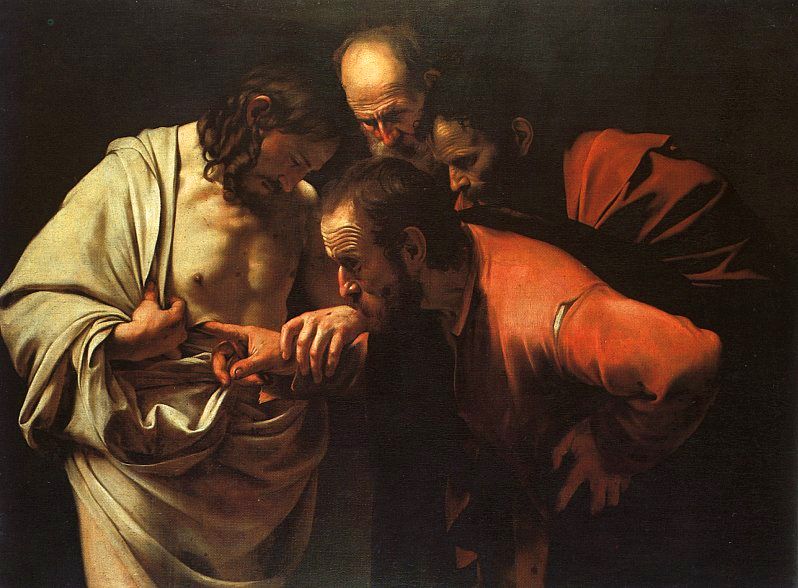
    “If I don’t see the mark of the nails in his hands, put my finger into the mark of the nails, and put my hand into his side, I will never believe.”

    For they had all told me how they had seen the scars of His crucifixion.

    Jesus tells Thomas, “Put your finger here..”

    Suddenly, the Lord also appeared in the locked upper room to me. The Lord greeted us all, “Peace be with you.” Then He turned to me.

    “Put your finger here and look at my hands. Reach out your hand and put it into my side. Don’t be faithless, but believe.”

    I touched the bloodless indentation in the Lord’s right hand, buckled to my knees, weeping and looking into His familiar loving eyes.

    “My Lord and my God!”

    Jesus’ look accepted my belated worship. Then He said to all of us:

    “Because you have seen me, you have believed.”

    “Blessed are those who have not seen and yet believe.”

    John 20:29B CSB – words of the risen Christ Jesus

    Μαθθαῖος לֵוִי – Matthew Levi

    The Gospel of Matthew

    The Hebrews know me by Levi and I collected the Roman tax for their leaders. But once the Lord called on me to follow Him, I was mostly called by my Greek name, Matthew.

    Besides John, I am one of the twelve witnesses to the incarnate life of the Messiah Jesus. We were all, of course, Jews, who spoke Aramaic and Greek with the Romans. My Gospel adds other detail to John’s Gospel.

    The Gospels of Mark and Luke

    You would probably call us second generation disciples of Jesus. Just a short time after the resurrection of the Lord Jesus, Peter came to us after Herod executed James, John’s brother with the sword. John Mark began recording all that Peter witnessed and then interviewed other Apostles as well.

    The physician Luke also wrote a detailed Gospel of the events in Jesus’ life and a second scroll of the Acts of the Apostles, where Luke faithfully records the events of Pentecost. John also recorded the receiving of the Holy Spirit, as the Lord Jesus had promised.

    John – Much more to say

    The Apostle John closes his Gospel and resurrection account in this way:

    The Purpose of This Gospel

    Jesus performed many other signs in the presence of his disciples that are not written in this book. But these are written so that you may believe that Jesus is the Messiah, the Son of God, and that by believing you may have life in his name.

    John 20:30-31 CSB

    The young Apostle John would be the only Disciple to live to old age. (All others sacrificed their own lives for the sake of the Good News of Christ Jesus).

    John wrote three letters to the church as well as the closing book of the Bible about the apocalypse of the close of the age, Revelation.

    Παῦλος שָׁאוּל – Paul [Saul of Tarsus]

    Our witness of the risen Christ would not be complete without that of a zealous Jewish scholar and Pharisee once opposed to the Lord Jesus and a murderer of followers of The Way, Paul, known as Saul.

    Luke records Paul’s own witness in Acts 9:

    3 As he traveled and was nearing Damascus, a light from heaven suddenly flashed around him. Falling to the ground, he heard a voice saying to him, “Saul, Saul, why are you persecuting me? ” “Who are you, Lord? ” Saul said. “I am Jesus, the one you are persecuting,” he replied.

    Paul’s later letter to the church at Corinth speaks to us about the all-important witness of the resurrection of Christ.

    1 Corinthians 15

    Resurrection Essential to the Gospel

    Now I want to make clear for you, brothers and sisters, the gospel I preached to you, which you received, on which you have taken your stand.

    .. that Christ died for our sins according to the Scriptures,

    • 4 that he was buried,
    • that he was raised on the third day according to the Scriptures,
    • 5 and that he appeared to Cephas [Peter]
    • then to the Twelve)

    Then he [the risen Christ Jesus] appeared to over five hundred brothers and sisters at one time; most of them are still alive, but some have fallen asleep.

    1 Corinthians 15:6
    • 7 Then he appeared to James,
    • then to all the apostles.
    • 8 Last of all, as to one born at the wrong time,a he also appeared to me.

    Resurrection Essential to the Faith

    13 If there is no resurrection of the dead, then not even Christ has been raised… 17 And if Christ has not been raised, your faith is worthless; you are still in your sins…

    If we have put our hope in Christ for this life only, we should be pitied more than anyone.

    1 Corinthians 15:19

    Christ’s Resurrection Guarantees Ours

    20 But as it is, Christ has been raised from the dead, the firstfruits of those who have fallen asleep… If the dead are not raised, Let us eat and drink, for tomorrow we die.

    Note that he does not call on us to party (as the world misquotes), but warns that to live in this way is fruitless, since we believe in the resurrection. Our certainty of eternal life in Christ guarantees that the fruit of this life becomes our reward for eternity.

    A closing thought for Easter

    John has told us that he could have told us many more convincing things to convince us that Jesus IS the Messiah. Many witnesses, even historians outside the Bible testify to Jesus.

    Paul continues his eloquent witness for Christ and the resurrection of Jesus, which I commend to your prayer and study.

    Question is: Do you believe in the Lord, Christ Jesus?

    I will close with Paul’s own further witness, which I pray you will take to heart for the sake of your eternal soul.

    Death has been swallowed up in victory.
    55 Where, death, is your victory?
    Where, death, is your sting?

    56 The sting of death is sin, and the power of sin is the law.

    57 But thanks be to God, who gives us the victory through our Lord Jesus Christ!

  • A Witness through John – Samira سمير

    “My food is to do the will of him who sent me and to finish his work,” Jesus told them.

    John 4:34 CSB

    Shopping for Groceries

    If you’re reading the Gospel (Good News) wondering why Jesus did something or other you will often find mentions of food. John answers our cravings into the personalness of Jesus with stories using symbolism for food, signs like  turning water into wine or feeding of the five thousand.

    In our series on the Gospel and writings of John you may find satisfaction for your hunger to know why Jesus did what He did. We left off with John’s most famous story of Nicodemus coming to Jesus in Jerusalem at night.

    John 3:

    22 After this, Jesus and his disciples went to the Judean countryside, where he spent time with them and baptized.

    23 John also was baptizing in Aenon near Salim, because there was plenty of water there.

    John then continues his stories of witness with Jesus having a conversation with someone unexpected as they travel north through Samaria, a woman at a well. Even though John was not present, he tells us what they said and provides context into why their conversation is important.

    This story connects the first journey of Jesus and the Disciples in their travel and mission from Judea and Jerusalem, then back to the Galilean towns where they live. 

    Food for Thought

    I have fed you with milk, and not with meat: for hitherto ye were not able to bear it, neither yet now are ye able.

    1 Corinthians 3:2 KJV http://blb.sc/008Bfe

    To begin, just a brief mention here from a letter of the Apostle Paul to the church at Corinth.

    Paul uses a Greek word τροφή trophē which the King James Version translates literally as ‘meat.’ Trophe figuratively means nourishment, which most Bibles translate symbolically as food.

    We have more here than just milk or a little ‘evangelism moment.’ This is meat for the mature believer with ears to hear, nourishment for our famished souls.

    Jesus’ teaching to the Disciples after this encounter with the Samaritan woman and Paul’s encouragement to the church are the same; that is, both provide food to the mature listener.

    John 4:

    When Jesus learned that the Pharisees had heard he was making and baptizing more disciples than John (though Jesus himself was not baptizing, but his disciples were), he left Judea and went again to Galilee.

    “He, Jesus, left for Galilee. John records that his disciples were baptizing (presumably in the Jordan near where the Baptist drew crowds). As at other times Jesus may have gone ahead and set a meeting place with the Disciples for a later time.

    Samaria from Jerusalem via mountains or Jordan River valley wilderness

    4 He had to travel through Samaria; 5 so he came to a town of Samaria called Sychar near the property that Jacob had given his son Joseph.

    Retelling the Gospel

    John would have learned this Gospel witness in the time that followed; for only Jesus and the woman at the well were present at first.

    In order to put this conversation into an observable context I have chosen the name of Samira for the woman at the well.

    Samira  means ‘someone you chat with in the evening’ (in this instance, a Samaritan woman).

    يرة‎ – a conversation in Samaria with the Messiah

    Samira سميرة‎ – a woman at a well in Samaria

    7 A woman of Samaria came to draw water.

    Jesus: Give me a drink

    Samira: How is it that you, a Jew, ask for a drink from me, a Samaritan woman?

    Jesus: If you knew the gift of God, and who is saying to you, ‘Give me a drink,’ you would ask him, and he would give you living water.

    Samira: Sir (سيدى) (sayedy), you don’t even have a bucket, and the well is deep. So where do you get this ‘living water’?

    You aren’t greater than our father Jacob, are you? He gave us the well and drank from it himself, as did his sons and livestock.

    Jesus: Everyone who drinks from this water will get thirsty again. But whoever drinks from the water that I will give him will never get thirsty again.

    In fact, the water I will give him will become a well of water springing up in him for eternal life.

    Samira: Sir, give me this water so that I won’t get thirsty and come here to draw water.

    John’s later commentary

    [John (to the reader): The men of Sychar told me how their wives resented the sinful life of this woman, but Samira later witnessed to me that Jesus lovingly smiles at her, then initiating their quick dialogue.]

    Jesus: Go call your husband and come back here.

    Samira: I don’t have a husband.

    Jesus: You have correctly said, ‘I don’t have a husband,’ For you’ve had five husbands, and the man you now have is not your husband. What you have said is true.

    [John: She told me she wondered if this man could have spoken with the men in town; then thought, ‘No, it is not possible; for he has just arrived from the Jerusalem road.’ It was then that she knew this was no ordinary traveler and drew some water from the well for this son of man, as prophets are called.]

    Jesus, a man like no other

    Samira: Sir, I see that you are a prophet.

    Our fathers worshiped on this mountain, but you Jews say that the place to worship is in Jerusalem.

    Jesus: Believe me, woman, an hour is coming when you will worship the Father neither on this mountain nor in Jerusalem.

    You Samaritans worship what you do not know. We worship what we do know, because salvation is from the Jews.

    But an hour is coming, and is now here, when the true worshipers will worship the Father in Spirit and in truth.

    Yes, the Father wants such people to worship him.

    God is spirit, and those who worship him must worship in Spirit and in truth.

    [John: That was the same thing Jesus had just said to the Pharisee Nicodemus in Jerusalem.]

    Samira: I know that the Messiah is coming (who is called Christ). When he comes, he will explain everything to us.

    Jesus: I, the one speaking to you, am he. [ἐγώ εἰμι ὁ λαλῶν σοι]

    The Messiah, the Christ

    What a remarkable encounter John records. The Apostle will retell this story of Good News for years to come.

    Jesus, the Messiah of Israel, has come not only for those in Judea and Jerusalem, but to those of all of Israel, even the despised Samaritans.

    John’s Gospel records: 

    27 Just then his disciples arrived, and they were amazed that he was talking with a woman. Yet no one said, “What do you want?” or “Why are you talking with her?”

    Of course these were questions John also wanted to ask Jesus, but did not.

    The Samaritan woman returns to Sychar and later men and women from town come out to the well by the highway to meet the Messiah in person.

    John now records a conversation with Jesus and the Disciples with a focus no longer on water, but on food.

    31 In the meantime the disciples kept urging him, “Rabbi, eat something.”

    “I have food to eat that you don’t know about.

    33 The disciples said to one another, “Could someone have brought him something to eat?”

    34 “My food is to do the will of him who sent me and to finish his work.

    The Disciples most likely failed to understand this connection between their literal food and Jesus’ symbolic meat of spiritual nourishment.

    Why would Jesus even stop to talk to this Samaritan woman?

    35 “Don’t you say, ‘There are still four more months, and then comes the harvest’? Listen to what I’m telling you:

    A Harvest of Faith

    What is the harvest? What does the Messiah mean?

    Jesus speaks now to John and the Disciples.

    Jesus: Listen to what I’m telling you:

    • Open your eyes
    • and look at the fields, because they are ready for harvest.
    • 36 The reaper is already receiving pay
    • and gathering fruit for eternal life,
    • so that the sower and reaper can rejoice together.

    37 For in this case the saying is true: ‘One sows and another reaps.’

    38 I sent you to reap what you didn’t labor for; others have labored, and you have benefited from their labor.”

    The Harvest they Witnessed

    What did the Disciples likely see? Crowds of Samaritans, men and women coming from town to see their Messiah. These must have looked like a flowing sea of ripened wheat moving in waves toward them.

    Yet what harvest did Jesus see in Samaria?

    Labour not for the meat which perisheth, but for that meat which endureth unto everlasting life, which the Son of man shall give unto you: for him hath God the Father sealed.

    John 6:27 KJV

    Jesus tells John and the Disciples that they must work in the fields. They must stop and tell the people they meet about the meat or the food of the Gospel, the Good News of everlasting life.

    Other translations of John 6:27 read: ‘Don’t work for the food that perishes..’ or ‘Do not work for food that spoils..’

    Jesus and the Disciples were traveling though Samaria. The Disciples nearly missed the harvest, Jesus tells them before dwelling there for two nights. We almost miss the harvest as well.

    Work for the ‘food that lasts for eternal life,’ ‘food that endures to eternal life..’ This is the joining of the Reaper and the Sower in Samaria in John 4. It is the joining with Jesus after the feeding of the five thousand in John 6.

    We have food – food the Son of Man has given us, “.. because God the Father has set his seal of approval on him.”

    Samira, first fruits of an abundant harvest – food for the faithful

    Along a road less traveled in a place unexpected on the way to where we thought we were headed, a harvest of faith appears. In a simple encounter Jesus simply asks a sinner:

    “Give me a drink”

    What is your answer, fellow Samaritan, rejected gentile, priest or Levite?

    What say you, when a stranger approaches and asks you,

    “Give me a drink?”

    Will you ‘love your neighbor’ with the food of eternal life, as Jesus did for Samira, a mere woman by a well on His journey to the Cross?

    To be continued...

  • John 3:16 – God’s Love

    John 3:16 – God’s Love

    .. so that everyone who believes in him will not perish but have eternal life.

    John 3:16 b

    The Bible’s best known verse

    JOHN 3:16 green man
    John 3:16 KJVFor God so loved the world, that he gave his only begotten Son, that whosoever believeth

    STOP! You lost them on “whosoever and believeth.” (No one talks like that anymore except fanatics and crazy people with signs.)

    Nearly everyone has heard it. God so loved the world. – John 3:16  

    “So what?” think all the worldly viewers of your very public witness.

    And you want everyone to know the same love of our savior you have experienced (and they are so worldly). Yet every time they give you that “so what?” look.

    You may have even memorized John 3:16 as a child, but do you even get it as one mature in Christ? 

    In fact, have you truly read all of this chapter of John recently or have you ever studied John 3?

    As I mentioned in the previous post, Jesus’ dialogue with Nicodemus about Spirit continues past John 3:16.  Nicodemus, a faithful Jew, would have listened and considered every word of the Messiah of Israel.

    Let’s step back from witnessing to the world for just a moment of personal reflection in the Spirit.

    A Contemporary Conversation

    Even Christians fail to consider that Jesus spoke every word of witness fully aware that the end of His earthly mission was death — even death on a Cross.

    And so is your end, son or daughter of dust – your end is death and your destiny an awakening to the Judgment.

    Yet only in God’s Son will you have eternal life, mercy to save your soul from damnation you deserve, penalty for the sins of this mortal life.

    Those you have wronged cry out for justice. Almighty God, ‘el Shadday, from whom you walked away, grieves as a Father over the hardness of your heart.

    Why, just as Satan and your enemies have accused, you deserve no mercy.

    Has your unconverted friend or estranged family member given weight and consideration that we will perish? Do they see in Jesus eternal life in the Light of His love?

    This challenging dialogue from John’s Gospel confronts every mortal with a life or death decision: accountability to facing the LORD, with … or without repentance.

    Jesus’ Dialogue with Nicodemus, Good News for the world witnessed by John

    Now there was a Pharisee, a man named Nicodemus who was a member of the Jewish ruling council.

    John La Farge [Public domain], via Wikimedia Commons
    Visit of Nicodemus to Christ

    The Apostle John certainly records this dialogue with Nicodemus as a witness. John would have been present. His understanding at the time would not have been as complete as after the Resurrection, but John records a remarkable conversation.

    This learned Jewish official refers to Jesus as his teacher – a Master instructing him. 

    And in the room with Jesus sit John, Nicodemus, and perhaps others seeking to learn more from their Messiah.

    You should join them.

    In this dialogue with Jesus, you should listen to Jesus’ answers to informed questions of this learned ruler of Israel, who acknowledges his own place at the foot of the living Son of Man.

    And be certain to set aside what you think you know about Jesus and listen.

    John 3:

    Nicodemus: “Rabbi, we know that you are a teacher who has come from God…

    Jesus: “.. no one can see the kingdom of God unless they are born again.

    Nicodemus: “How can a man be born when he is old? ..

    Jesus: “Truly I tell you, unless someone is born of water and the Spirit, he cannot enter the kingdom of God. Whatever is born of the flesh is flesh, and whatever is born of the Spirit is spirit.

    Do not be amazed that I told you that you must be born again. The wind blows where it pleases, and you hear its sound, but you don’t know where it comes from or where it is going. So it is with everyone born of the Spirit.”

    Nicodemus: “How can these things be?

    Jesus: “Art thou a master of Israel, and knowest not these things?

    “Truly I tell you, we speak what we know and we testify to what we have seen, 

    “and you receive not our witness.

    Jesus confronts us with truth!

    Do you receive it? Or do you need to hear more from the Spirit to be convinced?

    Beloved listener, now witness to this dialogue with Nicodemus, a ruler of the Jews at the feet of Jesus for His teaching, what further proof do you need?

    Jesus: “I have spoken to you of earthly things and you do not believe; how then will you believe if I speak of heavenly things?

    “No one has ascended into heaven…

    except the one who descended from heaven —the Son of Man.

    So Jesus’ truth and question to the listener is:

    Do you believe that Jesus IS the Son of Man, the Messiah of God, descended from heaven – in the flesh?

    What will Jesus say to Nicodemus and the world of why He has descended lower than the angels to be born into the womb of a woman of dust?

    Miracle of the Cross

    14 And as Moses lifted up the bronze serpent on a pole in the wilderness, so the Son of Man must be lifted up, 

    Sign of a Raised Serpent
    Moses lifts up the brazen serpent in the wilderness
    “We sinned when we spoke against the Lord and against you. – Numbers 21:7

    The LORD intercedes for sinners… repentant sinners.

    Christ nailed to the Cross
    “so that everyone who believes in him may have eternal life.

    Nicodemus and every religious ruler of the Jews since Moses understand. Sin must be punished! A remedy for sin requires not only repentance, but sacrifice זֶבַח.

    Silence in the Presence of the Lord

    The leader of the Pharisees also remains silent in the presence of Jesus.

    Perhaps one scripture or another of response to hearing God’s Word comes to mind for Nicodemus, such as these words of the Prophet Isaiah.

    Then I said:
    
    Woe is me for I am ruined
    
    because I am a man of unclean lips
    
    and live among a people of unclean lips,
    
    and because my eyes have seen the King,
    
    the LORD of Armies.

    John 3:16

    We have listened with expectation to Jesus’ dialogue with Nicodemus, wondering along with the Apostle John what the Messiah will reveal next. In these most beloved words Jesus reveals the reason for His own Sacrifice at a time still unknown to them.

    “For God loved the world in this way:

    or “God loves the world this much:

    John’s Gospel would have been completed perhaps three decades after this conversation with Nicodemus. The world would be those to whom it is written at the time, a Greco-Roman world, believers in Greece, Asia-minor or modern-day Turkey. These gentile believers, along with Jews who accept Jesus as the Messiah, know that we are the world κόσμος kosmos to whom Jesus speaks.

    Nicodemus and Jews wondering if John the Baptist or Jesus could be their Messiah would have considered Scripture as Jesus speaks these words.

    וְהוּא יִשְׁפֹּֽט־תֵּבֵל בְּצֶדֶק יָדִין לְאֻמִּים בְּמֵישָׁרִֽים׃

    Psalm 9:8

    And he shall judge the world in righteousness, he shall minister judgment to the people in uprightness.

    Judge of the World

    You want someone to judge righteousness, don’t you?

    Yet who can judge the sins of others? Certainly not christians, as we often do. This is just one of the reasons the world hates Christ, but it is not the only reason.

    Who do you want to judge your own sin? Can you stand before the Judge of the world (whoever He may be)?

    He gave his one and only Son,

    Healing of the Serpent, Healing by the Cross

    John Wesley makes the connection of the Serpent lifted up in the wilderness [v.15] and the healing for believers by gazing upon Christ.

    He must be lifted up, that hereby he may purchase salvation for all believers: all those who look to him by faith recover spiritual health, even as all that looked at that serpent recovered bodily health.

    Yea, and this was the very design of God’s love in sending him into the world.

    God so loved the world – That is, all men under heaven: even those that despise his love, and will for that cause finally perish.

    John Wesley

    Eternal Life or Judgment?

    … so that everyone who believes in him will not perish,but have eternal life.

    Yes, all believers: Jews (Messianic Jews, as we know know them), Gentiles (the rest of the world), Greeks and Romans.

    You do not want to think of eternal life, but only this waning existence we call life. It is in the flesh and all realize it will end. But eternal life? That would be something else to consider, especially if it could contain the just punishment of our considerable sin and unrighteousness.

    17 For God did not send his Son into the world to condemn the world, but to save the world through him.

    So Jesus was not sent to condemn the world. This the Lord confirms to Nicodemus and those of you listening intently to the Messiah. Jesus came to save the world through him. Substitution for a required sacrifice, justification required for acquittal from our deserved sentence for sin.

    18 Anyone who believes in him is not condemned,

    Good News!

    This is Good News to the Pharisee Nicodemus, who by his knowledge of Scripture believes in the resurrection.

    And it is Good News to and who listen to the Messiah, the Son of God our Father in Heaven.

    Yet Jesus adds something here christian-sounding false preachers reject. In fact, as much as we would like for this Good News to apply to all of our loved ones and friends, it does not.

    … but anyone who does not believe is already condemned, because he has not believed in the name of the one and only Son of God. 

    Sorry … your mom or your dad, your brother, sister or friend, your misleading ‘good’ religious teacher – all are condemned, if they do not substitute this God-sent Sacrifice, Christ Jesus, for their own sin.

    19 This is the judgment:

    And why? Why does a loving God accept some for eternal life, yet punish others for not accepting the Messiah Jesus as their Lord?

    Darkness or Light?

    The light has come into the world,

    Jesus IS the Light of Almighty God!

    “In him was life; and the life was the light of men,” John testifies.

    John 1:4

    … and people loved darkness rather than the light because their deeds were evil.

    It’s true. We would hide our sin in the shadows.

    Yet in the Judgment hiding sin is not an option. In the Light of Christ, the Messiah of the Lord God, we have life eternal only because He paid this dear price and severe penalty for our sin.

    Here we sit listening to Jesus, along with Nicodemus. Or here we now sit reading the truth of the Word.

    To which mortal souls of the world will you run?

    20 For everyone who does evil hates the light and avoids it, so that his deeds may not be exposed.

    21 But anyone who lives by the truth comes to the light, so that his works may be shown to be accomplished by God.”

    We must believe in Jesus to have eternal life.

    Nicodemus, now in his later life, will leave the meeting in darkness to come to the light and practice the truth, true religion in his later life. John is the only Disciple who will not lose his life for his witness of Christ Jesus.

    Shortly after this conversation between Jesus and Nicodemus, John the Baptist will be beheaded for his witness that Jesus is the promised Messiah of God.

    The Invitation of John 3:16

    And what of your witness and mine in these last days?

    What has the Spirit put on your heart as you have listened with Nicodemus to the only begotten Son of God?

    Jesus would love you!
    o mortal of dust,
    wonderfully formed
    with water and spirit.

    Yet will you love
    the Son who came down,
    born like you
    to be crucified on a Cross?

    Just to save
    your sinful soul?
    Just to save
    your sinful soul.

    Jesus So Loves the World

    Jesus would love you!      

    Roger@talkofJesus.com

    God's Love Through John
    to be continued...