Tag: hebrews

  • The End of the Living – a letter from Peter – 7

    The End of the Living – a letter from Peter – 7

    Living toward the End

    Peter challenges persecuted believers to Suffer for Good and trust God to punish those who do evil. He then proceeds to warn of the judgement and the end of those living souls as well as for those who are dead.

    Just as the end of all life will come, so must the end of your suffering. The Lord will judge your living soul accordingly after the time of all expires.

    Who shall give account?

    5 Who shall give account to him that is ready to judge the quick and the dead.

    1 Peter 4:5 KJV

    The King James Version translates the Greek of Peter’s letter into words somewhat quait to our 21st century hearing. “The quick and the dead,” refers to the condition of all being judged after our death. Yet don’t miss the encouragement here in Peter’s contrast between believers and disobedient sinners, those who both infiltrate the church and persecute believers.

    the living

    Most versions of the Bible translate ‘quick,’ ζάω [zaō] as “the living.” From this we hear expressions like, “as I live and breathe” or, “[be] among the living.”

    Consider our more familiar references to ‘quick’ as the pace of something, even our quickly passing life. We tend to rush through our living of life more so than persecuted believers of the first century church. Yet we would do well in our quickness of life to consider its brevity.

    to give an account

    Perhaps in our money-driven daily lives of this 21st century we quickly think of accounting as it relates to buying and selling. This approach to Peter’s meaning is not entirely wrong, but you cannot buy your own soul.

    No good you accomplish in your quick days of living this life can outweigh the many sins of your living flesh.

    3:19 בְּזֵעַת אַפֶּיךָ תֹּאכַל לֶחֶם עַד שֽׁוּבְךָ אֶל־הָאֲדָמָה כִּי מִמֶּנָּה לֻקָּחְתָּ כִּֽי־עָפָר אַתָּה וְאֶל־עָפָר תָּשֽׁוּב׃

    Genesis 3:19
    By the sweat of your face
    You will eat bread,
    Till you return to the ground,
    Because from it you were taken;
    For you are dust,
    And to dust you shall return.”
    - Genesis 3:19 NASB

    So how does God balance the good of your quickly dying flesh with the evil of our living soul?

    The writer of Hebrews cautions those who turn against the Lord, providing an accounting of the judgment of souls.

    And as it is appointed unto men once to die, but after this the judgment: So Christ was once offered to bear the sins of many; and unto them that look for him shall he appear the second time without sin unto salvation.

    Hebrews 9:27-28 KJV

    Peter assures us that whether we suffer for good, experience persecution for Christ or conversely if our daily living displeases God, know that all will give an account. Even the dead will give an account for actions against God during their lifetime.

    You must give an account even for inattentiveness to your living soul, for all will will give an account before the Lord.

    Your life will pass quickly, then you will die and be called to God’s Throne of Judgment of your eternal living soul.

    to him that is ready to judge

    1 Peter 4:

    Who will judge?

    To whom will your departed soul be required to give an account of your living soul?

    Peter’s encouragement to persecuted believers goes back to the reason for and objects of their persecution.

    Therefore, since Christ suffered in the flesh, arm yourselves also with the same understanding…

    3 For there has already been enough time spent in doing what the Gentiles choose to do…

    … and they malign you; 5 but they will give account to Him who is ready to judge the living and the dead.

    They will give an account refers to the gentiles who remain sinful. The Lord will judge every soul of those who decay in the flesh, yet some living in sin may be saved by your preaching of the Gospel.

    Just as Christ preached to those in the grave, so also will your redeemed life doing good preach the Gospel to those who remain sinners. Perhaps the Spirit will use you to bring some back to life.

    6 For this reason the gospel was also preached to those who are now dead, so that, although they might be judged in the flesh according to human standards, they might live in the spirit according to God’s standards.

    Who will judge our living souls?

    A Hebrew understanding of living relates more to the soul than to our flesh.

    Then the LORD God formed man of dust from the ground, and breathed into his nostrils the breath of life; and man became a living being.

    So also it is written, “The first MAN, Adam, BECAME A LIVING SOUL.” The last Adam became a life-giving spirit.

    Genesis 2:7; 1 Corinthians 15:45 NASB

    When will it all end?

    Certainly the end appeared to be at hand as the Roman Empire fell into further decline during the first century A.D. Peter writes to those living as Christians persecuted for their faith in Jesus. He too would suffer further and then be crucified in Rome.

    The church to whom Peter wrote suffered in their home towns in Asia minor (modern Turkey) as if the end of their lives could be at any time. The church in Jerusalem suffered greatly and Jerusalem itself would fall into ashes and dust at the hands of its Roman oppressors.

    Perhaps the end of all things is near. [1 Peter 4:7]

    Even in recent centuries some have thought judgement near.

    In October of the year of our Lord 1962, some will recall that the world stood at the brink of destruction by nuclear missiles from Russia and the U.S.

    In September of the year of our Lord 2001, some believed that an attack of followers of the false prophet would lead us into the last days. Perhaps it has. The Lord knows.

    But in any case, our end will come to the measured days of our mortal life. All will end, and then the judgement. God only knows when.

    And like the followers of Jesus to whom Peter wrote, we also know:

    We will die in the flesh and then be judged. AND our soul is saved from our sin by the grace and mercy of Jesus Christ! Thanks be to God!

    Who shall give an account?

    Everyone – the living and the dead – will give an account for their living actions during the brief years of our flesh.

    οἳ ἀποδώσουσιν λόγον τῷ ἑτοίμως ἔχοντι κρῖναι ζῶντας καὶ νεκρούς

    1 Peter 4:5 Morphological Greek New Testament

    So since all souls must give an account, let’s look deeper into Peter’s text of his first letter to the church (whose believers understand Greek).

    but they will give account to Him who is ready to judge the living and the dead.

    1 Peter 4:5 NASB

    λόγος

    Trench’s Synonyms: lxxvi. λαλέω, λέγω (λαλιά, λόγος).
    lxxxix. φωνή, λόγος.
    xc. λόγος, μῦθος.

    Do you see it – the account you must give?

    It’s Greek root is from a verb legō, meaning to say, speak or affirm. It is the same word Jesus uses when He says,

    “But I say G3004 to you that everyone who is angry with his brother shall be guilty before the court;
    and whoever says G3004 to his brother, ‘You good-for-nothing,’ shall be guilty before the supreme court;
    and whoever says, G3004 ‘You fool,’ shall be guilty enough to go into the fiery hell.
    Matthew 5:22 – Strong’s G3004 – BlueLetterBible.org

    From ‘legos,’ the root of the word Peter and Jesus use, we see that all will give an account for what we say, in addition to what we do. Yet returning to Peter’s use of account, look closer. Do you see the noun Peter uses?

    λόγος

    Logos

    The KJV translates Strong's G3056 in the following manner: 
    word (218x), saying (50x), account (8x), speech (8x), Word (Christ) (7x), thing (5x), not translated (2x), miscellaneous (32x).

    You will give an account [logos]. That is, of speech they will give an account for slander and words of hatred. They will give an account for false teaching which goes against the precepts of God.

    We all know that keeping score means to give an account at the end of the game. This is no game, but a brief life for which we will give account to Almighty God.

    Jesus often used this word with the same meaning as Peter uses here to encourage persecuted believers.

    “For this reason the kingdom of heaven may be compared to a king who wished to settle accounts G3056 with his slaves.

    Matthew 18:23 NASB

    Greek-speaking Romans and Jews of the first century also referred to a word spoken from the Prophets in this way. Many of the Jews believed John the Baptist to be a Prophet with such power of the word of God spoken directly to man through him.

    Logos – Accounting in Peter’s words

    Peter has already encouraged readers of his letter with this same (logos) accounting:

    1Pe 1:23
    for you have been born again not of seed which is perishable but imperishable, that is, through the living and enduring word G3056 of God.

    1Pe 2:8b
    for they stumble because they are disobedient to the word, G3056 and to this doom they were also appointed.

    1Pe 3:1
    In the same way, you wives, be submissive to your own husbands so that even if any of them are disobedient to the word, G3056 they may be won without a word G3056 by the behavior of their wives,

    1Pe 3:15
    but sanctify Christ as Lord in your hearts, always being ready to make a defense to everyone who asks you to give an account G3056 for the hope that is in you, yet with gentleness and reverence;

    Therefore, Peter will continue by urging us how to speak and act, now that we are in Christ. (I will continue Peter’s first letter to the church from his advise continuing in 1 Peter 4:7, God-willing.)

    Christ – the living logos

    No men understood better the accounting and true word of God than Jesus’ inner circle of Apostles. In addition to Peter, these included James and John.

    Consider the accounting of the living and the dead to be made before Almighty God from the words of the Apostle John, only surviving one of the Twelve who was not martyred for Christ Jesus. You may read of it in his letters, Gospel, or in The Revelation of Jesus Christ to the church:

    The Revelation of Jesus Christ, which God gave Him to show to His bond-servants, the things which must soon take place; and He sent and communicated it by His angel to His bond-servant John,
    who testified to the word G3056 of God and to the testimony of Jesus Christ, even to all that he saw.
    Blessed is he who reads and those who hear the words G3056 of the prophecy, and heed the things which are written in it; for the time is near.

    John, like those to whom Peter wrote, suffered for Christ. And as a living soul for Jesus writes to seven of the same churches in Asia with exhortation as to how we much live as Christ.

    John’s Gospel to the church best solidifies the identity of God and Christ. In fact, John includes this same word as Peter has just used in his letter.

    In the beginning was the Word, G3056 and the Word G3056 was with God, and the Word G3056 was God.

    And the Word G3056 became flesh, and dwelt among us, and we saw His glory, glory as of the only begotten from the Father, full of grace and truth.

    John 1:1,8 NASB Strong’s G3056 – λόγος
    logos
    To be continued...
  • Hebrews – Benediction

    What is a benediction? Where did it originate and why is it the most appropriate closing to this or any letter?

    Perhaps you have heard a benediction or two, in Latin or another language, words sung closing a worship service.

    “So they shall invoke My name on the sons of Israel, and I then will bless them.”

    Numbers 6:22 NASB

    Benedictus Dominus Deus Israel
    Canticle of Zechariah
    Benedictus also known as the Canticle of Zechariah, is one of the hymns for Maundy Thursday in Holy Week. It was sung by the Jewish priest Zechariah, father of St. John the Baptist, in thanks for the son bestowed upon him by God. source:
    Benedictus Dominus Deus Israel:

    Definition: Benediction

    From the earliest times the records bear testimony that pronouncing the benediction or giving the blessing was a common practice. In the temple service, this duty was assigned to the Aaronites and was made an impressive part of the service. The form of the benediction used is given in Nu 6:22-27. References to this practice may be found in Le 9:22; De 10:8; 2Ch 30:27. After a time, minute directions were given concerning it and careful preparation was made for this part of the service. source: International Standard Bible Encyclopaedia

    The Priestly Blessing

    “The Lord bless you and keep you;
    The Lord make His face shine upon you,
    And be gracious to you;
    The Lord lift up His countenance upon you,
    And give you peace.” ’

    The blessing of worship given by the one who stands between the congregation and the Lord. Go in peace.

    Although an appropriate closing for a letter to be read to the congregation of a church, not all letters to the churches ended with such a benediction.

    Other Closings of Letters to the Church

    I have linked some benedictions of Paul above. Some letters such as James offer no benediction, while others close briefly.

    Peace to all of you who are in Christ. – First Letter of Peter 4:14B

    Some combine it with a closing caution and others offer just the exhortation.

    Little children, guard yourselves from idols. – 1 John 5:21

    While his last letter, the Revelation of Jesus Christ to John closes:

    Ἡ χάρις τοῦ κυρίου ἡμῶν Ἰησοῦ Χριστοῦ μετὰ πάντων ὑμῶν Ἀμήν

    The grace of our Lord Jesus Christ be with you all. Amen.

    Hebrews

    Before we conclude Hebrews 13 which begins, ‘Let love of the brethren continue’ and ends with a benediction, let’s take a brief look at the focus of the author’s letter.

    האגרת אל-העברים 1 Habrit Hakhadasha/Haderekh (HHH)
    א לפני שנים רבות דיבר אלוהים אל אבותינו באמצעות הנביאים בדרכים שונות, וסיפר להם, שלב אחרי שלב, על תוכניותיו.
    2 אך עתה, באחרית הימים, דיבר אלינו אלוהים באמצעות בנו, אשר בידו הפקיד את הכול ועל-ידו ברא את העולם ואת כל אשר בו.

    God, after He spoke long ago to the fathers in the prophets in many portions and in many ways, in these last days has spoken to us in His Son, whom He appointed heir of all things, through whom also He made the world.

    Hebrews 1:1-2 NASB

    The author of Hebrews’ point of scripture: God speaks to us in various ways. And now the Son, Jesus, heir and creator of the world, has spoken.

    3 The Son is the radiance of God’s glory and the exact expression of his nature, sustaining all things by his powerful word.

    Hebrews 1:3 CSB

    Jesus, the Son IS exactly, God’s own glory! Quite a statement. Because we are human, the Father became human in the flesh of the Son.

    3: Therefore, holy brethren, partakers of the heavenly calling, consider the Apostle and High Priest of our confession, Christ Jesus, who was faithful to Him who appointed Him, as Moses also was faithful in all His house.

    Note that the Apostle is ‘one sent with orders’ and so was the Son to us. The writer refers to us as holy partakers of the heavenly calling. For this same calling Christ Jesus is our High Priest.

    8:6 Jesus has now obtained a superior ministry, and to that degree he is the mediator of a better covenant, which has been established on better promises.

    But Christ came as High Priest of the good things to come, with the greater and more perfect tabernacle not made with hands, that is, not of this creation.

    Hebrews 9:11 NKJV

    15 Therefore, he is the mediator of a new covenant… Jesus secured a promised eternal inheritance, because of His Perfect Sacrifice for our sins.

    10:19 Therefore … enter the Holiest by the blood of Jesus, 20 by a new and living way which He consecrated for us, through the veil, that is, His flesh..

    Persecuted believers in Rome and beyond

    The persecution of Christians in Rome had likely already begun and these Hebrews likely faced severe social suffering, starvation, banishment and even death. So the writer of Hebrews encourages these prior to his closing.

    Endure the race of faith and persecution for His sake. Continue to love each other and continually praise God.

    17 Obey your leaders and submit to them, for they keep watch over your souls as those who will give an account.

    Pray also for me. This familiar theme of connection between leaders of the church separated from those they love. The author suggests that their prayer could lead him to be returned to them sooner. (Perhaps he is imprisoned or hiding elsewhere due to cautious fear for his life.)

    Benediction of the letter of Hebrews

    Now may the God of peace, who brought up from the dead our Lord Jesus—the great Shepherd of the sheep—through the blood of the everlasting covenant, equip you with everything good to do his will, working in us what is pleasing in his sight, through Jesus Christ, to whom be glory forever and ever. Amen.

    Hebrews 13:20-21 CSB

    God IS a God of peace, even when peace seems nowhere near.

    Jesus, Shepherd of the church, was brought up from the dead; therefore we honor Him as Lord. Do His will. All glory to Christ Jesus! Amen.

    This lesser shepherd of the church then encourages them with some additional timely good news of others they know. The author then closes:

    13:25 ἡ χάρις μετὰ πάντων ὑμῶν

    Grace be with you all.

    Philippine Madrigal Singers

    For by His Blood we have grace and peace.

  • Hebrews 13 -Remain in Philadelphia

    13:1 ἡ φιλαδελφία μενέτω [menō philadelphia menō]

    Philadelphia?

    ‘Wait,’ you say. Philadelphia – stay in Philadelphia?

    If your familiarity of the New Testament extends beyond the Pennsylvania ‘city of brotherly love’ in the U.S., you may recall the importance of one of the seven churches mentioned in Revelation. Not that Philadelphia either.

    The author of Hebrews has nearly concluded his letter, but we need to address an application of his purpose. By doing so we must first take a look at love as we often misrepresent it in the English language.

    A lesson in love

    C.S. Lewis wrote an important book addressing the translation issues from Greek to English called, “The Four Loves.” (Link to study guide.) For our lesson here I will outline the four Greek words which translate as “love.”

    1. eros – romantic love (which receives much worldly attention)
    2. storge – love for family and affectionate love
    3. agape spiritual love
    4. philia – friendship

    Understand that the Hellenistic or Greek culture was common to Jerusalem, Rome and the world in between. So to hear the word ‘love‘ in Hebrews and other letters of the New Testament and the Gospels as a Greek-speaking believer of the first century church, ask yourself ‘which of the four loves?’

    philia love

    The writer of Hebrews here uses this ‘philia’ love when he writes:

    Let love of the brethren continue.

    Hebrews 13:1 NASB

    Paul urges this same philia love of friendship in Romans 12:10-11.

    Be devoted to one another in brotherly love; give preference to one another in honor..

    Consider any urging of ‘brotherly love’ or ‘love for the brethren’ as φιλαδελφία translated to english as: philadelphia.

    agape love

    Earlier in Hebrews 6 we also encountered agape spiritual love.

    For God is not unjust so as to forget your work and the love which you have shown toward His name, in having ministered and in still ministering to the saints.

    Hebrews 6:10 NASB

    The author reinforces a call to this same spiritual love in Hebrews 10:24

    .. and let us consider how to stimulate one another to love and good deeds..

    Yet these loves overlap even in a Greek understanding of love. Occasionally one type of love illustrates a desired characteristic of another.

    Jesus uses a tense of agape love for His closest friends and Disciples in a command specific to them, yet applicable to all believers.

    αὕτη ἐστὶν ἡ ἐντολὴ ἡ ἐμή ἵνα ἀγαπᾶτε ἀλλήλους καθὼς ἠγάπησα ὑμᾶς

    “This is My commandment, that you love [agapaō] one another, just as I have loved [agapaō] you.

    John 15:12 Greek, NASB

    Could any command of our Lord hold more importance?

    In Christ spiritual brothers become family

    This spiritual love secured by our Lord Christ Jesus, of persons requires us to welcome, to entertain, to be fond of, to love dearly our brothers and sisters bound by our faith as His church.

    The author of Hebrews therefore encourages us that by this very love in Christ, we are different from everyone else.

    Of course our storge love for family and philia friendships rise to a higher good as well. And love’s action, ἀγάπη agapē, ofter translated ‘charity‘ derives from this grace-filled love of our spiritual relationship with God.

    Philadelphia: Remain in the Lord’s place of brotherly love, which witnesses our Lord’s own affection for the brethren (fellow-believers). Its adjective implies kindhearted.

    Hebrews 13:

    • 2 Don’t neglect to show hospitality,
    • 3 Remember those in prison..
    • the mistreated…
    • “as though you suffered with them.”
    • Honor marriage (pointing to eros as God intended).
    • Be satisfied with what you have…

    Once again the writer quotes scripture:

    I will never leave you or abandon you.

    Hebrews 13:5B, quoting Deuteronomy 31:6

    7 Remember your leaders who have spoken God’s word to you. As you carefully observe the outcome of their lives, imitate their faith.

    Jesus Christ is the same yesterday, today, and forever.

    Don’t be led astray by various kinds of strange teachings; for it is good for the heart to be established by grace…

    Hebrews 13:8-9a

    Our Altar in the Enduring City

    10 We have an altar from which those who worship at the tabernacle do not have a right to eat.

    Even Moses was unable to enter when the glory of the LORD filled the tabernacle, for it is the holy place where God accepts the sacrifice of man.

    The author of Hebrews illustrates that the blood is brought into the most holy place by the high priest as a sin offering is not a complete sacrifice. He make a point to show us the fate of the sacrificed bodies. 11 For the bodies of those animals… [from which the blood of the sin offering was sacrificed] are burned outside the camp.

    Abel Grimmer [Public domain]
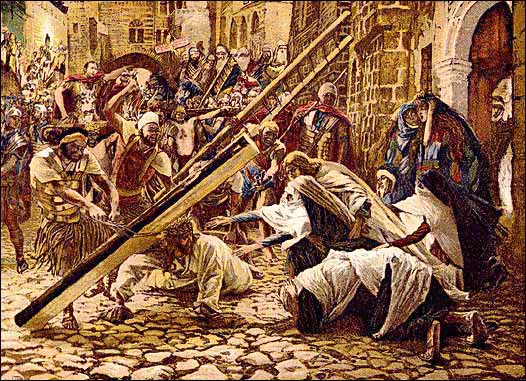
    The Road to Calvary

    Therefore, Jesus also suffered outside the gate, so that he might sanctify the people by his own blood.

    Hebrews 13:12 CSB

    Go to Christ outside the camp

    A works-driven Judaism, catholicism or easy christianity draw us to the victory procession of the king entering the city. Crowds will follow any easy path to the high hill of victorious faith.

    Jesus falls carrying Cross out of Jerusalem to Golgotha

    Yet those same expectant masses who laid palms before Jesus chastised a bloodied and beaten Son of Man as He was lead away from the city to the hill of Golgotha.

    Isaiah tells us: He bore the reproach for our sin. To this end, by our humble worship we must also take up His Cross to follow Jesus.

    The author of Hebrews therefore leads us to worship our Perfect High Priest following His path of reproach for our sake. His earlier mention of this reproach was in Hebrews 11.

    Let us therefore go forth to him outside of the camp, bearing his reproach.

    Hebrews 13:13 HNV

    14 We do not have enduring city here…

    True then of Jerusalem and more so true now of our own 21st century city of destruction. Our call to the path from the city therefore:

    … we seek the one to come.

    in conclusion

    Heaven is not found on the heights of our successes in faith, but on the humbling path of scorn where Christ bore our sin and death.

    We have a new High Priest of a New Covenant with God, the Father of all.

    Therefore, through him let us continually offer up to God a sacrifice of praise, that is, the fruit of lips that confess his name.

    Hebrews 13:15 CSB

    17 Obey your leaders and submit to them, since they keep watch over your souls as those who will give an account, so that they can do this with joy and not with grief, for that would be unprofitable for you.

    With this final caution the author concludes his letter to the Hebrews, having only to request prayers and leaving words of his blessing.

    Letter to the Hebrews: To be concluded...