Tag: history

  • 2 Peter 1 – Last Will and Testament of Simon Peter

    2 Peter 1 – Last Will and Testament of Simon Peter

    For where there is a legal ‘will,’ there must also be a death brought forward in evidence—the death of him who made it.

    Hebrews 9:16 Weymouth New Testament


    Last Will and Testament

    The New and convincing Testament of the Apostle Peter

    The Apostle writes his final testimony from Rome, providing convincing truth of Christ which many of us have sought as a new testament of good news.

    Hearing now a second Epistle read in our church from Simon Peter, the saints consider assurance of their salvation.


    Even the Jews will agree that Jesus had died some thirty years ago now. But among them many also maintained their faithful testimony of the Lord’s resurrection on the third day after Jesus’ crucifixion.

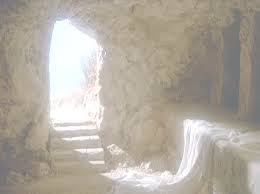
    Easter or Resurrection Sunday is the day the tomb of Jesus is found empty and when the risen Messiah appears risen after His crucifixion on a Corss

    Furthermore hundreds of Jews, Gentiles and Romans alike had reported numerous appearances of the risen Christ Jesus during a time of forty days after the Cross and His burial in Jerusalem.

    Jews see a fulfillment of prophetic Scripture and Greeks amazingly now seem included in a New Covenant as elect in the fellowship of the church — chosen and elect to eternal life by God the Father of all creation in the Sacrifice of His Only Son Jesus Christ for our sins.

    And Peter has confirmed this!


    The Last Will of Peter – Remember His Teaching

    Simon Peter, a prisoner for the Gospel in Rome, has good reason to believe that this second epistle may be the Apostle’s last letter to the church.

    Historical context of Peter’s Second Epistle

    Recent AD First Century Historical Events (all dates approximate)
    • ~ AD 30-33 – Resurrection of Jesus Christ witnessed by Simon Peter and the Apostles and more than 500 witnesses (some still living at the time of Peter’s two Epistles).
      • Peter & John jailed in Jerusalem for their testimony of Christ as the risen Messiah of Israel
    • ~ AD 37 – Caligua Caesar declares himself a god
    • ~ AD 40 Peter proclaims the Gospel to the Gentiles in Joppa and other towns
    • ~AD 41-54 – Claudius Caesar rules the Roman Empire
    • ~AD 44 – the Apostle James, brother of John also of Jesus’ inner circle, is martyred
    • ~ AD 49 – Jews (including followers of “the Way”) expelled from Rome
    • ~ AD 54-68 – Nero Caesar rules the Roman Empire
    • AD 50’s – John Mark, a scribe to Peter who had previously accompanied Paul on his first missionary journey, writes his GOSPEL which is read in churches as testimony primarily of the Apostle Peter.
    • ~ AD 60 – Paul is brought to Rome, placed under house arrest and later released.
    • AD 60’s – The Apostle Matthew records his GOSPEL.
    • AD 60’s – Luke, an esteemed gentile physician to Paul, records his GOSPEL followed by a second volume detailing the ACTS of the Apostles.
    • ~AD 62 – James, leader of the Jerusalem church, author of his own epistle and half-brother of Jesus is martyred.
    • AD 64 – Peter and Paul remain diligent in sending several epistles (from Rome)to the church

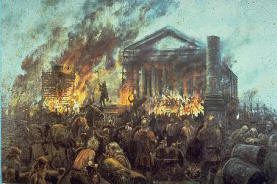
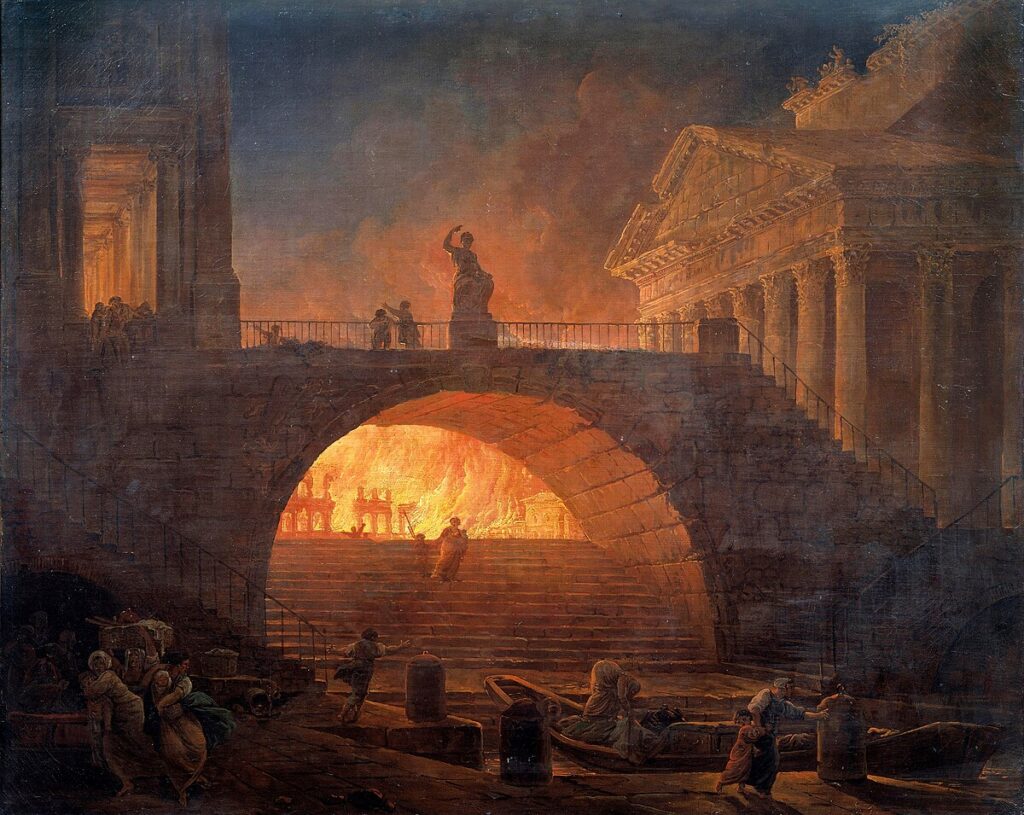
    19 JULY, 64 AD – a great fire burns for six days, consuming many structures in Rome.


    2 Peter 1:

    Simeon Peter, a slave and apostle of Jesus Christ,

    To those who have received the same kind of faith as ours, by the righteousness of our God and Savior, Jesus Christ:


    Therefore, I will always be ready to remind you of these things, even though you already know them, and have been strengthened in the truth which is present with you.

    I consider it right, as long as I am in this earthly dwelling, to stir you up by way of reminder, knowing that the laying aside of my earthly dwelling is imminent, as also our Lord Jesus Christ has indicated to me.

    And I will also be diligent that at any time after my departure you will be able to call these things to mind.

    2 Peter 1:12-15 LSB

    meta emos exodos

    .. ‘after my decease,’ translates the King James.

    ‘to have these things always in remembrance.’

    v.15 KJV


    What this Apostle of Christ Jesus is about to tell those chosen for eternal life reminds us of the Apostolic faith we must remember. Peter’s witness stands against those like the Caesar’s — Caligula and Nero — idolatrous men who declare that they have become gods.

    Peter’s testament here In his second epistle stands firmly against a false gospel and philosophies seeping into the churches.

    One false gospel seeking to undermine the Way and Truth will later claim to be a “Gospel of Peter,” introducing heresies opposed to the true faith of the Apostles.

    So Peter reminds of of his unique witness of the Divine Jesus of Nazareth.

    Peter’s Testimony of Christ’s Divine Nature

    For we did not make known to you the power and coming of our Lord Jesus Christ, following cleverly devised myths,

    but being eyewitnesses of His majesty.

    Peter testifies to his EYEWITNESS of the GOOD NEWS previously recorded in THREE GOSPELS.

    For He received from God the Father honor and glory when such a voice came to Him from the Excellent Glory:

    “This is My beloved Son, in whom I am well pleased.”

    2 Peyer 1:17 NKJV

    and we ourselves heard this utterance made from heaven when we were with Him on the holy mountain.

    v. 18 LSB


    Apostolic testimony or idios interpretation?

    And so we have the prophetic word made more sure, to which you do well to pay attention as to a lamp shining in a dark place, until the day dawns and the morning star arises in your hearts.

    2 Peter 1:19 NASB20

    Know this first of all,
    that no prophecy of Scripture comes by one’s own interpretation [idios epilysis].

    2 Peter 1:20 LSB

    For no prophecy was ever made by the will of man, but men being moved by the Holy Spirit spoke from God.


    The Stage is set for the Debate of False Prophets

    As I have pointed out from this current historical context of Peter’s second epistle to the Church, not only do Rome and local communities oppose the true gospel, but in fact, many Christians trained in Jewish culture have an agenda of their own to convert Christ’s church to more palatable heresies desired by many.

    The Greeks and Romans did not care whether their gods really existed. They were myths and they knew they were myths.

    (May I interject that the same applies to Hindus, Buddhists, Universalists and many other compromising polytheistic or atheistic religions of this century.)

    [Referring to vs.16-18]

    Peter was not ready to put off his mortal tent for a myth but for that which he had witnessed.

    RC Sproul 1-2 Peter – An Expositional Commentary, p.203

    NEXT: Accepting Apostolic Testimony OR Following False Prophets


    APOSTOLIC FAITH 2 Peter 2 Timothy from Paul 2 John & 3 John

    Talk of JESUS . com

    Comment on Scripture – Share the Gospel

  • Acts 28 – Malta – Not nearly to Rome

    Acts 28 – Malta – Not nearly to Rome

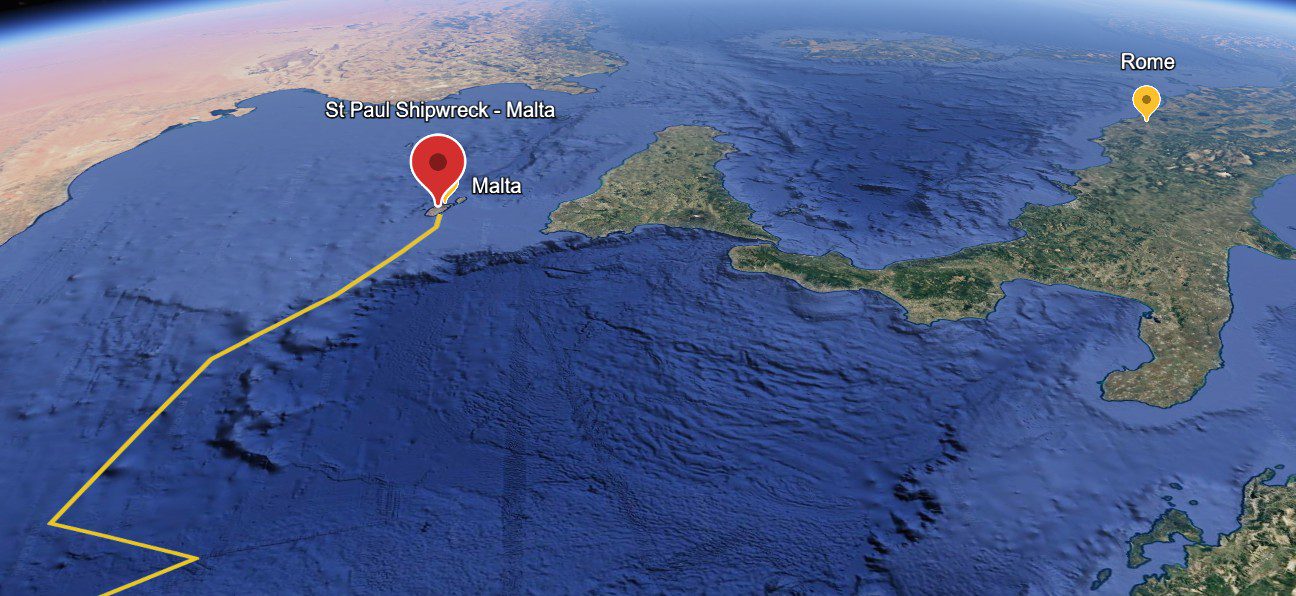
    Malta - Earth view of Malta in the Mediterranean Sea

    Acts of the Apostles 28:

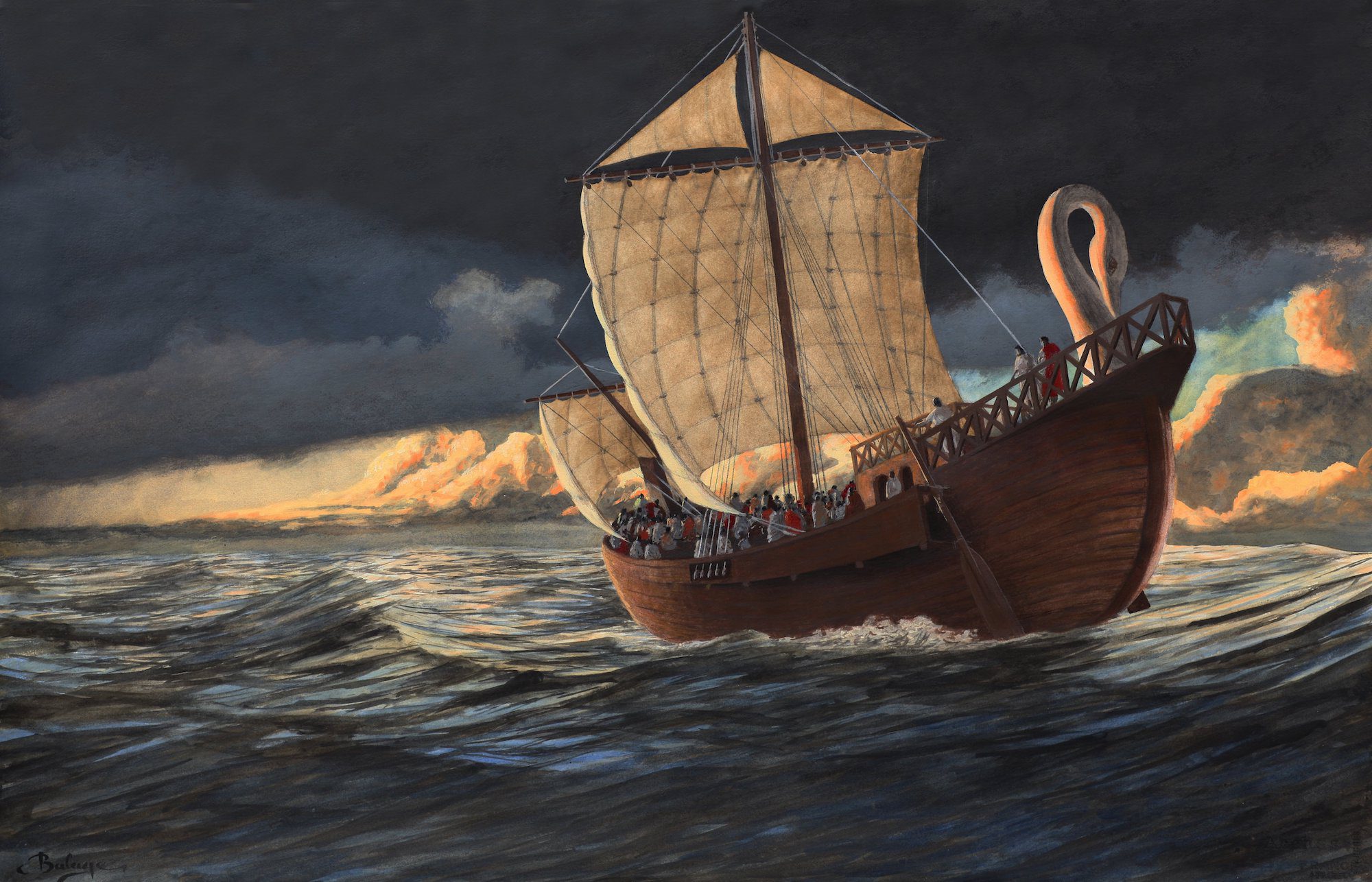
    Roman grain ship

    Once safely ashore, we then learned that the island was called Malta.

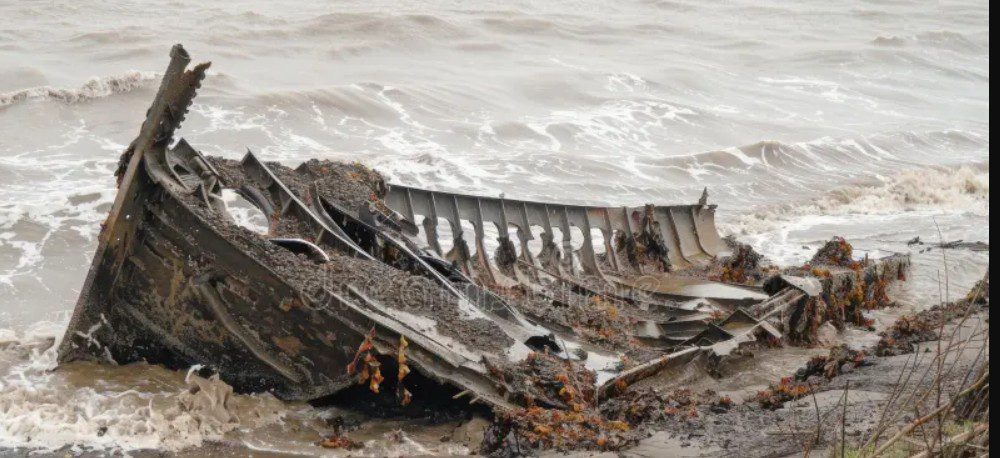
    shipwreck remains washed to shore as Paul's ship would have been devastated in a storm near Malta

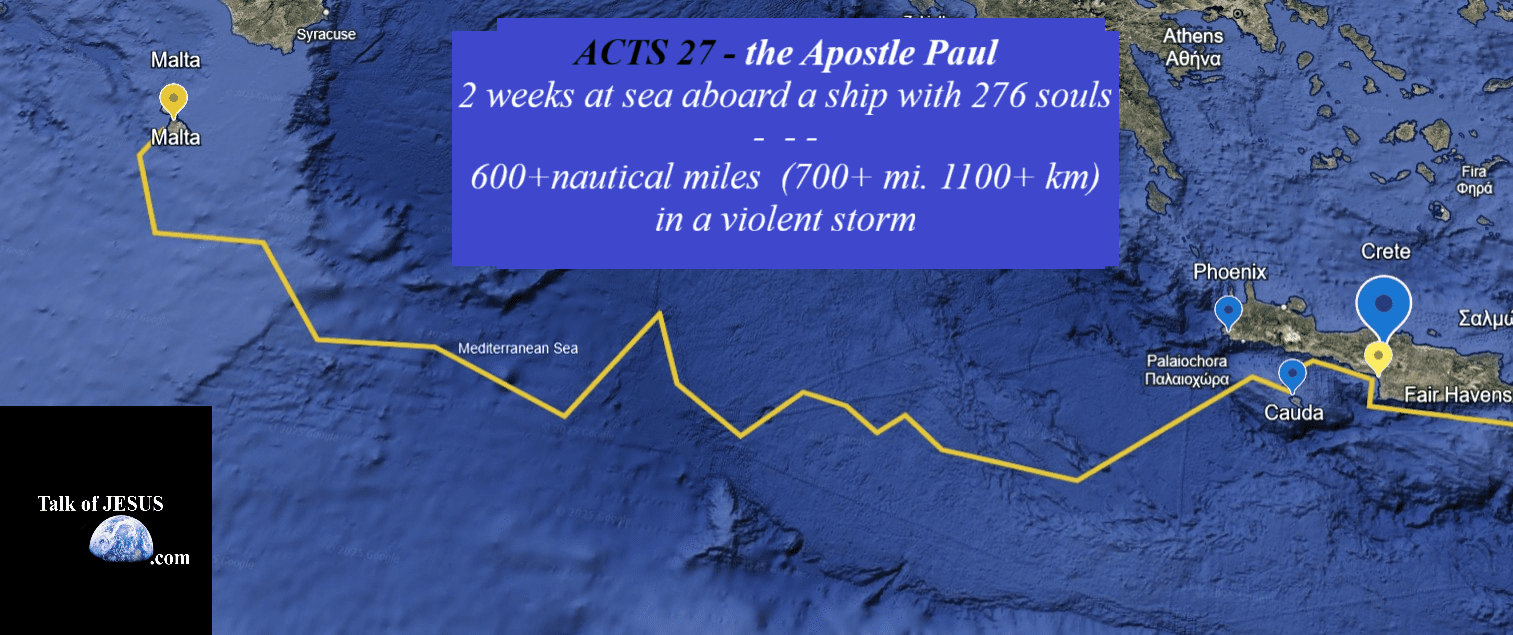
    Two hundred seventy-six men in the hand of God tossed about in an autumn storm of the Mediterranean Sea survive —  some on planks and some on debris from the ship on a remote beach of Malta — far from their destination of Rome.

    And the barbarous people shewed us no little kindness: for they kindled a fire, and received us every one, because of the present rain, and because of the cold.

    Acts of the Apostles 28:2 KJV

    Melita or Malta history

    3 inhabited islands & 18 uninhabited

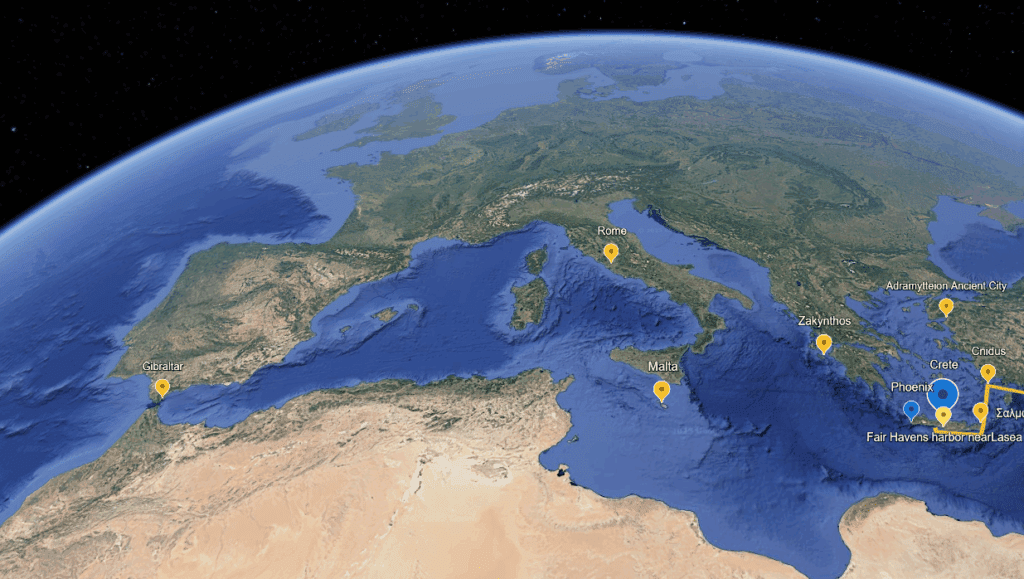
    Mediterranean Gibraltar to Crete - winter Tempests

    Ancient Greeks in 700 BC, then the Phoenician traders who were followed by the Romans.

    the Phoenicians referred to Mdina as Maleth, which means “shelter”. The Phoenicians were highly civilized people, with many great sailors and traders, who used the Maltese islands as a stop on their trade routes. Carthage (now known as Tunisia) was a city founded by the Phoenicians on the north coast of Africa and the Carthaginians ruled Malta from about 400 BC.

    The Carthaginians ruled the Maltese islands for ~250 years, until the Romans seized Malta in 218 BC at the second Punic War. Twisting the island’s Phoenician name, the Romans called MaltaMelita”.

    Source: Malta.com/en/

    Maltese Barbarians

    βάρβαρος - the barbourous people 

    The KJV contrasts the culture of these resident natives along the shore calling them barbarians simply because like all the rest of the Roman world and an inland city on Malta, they didn’t speak Greek.

    As Paul gathered an armful of sticks and was laying them on the fire, a poisonous snake, driven out by the heat, bit him on the hand. But Paul shook off the snake into the fire and was unharmed.

    Acts 28:3,5 NLT

    And when the barbarians saw the venomous beast hang on his hand, they said among themselves, No doubt this man is a murderer, whom, though he hath escaped the sea, yet vengeance suffereth not to live.

    Howbeit they looked when he should have swollen, or fallen down dead suddenly:

    but after they had looked a great while, and saw no harm come to him, they changed their minds, and said that he was a god.

    Acts 28:4,6 KJV


    Was it not a miracle that this man among more than 200 men had survived the raging sea?

    ship on the rocks like that in Acts 28 where Paul survives on Malta

    Acts 28: moving inland on Malta

    Near the shore where we landed was an estate belonging to Publius, the chief official of the island.

    (Note the Roman name of the man in charge of the island, as Julius had been in charge of Paul's ship wrecked on its shore.)

    He welcomed us and treated us kindly for three days.

    As it happened, Publius’s father was ill with fever and dysentery. Paul went in and prayed for him, and laying his hands on him, he healed him.

    Then all the other sick people on the island came and were healed.

    As a result we were showered with honors…

    Acts of the Apostles 28:7-10a NLT

    Safe and Blessed for the Winter

    DON’T MISS THIS:

    The Centurion Julius, the Apostle Paul and now more than 300 men witness the power of God in Christ’s Apostle to the gentiles delayed in a violent storm on his way to Rome.

    In these few verses THREE MONTHS PASS.

    Once the dangers of winter will no longer threaten Paul and his Roman companions and the Centurion Julian finds a new ship for their voyage, God-willing, we will sail on to Rome.

    Alexandrian ship in storm near Malta

    NEXT

    In the meantime, we will take a brief overview of ALL of Acts of the Apostles and timely connections of LETTERS written by Paul and other Apostles during these same years.

    I pray that you will join us as we continue our journey into all the world with the Gospel.

    Roger@TalkofJesus.com


    Comment on Scripture – Share the Gospel

  • Justice deferred in a Political Theatre of Law

    Justice deferred in a Political Theatre of Law

    We suppose Law to be a tool of Justice

    Citizens of Greek City-States claimed freedom and justice..

    (although like everywhere else, Greek democracy did not apply to its slaves.)

    Socrates drank the hemlock of justice weighed by his opponents of classic philosophy.

    And, of course, Alexander the Great Macedonian claiming all Greece and the world had different ideas of law to make the world Greek again.

    (“There’s nothing new under the sun,” stated Solomon, King over much of the same empire nearly a thousand years before Alexander.)

    Justina Roman goddess pictured "LAW in the Roman theatre of JUSTICE

    Roman Law

    In today’s setting of Acts of the Apostles it’s important for us to remember that in Jerusalem – Judean LAW (it isn’t even fully JEWISH LAW applicable in other Roman Provicences (or States by contemporary comparison) – as administered by the Sanhedron separate of the Roman Governor, a minor appointed Proconsul accountable to the Emporor.

    This jurisdictional oversight – similar to that when Pontius Pilate tried to pass the political hot potato of the King of the Jews back and forth to Herod or the Jewish leaders of Jerusalem – is little different when just a few years later Paul retuns to Jerusalem to face JUSTICE redefined in various venues.

    Jews demanding JUSTICE

    The Apostle of Jesus sent to the Gentiles (Greeks) has just returned home.

    After his witness to the Jews (in Hebrew) of being sent by Jesus (who had been crucified) on the road to Damascus) AND being sent to the Gentiles — (this had been 20 years ago, back in A.D. 37) — once again, Paul proclaims Christ risen!

    The adjitated jewish crowd was about to stone him, just as when he himself had witnessed the execution of Stephen.

    “Is it lawful for you to flog a man who is a Roman citizen and uncondemned?”

    When the centurion heard this, he went to the tribune..

    Acts of the Apostles 22:25b-26a ESV

    There he's done it! 

    Paul initiates a whole chain-of-events triggering the chain-of-command in Roman oversight and justice.

    But on the next day, desiring to know the real reason why he was being accused by the Jews, he [the Tribune in charge of the Centurians] unbound him and commanded the chief priests and all the council to meet, and he brought Paul down and set him before them.

    Acts 22:30 ESV

    This JEWISH council — about seventy leading men, SUMMONED to apprear before the ROMAN Tribune and his COURT of Roman justice in Jerusalem — are NOT in charge of the proceedings. 

    Acts 23:

    And looking intently at the council, Paul said, “Brothers, I have lived my life before God in all good conscience up to this day.”

    Remember: Although the courtroom is that of the Jews, Paul — the DEFENDENT — faces them as his PROSECUTOR (not his judge).

    And the high priest Ananias commanded those who stood by him to strike him on the mouth.

    “God is going to strike you, you whitewashed wall!

    Are you sitting to judge me according to the law, and yet contrary to the law you order me to be struck?”

    Some savvy oral arguments take place (as is common in court). Paul seeks to divide the jury of his accusers:

    “.. It is with respect to the hope and the resurrection of the dead that I am on trial.”

    It worked. One of his fellow Pharisees stands in his defense,

    “We find nothing wrong in this man.

    What if a spirit or an angel spoke to him?”

    The dissension (between the two parties of the Pharisees and Sadducees)became violent.

    Now the Jews of this local lower court — to which the rules of the Pax Romana defer — sound more like a lynch mob than a place of justice AND (let’s not forget) Paulos is a ROMAN CITIZEN.


    And as a great dissension was developing, because the commander was afraid Paul would be torn to pieces by them, he ordered the troops to go down and take him away from them by force, and bring him into the barracks.

    Acts 23:10 LSB

    Conspiracy against Christ and His Apostle

    The world will often witness an unexplainable boldness in a certain saint of God is seemingly insurmountable circumstances. (This had happened with the Apostle time and time again during his ten-plus years of travel among the gentiles and Greeks.)

    The night before his highly anticipated public trial in Jerusalem the Apostle of Christ Jesus again received supernatural instruction.

    But on that very night, the Lord stood at his side and said,

    “Take courage; for as you have solemnly borne witness to My cause at Jerusalem, so you must bear witness at Rome also.”

    Acts 23:11 LSB

    Imagine — the Lord Jesus Christ, who had been crucified twenty-seven years ago —  the same risen Lord who had appeared in a vision of great glory twenty years ago —  stands beside the Apostle and now sends him to Rome!

    So of course, Paul is emboldened when he is brought to trial before the Roman court the next day.

    Meanwhile, more than forty of the jews made a plot to murder Paul (outside of the jurisdiction of the Roman authorities).

    They went to the chief priests and elders and said,

    “We have strictly bound ourselves by an oath to taste no food till we have killed Paul. Now therefore you, along with the council, give notice to the tribune to bring him down to you, as though you were going to determine his case more exactly. And we are ready to kill him before he comes near.”


    The Plot Thickens

    steps from Antonia Fortress to roofs of Temple porticos

    Paul’s jewish nephew hears of the plot of these forty men, so the young man heads to the Roman fortress to try to warn Paul.

    Paulos —  the Roman citizen held in protective custody after the big hubbub of the jewish crowds —  instructs his guards to go to the man in charge.

    Paul called one of the centurions and said,

    “Take this young man to the tribune, for he has something to tell him.”

    Acts 23:17 ESV

    The tribune [Claudius Lysias] took him by the hand, and going aside asked him privately, “What is it that you have to tell me?”

    Note the gentleness of this tribune, Claudius Lysias - a man in charge of the centurions of Antonia Fortress as he seeks to get to the truth of the matter. 

    The young son of Paul’s sister responds:

    “The Jews have agreed to ask you to bring Paul down to the council tomorrow, as though they were going to inquire somewhat more closely about him.

    But do not be persuaded by them, for more than forty of their men are lying in ambush for him, who have bound themselves by an oath neither to eat nor drink till they have killed him. And now they are ready, waiting for your consent.”

    Acs 23:21b-22 ESV

    “Tell no one that you have informed me of these things.”


    An Imposed Authority of Roman Justice

    “Get ready two hundred soldiers, with seventy horsemen and two hundred spearmen to go as far as Caesarea at the third hour of the night.[9 pm]

    Caesarea! a model of Roman incursion into all the world of the Mediterranean - a key port for Romans, a city where Cornelius, Philip, Peter, Paul and others brought the gospel
    Caesarea – (Caesar’s Palace in Judea

    Also provide mounts for Paul to ride and bring him safely to Felix the governor.”

    This military escort of a Roman citizen Paulos is most unlike the handling of Jesus the king of the Jews sent to the Pontius Pilate, governor of that time, (who happened to be in Jeruslem rather than Caesarea). 

    Official Orders sent with Paul

    “Claudius Lysias,

    to his Excellency the governor Felix,

    greetings.

    This man was seized by the Jews and was about to be killed by them when I came upon them with the soldiers and rescued him, having learned that he was a Roman citizen. And desiring to know the charge for which they were accusing him, I brought him down to their council. And desiring to know the charge for which they were accusing him, I brought him down to their council. And when it was disclosed to me that there would be a plot against the man, I sent him to you at once, ordering his accusers also to state before you what they have against him.”

    Acts 23:26-30 ESV

    You might call this 'the official COURT record.' 

    Of course —  ALL follow orders and the next scene with, with Roman effeciency, take place in Caesarea.

    Marcus Antonius Felix

    Antonius Felix, served as the Roman procurator of Judea from ~AD 52-58. He was appointed by the Emperor Claudius and was known for his harsh and often corrupt administration. Felix was a freedman of Claudius' mother, Antonia. - source: BibleHub 

    When they had come to Caesarea and delivered the letter to the governor, they presented Paul also before him.

    The Governor inquires about jurisdiction – that is, in effect – Am I the appropriate judge of this case?

    And when he learned that he [Paulos] was from Cilicia, he said, “I will give you a hearing when your accusers arrive.” And he [Antonius Felix] commanded him [the Centurian in charge of Paul’s escort] to be guarded in Herod’s praetorium [there in Caesarea].

    Acts of the Apostles 23:35 ESV [with names of prepositions]

    Justice – a Case to be continued


    Talk of JESUS . com

    Comment on Scripture – Share the Gospel