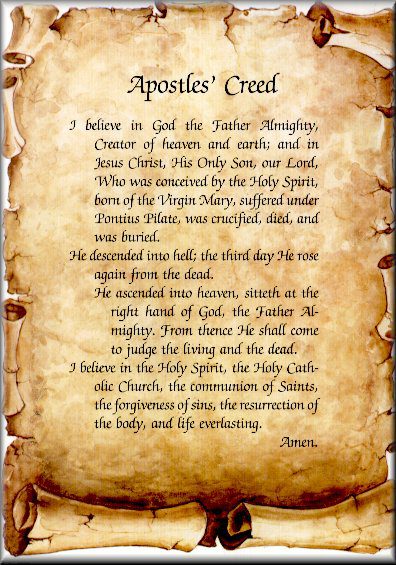
The Apostles’ Creed is foundational to our Apostolic Christian faith (even though Jesus’ Twelve Apostles didn’t write it).
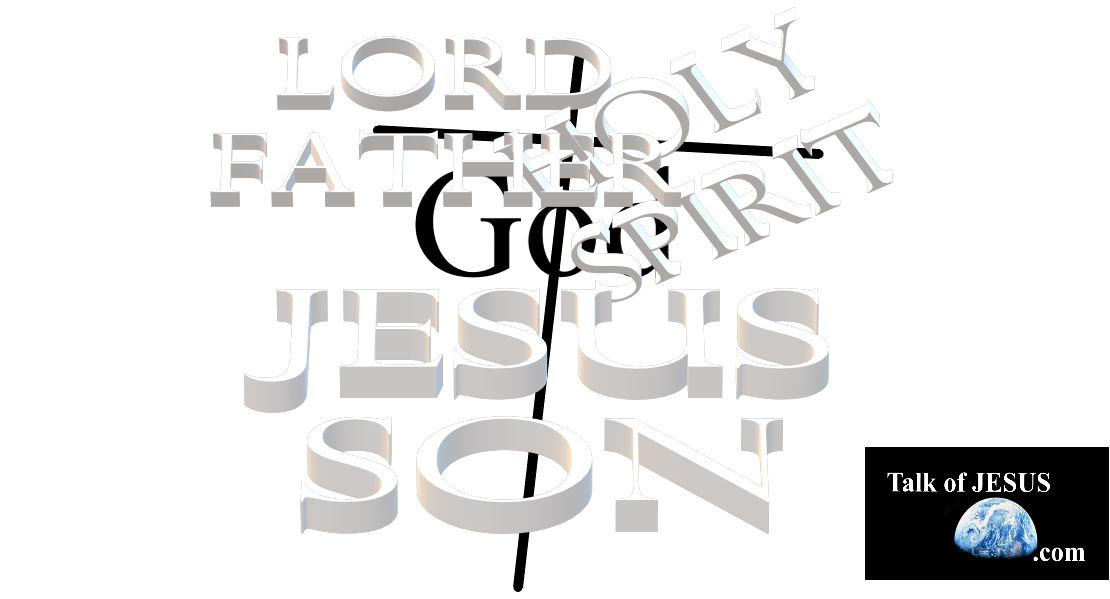
TalkofJESUS.com has previously examined and defined creeds and Trinity, but today we’ll briefly connect this fundamental of the faith to authority and truth of Apostolic faith from Scripture.
Talk of JESUS .com
Creeds and Credo
How do we know if our fellow worshipers also believe what we do?
Although creeds were originally individual (credo from the Latin, I believe), they shortly became statements of doctrine in which groups set forth their essential beliefs.
Zondervan Pictorial Encyclopedia of the Bible, Tenney, v.1,p.1025
We believe in…
That’s how (regardless of the frequency and regularity of our corporate affirmations) the Apostle’s Creed and other affirmations of faith came about.
Therefore, as part of weekly worship, baptism and other corporate gatherings of believers WE sometimes affirm our CREED together:
YOU witness publicly in worship of the LORD GOD that WE believe in this.
So, DO YOU?
Do YOU really believe this? It's a fair question — a foundational question of WHAT YOU BELIEVE concerning God and Jesus Christ (regardless of recitation as ritual or perhaps never having confessed your faith pubically at all).
Structure of Christian CREEDS
Here’s a brief outline of the fundamental objects of our faith found in The Creed:
I BELIEVE or WE BELIEVE IN:
God
Jesus Christ
the Holy Spirit
and the Virgin Mary
Jesus was crucified
and was buried
He rose from the dead
He ascended to heaven
He sits in the favored place of God the Father
He will judge the living and the dead.
Here, the weightiness of what we have just confessed must certainly convict the faithful soul. Then follows a reiteration and underlining of the same fundamental faith:
The early church taught what is basically in the Apostles creed, yet, they never had a written form of their teaching and called it “The Apostles Creed.” It was not till heresies and divisions in the church that any creeds were established.
The very first established creed that was accepted throughout the church as a whole was the Nicene Creed. The Nicene Creed was established by the Ecumenical church in 325 A.D.. The Apostles creed was established shortly after.
Our outline above used for this SERIES taken from the Old Roman Creed (vide ante) from which the Apostles’ Creed was adapted and possibly in use before the mid-2nd century.
Christians proclaiming Apostolic faith adhere to the narrow path of Scriptural orthodoxy. (I am not the first to have said so.)
Roger@TalkofJesus.com
These essays are concerned only to discuss the actual fact that the central Christian theology (sufficiently summarized in the Apostles’ Creed) is the best root of energy and sound ethics.
G.K. CHESTERTON – ORTHODOXY (pub. AD 1908)
Chesterton also quipped:
There is only one unanswerable argument against Christianity: Christians.
ORTHODOXY (pub. 1994), forward by Philip Yancy, p.xii
The Apostles’ Creed and other affirmations of faith were adopted corporately by the Church to refute permeating heresies plaguing believers since the time of the Apostles.
We begin our SERIES from the Epistles of three Apostles with Simon Peter.
Peter – a Foundation of Apostolic Faith
Our best impressions of Simon Peter from the Gospels and the early ACTS of the Apostles cannot fully convey the heart of this ROCK whom JESUS had claimed for building His Church..
We tend to recall moments from back in the AD 30’s with Peter in Jerusalem.. Yet even then the Apostle was sent to surrounding towns with the Gospel.
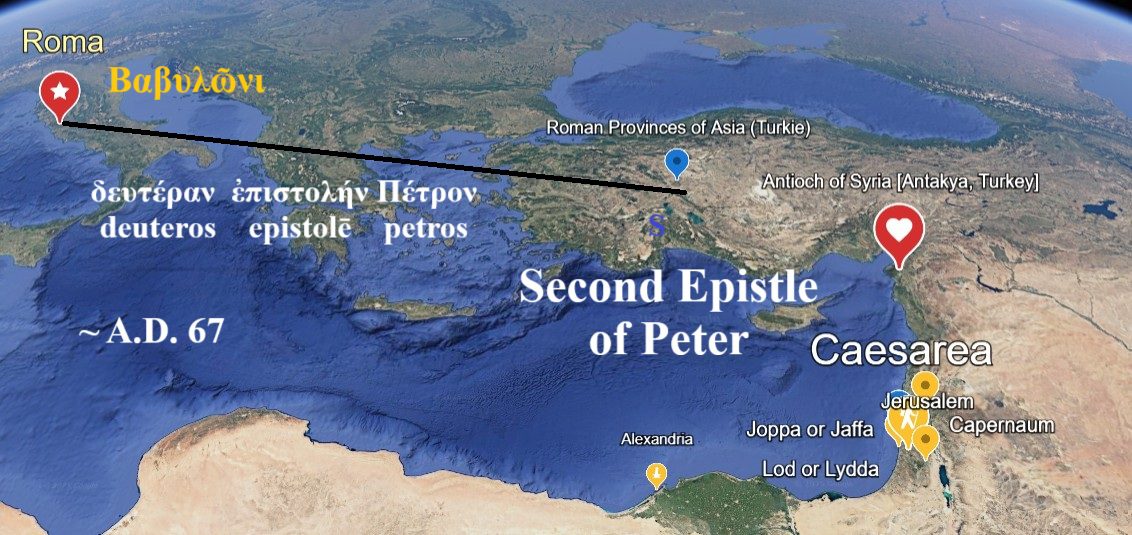
33 Years – Journeys from Capernaum to Rome
C
Capernaum
Jesus had appeared to Peter and others as they fished near the shore of the Sea of Galilee. The Lord instructed Simon Peter and the Apostles to go into all the world with the Gospel — Good News that they had all seen and touched, and had heard and obeyed the Lord – the risen Christ JESUS.
Now it is Simon Peter who will build not one church in Jerusalem, Capernaum or even Rome, but a living Church throughout the world (of Rome) — connected by the love of Christ and the Holy Spirit into a fellowship of saints sanctified and separated to the faith of eternal life in the Lord Jesus Christ.
Peter’s gospel is an apostolic gospel; Simon Peter’s faith is a Christian faith
So now after Jesus’ ascension, the Apostle will sojourn between Capernaum, Jerusalem and other Jewish communities of Galilee, eventually meeting Jewish believers from every corner of the world who will come to faith in Jesus Christ.
Simon Peter, sought out as a criminal by leading Jews opposing their own Messiah, would eventually be brought to Rome. Christ’s leading Apostle would also eventually be crucified there, but not until an appointed time after many years proclaiming the Gospel.
Like Paul and other Apostles, Peter wrote epistles and instructions for many years to those he had encouraged in the churches throughout Asia.
2 Peter
The World into which the Apostles Preached
~ AD 30’s – AD 60’s
We cannot fully appreciate the magnitude of Jesus’ great commission with only the Gospel accounts or even all Scripture of the Old Testament.
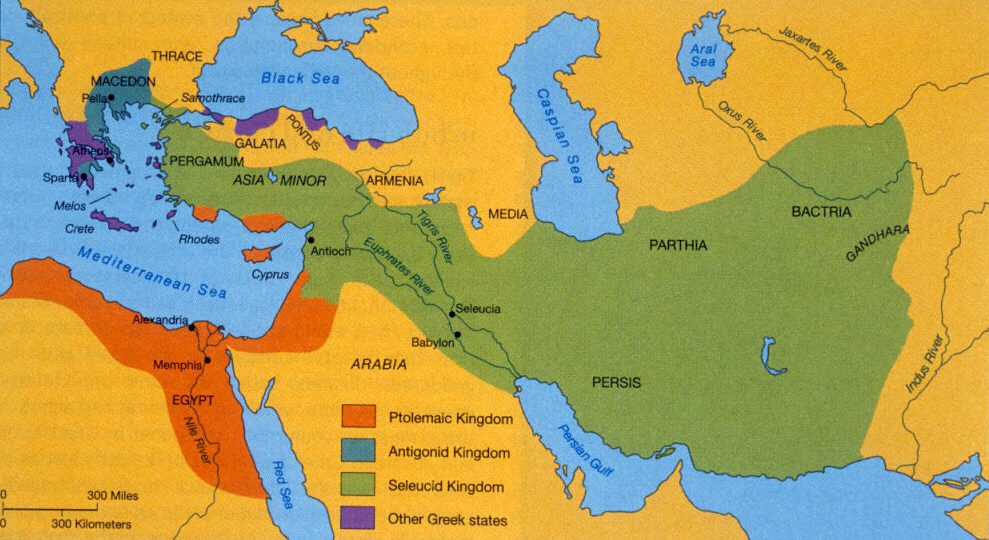
This is due a historic extended silence of God during a post-exilic gap which includes the powerful reign of Alexander the Great (of Macedonia) prior to the dominance of Rome.
a ROMAN world
The Messiah of Israel was given into a Roman world, not a Judaic land.
This Jewish fisherman, Simon Peter of Capernaum on the Sea of Tiberius (so renamed by Rome), though not a Roman, lived a daily existence dependent on Rome, This same dependence had also Romanized the half-Jewish Herod’s, adopted into an all-inclusive culture of the Caesar’s.
Without stepping into the Jewish controversies into which Jesus sometimes ventured about the state of Abrahamic or Mosaic of Semitic faith, let’s just say that Simon Peter’s faith, both before meeting the Messiah and after Jesus’ resurrection until now, is not specifically tied to either the Jewish sects returned from Medo-Persia or those Jews left in a devastated Israel and Judah.
Simon Peter sought to preach the Gospel to his fellow Jews, many who were local proselytes. Rome frequently rejected Jews, often sent on their way at any sign of controversy in distant provinces.
The Apostle writes to churches in lands once dominated by Alexander. And thousands of Jews had remigrated into a European world from an ancient Asia, once dominated by the Babylonians, Medes and Persians. [See your Old Testament.]
Greek culture prevails long after the return of the Jews into a Herodian re-built Roman Jerusalem.
The Twelve Apostles (and I include Matthias) led by Simon Peter were all Jews. And the scattered Jews throughout a world now dominated by Rome wanted to hear from these Apostolic witnesses of the risen Son of David, the Messiah Jesus.
a Second Epistle of Simon Peter
In case you missed the definition of Epistle, you may read it HERE from our introduction.
Simon Peter, a servant and apostle of Jesus Christ,
To those who through the righteousness of our God and Savior Jesus Christ have received a faith as precious as ours:
2 Peter 1:1 NIV
Who is Peter writing to?
We’ll get back to that in the context of this second letter, but let’s take a quick glance at his first epistle for an introductory clue.
παρεπίδημος Aliens of the Diaspora
Peter, an apostle of Jesus Christ,
To those who are elect exiles of the Dispersion in Pontus, Galatia, Cappadocia, Asia, and Bithynia, according to the foreknowledge of God the Father, in the sanctification of the Spirit, for obedience to Jesus Christ and for sprinkling with his blood:
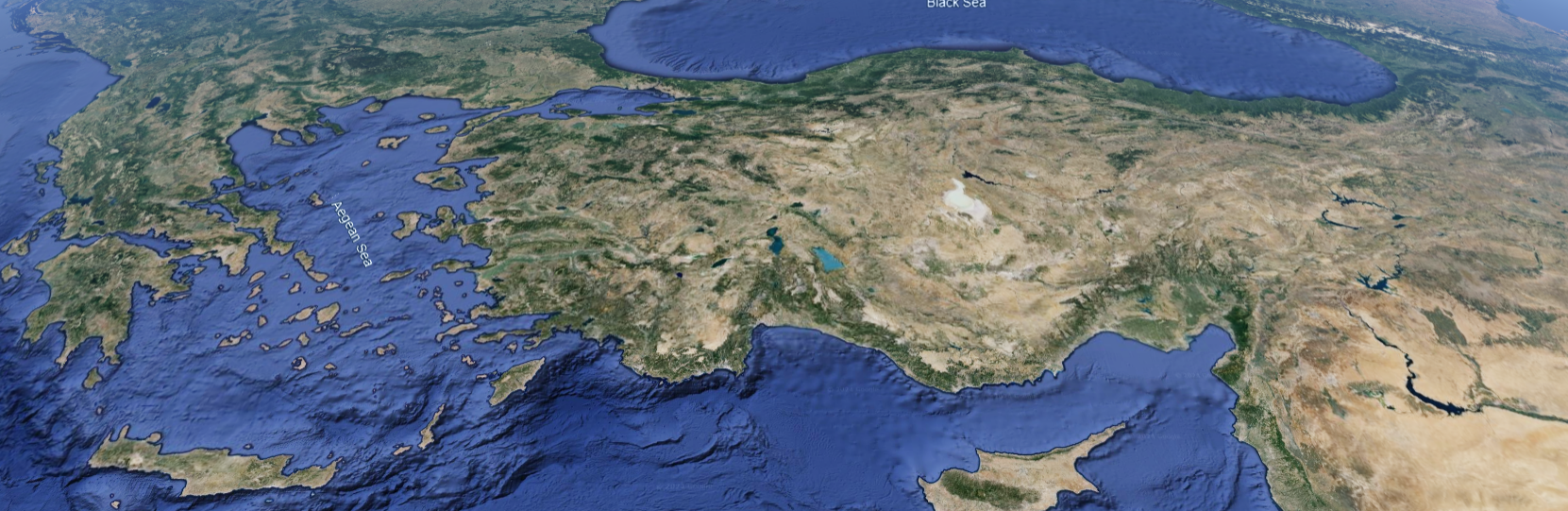
Anatolian peninsula
1 Peter 1:1-2a ESV
We can suppose that both epistles of Peter were sent to all of these churches on the Anatolian peninsula — all Roman provinces throughout modern-day Turkie.
some scholars date the Second Epistle of Peter in AD 64
These Jewish Christians, members of the Diaspora, are addressed here as pilgrims or sojourners… Jews expelled.. and living in a pagan environment.
1&2 Peter An Expositional Commentary, R.C. Sproul
Simon Peter: To the pilgrims
Peter, an apostle of Jesus Christ, To the pilgrims of the Dispersion..
1 Peter 1:1a New King James Version
"But WAIT.."as the old late-night TV ad suggested..
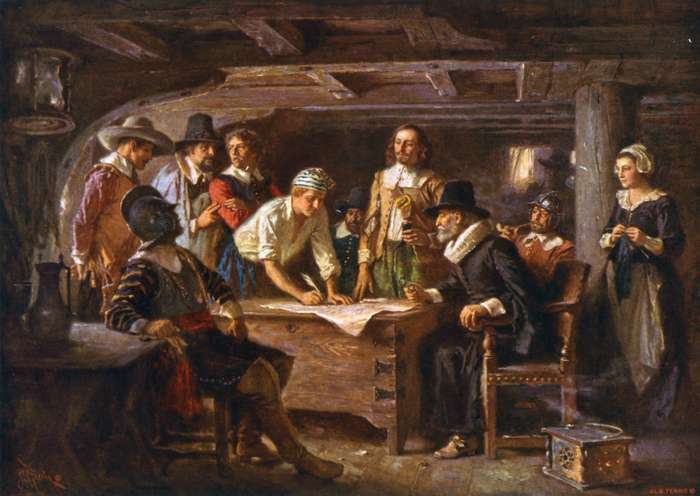
You probably have the WRONG PICTURE of PILGRIMS with an implanted prejudice of clashing cultures.
properly, “one who comes from a foreign country into a city or land to reside there by the side of the natives; hence, stranger; sojourning in a strange place, a foreigner“
Sojourn in this land, and I will be with thee,
Genesis 26:3a KJV – Oath of the LORD to Isaac, son of Abraham in Garar, a location south of Gaza – Source BLB
Alien, migrant, immigrant, foreigner — all have subtle prejudicial meaning.
These Christians to whom the Apostle’s write are rejected by former friends, neighbors and in workplaces. This sect of Jews following the way of the Messiah [or Christos] were also deported along with their families from their homes and Hellenist hometowns.
Therefore Christ-followers must sojourn to distant towns throughout the world of Roman citizens and pagans, those who rejected Jews anyway for the intolerance of their ONE GOD.
Why do they want to hear from Simon Peter?
Place yourself into any of the varied cities or towns in the Roman provinces addressed by the Apostle in ~ AD 64.
RC. Sproul in his PREFACE to 1-2 Peter offers one of the best descriptions of the heart of the saints receiving Simon Peter’s letter in the context of their situation:
Imagine what it would be like to receive a letter from someone who was a personal friend of Jesus during his earthly ministry?
Referring specifically to Peter, James and John, eyewitnesses to the glory of the transfigured Christ, Dr. Sproul continues:
A letter from a man such as this is a treasure for the church. His letter, beyond the value of his own eyewitness testimony and his intimate friendship with Jesus carries with it the weight of the divine inspiration of God the Holy Spirit.
ibid. R.C, Sproul
Why does Peter write a SECOND Epistle to them?
Remembering our AD 1st century cultural setting of the Church, as we discovered in Paul’s missionary journeys, the people living here are Hellenists.
Hellenists worshiped the tree of knowledge — towering temples of their gods — where philosophers plucked the forbidden fruit of wisdom.
Therefore, brethren, be even more diligent to make your call and election sure, for if you do these things you will never stumble
2 Peter 1:10 NKJV
Again, quoting R.C. SPROUL from: BE ALL THE MORE DILIGENT TO MAKE YOUR CALLING AND ELECTION SURE, concerning the recipiants of 1 Peter (likely the same churches):
The gnostics took a variety of religions and philosophies and thought to blend them to produce a new religion or philosophy… They targeted the early Christian community.. The only way the Gnostics could seduce Christians to believe their heresy was to undermine the authority of the Apostles.
ibid. p.6
Therefore,
Simon Peter, doulos and Apostle of Jesus Christ
2 Peter 1:1
writes an epistle —
(Remember the one definition emphasizing its impact as a letter of written command?) —
to encourage Elders ‘ (and those saints willingly obedient to their teaching [doctrine] and authority)
in the (precise and correct) KNOWLEDGE of God [epignōsis theos] and of Jesus our Lord..
NEXT .. 2 PETER 1:
His precious and magnificent promises
Partakers of the Divine Nature
Cookie Consent
We use cookies to improve your experience on our site. By using our site, you consent to cookies.
Used to monitor number of Google Analytics server requests
10 minutes
__utmb
Used to distinguish new sessions and visits. This cookie is set when the GA.js javascript library is loaded and there is no existing __utmb cookie. The cookie is updated every time data is sent to the Google Analytics server.
30 minutes after last activity
__utmc
Used only with old Urchin versions of Google Analytics and not with GA.js. Was used to distinguish between new sessions and visits at the end of a session.
End of session (browser)
__utmz
Contains information about the traffic source or campaign that directed user to the website. The cookie is set when the GA.js javascript is loaded and updated when data is sent to the Google Anaytics server
6 months after last activity
__utmv
Contains custom information set by the web developer via the _setCustomVar method in Google Analytics. This cookie is updated every time new data is sent to the Google Analytics server.
2 years after last activity
__utmx
Used to determine whether a user is included in an A / B or Multivariate test.
18 months
_ga
ID used to identify users
2 years
_gali
Used by Google Analytics to determine which links on a page are being clicked
30 seconds
_ga_
ID used to identify users
2 years
_gid
ID used to identify users for 24 hours after last activity
24 hours
_gat
Used to monitor number of Google Analytics server requests when using Google Tag Manager
1 minute
_gac_
Contains information related to marketing campaigns of the user. These are shared with Google AdWords / Google Ads when the Google Ads and Google Analytics accounts are linked together.