Tag: Isaiah

  • God’s Love Through John: A God-sent Baptist

    God’s Love Through John: A God-sent Baptist

    John the Baptist is a brash Nazarite, an older cousin of Jesus who confronts all with our need for repentance.
    There was a man sent from God whose name was John. He came as a witness to testify about the light, so that all might believe through him.

    John 1:6-7 CSB

    The Gospel prologue of the Apostle John describes John the Baptist as an apostellō ἀποστέλλω, one commissioned or sent.

    See: John 1:6

    The Baptist has gained a notable following, therefore officials of the Temple send men to keep tabs on this brash Prophet.

    John the Baptist is not the kind of parishioner you particularly want to visit your synagogue.  He even challenges the validity of Herod, King of Judea. And even more threatening than that, John now has a growing following among common Jews, even as some advocate violence against their Roman captors.

    Who are you?

    19 This was John’s testimony when the Jews from Jerusalem sent priests and Levites to ask him, “Who are you?”

    John the Baptist’s Testimony

    And he confessed and did not deny; and this is what he confessed:

    “I am not the Christ.”

    21 “What then?” they asked him. “Are you Elijah?”

    “I am not,” he said.

    They asked this because of a prophesy of Malachi. 

    “Look, I am going to send you the prophet Elijah before the great and terrible day of the LORD comes.

    click for Malachi reference

    John is not the Messiah, but a messenger of the incarnation of the Messiah. Yet the Messiah would no more bring a terrible immediate judgment on Israel than John, but a lasting fulfillment of all prophesy.

    “Are you the Prophet?”

    “No,” he answered.

    John humbly answers that he is not a Prophet, but Jesus will later state clearly that John is the greatest Prophet who has ever lived. The purpose for which John is sent is not prophesy, but announcement of the Messiah.

    22 “Who are you, then?” they asked. “We need to give an answer to those who sent us. What can you tell us about yourself?”

    23 He said,

    “I am a voice of one crying out in the wilderness:

    Make straight the way of the Lord—just as Isaiah the prophet said.”

    click for reference to Yeshaiya (Isaiah) 40:3

    What did they expect?

    Let’s take a brief look at this prophesy of Isaiah for a contemporary Jewish understanding of what John the Baptist had told them as an answer to who he was.

    Isaiah 40:

    “Comfort, comfort my people,”
    says your God.
    2 “Speak tenderly to Jerusalem,
    and announce to her
    that her time of forced labor is over,
    her iniquity has been pardoned,
    and she has received from the Lord’s hand
    double for all her sins.”

    Understand that Jerusalem is not only a political capital of Judea, but a religious capital — a place of worship of the LORD for all Israel. 

    A once united Kingdom of Israel under David and Solomon is now ruled as several different Roman-governed captive states called principates. [click to see more] Octavian has seized power from the republic of Rome and proclaimed himself as the Emperor Augustus Caesar, a ruler to be worshiped as one of many Roman gods in the world he conquers.

    3 A voice of one crying out:

    Prepare the way of the Lord in the wilderness;
    make a straight highway for our God in the desert.
    4 Every valley will be lifted up,
    and every mountain and hill will be leveled;
    the uneven ground will become smooth
    and the rough places, a plain.
    5 And the glory of the Lord will appear,
    and all humanity together will see it,
    for the mouth of the Lord has spoken.

    Isaiah’s prophecy for the freedom of Jerusalem does not say that all will take place at once; however the Jews, captives of Rome and led by a corrupt, evil and powerless King Herod, certainly must have hoped for the Lord to intervene as in the days of Moses.

    In the time of John the Baptist, the wildness near the Jordan would have been a welcome escape from the delicate politics of the Pharisees, Priests, Scribes, Temple guards and Roman legions, who all maintained strict loyalties and delicate alliances.

    Why do you baptize?

    In fact, John, the messenger of the coming Messiah preached repentance. It is the same message proclaimed by all prophets whose message is from the Lord. ‘Return to Me and I will again be your Lord.’

    John’s call to baptism of repentance is far more than a temporary religious cleansing, but personal commitment to a personal transformed return to the Lord.

    Baptism is a symbolic and public witness of this permanent change.

    click to learn more βάπτισμα

    New traditions of worship established during Israel’s several recent captivities had cultivated a politically-charged conversation about religious observances and traditions. Not least among these religious disputes is the need for cleansing and the role of various religious authorities. Of course, Jerusalem’s religious authorities had been limited not only by Rome, but also by the Herod’s.

    John 1:

    24 Now they had been sent from the Pharisees. 25 So they asked him, “Why then do you baptize if you aren’t the Messiah, or Elijah, or the Prophet?”

    26 “I baptize with water,” John answered them.

    Here is John’s message for the religious officials of captive Jerusalem:

    “Someone stands among you, but you don’t know him.

    27 He is the one coming after me, whose sandal strap I’m not worthy to untie.”

    MORE: He will baptize you with the Holy Spirit and fire.

    What next for John the Baptist?

    What do you suppose the reaction of the Pharisees in Jerusalem, Herod and others might be? 

    Fear, perhaps?

    For if the one coming after John stands among them and they don’t even know Him, the Messiah of God will have great power.

    Would the Messiah oppose the religious leaders of the chosen?

    Further, John the Baptist has a great following of the common people, faithful Jews willing to repent of their sins. A righteous crowd following powerful leaders threaten a religious and political establishment subservient to Rome and disobedient to the LORD.

    The Pharisees must be concerned about both the preaching of John and his announcement of the Messiah.

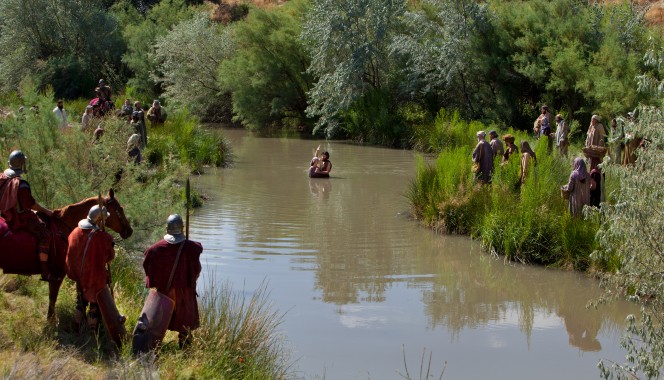
    depiction of John baptizing a man at the Jordan river

    28 All this happened in Bethany across the Jordan, where John was baptizing.


    To be continued...
  • A River of Redemption Flowing from Eden – 7 – Upstream in History

    A River of Redemption Flowing from Eden – 7 – Upstream in History

    Philip found Nathanael and said to him, “We have found him of whom Moses in the Law and also the prophets wrote, Jesus of Nazareth, the son of Joseph.” – John 1:45 ESV

    What does it mean to look upstream in history? Those seeking eternal truth look back through the eyes of scripture.

    A Basis of Law and Justice

    Looking back on the source of law somewhat resembles our search for Eden and the basis of life. We move from the still waters of a river with visible bottom to swim upstream against torrents of the unseen. How can we see justice and redemption, so distant to our own existence? 

    The answers of justice rest not in the law, but in the Lawgiver and relationship of the redeemed.


    Before the incarnation of the Messiah, yet long after the fall of Jerusalem  the Prophet Isaiah [יְשַׁעְיָה] had proclaimed: 1:27 צִיֹּון בְּמִשְׁפָּט תִּפָּדֶה וְשָׁבֶיהָ בִּצְדָקָֽה׃

    Zion shall be redeemed by justice, and those in her who repent, by righteousness. But rebels and sinners shall be broken together,
    and those who forsake the LORD shall be consumed. – Isaiah 1:27-28


    Even Isaiah had looked back upstream through the torrent of sin, just as Moses had warned in Genesis.

    9 If the Lord of hosts
    had not left us a few survivors,
    we should have been like Sodom,
    and become like Gomorrah.

    10 Hear the word of the Lord,
    you rulers of Sodom!
    Give ear to the teaching of our God,
    you people of Gomorrah!

    These warnings to obedience refer not to the law, but a broken relationship with the Lord and sinful relationships with other men. Law has basis in the relationships of men and women to each other; but above all, law requires a relationship to the commands of the Living God.

    Do godless men and evil women desire judgment?

    Their contempt for authority reflects the darkness of a mortal life lacking fear of The Almighty God. They neglect, trespass and try to circumvent the law. 

    Evil men and godless women rebel against righteousness, without regard of consequence for others or their own inevitable punishment when convicted. Do you rebel against righteousness?

    Justice fails when licentiousness claims all sin as freedom.    

    Though we tend towards lawlessness, we are free to choose obedience to the Lord. A humble sinner desires mercy and the repentant law-breaker wants restoration of relationship with the Lord. And this in addition to redemption with a community of loved-ones.

    Returning to Joseph, further upstream

    Moses, giver of the Law, was educated in Egypt and instructed by the Lord. In our previous look at these two men we learned  that Joseph was educated by Israel in Canaan, but also apprenticed under Potiphar and Pharaoh in Egypt.

    GENESIS 41:

    28 “It is just as I told Pharaoh: God has shown Pharaoh what he is about to do…

    … all the abundance in the land of Egypt will be forgotten. The famine will devastate the land… the matter has been determined by God, and he will carry it out soon.

    34 Let Pharaoh do this: Let him appoint overseers over the land and take a fifth of the harvest of the land of Egypt during the seven years of abundance.


    Does anyone note the 20% tax here? It allows the administration of government to help its citizens in the seven years of struggle ahead. Of course, the tithe (tenth) to the Lord was long established.

    Even in Egypt the King may have just required a double-portion to balance the years ahead when major markets would fail. No crops, therefore no income for the country. In addition, the people would need help or they would perish.

    We cannot think of law separate of its authority, intent and righteousness.

    Joseph, with God’s help, redeems not only Egypt, but also its struggling neighbors (for a small price). These would include his own brothers and father.

    Where there is no vision, the people perish: but he that keepeth the law, happy is he. – Proverbs 29:18 KJV


    Prince Zaphenath-paneah

    41 Pharaoh also said to Joseph, “See, I am placing you over all the land of Egypt.” 

    … 45 Pharaoh gave Joseph the name Zaphenath-paneah and gave him a wife, Asenath daughter of Potiphera, priest at On. [Heliopolis] And Joseph went throughout [Joseph gained authority over] the land of Egypt…

    50 Two sons were born to Joseph before the years of famine arrived. Asenath daughter of Potiphera, priest at On, bore them to him.

    53 Then the seven years of abundance in the land of Egypt came to an end, 54 and the seven years of famine began, just as Joseph had said. There was famine in every land, but in the whole land of Egypt there was food.

    55 When the whole land of Egypt was stricken with famine, the people cried out to Pharaoh for food. Pharaoh told all Egypt, “Go to Joseph and do whatever he tells you.”


    Moses and Pharaoh would have both spoken Egyptian (the language that became Coptic, not modern Egyptian Arabic). Moses would have almost certainly spoken Hebrew too. – source 

    As Moses looks upstream toward this time he reminds the Hebrew people, who have not yet entered the promised land of Joseph. It would be accurate in Hebrew to say this. 

    41:55 וַתִּרְעַב כָּל־אֶרֶץ מִצְרַיִם וַיִּצְעַק הָעָם אֶל־פַּרְעֹה לַלָּחֶם וַיֹּאמֶר פַּרְעֹה לְכָל־מִצְרַיִם לְכוּ אֶל־יֹוסֵף אֲשֶׁר־יֹאמַר לָכֶם תַּעֲשֽׂוּ׃

    Yet in their native Egyptian language, now the fluent first language of Joseph, these God-spoken words through Pharaoh would have been heard and later told in all the land:

    Pharaoh told all Egypt, “Go to Zaphenath-paneah and do whatever he tells you.”

    A familiar Redeemer we do not understand

    Later, Israel will send his other sons to Pharaoh to buy the grain they must have for survival of their animals and for food.

    The ruler of Egypt they hear (actually, Joseph) speaks a different language. He looks different than these poor men who humbly raise sheep and trade for those things they require. This redeemer they hear speaks through others in a foreign language.

    Genesis 42:

    “Where do you come from?” he asked.

    “From the land of Canaan to buy food,” they replied.

    “You are spies. You have come to see the weakness of the land.”

    “No, my lord. Your servants have come to buy food,” they said.

    17 So Joseph imprisoned them together for three days.

    18 On the third day Joseph said to them, “I fear God—do this and you will live.

    Moses’ hearers knew the outcome of redemption as we do; but Israel’s other sons did not.

    Read this reunion story again, as experienced from the fear of these men now humbled, hungry and imprisoned by a rich foreign ruler. 

    Their Redeemer Revealed

    Time passes as Israel’s sons return to him in Canaan, but the famine continues and they again run out of food. No alternative but to return to Egypt, ruled by Zaphenath-paneah, whose word is law of the land.

    Genesis 43:

    But the men were afraid because they were taken to the house of Zaphenath-paneah. (Of course, Moses tells us his true identity even before this redeemer of Israel reveals the Lord’s purpose.)

    … they brought him the gift they had carried into the house, and they bowed to the ground before him.

    27 He asked if they were well, and he said, “How is your elderly father that you told me about? Is he still alive?”

    28 They answered, “Your servant our father is well. He is still alive.” And they knelt low and paid homage to him.

    32 They served him by himself, his brothers by themselves, and the Egyptians who were eating with him by themselves, because Egyptians could not eat with Hebrews, since that is detestable to them.


    Are you, poor sinner, detestable to the rich? Would they choose to disavow you because they do not know the God we serve?


    Everyone leaves and they depart the next morning. Then yet another deceptive plot to bring them back once more.

    Judah pleads: “My lord, please let your servant speak personally to my lord. Do not be angry with your servant, for you are like Pharaoh. [44:18]

    Genesis 45:

    Joseph could no longer keep his composure in front of all his attendants, so he called out, “Send everyone away from me!”

    No one was with him when he revealed his identity to his brothers. 2 But he wept so loudly that the Egyptians heard it, and also Pharaoh’s household heard it.


    You know the rest, but have you weighed justice by the measure of the Lord’s purposes?

    Do you truly believe that God provides a redeemer not only through your own sufferings, but through suffering and injustice to another?

    ‘Why does God allow evil?’ we ask.

    The Redeemer of Israel gives us the Lord’s answer.

    Moses tells a people who have endured forty years in the wilderness after the passing of a generation who turned against the Law, which they both heard from the Lord and read on tablets of stone from the finger of God:

    Listen to Joseph’s words to his brothers of why this evil has happened.


    4 Then Joseph said to his brothers, “Please, come near me,” and they came near. “I am Joseph, your brother,” he said, “the one you sold into Egypt.

    7 God sent me ahead of you to establish you as a remnant within the land and to keep you alive by a great deliverance. 8 Therefore it was not you who sent me here, but God.


    And consider the weight and Authority in Joseph’s next words about Providence:

    He has made me a father to Pharaoh, lord of his entire household, and ruler over all the land of Egypt.

    A ‘father‘ to Pharaoh; not only as Jacob is their father but also in authority, even loving authority, as God IS our Father.

    Later Joseph will give the reason for their redemption:

    As for you, you meant evil against me, but God meant it for good, to bring it about that many people[fn] should be kept alive, as they are today. – Genesis 50:20 ESV

    22 Joseph and his father’s family remained in Egypt. Joseph lived 110 years.


    To be continued…


  • Disaster From Disobedience, A Savior From Before Eden – 3

    The Fall before the Fall

    … so also the Messiah, having been offered once to bear the sins of many, will appear a second time, not to bear sin, but to bring salvation to those who are waiting for Him.

    Hebrews 9:28 HCSB

    In ‘Disaster From Disobedience 2’  we considered the ‘In the beginning’ creation narrative. Genesis continues with the creation of man. We know that the fall of mankind and our expulsion from Eden will follow, but consider first an earlier significant event, the fall of angels.

    The Fall Of The Rebel Angels Painting by Gustave Dore

    Luke 10:

    … “Lord, even the demons submit to us in Your name.”

    18 He said to them, “I watched Satan fall from heaven like a lightning flash.

    19 Look, I have given you the authority … over all the power of the enemy; nothing will ever harm you. 20 However, don’t rejoice that the spirits submit to you, but rejoice that your names are written in heaven.”


    Christ Jesus instructs followers of what only the Son of Man from before creation can know. Angels disobeyed God, Creator and Master of all He Created.

    Yet witness here Christ’s authority over fallen angels. Demons submit to God by the Apostle.s command in Christ’s authoritative Name.

    Angels – Other Beings who Serve

    Angels were created also to serve God. When? We can’t be certain, but we do know that it was prior to the fall of man. And like us, they were also given freedom for obedience. 

    I suppose it is possible that angels and man were created at the same time, since Adam and Eve may have lived many years in Eden until the fall. Yet the presence of the serpent in Eden would seem to indicate an earlier creation of angels.

    Like mankind, some angels rebelled against the purpose for which the Lord God created them. God created angels as several, specific types of spirit-creatures. Angels are not the spirits of those who have died, but were created as beings in heaven. And like the creatures of earth, not all angels are alike. 

    Picture angels as many individual and diverse spirit-beings just as the creatures of this Earth vary.  Visualize their lives in a real and existing, unseen dimension, separate of this visible place.

    Unlike the Lord, no spirit rules over the day or fills flesh with the power of life! Angels are messengers for good or for evil, depending on who they serve.

    The Fallen Star 

    Satan is just one of the disobedient angels of darkness, posing falsely as hope for mankind.

    Returning briefly to a time after the fall of Jerusalem, the Prophet Isaiah had predicted Israel’s return after seventy years of captivity. Isaiah also interestingly described hell and the fall of Satan.

    Isaiah 14:

    12 “How you are fallen from heaven,
    O Lucifer, son of the morning!
    How you are cut down to the ground,
    You who weakened the nations!
    13 For you have said in your heart:
    ‘I will ascend into heaven,
    I will exalt my throne above the stars of God…
    14 I will ascend above the heights of the clouds,
    I will be like the Most High.’
    15 Yet you shall be brought down to Sheol,
    To the lowest depths of the Pit…

    Disaster is not punishment for sin, but consequence of the fall.

    Job chronicles several conversations between the Lord and Satan. Here Satan comes before the Lord asking for permission to inflict evil upon Job, even though God sites Job as blameless. The common scene is Satan as prosecutor, accusing and condemning the criminal to death for some sin; even tempting man to turn again God and follow his own demise into eternal punishment.

    Job 1

    6 One day the sons of God came to present themselves before the Lord, and Satan also came with them. 7 The Lord asked Satan, “Where have you come from?”

    “From roaming through the earth,” Satan answered Him, “and walking around on it.”

    Beware of the tempter

    Beware of what you cannot see, for Satan roams the earth for the prize of sinners tempted into disobedience against God.

    Satan rules unseen spirits and principalities of darkness. Whether original sin, where the tempter is mentioned as the serpent or in Isaiah, where Lucifer appears as false light, Satan seeks disobedient sinners.

    Even now that prince of devils opposes righteous men and women who seek to serve God and Christ faithfully.


    8 Then the Lord said to Satan, “Have you considered my servant Job? No one else on earth is like him, a man of perfect integrity, who fears God and turns away from evil.”

    9 Satan answered the Lord, “Does Job fear God for nothing? 10 Haven’t you placed a hedge around him, his household, and everything he owns? You have blessed the work of his hands, and his possessions have increased in the land. 11 But stretch out your hand and strike everything he owns, and he will surely curse you to your face.”


    The entire saga of Job begs the question from his wife, his friends and the reader, “Why would God allow this to happen to ‘a man of perfect integrity, who fears God and turns away from evil?’” 

    The Lord even permits Job to question the intentions of the Almighty! However the LORD answers Job and the readers at length.

    HE IS THE LORD! … and man is not. 

    Nor is Satan, or angels; kings or idols. God IS God and we are not. Yet we would do well to remember the tempter’s appeal to our own desires, even as in Eden and since the inherited evil of ‘adam.

    Angels who serve God

    Much more is written of angels serving the fallen prince of the darkness and angels who remain messengers and worshipers of the Lord God.

    Though our series addresses our disobedience, let’s close with a brief description by a Prophet of spirits near to the Living God. And like other descriptions of heaven, our mortal minds can barely take-in the immense glory of the scene.

    Ezekiel 1

    4 I looked, and there was a whirlwind coming from the north, a huge cloud with fire flashing back and forth and brilliant light all around it. In the center of the fire, there was a gleam like amber. 5 The likeness of four living creatures came from it, and this was their appearance:

    They looked something like a human, 6 but each of them had four faces and four wings. 7 Their legs were straight, and the soles of their feet were like the hooves of a calf, sparkling like the gleam of polished bronze. 8 They had human hands under their wings on their four sides. All four of them had faces and wings. 9 Their wings were touching. The creatures did not turn as they moved; each one went straight ahead.

    10 Their faces looked something like the face of a human, and each of the four had the face of a lion on the right, the face of an ox on the left, and the face of an eagle. 11 That is what their faces were like. 

    Their wings were spread upward; each had two wings touching that of another and two wings covering its body. 12 Each creature went straight ahead. Wherever the Spirit wanted to go, they went without turning as they moved…

    Throne of the LORD

    lapis lazuli

    25 A voice came from above the expanse over their heads; when they stopped, they lowered their wings. 26 Something like a throne with the appearance of lapis lazuli was above the expanse over their heads.

    On the throne, high above, was someone who looked like a human…


    Read on if you like, or read other descriptions of the awe of the Lord and of the heavenly servants which include angels

    Man is fallen and sin has consequence. Next, we will return to the fall of man.


    To be continued…