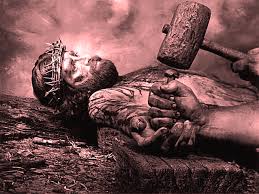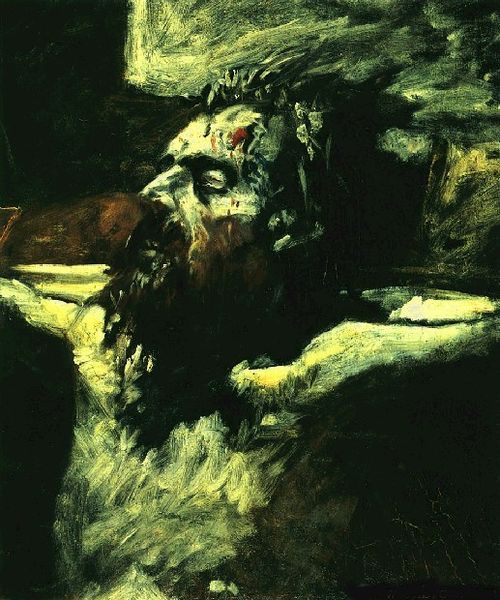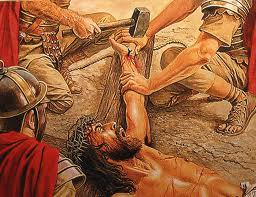
What does does a scene of Jesus enduring excruciating when being NAILED to a CROSS have to do with us?
At the urging of a beloved brother in Christ I will once again witness the ANSWER to my opening question in this UPDATED post ABOUT GOOD FRIDAY from A.D. 2014.
What happened April 18, Good Friday, 2014?
As for Good Friday ~30 years ago (a guess in recalling that eventful year):
I could NOT find any more significant event than this..
Born again in the Holy Spirit!
I am witness that God filled me with His Holy Spirit of new Life in Christ Jesus twenty years ago on Good Friday.
Roger@talkofJesus.com
The convicting evidence of my sin and Christ’s Sacrifice was given to me by the Holy Spirit as I prayerfully walked through the Stations of the Cross, when “Jesus is nailed to the Cross.”
NOTE: YouTube labels the LINK ABOVE (same link below)
Age-restricted video (based on Community Guidelines)
I recommend it for any TEEN and adult who wants to see a 'Passion of The Christ' violent representation of NAILING JESUS TO THE CROSS FOR OUR SINS!
WE deserve what you see Christ enduring.
Christ’s suffering for my sins was excruciating!
Our conviction for HIS trial in darkness and swift execution of injustice ought to point toward the darkness of our own souls as we consider the Sacrifice of this innocent Son of Man on a Cross for us.
The Trial of Jesus
IF you dare to look into the shadows of the dark mirror of your mortal soul consider the accounts of the trial, torture and excruciating death of Jesus Christ!
Mark 14: … Judas came, one of the twelve, and with him a crowd with swords and clubs, from the chief priests and the scribes and the elders…
And they led Jesus to the high priest. And all the chief priests and the elders and the scribes came together.
And they all condemned him as deserving death.
65 And some began to spit on him and to cover his face and to strike him, saying to him, “Prophesy!”
And the guards received him with blows.
ALL this took place during the darkness of night.
However because of Rome, their captive government and Herod their King did not have the authority to execute a man… no death sentence.
And as soon as it was morning, the chief priests held a consultation with the elders and scribes and the whole council. And they bound Jesus and led him away and delivered him over to Pilate.
Pilate asked him, “Are you the King of the Jews?”
And he answered him, “You have said so.”
… But the chief priests stirred up the crowd…
And Pilate again said to them, “Then what shall I do with the man you call the King of the Jews?”
And they cried out again, “Crucify him.”
Pilate said to them, “Why, what evil has he done?”
But they shouted all the more, “Crucify him.”
(Is that not what the crowds of these last days shout at mention of the Name of Jesus Christ?)
So Pilate (politician & diplomat), wishing to satisfy the crowd…
Understand the excruciating pain JESUS our Lord and Sacrifice suffered for our sins. From the Vine's Expository DictionaryPICTURE IT (even if you couldn't watch the video)
Scourge (Noun and Verb):
(akin to A: Latin, flagello; Eng., “flagellate”), is the word used in Mat 27:26; Mar 15:15, of the “scourging” endured by Christ and administered by the order of Pilate. Under the Roman method of “scourging,” the person was stripped and tied in a bending posture to a pillar, or stretched on a frame. The “scourge” was made of leather thongs, weighted with sharp pieces of bone or lead, which tore the flesh of both the back and the breast (cp. Psa 22:17). Eusebius (Chron.) records his having witnessed the suffering of martyrs who died under this treatment. Note: In Jhn 19:1 the “scourging” of Christ is described by Verb No. 2, as also in His prophecy of His sufferings, Mat 20:19; Mar 10:34; Luk 18:33. In Act 22:25 the similar punishment about to be administered to Paul is described by Verb No. 3 (the “scourging” of Roman citizens was prohibited by the Porcian law of 197, B.C.).
.. he [Pilate] delivered him [the unjustly scourged Jesus] to be crucified.
16 And the soldiers led him away inside the palace (that is, the governor’s headquarters), and they called together the whole battalion.
17 And they clothed him in a purple cloak, and twisting together a crown of thorns, they put it on him. 18 And they began to salute him,
“Hail, King of the Jews!”
19 And they were striking his head with a reed and spitting on him and kneeling down in homage to him. 20 And when they had mocked him, they stripped him of the purple cloak and put his own clothes on him.
Then they led him out to crucify him.
Truly, don’t you sometimes think that this is what you deserve for some of your sins?
Shouldn’t a Holy God punish ALL true sin?
How will we escape the wrath of God for so many sins of our past?
So they took Jesus, 17 and he went out, bearing his own cross, to the place called The Place of a Skull, which in Aramaic is called Golgotha.
18 There they crucified him, and with him two others, one on either side, and Jesus between them.
19 Pilate also wrote an inscription and put it on the cross. It read,
“Jesus of Nazareth, the King of the Jews.”
XI Jesus is Nailed to the Cross
Any Christian familiar with the stations of the Cross will recognize this moment commemorated.
It was the moment on a Good Friday about 30 years ago I was born again in the Spirit!
At the conclusion of my updated GOOD FRIDAY post in the year of our Lord 2023 on TalkofJESUS.com I will include a text for you to prayerfully READ as if you walked through all of the excruciating agony Jesus suffered prior to being NAILED to the CROSS.
Roger@talkofJesus.com
Jesus stands in the most human of places. He has already experienced profound solidarity with so many on this earth, by being beaten and tortured. Now he is wrongfully condemned to punishment by death. His commitment to entering our lives completely begins its final steps. He has said “yes” to God and placed his life in God’s hands. We follow him in this final surrender, and contemplate with reverence each place along the way, as he is broken and given for us…
Two issues & two cases continually used as precedent by God and Jesus (Advocate for believers):
Covenant between God and man, broken by man
Covenant between a man and his wife, broken by a man (who was the only one permitted by the Law to write a bill of divorce to put away his wife).
Malachi addresses the issue of unfaithfulness of God’s chosen people of Judah and the Priests of the Temple in Jerusalem by comparison of Judah as the chosen wife of God. Malachi 2:16 in the Revised Standard Version is translated:
“For I hate divorce, says the LORD the God of Israel, and covering one’s garment with violence, says the LORD of hosts. So take heed to yourselves and do not be faithless.” – Malachi 2:16
As we will address later, Jesus points out that from the beginning it was not so.
IF God and Christ hate divorce, THEN so should Christians.
IF God and Christ love truth, THEN so ought the vows of a Christian speak truth.
Isaiah takes it a step further and points out that the unfaithfulness of God’s wife is a covenant with death and warns us that such unfaithfulness to God not only breaks His covenant with us, but places us as adulterers against God in a counter-covenant:and with hell are we at agreement.
God instructs the Prophet Hosea to take the illustration of the covenant of marriage and the counter-covenant of the unfaithful woman with hell a step further. Hosea is told to marry a whore!
We will address the witness and truth of Christian marriage once again, later. We will also address the issue of truth verses hypocrisy.
Truth and covenant (solemn promise and vow of permanence) stand as witness before God in the Court of our betrothal to Righteousness.
Again, as books are opened before God our Judge, Isaiah indicts:
“for we have made lies our refuge, and under falsehood have we hid ourselves…”
Yet before the all-knowing eyes of the Lord our Creator, we stand naked in our sin. Again, in Hosea, God threatens to uncover our nakedness for all to see! God will show our naked sin to all IF we do not repent and return to Him who has married us, against whom we have committed adultery.
Shall I ransom them from the power of Sheol?
Shall I redeem them from Death?
O Death, where are your plagues?
O Sheol, where is your sting?
Compassion is hidden from my eyes.
We have broken our covenant with God!
Will the LORD not also punish the one who would stand before Him without truth?
Consider your covenant with God and with our Lord, Christ Jesus.
Before we reexamine the covenant of our ‘Christian Marriage,’ next we will consider God’s premium He places on truth.
14 And Jesus returned in the power of the Spirit to Galilee, and a report about him went out through all the surrounding country. 15 And he taught in their synagogues, being glorified by all.
Jesus Rejected at Nazareth
16 And he came to Nazareth, where he had been brought up.
Generally, Doctor Luke provides us with great detail of proof from eye witness accounts of Jesus and the Acts of the Apostles; however in this chronological glance at the beginning of Jesus’ three-year ministry on earth after being led into the wilderness by the Holy Spirit a look through the eyes of the Apostle Matthew is more helpful.
12 Now when he heard that John had been arrested, he withdrew into Galilee. 13 And leaving Nazareth he went and lived in Capernaum by the sea, in the territory of Zebulun and Naphtali…
Jesus of Nazareth, as He was known, then moved to and lived in Capernaum by the sea of Galilee.
17 From that time Jesus began to preach, saying, “Repent, for the kingdom of heaven is at hand.”
Let us speak to the vocation and mission of the Prophet for a moment.
To begin, God appoints Prophets, generally separate of the Priestly office and official leadership of God’s own people. Prior to John the Baptist, the Prophet spoke and wrote to and of the fallen Nations: Israel, Judah and the gentile nations who God used to humble and punish His own people into repentance.
Isaiah was probably an aristocrat with influence of kings. He lived about 700 years before Christ.
Jeremiah and Daniel ( both about 600 B.C.) were both young when God used them as prophets to their own people and both older as God used them to show His glory to the rulers of conquering gentile nations. Ezekiel is also an exile around the same time.
These men are not in charge; yet all, through the voice and power of God, call men to repentance.
Amos is just a farmer and a shepherd in Judah (about 800 B.C.) who God uses to announce the fall of the northern Kingdom Israel. Micah was just a countryman in Israel who lived near the Philistine border about this same time.
Hosea gets his marriage advice from God who instructs him to marry a whore, as His people have become. Jonah did not even want to be God’s Prophet and ran away (though God pursued and saved him.) We know almost nothing about the Prophet Joel.
Although Zechariah and Haggai were connected to the office of Priest, it was at a time after repentance during the rebuilding of the Temple by Ezra and Nehemiah (about 500 B.C.). Malachi warns of too casual of an attitude toward worship of God (about 460-430 B.C.).
The Second Temple is destroyed. God keeps silent for over 400 years – 20 generations!
Herod the Great, by alliance with gentile Rome, builds yet another Temple in captured Jerusalem.
Along comes John the Baptist telling another Herod, Pharisees, Sadducees, Scribes, Temple authorities and the people everywhere: REPENT!
He dresses and acts like a madman and lives in the wilderness; but the people believe and follow John. He baptizes and witnesses that Jesus of Nazareth is the one on whom the Spirit of God descends. He IS the Promised One.
Now Jesus, who they all knew since boyhood, a man raised as a carpenter moves away from His hometown. He travels a few miles, moving His belongings to a little inland fishing village, Capernaum. And what was Jesus’ first message to his new hometown?
Matthew 4:17 From that time Jesus began to preach, saying, “Repent, for the kingdom of heaven is at hand.”
Jesus left His mother and brothers and family, their carpenter business and comes to a fishing village. Jesus doesn’t look like the wild Prophet John. He is gentle. He looks like his new neighbors. He dresses like them. He eats with them. And Jesus worships with them.
Why would Jesus have that same crazy message for these new neighbors and new friends as He had for his family back home in Nazareth? Repent, you of Capernaum (also known as Chorazin). Repent Bethsaida (a neighboring fishing town on Chinnereth (the Sea of Galilee.)
Jesus calls His Disciples to leave their fishing businesses to follow Him. They do. And among them another local resident, resented by almost every working man: Mathew Levi, a tax collector, who continues his narrative Gospel:
Jesus Ministers to Great Crowds
23 And he went throughout all Galilee, teaching in their synagogues and proclaiming the gospel of the kingdom and healing every disease and every affliction among the people. 24 So his fame spread throughout all Syria, and they brought him all the sick, those afflicted with various diseases and pains, those oppressed by demons, epileptics, and paralytics, and he healed them. 25 And great crowds followed him from Galilee and the Decapolis, and from Jerusalem and Judea, and from beyond the Jordan.
We, too, focus on these wonderful miracles witnessed by many and refuted by none. We look to follow this Jesus;He IS the same Jesus who comes to us, as did John the Baptist, saying: Repent!
To be continued…
Cookie Consent
We use cookies to improve your experience on our site. By using our site, you consent to cookies.
Used to monitor number of Google Analytics server requests
10 minutes
__utmb
Used to distinguish new sessions and visits. This cookie is set when the GA.js javascript library is loaded and there is no existing __utmb cookie. The cookie is updated every time data is sent to the Google Analytics server.
30 minutes after last activity
__utmc
Used only with old Urchin versions of Google Analytics and not with GA.js. Was used to distinguish between new sessions and visits at the end of a session.
End of session (browser)
__utmz
Contains information about the traffic source or campaign that directed user to the website. The cookie is set when the GA.js javascript is loaded and updated when data is sent to the Google Anaytics server
6 months after last activity
__utmv
Contains custom information set by the web developer via the _setCustomVar method in Google Analytics. This cookie is updated every time new data is sent to the Google Analytics server.
2 years after last activity
__utmx
Used to determine whether a user is included in an A / B or Multivariate test.
18 months
_ga
ID used to identify users
2 years
_gali
Used by Google Analytics to determine which links on a page are being clicked
30 seconds
_ga_
ID used to identify users
2 years
_gid
ID used to identify users for 24 hours after last activity
24 hours
_gat
Used to monitor number of Google Analytics server requests when using Google Tag Manager
1 minute
_gac_
Contains information related to marketing campaigns of the user. These are shared with Google AdWords / Google Ads when the Google Ads and Google Analytics accounts are linked together.