Tag: israel

  • Your Mistake – You don’t know the Scriptures

    Jesus replied, “Your mistake is that you don’t know the Scriptures, and you don’t know the power of God.

    Matthew 22:29 NLT

    כְּתָב – a writing, document, edict

    Scriptures, the written word of God

    First, let’s understand scripture. It’s written down, recorded, a message of importance with authority; but scripture is much more than that.

    • a written edict
      • of royal enactment
      • of divine authority
    http://slideplayer.com/slide/4487529/

    We forget the igniting spark of the Reformation just five centuries ago. The printing press fanned the flame of scripture now available to ordinary saints of the church.

    In the early church, the time of Jesus and before Christ, Scriptures were hand-written on individual sheets or rolls of parchment. Faithful Scribes meticulously recorded every jot and tittle on individual scrolls. Worshipers relied on leaders of the faith for the truth of the Bible recorded through the generations and millenia.

    I remind us: no cell phones, no internet, no television, no radio, no media producers and analysts of pronouncements by authorities. Just authoritarian leadership with men who wrote down important words to be shared with the people. Scriptures for worship and written announcements for a king or emperor’s  emissaries to send out to all the land.

    Jesus spoke with such authority and sent out the Twelve as emissaries to proclaim the Gospel to Israel. Israel was a captive land ruled by a king dependant on Rome. Jesus’s authority, proclaimed throughout these Roman provinces, not only resonated with the common people, but challenged the very limited authority of Jewish officials in Jerusalem.

    Sadducees Ask About the Resurrection

    23 The same day Sadducees came to him, who say that there is no resurrection, and they asked him a question…

    Let’s examine the role of the Sadducees who have been part of the crowds in various places and among those with no ears to hear. Look for these religious unbelievers in the multitudes. 

    Matthew 5-7

    The Sermon on the Mount

    Seeing the crowds, he went up on the mountain, and when he sat down, his disciples came to him…

    Crowds of men, women and children came to hear Jesus from distant and nearby towns. Most could not read, although a few local religious authorities always seemed to show up in the crowds. Jesus’ listeners had heard very little of the scriptures in their weekly gatherings and seasonal festivals of the church. 

    Is it so different today among the ‘literate’ of the church illiterate in the Scriptures?

    Many of us know and some can quote the beatitudes (or blessings) Jesus spoke. Jesus’ encouraging proverbs lift our hearts. But let’s listen further.

    17 “Do not think that I have come to abolish the Law or the Prophets; I have not come to abolish them but to fulfill them… 20 For I tell you, unless your righteousness exceeds that of the scribes and Pharisees, you will never enter the kingdom of heaven…

    (We will see how Jesus addresses the mistakes of the Pharisees later.)

    Israel just before Jesus

    So you think we have controversy today?

    The undercurrent of politics between conservative and liberal, republican and democrat, communist and  theist in the 21st century pales by comparison to Roman rule of 1st century Israel.

    Every religious encounter with Jesus comes from a different perspective.

    Before the empire, Rome once had a king and then a republic in 509 BC until about 29 BC. 

    A glance at a map from 90 BC,  just a little more than a century before Christ, shows a Hellenistic (Greek) Hasmonean State.  It would be like us thinking back to about 1890.

    The Romans had invaded Greece, Macedonia and many other countries. It would be only a few more years until the fall of Jerusalem and massive political and religious changes.

    The Sadducees were a political party consisting mainly of high priests and aristocrats of Jerusalem, who had only been around since about 150 B.C. Their claim to priestly authority came through Zadok and Aaron, but their line was by no means continuous back to those generations.

    They were aristocrats and fancily-dressed priests. Even though they claimed only literal scripture and no validity to any oral Torah, their party had wholeheartedly embraced hellenism as comprise of retaining influence with their greek captors. Jesus may have easily pointed to Sadducees in the crowd by telling any parable against the rich. 

    Once again, it may be helpful to think back on the history of each of these perspectives of the time of Jesus in parallel to looking back the same number of years in the 21st century. In Jesus’ time, Sadducees would only have a history comparable of us looking back to around the 1830’s.

    Just before Christ

    Suppose you sit among the multitudes listening to Jesus on a hillside or by the seashore. The year, about AD 30. A few of the old men will remember well the stories of their fathers about 63 B.C.

    In our current context we would look back only to 1925 A.D. My father had been born. One of my grandfathers was twenty-five years old and I remember his stories about World War I.

    This is how recent the memory of the crowds listening to Jesus would have remembered the fall of Jerusalem in 63 B.C.

    The Roman general Gnaeus Pompeius Magnus, Pompey the Great, conquered Jerusalem, entered and defiled the Holy of Holies. 

    Just four years later Pompey would enter into an alliance with Julius Caesar. who would be assassinated on the Ides of March (March 15), 44 BC. by Gaius Cassius Longinus, Decimus Junius Brutus, and Marcus Junius Brutus, ironically next to the Theatre of Pompey.

    In contemporary terms we only need to think back as far as March 15, 1944, near the end of WWII.

    Controversies of the Jews

    Then they understood that he did not tell them to beware of the leaven of bread, but of the teaching of the Pharisees and Sadducees –Matthew 16:12

    Hellenistic Period (332-141 BCE)

    Sadducees embraced Hellenism (Greek culture) but argued for the strict religious obligations of Levitical priesthood. Priests have authority over the people according to Hebrew scripture, not the Septigent

    The Torah gave this aristocratic class the authority of Law. Sadducees also argued that the resurrection did not exist.

    They opposed any Authority of Jesus as King or Son of God and argued against the Pharisees; for after all they were just common people. Unlike the Sadducees, the multitudes with ears to hear Jesus were, for the most part, just like you and me.


    To be continued…
  • Your Mistake – Leaders Handling Controversy

    Your Mistake – Leaders Handling Controversy

    Jesus replied, “Your mistake is that you don’t know the Scriptures, and you don’t know the power of God.

    Matthew 22:29 NLT

    An Answer to Controversy

    How do leaders under constant scrutiny of the public eye handle controversy?

    Perhaps a leader or two from our times may come to mind. A typical scenario: A leader makes a statement, then media analyze endlessly, opponents criticize constantly and the controversy recycles. It’s always an “us versus them” scenario, with spins in the marketplace of public opinion. What is true, what’s best, what is or should have been required?

    I could point out the obvious that God is a ruler or leader above all things and all mankind. Yet many would question even this prerequisite to leading others in the paths of righteousness and prevailing in the truth.

    No man has ever been such a controversial leader as Christ Jesus. He was proclaimed as ‘King of the Jews.’ We won’t see many leaders follow in His example; for our Lord was crucified on a Cross.

    The crucifixion of Jesus Christ seems like our biggest loss of any leader ever, but in truth His Sacrifice is a victory over sin. No other man could do that!

    Jerusalem in the time of the Passover

    Few places become more important for celebrations of religious festivals than Jerusalem. Israel’s most important celebration is the Passover, a celebration of the miracles of the Lord in Egypt. When the Hebrew people escaped Pharaoh they could not have done it without the Lord. Moses may be given much credit, but the scriptures record how many miracles of God made freedom possible.

    Two-thousand and some years ago an upcoming leader among the captive jews in their own land challenged the teaching of Jerusalem’s authorities. Jesus of Nazareth made pilgrimage to Jerusalem for the Passover festival from another captive part of Rome’s empire.

    No man was ever so controversial as Jesus and even to this day no man is more controversial than Jesus.

    Jesus, Son of Man, has been teaching among the Jews for three years. He had taught in Jerusalem before, but by now Jesus has crowds following Him. Christ Jesus creates not only converts but also controversy.

    A Triumphal King of Controversy

    Jesus a King of controversy approaches Jerusalem

    Crowds of worshipers lay palm branches before this King of the Jews, followed by multitudes to the gates of Jerusalem guarded by Romans. The good news spreads quickly to those who do not know Him. Jesus spoke truly the words of controversy many suppressed in their hearts. His words ignited a new hope in their down-trodden lives.

    Furthermore, many followers witness the recent resurrection of Lazarus in nearby Bethany to others in the crowd. Here comes a King with power!

    On Monday Jesus storms into the Temple, overturning the tables of its merchant money changers. The crowds have all heard of Jesus controversial teaching of the past three years. Followers echo His words.

    Matthew 10:

    34 “Do not think that I have come to bring peace to the earth. I have not come to bring peace, but a sword… 36 And a person’s enemies will be those of his own household… 38 And whoever does not take his cross and follow me is not worthy of me.

    Matthew 11:

    16 “But to what shall I compare this generation? …18 For John came neither eating nor drinking, and they say, ‘He has a demon.’ 19 The Son of Man came eating and drinking, and they say, ‘Look at him! A glutton and a drunkard, a friend of tax collectors and sinners!’ Yet wisdom is justified by her deeds.”

     20 Then he began to denounce the cities where most of his mighty works had been done, because they did not repent.

    Matthew 12:6 I tell you, something greater than the temple is here. 7 And if you had known what this means, ‘I desire mercy, and not sacrifice,’ you would not have condemned the guiltless. 8 For the Son of Man is lord of the Sabbath.”

    38 Then some of the scribes and Pharisees answered him, saying, “Teacher, we wish to see a sign from you.” 39 But he answered them, “An evil and adulterous generation seeks for a sign, but no sign will be given to it except the sign of the prophet Jonah.

    Jesus IS Controversial

    No human intellect can stand against the immeasurable knowledge of God. Yer many attempt to find flaws in scripture or in the answers of Jesus. In fact, the religious authorities do not even agree with each other.

    For three years Jesus of Nazareth challenges pharisees, sadducees, scribes and rabbis. He taught on the mountains, by the seashore and in synagogues throughout Galilee, Samaria and Judea. Even the names of these Roman provinces differed from cultural references by the captive jews.

    Controversy: who rules over this captive promised land?

    After making the entrance of a King and entry into the Temple with all Authority, Jesus will answer accusations of those in power. He answers with truth, even though Jerusalem’s powerful leaders seek to murder the innocent Son of Man.

    Matthew 22:

    15 Then the Pharisees went and plotted how to entangle him in his words. 16 And they sent their disciples to him, along with the Herodians, saying, “Teacher, we know that you are true and teach the way of God truthfully, and you do not care about anyone’s opinion, for you are not swayed by appearances. 17 Tell us, then, what you think…

    The Passover Sacrifice

    The true controversy of Christ will be a Passover Sacrifice which changes the relationship of Almighty God to created sinners.

    Jesus Christ IS the Good News of Easter and the resurrection. The King or Kings and Lord of Lords leads His subjects differently than every man.

    He IS God With Us! Controversial to any created man or flesh, who will not bow down to the Creator King.


    To be continued…

    Your Mistake – You don’t know the Scriptures

  • Looking Back – The Evil Before US, a history from Ezra

    Ezra, Looking Back

    Ezra c. 450 BC

    Picture the priest Ezra speaking to the builders and worshipers in Jerusalem:

    You know well how we have come to this place and the work which is before us.


    In the first year of Cyrus king of Persia, that the word of the LORD by the mouth of Jeremiah might be fulfilled, the LORD stirred up the spirit of Cyrus king of Persia, so that he made a proclamation throughout all his kingdom and also put it in writing: 

    “Thus says Cyrus king of Persia: The LORD, the God of heaven, has given me all the kingdoms of the earth, and he has charged me to build him a house at Jerusalem, which is in Judah.

    – Ezra 1:1-2

    Looking Back before US

    Our focus in Ezra’s story today begins in ‘the eighteenth year of King Jeroboam.’  Ezra chronicles time beginning with genealogies from Adam to the tribes of Israel.  Then he proceeds to the united kingdom of David and Solomon. Finally he reveals a story from about five hundred years before the construction of the second Temple.

    If today you and I looked back 500 years we would record important events of the 16th century.  From our contemporary perspective it would compare to chronicling the turbulent times of Martin Luther.

    Our forefathers fled wars in Europe which had caused the deaths of 10-20% of the population. Therefore colonies of the new world became a promised land for those persecuted for varying religious beliefs.

    Visit this link for more well-researched history of a pre-colonial America.  

    Return now to Ezra’s perspective of history looking back as if you were telling the story of the US in the 1600’s. Once again, imagine Ezra telling the story. 

    A Story from Israel’s Past

    While we rebuild the Temple of the Lord let me tell you a story from the chronicles of our history.

    2 Chronicles 13:

    Now there was war between Abijah and Jeroboam… 9 Have you not driven out the priests of the Lord, the sons of Aaron, and the Levites, and made priests for yourselves like the peoples of other lands? Whoever comes for ordination with a young bull or seven rams becomes a priest of what are not gods… so there fell slain of Israel 500,000 chosen men.

    Imagine: a half million men chosen by God fell on the battlefield due to the sins of Israel.

    2 Chronicles 14:

    Abijah slept with his fathers, and they buried him in the city of David.

    And Asa his son reigned in his place. In his days the land had rest for ten years. 2 And Asa did what was good and right in the eyes of the Lord his God. 3 He took away the foreign altars and the high places and broke down the pillars and cut down the Asherim 4 and commanded Judah to seek the Lord, the God of their fathers, and to keep the law and the commandment…

    Do we 'Seek the LORD..and keep the law and commandment?'

    9 Zerah the Ethiopian came out against them with an army of a million men and 300 chariots, and came as far as Mareshah.


    Many of their fathers had been slain on the battlefield and now a defeated army of Israel must face a million mighty warriors.


    10 And Asa went out to meet him, and they drew up their lines of battle in the Valley of Zephathah at Mareshah. 11 And Asa cried to the Lord his God,

    “O Lord, there is none like you to help, between the mighty and the weak. Help us, O Lord our God, for we rely on you, and in your name we have come against this multitude. O Lord, you are our God; let not man prevail against you.”

    12 So the Lord defeated the Ethiopians before Asa and before Judah, and the Ethiopians fled. 13 Asa and the people who were with him pursued them as far as Gerar, and the Ethiopians fell until none remained alive, for they were broken before the Lord and his army.

    Ezra’s lesson to a people looking back

    2 Chronicles 15 English Standard Version (ESV)
    Asa’s Religious Reforms

    The Spirit of God came upon Azariah the son of Oded, 2 and he went out to meet Asa and said to him, “Hear me, Asa, and all Judah and Benjamin:

    The Lord is with you while you are with him. If you seek him, he will be found by you, but if you forsake him, he will forsake you.

    3 For a long time Israel was without the true God, and without a teaching priest and without law, 4 but when in their distress they turned to the Lord, the God of Israel, and sought him, he was found by them.


    Do we do that?  In our current distress will we turn to the Lord?


    5 In those times there was no peace to him who went out or to him who came in, for great disturbances afflicted all the inhabitants of the lands. 6 They were broken in pieces. Nation was crushed by nation and city by city, for God troubled them with every sort of distress.

    7 But you, take courage! Do not let your hands be weak, for your work shall be rewarded.”

    Asa Takes Action

    8 As soon as Asa heard these words, the prophecy of Azariah the son of Oded:

    • he took courage
    • and put away the detestable idols..
    • and he repaired the altar of the Lord..
    • 9 And he gathered all Judah and Benjamin..
    • 10 They were gathered at Jerusalem in the third month of the fifteenth year of the reign of Asa. 11 They sacrificed to the Lord on that day..

    12 And they entered into a covenant to seek the Lord, the God of their fathers, with all their heart and with all their soul,

    13 but that whoever would not seek the Lord, the God of Israel, should be put to death, whether young or old, man or woman. 14 They swore an oath to the Lord with a loud voice and with shouting and with trumpets and with horns.

    15 And all Judah rejoiced over the oath, for they had sworn with all their heart and had sought him with their whole desire, and he was found by them, and the Lord gave them rest all around.

    16 Even Maacah, his mother, King Asa removed from being queen mother because she had made a detestable image for Asherah. Asa cut down her image, crushed it, and burned it at the brook Kidron. 17 But the high places were not taken out of Israel.

    Nevertheless, the heart of Asa was wholly true all his days. 18 And he brought into the house of God the sacred gifts of his father and his own sacred gifts, silver, and gold, and vessels. 19 And there was no more war until the thirty-fifth year of the reign of Asa.

    Looking Back – Ezra’s lessons for US 

    Americans and others tend to look back only briefly at history with eyes that will not see. And any mention of Christ Jesus or the Lord God will quickly repulse those with ears which refuse to hear.

    We evaluate our present dilemma in terms of who we think has wronged US.

    Justice and righteousness fail in our palaces of partisan politics where mention of the Lord is anathema to reelection.

    A cynical nation cries out to the masses without one plea to Almighty God. Do we not justify our ungodly actions and inattentive inactions by a tolerant accomodation of our own self-righteousness? 

    Why do we not cry out to the God of our founders? (That is what King Asa did when he faced certain defeat.) 

    WE THE PEOPLE have forgotten the Lord. Surely the decline of our nation will outpace the fall of forgotten mighty empires.

    As Lesson for US from Ezra Looking Back

    Will it take a leader of another nation to lead US back to the Lord? That was the history behind the story Ezra tells here. 

    And I, even I Artaxerxes the king, do make a decree to all the treasurers which are beyond the river, that whatsoever Ezra the priest, the scribe of the law of the God of heaven, shall require of you, it be done speedily.. – Ezra 7:21

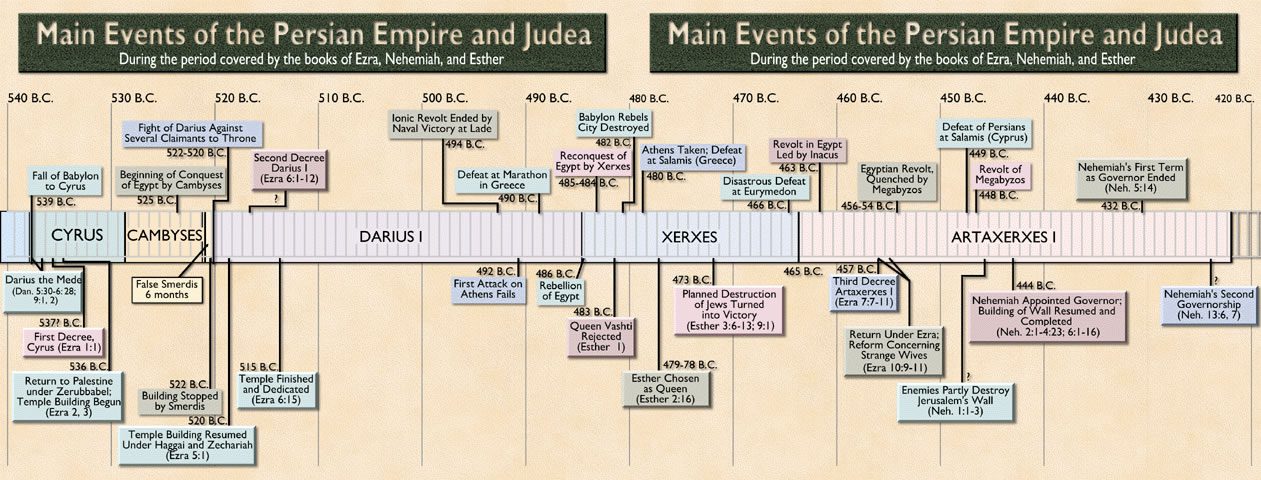
    Ezra was living in Babylon when in the seventh year ( c. 457 BCE) of Artaxerxes, king of Persia, the king sent him to Jerusalem to teach the laws of God to any who did not know them. source

    In the 20th year of Artaxerxes, king of Persia, (445/444 BC), Nehemiah was cup-bearer to the king. Learning that the remnant of Jews in Judah were in distress and that the walls of Jerusalem were broken down, he asked the king for permission to return and rebuild the city.


    Ezra tells of a King Asa, five centuries earlier, who the Lord used to restore Jerusalem (for a time). Then Nehemiah follows with the proclamation from Artaxerxes, king of Persia, to rebuild Jerusalem.

    Yet Israel will again turn from the Lord and captive Israel will await a Messiah to save them from evil.

    When will the nations of these last days remember the love of the Lord?

    For the Messiah Jesus has come to us. He was sacrificed for our sins and rose from the grave in victory! And our Lord will return on the clouds in victory over sin and death. Jesus calls out to the downtrodden souls of humble sinners.

    God rules over the nations and loves our worship and praise. He came to us in Person in Christ Jesus.

    When will you look up and cry out to the Lord?