Herodian coin from Judea with palm branch (right) and wreath (left), 34 AD.
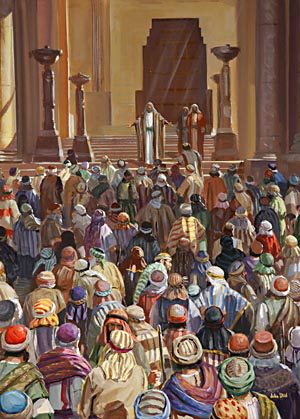
And Pilate asked him, “Are you the King of the Jews?” And he answered him, “You have said so.” – Luke 23:3
They had remembered hearing the indictment of this gentile governor
while hiding their faces from his Roman judgment seat. Although complicit in Jesus’ prosecution, an illegitimate half-jew Herodian sat powerless while Roman troops ruled the streets of Jerusalem.
While Jesus was not the kind of Messiah King they had expected, He did acknowledge the title bestowed by Jews accusing Jesus of treason against Judah and Rome.
Most amazingly, Jesus has now appeared to these disciples after His resurrection! He continues to appear to hundreds of disciples; here and there, even in the locked rooms of Jerusalem.
Herod’s rule as tetrarch of Galilee and Peraea, holds no authority over Judea, ruled by Marcus Pontius Pilatus, Roman prefect (governor) under the emperor Tiberius.
Captive Israel, now named Judea, Samaria, Galilee and Perea had no king, only legions of Rome. Most people lamented for the days of their strong kings, David and Solomon. Occasionally some rebelled against Rome, led by misguided ambitious young lions in hope of glory.
Judge or King?
From the day Israel crossed the Jordan its people encountered many kings of surrounding kingdoms. The Hebrew people had followed the Lord, but judges would become unable to rule this stiff-necked and proud people.
15 Samuel judged Israel all the days of his life. 16 And he went on a circuit year by year to Bethel, Gilgal, and Mizpah. And he judged Israel in all these places. 17 Then he would return to Ramah, for his home was there, and there also he judged Israel. And he built there an altar to the Lord.
“… Now appoint for us a king to judge us like all the nations.”
More than a thousand years before Pilate judged Judea, here marks the beginning of kings of the Jews. Samuel was no more inclined to accept a king of the Jews than the Roman governor Pilate.
6 But the thing displeased Samuel when they said, “Give us a king to judge us.” And Samuel prayed to the Lord. 7 And the Lord said to Samuel,
“Obey the voice of the people in all that they say to you, for they have not rejected you, but they have rejected me from being king over them.
8 According to all the deeds that they have done, from the day I brought them up out of Egypt even to this day, forsaking me and serving other gods, so they are also doing to you. 9 Now then, obey their voice; only you shall solemnly warn them and show them the ways of the king who shall reign over them.”
A King to rule over Israel
A risen Christ Jesus must have reminded disciples of the Lord’s anointing of their kings. Its truth had not been as their traditions recalled, but rather a concession to the desires of their forefathers.
… “Behold, there is a man of God in this city, and he is a man who is held in honor; all that he says comes true. So now let us go there. Perhaps he can tell us the way we should go.” …
5 Now the day before Saul came, the Lord had revealed to Samuel: 16 “Tomorrow about this time I will send to you a man from the land of Benjamin, and you shall anoint him to be prince over my people Israel. He shall save my people from the hand of the Philistines. For I have seen my people, because their cry has come to me.” 17 When Samuel saw Saul, the Lord told him, “Here is the man of whom I spoke to you! He it is who shall restrain my people.”
A Humble King and Triumphant Return
What was it worshipers near Jerusalem had sung while laying palm branches before Jesus?
“As for me, I have set my King
on Zion, my holy hill.”
I will tell of the decree:
The LORD said to me, “You are my Son;
today I have begotten you.
Ask of me, and I will make the nations your heritage,
and the ends of the earth your possession.
You shall break them with a rod of iron
and dash them in pieces like a potter’s vessel.”
It had been a week of anointing for the King of the Jews.
The Cross had not been the anticipated breaking of Israel’s oppressors, but the Lord’s embracing forgiveness for mankind.
And now with a resurrection begins the ascent to His Kingdom of righteousness and everlasting reign. Jesus certainly must have repeated stories of the kings and predictions of the Prophets. For the Gospels retell those very scriptures.
His disciples hear their beloved friend, the risen Messiah, tell why He had to be crucified on a cross and sacrificed for our sins.
Rejoice greatly, O daughter of Zion!
Shout aloud, O daughter of Jerusalem!
Behold, your king is coming to you;
righteous and having salvation is he,
humble and mounted on a donkey,
on a colt, the foal of a donkey.
“So nation was destroyed by nation, and city by city, for God troubled them with every adversity. – 2 Chronicles 15:6 NKJV
Chronicles is more than just recording the history of the hebrew people. Kings and other historical books of the Bible record the events of a nation. Why would someone write out a history of events which will only be read by generations to come? God knows.
In Looking Back – Nations in the eyes of the LORD we examined history from the perspective of God. Why would the LORD allow His chosen people to fall into captivity? In fact, the Lord had warned Israel to keep her covenants since the time of Moses.
We observed that events predicted by Prophets would be like someone in pre-colonial days accurately predicting the amazing power of the United States today.
The Lord knows what will happen, revealing future events to Prophets. Surely the Lord holds power over the nations and reveals events impacting His chosen people Israel.
The Lord had a hand in the fall of Jerusalem many times and also in the rebirth of Israel in the 20th century.
Two Perspectives – Looking Ahead and Looking Back
Looking back on the nations by the Lord always comes from an all-knowing perspective of everlasting to everlasting. ‘God only knows,’ would be man’s best expression.
Human perspectives of mankind measured in years can look ahead in speculation or back in retrospection. The chronicles of years of mortal men record history as it happened or as events take place presently. Some Prophets with longevity like Daniel reveal the future from the Lord, then live to record some fulfillment. Even the Psalmists reveal prophesy from the Lord in songs of present praise or lament.
Moses chronicles the journey of the Hebrew people to and from slavery in Egypt. Yet the Lord reveals not only the Law through Moses, but also prophesy as Moses records history.
Do the warnings of Deuteronomy not reveal precisely how Israel would turn away from the Lord?
The book of Kings records the history of a United Israel and division into the kings of Judah and kings of Israel. Kings reveals which kings ‘did evil in the sight of the Lord’ or what good they accomplished. It continues with defeats, captivity and restoration in an account nearly parallel to Chronicles.
So what’s the difference in these two books? (One scroll practically reads like the other.)
I want to attribute the apt description above and following explanation of this historical book [a single scroll in Hebrew] to Dr. J. Vernon McGee.
WRITER: Probably Ezra. There is a striking resemblance in style and language to the Books of Ezra and Nehemiah. Evidently Chronicles was written during the Babylonian captivity… probably between 450 and 435 B.C.
Ezra records events which go back to and before the chart above, again, like you or I might do to record historic events for centuries preceding us. Again, Dr. McGee observes:
COMMENT: Many treat Chronicles and Kings as if they were “Cabbages and Kings.” Are the Chronicles a duplication of Kings? Although they cover the same ground from Saul to Zedekiah, they are not duplications…
In Kings, the history of the nation is given from the throne; in Chronicles, it is given from the altar. The palace is the center in Kings; the temple is the center in Chronicles. Kings records the political history; Chronicles records the religious history…
Kings gives us man’s viewpoint; Chronicles gives us God’s viewpoint (note this well as you read Chronicles; it will surprise you).
How does the LORD use the Bible? How do we use the Bible to show others the Lord Jesus?
All Scripture is God-breathed and is useful for teaching, rebuking, correcting and training in righteousness, so that the servant of God may be thoroughly equipped for every good work.
Peter’s powerful sermon of Pentecost is perhaps among the best preaching in the Bible after Jesus is raised from the grave. Yet if you or I had been in Peter’s sandals and new position of leadership, what would we have to say?
Let’s take a look at the context and application of events confronting this ‘preacher’ and ask of our situation, ‘What do I do with this?’
When the day of Pentecost arrived, they were all together in one place.2 And suddenly there came from heaven a sound like a mighty rushing wind, and it filled the entire house where they were sitting.3 And divided tongues as of fire appeared to them and rested on each one of them.4 And they were all filled with the Holy Spirit and began to speak in other tongues as the Spirit gave them utterance.
+
Let’s be clear of the place and condition of the coming of the Holy Spirit, the Third Person of the LORD GOD, promised by Christ Jesus, Son of the Living God: “they were all together in one place.” Peter and the Apostles were worshiping.
Peter and the Apostles were worshiping in Jerusalem where Christ Jesus had been crucified on the Cross outside the gates for our sins; in Jerusalem where Christ Jesus our Lord had risen from the grave to appear to Peter, the Twelve and many (and in many places for fifty days) Pentecost is a celebration of worship, like the Passover, which brought many of the faithful to the city of Jerusalem to worship the LORD.
5 Now there were dwelling in Jerusalem Jews, devout men from every nation under heaven.6 And at this sound the multitude came together…
The sound of Almighty God draws worshipers to the place where worshipers dwell. Inexplicable, all-powerful Spirit of the Living God, here-present; NOT in the Temple of God (re-built by Herod), nor before only a High Priest behind a veil which separates the Holiness of the LORD from the sinners of God’s choosing. NO! The Holy Spirit of the Living God fell on the Apostles of Jesus and the Twelve began to preach with the Power of the Living GOD.
“Are not all these who are speaking Galileans?8 And how is it that we hear, each of us in his own native language?
Some things only God can do. Perhaps a High Priest might witness the Holy Presence of the LORD.
Centuries before the great silence of God in defeated Israel and defeated Judah, on occasion the Voice of God would be heard out of the mouth of the LORD’s Prophet. It is one of these great Prophets this uneducated Galilean fisherman taught from and rebuked the unbelieving people who had witnessed the Crucifixion less than two months ago. It is a fisherman speaking in languages of gentiles and of Jews who all amazingly understand the Apostles. It is the Spirit of the LORD instructing Jews and gentiles through faithful worshipers, rather than by educated Pharisees like a Saul of Tarsus, who would later witness the risen Christ.
What was it the Apostle Peter reiterates in Jerusalem of Judea from the Prophet Joel of 800 years before Christ?
[Joel (meaning “one to whom Jehovah is God,” that is, worshiper of Jehovah) seems to have belonged to Judah. – Commentary by A. R. Faussett ]
What had worshipers in Jerusalem forgotten in the short weeks since a dramatic blood moon at the Crucifixion of Jesus and the tearing of the veil of the Temple?
What have some of us forgotten since the worshipful festival of Easter just a few Sundays ago?
Joel 1:
1 The word of the LORD that came to Joel, the son of Pethuel: 2 Hear this, O elders, And listen, all inhabitants of the land. Has anything like this happened in your days Or in your fathers’ days?…
8 Lament like a virgin wearing sackcloth for the bridegroom of her youth.
+
Was Israel not the Chosen Bride of the Living God?
Was the Bridegroom not crucified by those rejecting God’s promised grace of Perfect forgiveness?
The Spirit of the LORD poured forth from Peter and the Apostles. Worshipers of GOD were drawn to the Invisible Word spoken through these servants of Christ Jesus.
17 “‘And in the last days it shall be, God declares, that I will pour out my Spirit on all flesh, and your sons and your daughters shall prophesy, and your young men shall see visions, and your old men shall dream dreams; 18 even on my male servants and female servants in those days I will pour out my Spirit, and they shall prophesy. 19 And I will show wonders in the heavens above and signs on the earth below, blood, and fire, and vapor of smoke; 20 the sun shall be turned to darkness and the moon to blood, before the day of the Lord comes, the great and magnificent day. 21 And it shall come to pass that everyone who calls upon the name of the Lord shall be saved.’
+
Peter is not reading from a scroll in the Temple. This uneducated fisherman is reminding Jerusalem of not only infrequently heard words of the Prophet Joel, but of the dramatic events of just two months earlier when the sun turned to darkness and the Bridegroom of Righteousness cried out from a cross, “Father, forgive them; for they know not what they do.”
Peter now preaches by the Spirit of what Joel had foretold of these very last days, begun on a Cross just weeks before.
22 “Men of Israel, hear these words: Jesus of Nazareth, a man attested to you by God with mighty works and wonders and signs that God did through him in your midst, as you yourselves know—23 this Jesus, delivered up according to the definite plan and foreknowledge of God, you crucified and killed by the hands of lawless men.24 God raised him up, loosing the pangs of death, because it was not possible for him to be held by it.
+
The bold fisherman of Galilee again quotes scripture from the hymnal of the Jews, the words of Psalm 16 :
25 For David says concerning him,
“‘I saw the Lord always before me, for he is at my right hand that I may not be shaken; 26 therefore my heart was glad, and my tongue rejoiced; my flesh also will dwell in hope. 27 For you will not abandon my soul to Hades, or let your Holy One see corruption. 28 You have made known to me the paths of life; you will make me full of gladness with your presence.’
+
The Spirit then gives Peter not only more scripture to speak to the souls before him, but application to their salvation. Speaking of King David, a man after God’s own heart, Peters says:
31 he foresaw and spoke about the resurrection of the Christ, that he was not abandoned to Hades, nor did his flesh see corruption.
Speaking of what some in the crowd surely had witnessed in Jerusalem at the previous feast of Pentecost, Peter proclaims:
32 This Jesus God raised up, and of that we all are witnesses.
33 Being therefore exalted at the right hand of God, and having received from the Father the promise of the Holy Spirit,
he has poured out this that you yourselves are seeing and hearing.
God’s chosen worshipers are once again witnessing the invisible and inexplicable signs and wonders in the Apostles, signs and wonders not unlike those many had also witnessed personally in Christ Jesus of Nazareth.
The Spirit and Peter confront their souls with the evidence of the Messiah, sacrificed and risen. Jesus is not a King like David; Jesus is more than a King of the Jews and of Jerusalem.
34 For David did not ascend into the heavens, but he himself says,
“‘The Lord said to my Lord, “Sit at my right hand, 35 until I make your enemies your footstool.”’
36 Let all the house of Israel therefore know for certain that God has made him both Lord and Christ, this Jesus whom you crucified.”
Peter, by the power of the Spirit and the convicting words of scripture has applied the Word of God to the very moment of salvation for those with ears to hear.
The Bridegroom of the church speaks by the Spirit to those with ears to hear:
Will you hear the conviction of the Savior you crucified in the words of Peter?
Will you turn from your sinful ways to take up your cross and follow Christ Jesus?
Has Jesus’s love drawn your soul to the wedding feast which will come on the clouds of these last days?
Will this Spirit-filled sermon make any difference in your days?
Will the Lord Jesus be your Lord?
God IS in Person, Christ Jesus!
The Spirit of the I AM, the LORD, calls out to you.
Used to monitor number of Google Analytics server requests
10 minutes
__utmb
Used to distinguish new sessions and visits. This cookie is set when the GA.js javascript library is loaded and there is no existing __utmb cookie. The cookie is updated every time data is sent to the Google Analytics server.
30 minutes after last activity
__utmc
Used only with old Urchin versions of Google Analytics and not with GA.js. Was used to distinguish between new sessions and visits at the end of a session.
End of session (browser)
__utmz
Contains information about the traffic source or campaign that directed user to the website. The cookie is set when the GA.js javascript is loaded and updated when data is sent to the Google Anaytics server
6 months after last activity
__utmv
Contains custom information set by the web developer via the _setCustomVar method in Google Analytics. This cookie is updated every time new data is sent to the Google Analytics server.
2 years after last activity
__utmx
Used to determine whether a user is included in an A / B or Multivariate test.
18 months
_ga
ID used to identify users
2 years
_gali
Used by Google Analytics to determine which links on a page are being clicked
30 seconds
_ga_
ID used to identify users
2 years
_gid
ID used to identify users for 24 hours after last activity
24 hours
_gat
Used to monitor number of Google Analytics server requests when using Google Tag Manager
1 minute
_gac_
Contains information related to marketing campaigns of the user. These are shared with Google AdWords / Google Ads when the Google Ads and Google Analytics accounts are linked together.


 Herod’s rule as tetrarch of Galilee and Peraea, holds no authority over Judea, ruled by Marcus Pontius Pilatus, Roman prefect (governor) under the emperor Tiberius.
 The book of Kings records the history of a United Israel and division into the kings of Judah and kings of Israel. Kings reveals which kings ‘did evil in the sight of the Lord’ or what good they accomplished. It continues with defeats, captivity and restoration in an account nearly parallel to Chronicles.