Tag: jude

  • Jude -2- Necessity is the Father of Exhortation

    Jude -2- Necessity is the Father of Exhortation

    To Correct or Encourage?

    Do I just keep encouraging my child, servant or follower, or must I instruct them with words of exhortation? Every parent, master, or leader must judge between the value of correction versus positive reinforcement.

    Jude, a leader of the church no less loving of the recipients of his letter than the Apostles, faces this familiar dilemma of the parent. I want to encourage you, my beloved children, by acknowledging all of the good things you do. BUT, (Oh, oh, here it comes…) I have this against you.

    If this approach of dealing with the church and individual wayward relationships to the Lord and each other sounds familiar, it should. In the Revelation of Jesus Christ to the Apostle John exhortation to the seven churches also takes this form.

    Like John, Peter, Paul and others, Jude has a close relationship with many individual saints of the church. As a father encourages a son or daughter, so the words of Jude touch the hearts of the hearers of his letter.

    They will hear Jude’s letter as words from a beloved mentor. Many know Jude, Servant of Jesus Christ as the brother of James or know of him.

    Jude’s greeting:

    Mercy unto you, and peace, and love, be multiplied.

    Jude 1:2 KJV

    ἔλεος Mercy to you, Jude writes.

    It means kindness or good will towards the miserable and the afflicted, joined with a desire to help them. Jude not only knows them but cares about their struggles and community.

    When Jesus tells the parable of the good Samaritan, our Lord convicts us that we often fail to show mercy to our fellow man. We too tend to qualify which neighbor we choose for our mercy. Yet like those who questioned the Lord we know which one acted as Christ would act.

    “The one who showed mercy to him,” he said.
    Then Jesus told him, “Go and do the same.”

    Luke 10:37 CSB

    Jude shows the church compassion and mercy, also greeting them with peace and love multiplied. If you are one of those called by the Father you will recognize the same peace of Jesus Christ regardless of what exhortation will follow.

    “Peace I leave with you; My peace I give to you; not as the world gives do I give to you. Do not let your heart be troubled, nor let it be fearful.

    The words of Jesus Christ, the Good News of John 14:27 NASB

    ἀγάπη – Love

    Love is much misaligned and misdirected in and by the church. Jude speaks here of agapē [ah-gah’-pay], the love by which all hearers of the Gospel of Jesus Christ must be known.

    ἀγάπη – Agape is affection, good will, love, benevolence, brotherly love; that visible relationship between Christians. One key reason Jude and others must exhort individuals to such love is so that others will always recognize us as beloved children of our loving Father and our Lord Jesus Christ.

    Jesus warns us in the Gospel of Matthew:

    “Many false prophets will rise up and deceive many. Because lawlessness will multiply, the love of many will grow cold.

    Did our Lord not describe this familiar brokenness of the church in these last days? Jude must warn the saints faithful to the Lord.

    Jesus added an encouragement to this caution about our potential loss of agape love:

    “But the one who endures to the end will be saved.

    Jude will exhort believers to keep in Jesus’ love, abide in His love or live as Jesus taught us by His example.

    “Just as the Father has loved Me, I have also loved you; abide in My love.

    If you keep My commandments, you will abide in My love; just as I have kept My Father’s commandments and abide in His love.

    Encouragement of Jesus – Gospel of John 15:9-10 NASB

    Occasion of Jude’s Letter

    Jude – NRSV

    Jude clearly states the reason for his exhortation replacing unsalted positive encouragement.

    3 Beloved, while eagerly preparing to write to you about the salvation we share, I find it necessary to write and appeal to you to contend for the faith that was once for all entrusted to the saints. 4 For certain intruders have stolen in among you, people who long ago were designated for this condemnation as ungodly, who pervert the grace of our God into licentiousness and deny our only Master and Lord, Jesus Christ.

    His indictment is clear, a warning to the saints to watch out for those ungodly ‘christians’ who have stolen their way into the trust of the church. They pervert grace into licentiousness.

    Because now we rarely hear such pointed exhortation, let’s look just a bit closer into the problem outlined in verse 4.

    • Certain intruders pervert God’s grace.
      • It’s not everybody or even the majority of the saints.
      • These sinners were marked out beforehand for condemnation, pointing to their same sins from the Old Testament. Jude’s following verses point to these OT examples.
    • This is Jude’s and the church’s general condemnation of ungodly persons who turn from the grace of God, as opposed to the repentance possible for those God allows to return to righteousness.
    • They pervert the grace of God into licencentious.
      • one of Jude’s two serious indictments
    • and deny our only Master and Lord, Jesus Christ.

    How can ANY man or woman identified as a ‘christian’ deny Jesus as the Messiah (Christ), Lord God & ONLY lord and master of your mortal and eternal life?

    Jude, bondservant of Jesus, would have us ask this question of every hearer of his letter. Who truly serves Jesus Christ as your Master and Lord?

    Other Description of Jude’s purpose

    The Geneva Bible of 1599 states:

    3 He warneth the godly to take heed of such men, 4 that make the grace of God a cloak for their wantonness:

    Like licentiousness, wantonness leaves us thinking of an archaic approach to sin rarely mentioned in this day and translated gently for contemporary readers of Jude’s exhortation.

    All will agree that Jude urges the saints (all Christians) to contend earnestly or defend the true faith handed down to the church by Christ and through the faithful word of God in the the Old Testament. From there we easily stray when called upon to confront a false claimant of Christ.

    Who are these?

    Jude writes, ‘certain men have crept in unnoticed,’ or ‘by stealth’ some versions translate.

    Let’s examine Jude’s two-part accusation.

    ἀσέλγεια – Licentiousness

    Defined: unbridled lust, excess, licentiousness, lasciviousness, wantonness, outrageousness, shamelessness, insolence

    We tend to think of the sin of these men Jude describes as sexual sin, a sin which may accurately describe just part of their specific acts against God. Yet other sinful behaviors men and women would hide from the saints with whom they worship certainly apply to Jude’s warning.

    Jude’s exhortation describes a general conduct thought to be private which would cause a public disgust. These shameless excesses could include gluttony, tyrannical demeanor, greediness and other excesses of the fleshly senses, which include hunting for victims prone to your sins.

    You may notice the similarity of the Greek word translated as licentiousness, ἀσέλγεια, and it’s Hebrew root, ἄλφα.

    “I am the Alpha and the Omega, the first and the last, the beginning and the end.”

    Revelation of Jesus Christ to John 22:13 KJV

    This Greek description as a compound negative participle of Alpha, the word of God and Christ, indicates an antichrist, a description other New Testament writers use of those opposed to the Gospel.

    ἀρνέομαι Ἰησοῦς Χριστός – Deny Jesus Christ

    This is the most serious of Jude’s two accusations against these antichrists who have found their way into the church, men and women against whom he must warn other followers of the Lord.

    Ungodly persons [ἀσεβής] καὶ τὸν μόνον δεσπότην καὶ κύριον ἡμῶν Ἰησοῦν Χριστὸν ἀρνούμενοι, that is: “only Master and Lord our Jesus Christ deny.”

    • Jesus is our Lord, the LORD God
    • The LORD IS our only Master
    • Jesus IS the Messiah, the Christ
    • We serve ONLY Him.

    Many deny the Lord, our personal Master whom we serve as Christians. Ungodly persons may claim Jesus or claim God, yet not serve Him. Many more will claim a god or antichrist because they oppose the LORD.

    Jude is not alone in his exhortation for believers. The Apostle John also warns of such antichrists:

    … so now many antichrists have come. …They went out from us, but they did not belong to us… I write these things to you concerning those who would deceive you.

    First Letter of John, excerpts from 2:18-19 & 26 NKJV

    Biblical warnings from the Old Testament

    Next we will continue in Jude’s letter to saints of the first century church with his Old Testament examples. Remember, the Old Testament was the only Bible for Jesus, Jude, James and the Apostles. But feel free to preview these few verses as if you knew only this Bible, still applicable today.

    To be continued...

    
  • Jude – Now I will praise the Lord

    Jude – Now I will praise the Lord

    Who is Jude?

    The first thing I want to know about any letter I receive is who sent it to me. So as a leader or member of one of several churches we would want to be certain of the identity of the author of Jude and the authenticity of Jude’s message.

    Jude, a bondservant of Jesus Christ, and brother of James

    Letter of Jude 1:1a NKJV

    To fully understand the identity of the man who’s name is translated in English as ‘Jude” we must look to both the original Greek text and the common name of its Hebrew origin in first century Judea and Galilee.

    Ἰούδας

    Pronounced: ē-ü’-däs — Most translations of the Greek use Jude, the Latin Iudas and Yehudah in the Hebrew Names Version. The root word of the Greek name is Yĕhuwdah from the Hebrew יְהוּדָה meaning “praised” and translated at Judas. (We understand why after Jesus’ betrayal no man wanted to be known by this name now synonymous with ‘betrayer.’)

    In James – Witness of a Converted Brother we learned that Roman names derived from local languages had become Hellenized. James could be Jim, but Judas and Judah easily become, Jude.

    Some fathers named their sons after a forefather of their tribe like Judah or Israel. Judah יָדָה is the familiar Hebrew root of both the Greek and English.

    Brother of James

    Jude means: he shall be praised.

    The author of our letter identifies himself as the brother of James.

    Jude refers to James, head of the church of Jerusalem, leader of the first century churches who exchanged letters throughout Asia minor, Greece, Palestine and other areas receiving the Good News of Christ. Most Biblical commentators agree that like James, Jude is is also a half-brother of Jesus.

    Both James and Jude identify themselves as servants of Jesus, rather than claiming their biological relationship to the Lord. Most kings come to power via their family connection and install relatives in high positions.

    One of the great Jewish controversies Jesus would take no part in was that of the legitimacies of kings and followers of certain political traditions. These political/family controversies had progressed and preceded Jude, James and Jesus by several generations back to the second century B.C.

    Maccabees

    Source: BibleHub.org (a hammer), This title, which was originally the surname of Judas, one of the sons of Mattathias, was afterward extended to the heroic family of which he was one of the noblest representatives. Asmonaeans or Hasmonaeans is the Proper name of the family, which is derived from Cashmon, great grandfather of Mattathias. The Maccabees were a family of Jews who resisted the authority of Antiochus Epiphanes king of Syria and his successors who had usurped authority over the Jews, conquered Jerusalem, and strove to introduce idolatrous worship.

    Judas, one of the sons of Mattathias generally called in English the Maccabees, a celebrated family who defended Jewish rights and customs in the 2nd century B.C. (1 Maccabees 2:1-3 {from the Apocrypha, for those unfamiliar with extra-Biblical texts.}

    Herodians

    The end of the era of the Hasmoneans is probably the most turbulent time in Jewish history. It is hard to imagine a “Jewish” government more antithetical to Jewish principles and ideals than that of Herod and his successors, whose murderous, tyrannical ways would eventually lead to the destruction of the Temple and the beginning of the long exile that Jews find themselves in.Source: JewishHistory.org

    Herod the Great, born in Rome around 70 B.C and known as Herodes Magnus, was appointed a governor at around age 20 (along with his brother) and appointed King by the Roman senate in 37 B.C. He became known as Judah’s great builder and built the Temple in Jerusalem.

    During the time of Jesus, James and Jude and continuing into the years of the early church, the Herods wielded much power. Rome finally turned on Jerusalem and their client king appointed to help Rome defend the Empire against enemies east of Palestine. The Herodians failed to control the “Jewish problem,” which caused trouble throughout the Empire.

    Bondservant of Jesus Christ

    The brother of James could have begun his letter to the church as a ‘brother of the King and Messiah,’ implying his authority of position via his family. The Herodians or Maccabees made familial claims to kingdom leadership, but not these half-brothers of Jesus who had not even followed the Lord prior to His resurrection.

    James begins his letter (ἐπιστολή epistle, in greek): James, a bond-servant of God and of the Lord Jesus Christ.’ Jude chooses to identify in the same way as a bondservant of Christ.

    Jude would have been known to his readers as the brother of James, leader of the church in Jerusalem, both related to Jesus the Messiah.

    Understanding the Servant of Christ

    The Bible uses the word ‘servant‘ almost 500 times. A few English translations use the word ‘bondservant,’ a concept we no longer use or understand. Furthermore, many contemporary christians resist this concept of sometime voluntary compliance.

    I am the LORD your God, which brought you forth out of the land of Egypt, that ye should not be their bondmen; and I have broken the bands of your yoke, and made you go upright.

    Leviticus 26:13 KJV

    עָבַד עֶבֶד – A slave or servant; to work, serve. Also used as form of address between equals.

    Genesis 18: KJV

    And the LORD appeared unto him [Jacob] in the plains of Mamre: … three men stood by him: and when he saw them, he ran to meet them from the tent door, and bowed himself toward the ground, And said, My Lord, if now I have found favour in thy sight, pass not away, I pray thee, from thy servant:

    Jacob served the LORD. We serve the LORD. Jude served Christ, the Lord.

    Malachi 4:

    About four centuries before Christ (and Jesus’ half-brothers) the prophet Malachi writes:

    “Remember the instruction of Moses my servant, the statutes and ordinances I commanded him at Horeb for all Israel.

    Malachi 4:4

    The closing verses of Malachi clearly point back to Moses and the Law with the Lord calling Moses, “my servant.” James and Jude are servants of Jesus just as Moses was servant to the Lord at Horeb.

    עֶבֶד – `ebed

    Are you, beloved follower of Christ, first a servant of the Lord?

    διάκονος – diakonos

    “If anyone serves me, he must follow me. Where I am, there my servant also will be. If anyone serves me, the Father will honor him.

    Command of the Lord Jesus – Gospel of John 12:26 CSB

    The servant (from the Greek context) is ‘one who executes the commands of another, esp. of a master.

    1. the servant of a king
    2. a deacon [diakonos], one who, by virtue of the office assigned to him by the church, cares for the poor and has charge of and distributes the money collected for their use.
    3. a waiter, one who serves food and drink

    “The greatest among you will be your servant.

    The word of the Lord – Matthew 23:11

    Abraham was a servant of the Lord. Moses was a servant of the Lord. And like their forefathers in the faith, Jude and James became servants of the Lord first and servants of the Lord’s followers second.

    Paul, referring to the church writes to the church at Colossae:

    I have become its servant, according to God’s commission that was given to me for you, to make the word of God fully known …

    Jude writes to the church

    Jude, a servant of Jesus Christ and a brother of James:

    To those who are the called, loved by God the Father and kept for Jesus Christ.

    Jude 1:1b CSB

    Are you a fellow servant of Christ Jesus? If so, know that you are loved by God the Father. Know that by His grace you are kept for Jesus Christ at the day of His victorious return.

    2 May mercy, peace, and love be multiplied to you.

    To be continued

  • James – Preaching to a Worldly Church – 4

    James – Preaching to a Worldly Church – 4

    Worldliness in the Church

    These people create divisions and are worldly, not having the Spirit.

    Jude 1:19

    Jude, brother of James and also witness of Jesus risen from death, stands with all the Apostles when he urges us, “Contend for the faith.” He cautions, “some have come in by stealth; they are ungodly, turning the grace of our God into sensuality and denying Jesus Christ, our only Master and Lord.

    The concern of both half-brothers of Jesus for the saints (those of the church) to whom they write calls for inward discernment. Among us are worldly (false worshipers) who do not have (or know) the Holy Spirit, therefore beware of the divisions they would create.

    What is worldliness?

    Some versions translate ψυχικός [psychikos] (a root you will recognize in the common thinking of the church today) as worldly-minded (a caution rarely heard from a contemporary pulpit). Other versions translate it as: sensual,’ ‘natural instincts,’ ‘worldly.’

    • the principal of animal life, which men have in common with the brutes
    • the sensuous nature with its subjection to appetite and passion

    James cautions the church to beware of the worldly among the sheep, men and women without the Spirit who would devour us. (And what if they are most of the church or among our leaders?) He tells us how to recognize them.

    Jude calls them ungodly. James calls them adulterous, comparing the worldly of the church to unbridled horses and rudderless ships. And why is that?

    The ungodly (by definition) are destitute of reverential awe towards God, condemning God, and impious. But it goes deeper than that; for examination of the Greek root word for ungodliness, ἄλφα [Alpha] (as a negative particle) literally implies, anti-Christ.

    Christ is the Alpha to indicate that he is the beginning and the end. The ungodly do not teach or recognize Jesus in this way and do not have the Holy Spirit.

    ‘BUT IN VAIN DO THEY WORSHIP ME,
    TEACHING AS DOCTRINES THE PRECEPTS OF MEN.’”

    Matthew 15:9

    Previously in the Letter of James

    We introduced James in Witness of a Converted Brother, clarifying that this leader of the church in Jerusalem was likely none other than one of the unbelieving half-brothers of Jesus. A commentator suggests, ‘This book offers sound advice for practical Christian living.” So I have begun today by mentioning Jude.

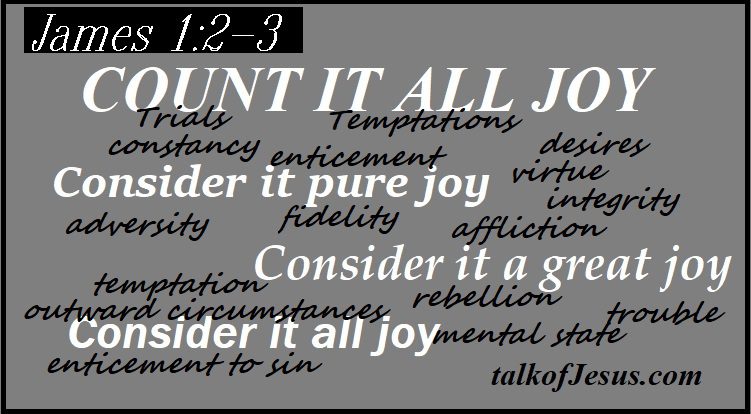
    James 1:2-3 words meaning count or consider joy

    In Count it All Joy we learned that James writes his letter to several churches, much as we read the Revelation of Jesus Christ to John addressing several churches by a letter sent by messenger.

    Then in a Word on Works James encourages followers of Christ to be quick to listen, slow to speak, and slow to anger.

    Now he has something to say about teachers and preaching; but first, more about the tongue.

    Our Untamable Tongue

    2 For we all stumble in many ways. If anyone does not stumble in what he says, he is mature, able also to control the whole body.

    We are sinners, every one of us. All stumble, but as James suggests earlier, watch your mouth. Hold your tongue, some would say.

    IF anyone does not stumble — is he kidding? Who does not open their mouth and insert a foot, as the expression goes?

    But James suggests that by the Spirit (and not our own natural worldliness) some may be mature enough in Christ to speak for the Lord. He suggests that what we say shows the fruit of justification, but our words could possibly yield fruit spoiled by our sins.

    James 3:

    3 Now if we put bits into the mouths of horses so that they obey us, we direct their whole bodies.

    Those who live by the Law of Freedom may not run wildly. Christ does not give us license to do as we please, but He is our Master who reigns over us and reins us in.

    4 And consider ships: Though very large and driven by fierce winds, they are guided by a very small rudder wherever the will of the pilot directs.

    5 So too, though the tongue is a small part of the body, it boasts great things.

    campfire burning at night

    Consider how a small fire sets ablaze a large forest. And the tongue is a fire.

    The tongue, a world of unrighteousness, is placed among our members. It stains the whole body, sets the course of life on fire, and is itself set on fire by hell.

    Every animal can be tamed by mankind, James tells us. Neither your preacher nor I can illustrate this power and control of the tongue any better. In addition to other applications of reason for us to bridle our tongues prior to speaking James continues:

    … but no one can tame the tongue. It is a restless evil, full of deadly poison.

    James 3:8 CSB

    10 Blessing and cursing come out of the same mouth. My brothers and sisters, these things should not be this way.

    Be SLOW to speak. Does blessing only pour from the spring of your mouth?

    Therefore be QUICK to listen. Does your brother or sister in the Lord, even a leader of your church light a forest or produce the wrong fruit of the tongue?

    James will address these when we continue, God willing.

    To be continued...
    Preview below

    Teachers and Preachers

    Some time ago I embraced this verse from Job.

    I will teach you concerning the hand of God;
    That which is with the Almighty will I not conceal.

    Job 27:11 ASV

    To this, most everyone I know would say, “Amen.”

    Although I include teaching as one of my gifts, speaking for the Lord is a high calling which James addresses.

    My brethren, let not many of you become teachers, knowing that we shall receive a stricter judgment.

    James 3:1 NKJV

    †