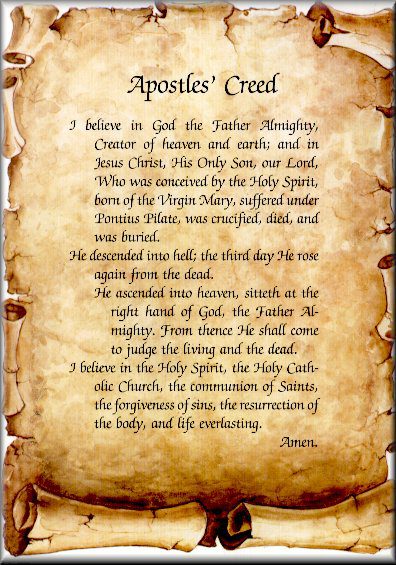
The Apostles’ Creed — foundational to our Apostolic Christian faith
I BELIEVE or WE BELIEVE IN:
The Apostles’ Creed
We believe JESUS will JUDGE the living and the dead.
The Quick and the Dead
Death becomes a more serious matter IF WE consider an inevitable after-life of our lifeless flesh and blood and in a prepared place of our created soul.
This failing flesh, weakening sinews, crumbling of bones, flow through our heart and quickness of brain will not endure…
nor will the very breath of our brief mortal life.
And yet.. this created soul will remain…
What then?
Redemption OR Judgment?
Structure of Christian CREEDS
Here’s a brief outline of the fundamental objects of our faith found in The Creed:
God
Jesus Christ
the Holy Spirit
and the Virgin Mary
Jesus was crucified
and was buried
He rose from the dead
He ascended to heaven
Siteth at the right hand of the Father (ye olde English)
Whence He cometh to judge the living and the dead
more…
source: apostles-creed.org
We believe Jesus will judge the living and the dead
During His incarnation as the Son of Man and prior to His crucifixion Jesus had confessed:
The Apostle Paul helps us with this look at the judgment of the quick and the dead:
And if Christ be in you, the body is dead because of sin; but the Spirit is life because of righteousness. But if the Spirit of him that raised up Jesus from the dead dwell in you,
he that raised up Christ from the dead shall also quicken your mortal bodies by his Spirit that dwelleth in you.
We know it and recognize the the Apostles borrow this from the Gospel of what Christ has taught during His incarnation.
from the Greek [ζωοποιέω] it more specifically means:
to produce alive, begat or bear living young
to cause to live, make alive, give life
and as Jesus used it in a parable pointing to death:
of seeds quickened into life, i.e. germinating, springing up, growing
For as the Father raiseth up the dead, and quickeneth them; even so the Son quickeneth whom he will.
Gospel of John 5:21 KJV
Think of the implication of this to a mortal like us as we look toward the dust.
An the Lord Jesus assures the faithful:
It is the spirit that quickeneth; the flesh profiteth nothing:
and you believers with ears to hear, listen to this:
the words that I speak unto you, they are spirit, and they are life.
Gospel of John 6:63 KJV – the word of Jesus, the son of Man and Son of God
from Christ to the Apostles to Christian Creeds
The Apostle Paul writes to the church in Ephesus — a worldly cosmopolitan city with the temple of the Greek goddess Artemis (the goddess Diana of the Romans) — in about AD 60, quoting the Prophets:
“Awake, you who sleep, Arise from the dead, And Christ will give you light.”
See then that you walk circumspectly, not as fools but as wise, redeeming the time, because the days are evil.
Ephesisans 5:14b-16 NKJV
And the risen Christ speaks a warning against turning back from sins and heresies leading to hell, which had seduced many of the Ephesian ‘christians‘:
“Remember therefore from where you have fallen; repent and do the first works, or else I will come to you quickly and remove your lampstand from its place—unless you repent.
Revelation of Jesus Christ to John 2:5 NKJV
Their great falling from grace in Ephesus having taken place in the AD 90’s, a mere three decades after the Apostle Paul had pastored their church.
The historical record of the Church beyond the first century AD points to both firm doctrine and similar falling away from Christ.
Augustine of Hippo on the Apostles’ Creed
Born: AD 354, Augustine lived an early 'willfully, decadent, pagan life' in Carthage, even taking a mistress who bore him a bastard son.
Source: The Confessions of St. Augustine, Rosalie DeRosset – intro
In Carthage, Augustine’s knowledge.. he admits, made him, “swollen up with vanity” (Bk 3, chap. 6). — probably made him prey for the Manichean religion. The chief characteristic of this sect was Gnosticism, an extreme dualism that claimed evil and good as equal.
ibid. pp 13-14
In just four centuries heresies had encompassed and seeped into the churches. Later after after St. Augustine and the fall of Rome, considerable idolatry and various heresies would invade the Catholic Church and later after Luther, the Protestant Church.
READ what Augustine later taught about THE APOSTLES’ CREED:
“Thence He shall come to judge the quick and dead.”
The quick, who shall be alive and remain;
the dead, who shall have gone before.
It may also be understood thus: The living, the just; the dead, the unjust.
For He judges both, rendering unto each his own.
To the just He will say in the judgment, “Come, ye blessed of My Father, receive the kingdom prepared for you from the beginning of the world.” For this prepare yourselves, for these things hope, for this live, and so live, for this believe, for this be baptized, that it may be said to you, “Come ye blessed of My Father, receive the kingdom prepared for you from the foundation of the world.”
To them on the left hand, what?
“Go into everlasting fire prepared for the devil and his angels.”
Thus will they be judged by Christ, the quick and the dead.
We have spoken of Christ’s first nativity, which is without time;
spoken of the other in the fullness of time,
Christ’s nativity of the Virgin; spoken of the passion of Christ; spoken of the coming of Christ to judgment.
The whole is spoken, that was to be spoken of Christ, God’s Only Son, our Lord. But not yet is the Trinity perfect.
Church discipline continues to be the focus of the Apostle’s letter.
Previously Paul spoke of Judgment between Christ and Satan, but by discipline the Apostle does not mean judgement of Corinthians who do not identify with Christ Jesus. So now Paul INSISTS that the Corinthians judge a fellow church member in this case of moral sin.
Church Discipline in Moral matters
DareG5111 any of you, having a matter against another, go to law before the unjust and not before the saints?
1 Corinthians 6:1 King James Version – Paul’s challenge to judge our fellow believers rather than defer any matter of church discipline to a civil court.
Strong language from the writ of Judgment by Christ’s Apostle to the gentiles!
But note Paul’s comparison of the civil court –– (Roman lawfor Corinthians, even as civil common pleas law is practiced in the US and by other Common Era courts).
The Apostle directs the Corinthians to remain within the jurisdiction of God’s Law indicting common justice as law before the unjust .
τολμάω - From tolma (boldness, probably itself from the base of τέλος (G5056) through the idea of extreme conduct)
Paul applies his authoritative instruction of church discipline to what he has just stated.
It isn’t my responsibility to judge outsiders, but it certainly is your responsibility to judge those inside the church who are sinning.
The Apostle presents a case to the Corinthian Church supporting his judgement that THEY should judge their own members and therefore become accountable to the Lord God rather than the civil courts.
'But wait!' Paul might quickly follow. 'Not yet and here's why:'
And since you are going to judge the world, can’t you decide even these little things among yourselves? – 1 Corinthians 6:2b NLT
Let's glance at a perhaps more palatable explanation from the International Children’s Bible *additional link to the NIRV
You should be ashamed! Why do you not let God’s people decide who is right? 2 Surely you know that God’s people will judge the world. So if you are to judge the world, then surely you are able to judge small things as well. 3 You know that in the future we will judge angels. So surely we can judge things in this life.
4 So if you have disagreements that must be judged, why do you take them to those who are not part of the church? They mean nothing to the church. 5 I say this to shame you.
a Plea for Church Discipline
Surely there is someone among you wise enough to judge a complaint between two brothers in Christ.
6 But now one brother goes to court against another brother. And you let men who are not believers judge their case!
Has YOUR Common Era pastor preached this (or does he hope that his unseen judgements will go unnoticed)?

Do Elders of your local church wisely judge such offenders?
But instead, one brother takes another to court—and this in front of unbelievers!
It is actually reported that there is sexual immorality among you, and of a kind that even pagans do not tolerate: A man is sleeping with his father’s wife.
1 Corinthians 5:1 NIV
Spoiled Fruit of deferred Church Discipline
Will a pagan court, a jury of those condoning and practicing such fornication (porneia) not equate Christ’s saints to common practices of those who worship their self-gratifying gods of the flesh?
7 When you take another believer to court, you have lost the battle already. Why not be treated wrongly? Why not be cheated?
The Apostle asks: Are you NOT willing to suffer injustice by the hand of a fellow saint as witness of Jesus' love?
8 Instead, you yourselves cheat and do wrong.
'Christians,' they say, 'they're not so saintly, but openly sinful, just like us.'
And you do it to your brothers and sisters.
Who has died to the flesh?
9 Don’t you know that people who do wrong will not receive God’s kingdom? Don’t be fooled…
11.. You were made holy.
You were made right with God.
All of this was done in the name of the Lord Jesus Christ.
It was also done by the Spirit of our God.
Paul lists additional sins to this single case of one man of the Corinthian Church.
(9) Those who commit sexual sins will not receive the kingdom.
Neither will those who worship statues of gods
or commit adultery.
Neither will men who sleep with other men.
10 Neither will thieves
or those who always want more and more.
Neither will those who are often drunk
or tell lies
or cheat.
People who live like that will not receive God’s kingdom.
11 Some of you used to do those things. But your sins were washed away.
Discipline and discernment – Growing up in Christ
Later in his letter Paul will instruct the Corinthian saints:
When I was a child, I talked like a child,
I thought like a child,
I reasoned like a child.
When I became a man, I put the ways of childhood behind me.
15 Surely you know that your bodies are parts of Christ himself.
So I must never take parts of Christ and join them to a prostitute! 16 It is written in the Scriptures,
“The two people will become one body.”[Genesis 2:24]
Spoiled Fruit goes to Law
Paul will next include more delicate matters concerning sexual behavior between men and women, but first the Apostle appeals to the church as members of a holy body, the Temple of God – ONE SPIRIT WITH THE LORD JESUS CHRIST.
But he that is joined unto the Lord is one spirit.
So run away from sexual immorality. Every other sin that a person does is outside the body.
But those who are sexually immoral sin against their own bodies.
19 You should know that your body is a temple for the Holy Spirit. The Holy Spirit is in you. You have received the Holy Spirit from God. You do not own yourselves.
20 You were bought by God for a price. So honor God with your bodies.
Last time in my initial post of this SERIES I introduced GRACE linked to its root words of both the OLD and NEW TESTAMENTS of the Holy Bible.
Since only 15 of the 132 verses naming Grace occur in the Old Testament chances are that the first Bible verse you might SHARE about GRACE will come from the NEW TESTAMENT.
New Covenant GRACE
DYK that “Testament” διαθήκη – diatheke is the rendering of a Hebrew word meaning a “covenant” or agreement?
Was the grace of God different in the OLD TESTAMENT?
Has the grace of God changed in the Common Era of our post-Christian correctness?
You may as well offer your comments on those two questions as well.
But before I take on any contemporary question of grace in the Common Era let’s take a look back to one of the oldest illustrations of the Old Testament.
Old Covenant GRACE
JOB – a man blameless, upright, fearing God, and turning away from evil
There was a man in the land of Uz whose name was Job..
IF any man deserved GRACE it certainly would have been Job.
Yet Satan is as involved in this unseen story of a mere man as he was in the events of Eden.
Some Christians will no more consider the impact of unseen evil in our daily lives than did Job's friends and speculative advisors.

But other than your QUESTION about this post that would be a discussion for another day.)
Have YOU ever heard OR given such ill-conceived advice as Job’sadvisors?
Men and women typically try to conceive answers concerning God’s providence with little consideration or understanding of God’s redeeming grace.
(Yet do the so-called good men and women have their rewards in this brief life?)
If you would seek God earnestly And plead for the grace of the Almighty, If you are pure and upright, Indeed now He would rouse Himself for you And make your righteous abode at peace. Though your beginning was insignificant, Yet your end will increase greatly.
Job 8:5-7 LSB (ill-conceived advice of a friend and advisor to Job)
Ah! — Here Job’s smiling friend offers him a cheap grace of the Almighty bringing His power into his friend’s life NOW!
Job’s best Life could be filled with blessings before his end in death (never mentioned).
Is GRACE simply an increase of life’s everyday blessings?
Picture now a scene in the Heavenly Court of the Old Testament BEFORE God’s revelation of a perfect Priest and Mediator of Christ the only Son of a better Sacrifice for man’s sin.
JOB ASKS THE ENDURING QUESTION OF EVERY AGE:
But how can a man be in the right before God?
Job 9:2b LSB
If one desired to contend with Him, He could not answer Him once in a thousand times.
Wise in heart and mighty in power, Who has stiffened his neck against Him and been at peace?
Where do YOU stand before God
Job continues his hopeless defense (without the Perfect Powerful Advocate pleading his case for him:
the One who removes the mountains.. who shakes the earth.. out of its place..
Who alone stretches out the heavens, And tramples down the waves of the sea..
10 Who does great things, unsearchable, And wondrous works, innumerable.
11 Were He to sweep by me, I would not see Him; Were He to move past me, I would not perceive Him. 12 Were He to snatch away, who could turn Him back? Who could say to Him, ‘What are You doing?’
After Job's irrefutable argument worthy of any courtroom case he then makes an astounding statement concerning GRACE before the One Lord God.
“For though I were right, I could not answer [plead my case]; I would have to plead for the grace of my judge.
A blessing of Numbers 6 guides our prayer and plea
6:25 יָאֵר יְהוָה פָּנָיו אֵלֶיךָ וִיחֻנֶּךָּ׃ ס
The Adjudicator of Grace, Mercy and Peace
Many would attempt to plead their own case before the Judge!
I would — possibly even as I accuse every accuser who has brought me before the Authority to determine MY GUILT and PUNISH MY SIN.
Of course ALL of us tend to demand JUSTICE for all, i.e. ‘everybody else’, even while covering every personal trespass against others and expecting MERCY in the disposition of our own case.
Even in a Court of Law in a great America of the past …
Used to monitor number of Google Analytics server requests
10 minutes
__utmb
Used to distinguish new sessions and visits. This cookie is set when the GA.js javascript library is loaded and there is no existing __utmb cookie. The cookie is updated every time data is sent to the Google Analytics server.
30 minutes after last activity
__utmc
Used only with old Urchin versions of Google Analytics and not with GA.js. Was used to distinguish between new sessions and visits at the end of a session.
End of session (browser)
__utmz
Contains information about the traffic source or campaign that directed user to the website. The cookie is set when the GA.js javascript is loaded and updated when data is sent to the Google Anaytics server
6 months after last activity
__utmv
Contains custom information set by the web developer via the _setCustomVar method in Google Analytics. This cookie is updated every time new data is sent to the Google Analytics server.
2 years after last activity
__utmx
Used to determine whether a user is included in an A / B or Multivariate test.
18 months
_ga
ID used to identify users
2 years
_gali
Used by Google Analytics to determine which links on a page are being clicked
30 seconds
_ga_
ID used to identify users
2 years
_gid
ID used to identify users for 24 hours after last activity
24 hours
_gat
Used to monitor number of Google Analytics server requests when using Google Tag Manager
1 minute
_gac_
Contains information related to marketing campaigns of the user. These are shared with Google AdWords / Google Ads when the Google Ads and Google Analytics accounts are linked together.