TODAY we move forward in time from about 520 B.C. to around A.D. 100 and ‘a great cloud of witnesses’ from the New Testament book of Hebrews. This cloud of witnesses, however, goes back to the Old Covenant and continues until this day.
Previously in SHAKEN 2 “Think carefully about your ways we found political and religious leadership along with all the people once again turning back to the Lord their God who now proclaims HE IS with them.
“Speak to Zerubbabel governor of Judah, saying, ‘I am going to shake the heavens and the earth.
* NOTE: Some commentators question if this epistle or letter to the Hebrews, who’s author is unidentified in its text, was written by Paul or possibly by other A.D. 1st century apostles.
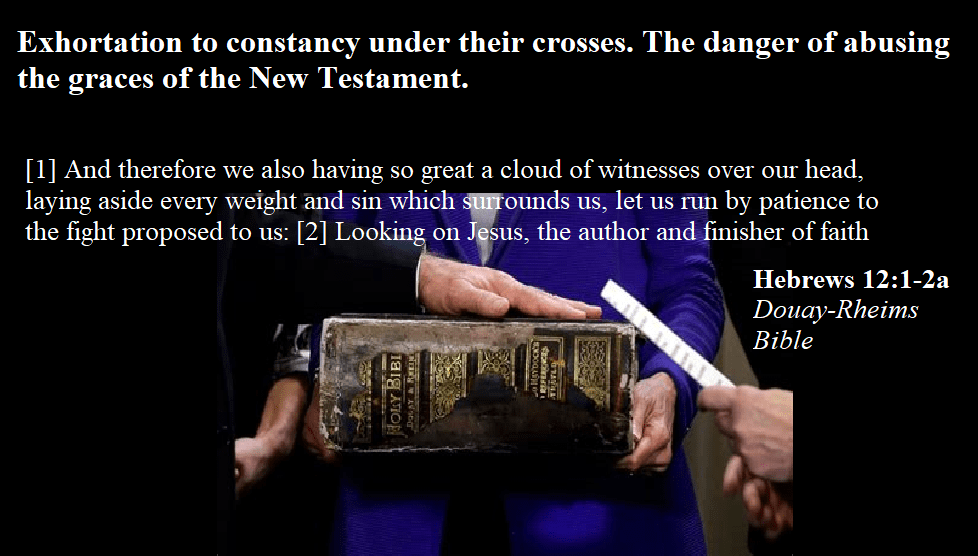
Some excerpts from D-R Bible {pictured with Joseph Biden, a professing Roman Catholic, being sworn in as 46th President of the United States}

Most translations from NASB translation or versions as noted.
God spoke of old by the prophets, but now by his Son, who is incomparably greater than the angels.
The Prophets provided not only a cloud of witnesses to Israel but spoke the very admonitions of the LORD God to a disobedient and unfaithful people.
[1] God, who, at sundry times and in divers manners, spoke in times past to the fathers by the prophets, last of all,
[2] In these days hath spoken to us by his Son, whom he hath appointed heir of all things, by whom also he made the world.
A List of Fathers of our founding
He again sets a certain day, “Today,” saying through David after so long a time just as has been said before,
“Today if you hear His voice, Do not harden your hearts.”
Hebrews 4:7b CSB
8 For if Joshua had given them rest, He would not have spoken of another day after that.
Melchizedek and Abraham – Heb. 7
Aaron & Moses – Heb. 7:11,14
And the Holy Spirit also testifies to us.. Heb. 10:15
Now where there is forgiveness of these things, an offering for sin is no longer required.
Is this justice you demand finally for ones you judge (opponents to your own world view)?
Or do you seek judgment on your own sins, transgressions and trespasses (for which you ask forgiveness)?
The Apostles wrote to a1st century church persecuted for their faith in Jesus Christ.
It was not faith in their failing leaders of government
OR was it faith in a zealous vision of their pastor.
Nor was it faith that their country would come under the LAW of God, their state under a mandate of morality and their community forced into the fellowship of love.
The CHURCH believed GOD in Christ Jesus and it was counted to them as righteousness.
These faithful saints suffered for their hope in the Lord and persevered by grace suffering for a higher community in a heavenly kingdom.
11 And every priest stands daily at his service, offering repeatedly the same sacrifices, which can never take away sins.
26 For if we sin deliberately after receiving the knowledge of the truth, there no longer remains a sacrifice for sins, 27 but a fearful prospect of judgment, and a fury of fire which will consume the adversaries.
For we know Him who said,
“Vengeance is Mine, I will repay.” And again, “The Lord will judge His people.”
It is a terrifying thing to fall into the hands of the living God.
Hebrews 10:30-31 CSB
the cloud of Witnesses [Hebrews 11]
From the Douay-Rheims Bible [background of Biden Presidential oath pictured above]
What faith is. Its wonderful fruits and efficacy demonstrated in the fathers.
[1] Now faith is the substance of things to be hoped for, the evidence of things that appear not. [2] For by this the ancients obtained a testimony. [3] By faith we understand that the world was framed by the word of God…
Hebrews 11 continues, mentioning these witnesses of faith in the Lord God:
Abel
Enoch
Noah
Abraham
Sarah
Isaac
Jacob [Israel]
Joseph
Moses
Rahab
Gideon, Barak, Samson, Jephthah, of David and Samuel and the prophets..
Hebrews 12 – surrounded by such a great cloud of witnesses
Exhortation to constancy under their crosses. The danger of abusing the graces of the New Testament.
Hebrews 12 summary from the Douay-Rheims Bible
Therefore, since we are surrounded by so great a cloud of witnesses, let us also lay aside every weight, and sin which clings so closely, and let us run with perseverance the race that is set before us, looking to Jesus the pioneer and perfecter of our faith..
in the context of A.D. 90, with application to A.D. 2020,
rather than chronologically, culturally or by chapter & verse..
..while during recent months:
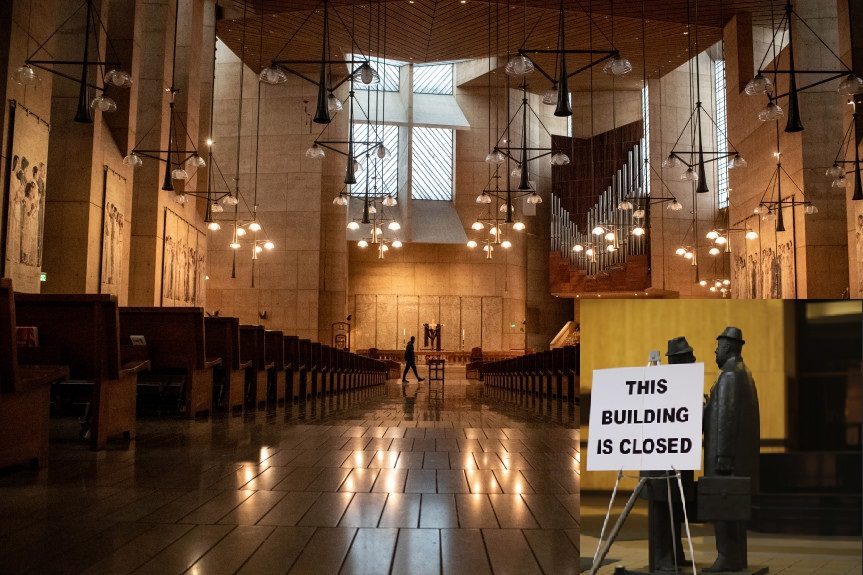
some sought to stream the stage of worship
some sent seeker-friendly scripture into our homes
some church communities disintegrated while others diminished & distanced (like our 2020 remote office meetings complete with slides).
To review the Gospel of John, simply click on any link in the outline below& it will open in a new window.
Roger – author of A.D. 2020 series on the Gospel of John
I hope you were blessed by the secure links to reliable sites for further study of Scripture, as well as insight into the 1st century church of John’s Gospel (written ~A.D.- 90).
Scripture encourages us to a more mature faith.
John’s Prologue – Good News!
IN THE BEGINNING was the Word, and the Word was with God, and the Word was God. He was in the beginning with God.
ALL THINGS came into being through Him, and apart from Him not even one thing came into being that has come into being. In Him was life, and the life was the Light of
MANKIND.
And the Light shines in the darkness, and the darkness did not grasp it.
14 And the Word became flesh, and dwelt among us; and we saw His glory, glory as of the only Son from the Father, full of grace and truth.
No one has seen God at any time; the only begotten God [Son] who is in the bosom of the Father, He has explained Him.
John’s Prologue [1:1-18], from which the Apostle next proceeds to the testimony of John the Baptist and the Messiah’s calling of the Twelve, states many important theological themes & along with his Epilogue [21:1-25 {linked below}] provides additional depth of purpose of John’s Gospel.
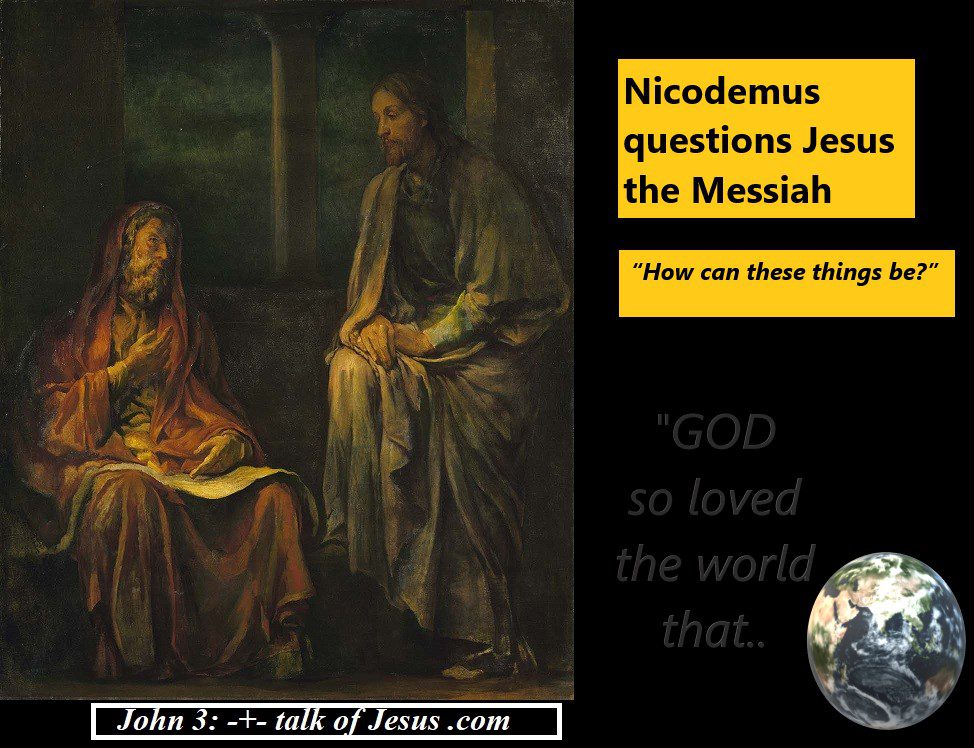
John 3: “Rabbi, we know that You have come from God as a teacher; for no one can do these signs that You do unless God is with him.” …
Teachings of the Lord Jesus Christ
‘My Father’s House – John 2
“You must be born again.
I am the Messiah – John 4
Before Abraham was, I AM
John 11
“..and he who hates his life in this world will keep it to life eternal.
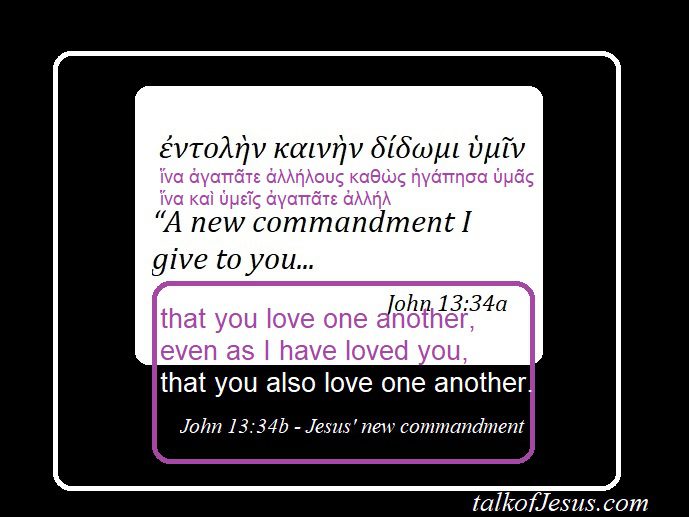
also love one another-John 13
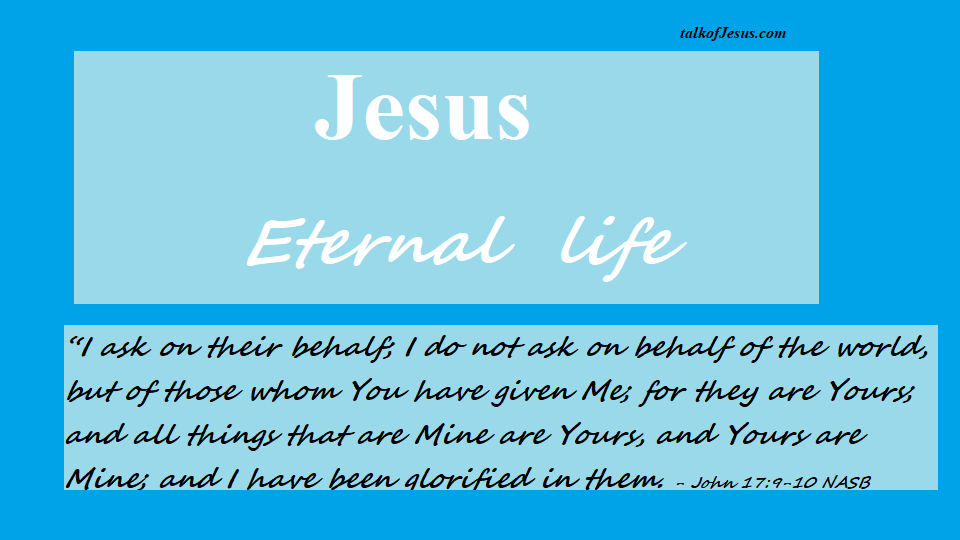
Jesus prays – John 17
Jesus answered him – John 19:11
Jesus said:
Gospel of John
“Behold! The Lamb of God who takes away the sin of the world! – John 1:29b
As Jesus passed by, He saw a man who had been blind from birth. – John 9:1
Are you greater than our father Abraham who died? And the prophets died. Who do you claim to be?” – John 8:53
“But you do not believe because you are not of My sheep. My sheep hear My voice, and I know them, and they follow Me; and I give eternal life to them, and they will never perish; and no one will snatch them out of My hand. – John 10:26-28
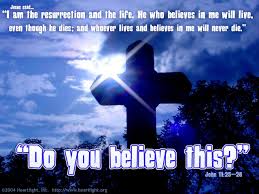
Jesus said to her, “Your brother will rise from the dead.” .. “I am the resurrection and the life; the one who believes in Me will live, even if he dies, and everyone who lives and believes in Me will never die. Do you believe this?” – John 11:23,25
Hear all the unrelenting bad news of yesterday or today.
For followers of Jesus, His death diminished life’s hope in eternal life; that is until the Gospel of the Lord’s resurrection reached the eyes and ears and touch of His dearly beloved friends.
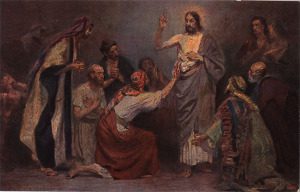
John and the Disciples witnessed the Lord Jesus in His Risen Flesh many times after His resurrection.
“Peace be with you.”
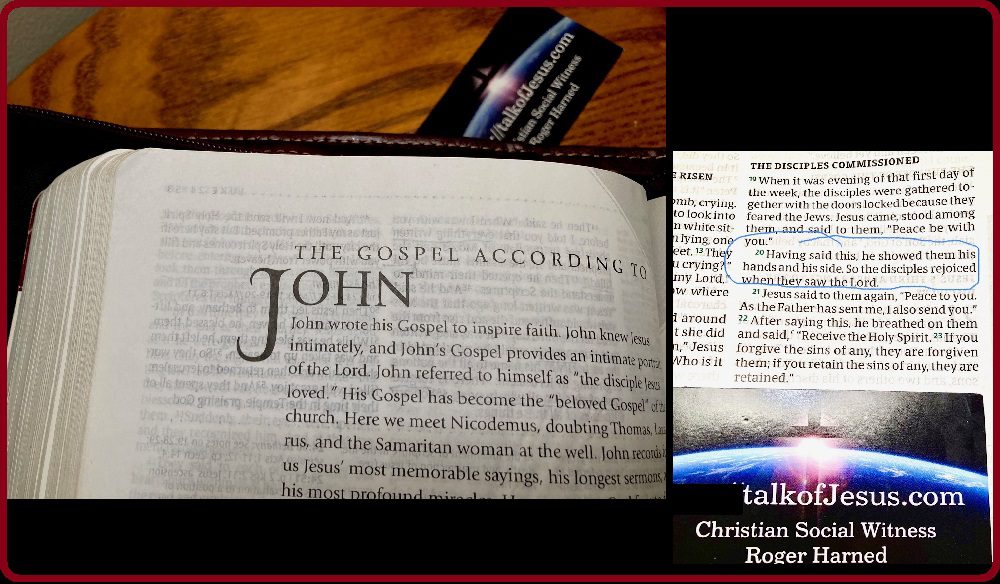
And when He had said this, He showed them both His hands and His side. The disciples then rejoiced when they saw the Lord.
John 20:20
Their sorrow had turned into joy and so must ours; for in Christ Jesus his disciples of every generation have eternal life through His sacrifice for our sins. This is our Gospel, His Good News to those who would believe.
NEWS of A.D. 2021
SEE what follows JOHN 2020 in JOHN 2021.
“Peace to you,” yet also a command of the risen Christ Jesus.
& without Him:
EXPECT MORE BAD NEWS
John’s Epilogue
John 20:30 Jesus performed many other signs in the presence of his disciples that are not written in this book.
But these are written so that you may believe that Jesus is the Messiah, the Son of God, and that by believing you may have life in his name.
John 20:21 CSB
I pray that the Lord has blessed you through the Gospel of John in A.D. 2020
Roger – Roger@talkofJesus.com
May our Lord Jesus Christ
draw you into His grace,
giving you new hope of Eternal Life
in the YEAR OF OUR LORD 2021,
in the Name of the Father and the Son and the Holy Spirit,
AMEN.
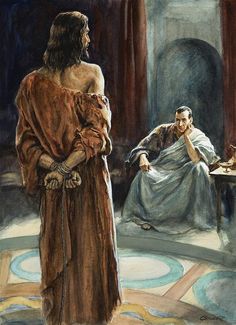
Previously, Pilate had questioned Jesus apart from the crowds and asked if He is a king. Now, after having had Jesus scourged 39 times and coming out to the barely controlled crowds of Jerusalem, Pilate will question this ‘man’ a second time in his judge’s chambers within the palace.
What has prompted Pilate’s new interrogation of Jesus?
This ‘man’ kept silent during all 39 lashes, confessing no crimes to receive some mercy from the whip.
When Rome’s Prefect had asked why Jesus should be crucified, the Jews answered Pilate, ‘.. because he made himself the Son of God.’
Pilate may have also been a religious man, though as we pointed out previously the Romans had many gods.
Could this man Jesus be one of them?
In a private appeal
Pilate said to Jesus, “Where are You from?” But Jesus gave him no answer. 10 So Pilate said to Him, “Are you not speaking to me?
Do You not know that I have authority to release You, and I have authority to crucify You?”
John 19:10b Pilate’s claim of authority to ‘the man’ Jesus
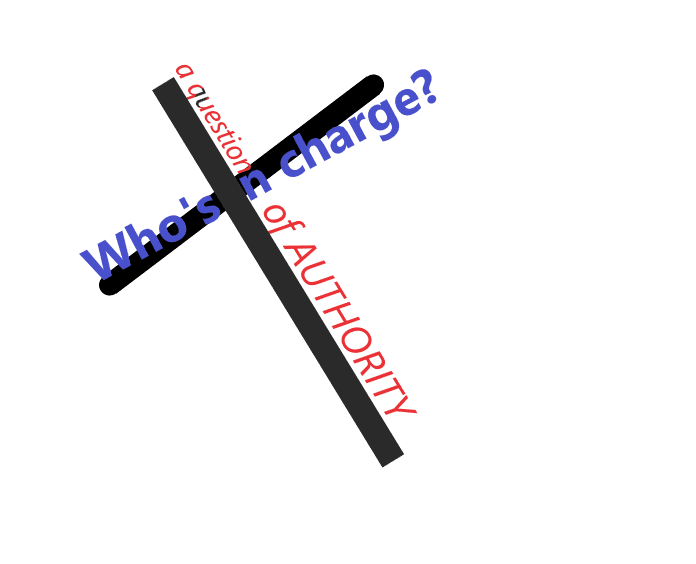
Roman Authority
Before we hear Jesus breaking the silence of Roman interrogation, let’s consider briefly an earlier encounter of Jesus in Galilee with a Roman officer.
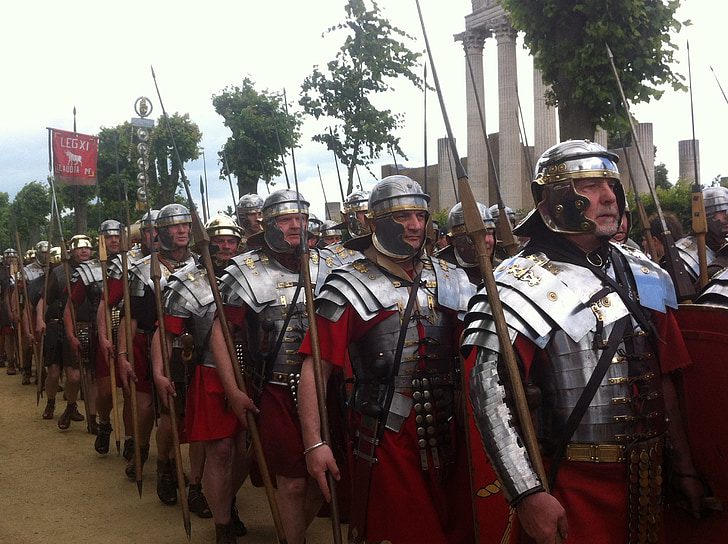
This healing by Jesus not only illustrates an absolute no questions asked authority of Roman Legions, but by his own high position, Pilate might have heard from this Roman leaderwho helped build a synagogue in Capernaum.
When He had come down from the mountain, great multitudes followed Him..
Now when Jesus had entered Capernaum, a centurion came to Him, pleading with Him, saying, “Lord, my servant is lying at home paralyzed, dreadfully tormented.”
And Jesus said to him, “I will come and heal him.”
The centurion answered and said, “Lord, I am not worthy that You should come under my roof. But only speak a word, and my servant will be healed.
For I also am a man under authority, having soldiers under me.
And I say to this one, ‘Go,’ and he goes; and to another, ‘Come,’ and he comes; and to my servant, ‘Do this,’ and he does it.”
When Jesus heard it, He marveled, and said to those who followed, “Assuredly, I say to you, I have not found such great faith, not even in Israel!
Judean Authority
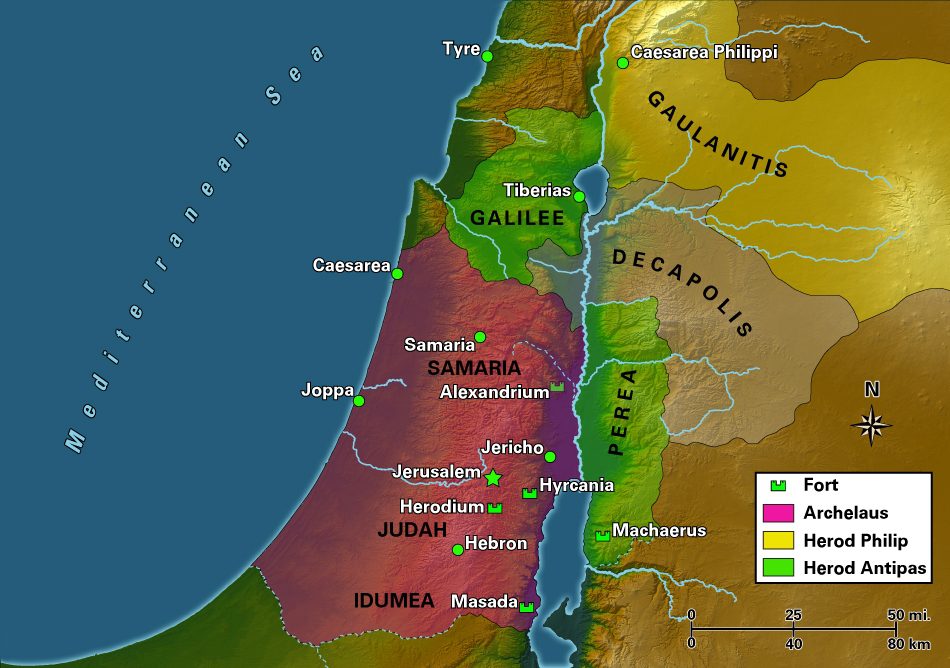
Make no mistake about the authority of Rome’s governor Pontius Pilate. Rome revoked the kingdom of Herod Archelaus of Judah just two years after he failed to govern as Rome expected. They renamed the new Roman province Judea and placed a Roman Prefect in charge.
Pilate governs with political authority similar to Antipas in Galilee to the north. Jesus of Nazareth is technically a subject of Herod Antipas. Pilate, however, may have heard of Jesus from a fellow Roman legion in the region of Galilee.
Authority – Pilate’s understanding
Pilate said to Him, .. Do You not know that I have authority to release You, and I have authority to crucify You?”
ἐξουσία, the Greek word for authority simply means, power. I am in charge. I can do whatever I please.
It could mean, I have influence and the privilege of judging you. In Pilate’s case, authority means: the power of rule or government (the power of him whose will and commands must be submitted to by others and obeyed). And specifically, the power of judicial decisions and authority to manage domestic affairs.
And Jesus remains silent, Pilate must have thought? Silent even when scourged 39 times and questioned by the Prefect with authority to sentence the ‘Man’ to a Cross?
Finally the Lord answers the authority of the governor in charge of this high Judean court.
The Authority of Christ
Jesus answered him, “You would have no authority over Me at all, if it had not been given to you from above..
John 19:11a NASB
Don’t miss this: Jesus in essence refers to a higher authority (from above).
Pilate is a religious man with many gods. Rome acknowledges these higher authorities as had Greece. These are gods defined as: the leading and more powerful among created beings superior to man, spiritual potentates (that is, kings and Caesars).
Again, perhaps Pilate has heard the buzz of the crowds witnessing Jesus healing the sick and even raising the dead. Romans kept close to the everyday happenings in Judea. Had he perhaps heard about the Galilean legion’s servant who Jesus healed?
Some dilemma, that a human judge should judge a god!
12 As a result of this, Pilate made efforts to release Him..
A Greater Sin
Perhaps, in a sense, Pilate considers or acknowledges the Higher Authority of Jesus. To some extent Jesus’ answer actually exonerates Pilate, but convicts another.
Listen to the second part of the Lord’s answer to Pilate:
Jesus answered him, “You would have no authority over Me at all, if it had not been given to you from above; for this reason the one who handed Me over to you has the greater sin.”
John 19:11 NASB
A greater sin than Pontius Pilate? For Christ-followers remember by our creeds the the Lord Jesus “was crucified also for us under Pontius Pilate?”
Yet Jesus says that one who handed Him over to Pilate has the greater sin.
Does the Lord mean to say that Pilate’s sin is forgivable? Perhaps.
We assume here that Jesus refers to Judas Iscariot, who betrayed Him to the Jews, is the one with the greater sin.
Have you ever considered that Annas or Caiaphas are truly the ones who handed Jesus over to the gentiles?
These High Priests of the Jews handed Jesus over to Pilate for crucifixion.
Annas, Caiaphas and other Jewish officials of the Sanhedrin, who betray their own Messiah, have greater sins than Pilate!
Had you have not known of the Highest Authority of Jesus until now, you may be forgiven for not knowing. But now that you know Jesus, you must accept Christ or oppose God Almighty.
Who will rule over you now?
Opposition to Authority
12 As a result of this, Pilate made efforts to release Him; but the Jews shouted, saying,
“If you release this Man, you are not a friend of Caesar;
everyone who makes himself out to be a king opposes Caesar!”
Pilate their Governor rules over those in the crowds and as Judea’s Governor. He appoints their religious authorities (who have consistently incited the crowds against the Authority of their Messiah) and outranks every member of the Sanhedrin in all civil matters.
But the Jewish authorities cite a technical argument, not a religious reason – a political reason for Pilate to condemn their messianic opponent.
Jesus claims to be a king.
Caesar, a king and a god to the Romans also commands their loyalty.
Will Pilate actually oppose the authority of Caesar by releasing a Man who makes claim as a king of the Jew?
Of course, the Governor cannot allow the crowds to think that. Now he must sentence the Man. Rome’s judge returns Jesus to the public court of crowd justice.
13 Therefore when Pilate heard these words, he brought Jesus out, and sat down on the judgment seat at a place called The Pavement—but in Hebrew, Gabbatha.
From the hour of Jesus’ betrayal by Judas under cover of darkness in Gethsemane until now, these trials, interrogations and cruel punishments have all been completed by morning’s end.
14 Now it was the day of preparation for the Passover; it was about the sixth hour..
The Jewish Authorities Prevail
No one likes to see the oppositionwin — not you, not me — and not even Pilate.
But in fact, here it would seem that evil prevails. Evil destroys its opponent in the agenda of those religious leaders who have stoked the hatred of the crowds.
Then he told the Jews, “Here is your king!” They shouted, “Take him away! Take him away! Crucify him!” Pilate said to them, “Should I crucify your king?”
The chief priests answered,
We have no king but Caesar.
John 19:15b KJV
16 Then delivered he him therefore unto them to be crucified. And they took Jesus, and led him away. KJV
Who are ‘they’ who crucify Christ?
We will explore the verdict, which would seem to suggest that the majority rules.
Who crucified the Man of God, Christ Jesus? This we must ask NEXT as we follow Christ with His Cross to the skull where criminals hang from a tree.
To be continued...
Please subscribe to our new posts & COMMENT on this one.
Cookie Consent
We use cookies to improve your experience on our site. By using our site, you consent to cookies.
Used to monitor number of Google Analytics server requests
10 minutes
__utmb
Used to distinguish new sessions and visits. This cookie is set when the GA.js javascript library is loaded and there is no existing __utmb cookie. The cookie is updated every time data is sent to the Google Analytics server.
30 minutes after last activity
__utmc
Used only with old Urchin versions of Google Analytics and not with GA.js. Was used to distinguish between new sessions and visits at the end of a session.
End of session (browser)
__utmz
Contains information about the traffic source or campaign that directed user to the website. The cookie is set when the GA.js javascript is loaded and updated when data is sent to the Google Anaytics server
6 months after last activity
__utmv
Contains custom information set by the web developer via the _setCustomVar method in Google Analytics. This cookie is updated every time new data is sent to the Google Analytics server.
2 years after last activity
__utmx
Used to determine whether a user is included in an A / B or Multivariate test.
18 months
_ga
ID used to identify users
2 years
_gali
Used by Google Analytics to determine which links on a page are being clicked
30 seconds
_ga_
ID used to identify users
2 years
_gid
ID used to identify users for 24 hours after last activity
24 hours
_gat
Used to monitor number of Google Analytics server requests when using Google Tag Manager
1 minute
_gac_
Contains information related to marketing campaigns of the user. These are shared with Google AdWords / Google Ads when the Google Ads and Google Analytics accounts are linked together.




![“He who loves his [fn]life loses it, and he who hates his [fn]life in this world will keep it to life eternal.](https://talkofjesus.com/wp-content/uploads/2015/03/triumphal-entry.jpg)