Tag: king

  • Hebrews 7- Melchizedek king & priest

    This Melchizedek was king of the city of Salem and also a priest of God Most High. When Abraham was returning home after winning a great battle against the kings, Melchizedek met him and blessed him.

    Hebrews 7:1 NLT

    We’ve heard this before

    Who was this Melchizedek?

    The writer of Hebrews is about to give us our more mature teaching of scripture.

    He has rebuked the readers of his letter (most likely Messianic Jews) for their elementary teachings. For after all, they know the Books of Moses and should connect Christ to the promises of their faith.

    In Hebrews 5 he refers to Christ as a high priest like Melchizedek, quoting Psalm 110:4. And he returns to this imagery in Hebrews 6 and now chapter 7 where he makes his case.

    The Mosaic Law points back to Abraham in Genesis. To hear God’s call to the Hebrews, even before they fled Egypt with Moses, hear just a little of this story.

    It started with Abram

    Genesis 12:

    The Lord said to Abram:
    Go out from your land,
    your relatives,
    and your father’s house
    to the land that I will show you.
    2 I will make you into a great nation,
    I will bless you,
    I will make your name great,
    and you will be a blessing.
    3 I will bless those who bless you,
    I will curse anyone who treats you with contempt,
    and all the peoples on earth
    will be blessed through you.

    12:3 וַאֲבָֽרֲכָה מְבָרְכֶיךָ וּמְקַלֶּלְךָ אָאֹר וְנִבְרְכוּ בְךָ כֹּל מִשְׁפְּחֹת הָאֲדָמָֽה׃

    … And in you all the families of the earth will be blessed.”

    genesis 12:3 NASB masoretic text

    Abram went up from Egypt to the Negev… He then moved his tent and went to live near the oaks of Mamre at Hebron, where he built an altar to the Lord. Several local kings (or tribal princes, if you prefer) waged war against each other. Then one clan captured his relative Lot, whom Abram rescued. The alliance of victorious kings celebrate their victory with the help of Abram.

    Melchizedek, King of Salem

    18 Melchizedek, king of Salem, brought out bread and wine; he was a priest to God Most High. 19 He blessed him and said:

    Abram is blessed by God Most High,
    Creator of heaven and earth,

    Genesis 14:18 CSB

    14:19 וַֽיְבָרְכֵהוּ וַיֹּאמַר בָּרוּךְ אַבְרָם לְאֵל עֶלְיֹון קֹנֵה שָׁמַיִם וָאָֽרֶץ׃

    El Elyon – GOD MOST HIGH has blessed Abram, says Melchizedek, ‘a priest of God Most High.’

    This is the foundation of scripture familiar to the hearers of the letter of Hebrews. Now the author explains.

    The Greatness of Melchizedek
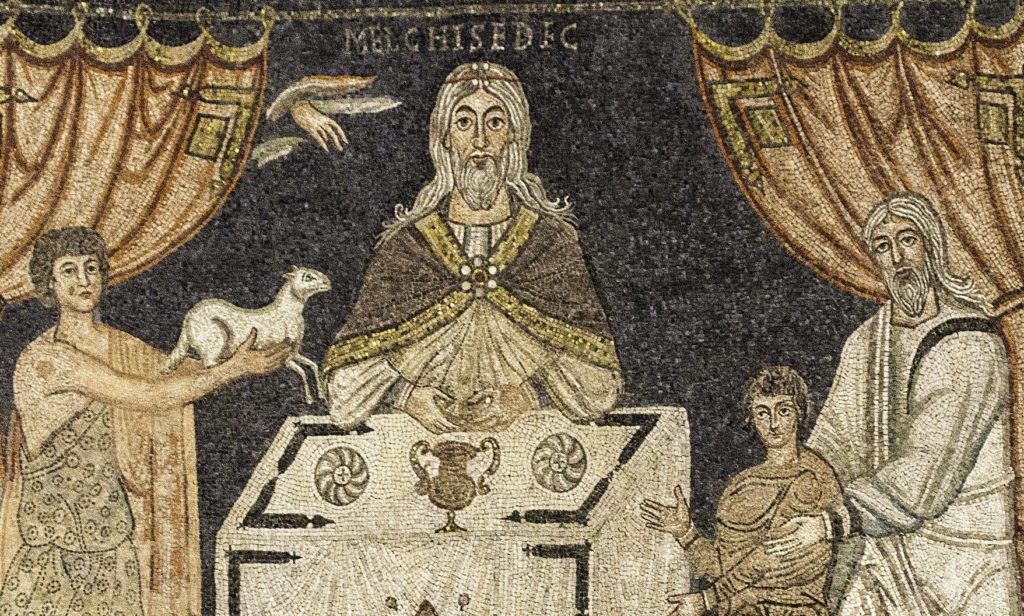
    First, his name means king of righteousness, then also, king of Salem, meaning king of peace.

    Good credentials. Yet the author of Hebrews then points out that Moses did not give us any genealogies to tell who this king of righteousness might be.

    Hebrews 7:

    NOTE: Versions in link above: CSB; NKJV; Complete Jewish Bible; NLT; NIV

    3 Without father, mother, or genealogy, having neither beginning of days nor end of life, but resembling the Son of God, he remains a priest forever.

    Now consider how great this man was: even Abraham the patriarch gave a tenth of the plunder to him.

    Hebrews 7:4

    We worship God, perhaps giving a tithe (tenth), but Abram gave a tenth to ‘the king of righteousness, king of peace.‘ The author then proceeds to quote Mosaic Law which instructs Levite priests to collect a tithe to the Lord. He presents the case for the Law and application, then asks for our mature look at the Messiah as Priest.

    11 Therefore, if perfection were through the Levitical priesthood (for under it the people received the law), what further need was there that another priest should rise according to the order of Melchizedek, and not be called according to the order of Aaron?

    Melchizedek belonged to a different tribe than Abraham (and therefore, Levi). Moses said nothing about that tribe concerning priests.

    Jesus, Son of Man, descended in the flesh from David and Judah, son of Israel [Jacob], son of Isaac, son of Abraham – Jesus the Messiah is not a Levite priest. Therefore the Messiah is something more.

    And it is yet far more evident if, in the likeness of Melchizedek, there arises another priest who has come, not according to the law of a fleshly commandment, but according to the power of an endless life. For He testifies:
    “You are a priest forever
    According to the order of Melchizedek.

    Hebrews 7:15-17 NKJV [quote of Psalm 110:4]

    Melchizedek, Priest to GOD MOST HIGH

    וּמַלְכִּי־צֶ֨דֶק֙ מֶ֣לֶךְ שָׁלֵ֔ם הֹוצִ֖יא לֶ֣חֶם וָיָ֑יִן וְה֥וּא כֹהֵ֖ן לְאֵ֥ל עֶלְיֹֽון׃

    And Melchizedek king of Salem brought out bread and wine; now he was a priest of God Most High.

    gENESIS 14:18 wlc; nasb

    Set aside the former commandment, because it is useless here, states the author of Hebrews. (The Law completed nothing.) 7:19 [NET] On the other hand a better hope is introduced, through which we draw near to God.

    Once again, the author points to God’s oath to Abraham from Psalm 110:4.

    110:4 נִשְׁבַּע יְהוָה וְלֹא יִנָּחֵם אַתָּֽה־כֹהֵן לְעֹולָם עַל־דִּבְרָתִי מַלְכִּי־צֶֽדֶק׃

    The LORD has sworn, and will not change his mind: “You are a Kohen forever in the order of Malki-Tzedek.”

    Psalm 110:4 Masoretic text & Hebrew Names Version

    The writer of Hebrews points to the priesthood, where Levites are appointed by birth rather than by an oath with the Lord. Jesus was not a Levite and neither was Melchizedek. The oath is a better promise, therefore he makes this case for both.

    21 but he [Melchizedek] became a priest with an oath made by the one who said to him:

    The Lord has sworn
    and will not change his mind,
    “You are a priest forever.”

    22 Because of this oath, Jesus has also become the guarantee of a better covenant.

    Though the scripture comes from a Psalm of David, the text is not about King David, who also died. The author of Hebrews also notes that Levitical priests die.

    But because Jesus lives forever, his priesthood lasts forever. Therefore he is able, once and forever, to save[e] those who come to God through him.

    Hebrews 7:24-25A NLT

    He lives forever to intercede with God on their behalf.

    26 He is the kind of high priest we need because he is holy and blameless, unstained by sin.

    Melchizedek like Jesus

    Some will make a case for the King and Priest of Salem as a “preincarnate” appearance of the Messiah Jesus. Certainly Christ IS our intercessor at the Altar.

    He [Jesus] has been set apart from sinners and has been given the highest place of honor in heaven. 27 Unlike those other high priests, he does not need to offer sacrifices every day.

    Certainly both Melchizedek and Jesus may be described as a: “King of peace” שָׁלֵם and “King of righteousnessצָדַק. Malki-Tzedek מַלְכִּי־צֶדֶק, transliterated into English from the Hebrew, from מֶלֶךְ (H4428) and צֶדֶק (H6664), meh’·lek – tseh’·dek. He is a King of Justice, of what is right in the place of peace.

    Abram gives him an offering of peace, the spoils of victory over the princes of evil. He stands at the altar of sacrifice on our behalf before the Lord God.

    The author of Hebrews, like David in Psalm 110, makes a case for the Messiah as a better intercessor for our sins.

    a text written later than the Torah, appoints a Son who has been brought to the goal forever.

    Hebrews 7:28c Complete Jewish Bible

    He will continue the case for Jesus as our Priest and intercessor in the next chapter of his letter to the Hebrews.

    To be continued...
  • A River of Redemption Flowing from Eden – Justice

    A River of Redemption Flowing from Eden – Justice

    Contemplation of Justice by James Earle Fraser – US Supreme Court building

    Justice

    At the beginning of this series I outlined topics which included justice. Here we will explore their linked applications.

    • Commandment
    • Law
    • Justice
    • Judgment
    • Penalty and Sentence
    • Redemption

    Justice – n. 1) fairness. 2) moral rightness. 3) a scheme or system of law in which every person receives his/ her/its due from the system, including all rights, both natural and legal. – source: dictionary.law.com

    The multi-branched tree of the knowledge of good and evil.

    “but you must not eat from the tree of the knowledge of good and evil, for on the day you eat from it, you will certainly die.” – Genesis 2:17 CSB

    Paradise by Lucas Cranach the Elder – painter, draughtsman, printmaker and court painter – 1530

    We move now from relatively calm waters of Adam knowing the difference between good and evil to a more tumultuous current of original sin flowing through the generations.

    Justice, and only justice, you shall follow, that you may live and inherit the land that the LORD your God is giving you. – Deuteronomy 16:20

    Justice in the Egypt of Joseph and Moses

    Recent research from Yale Law, The Representation of Justice in Ancient Egypt, confirms concepts of justice learned by the Hebrews. I have quoted it extensively below.

    The concept of “law” and “justice” are intimately associated with the proper behavior of kings and were embedded in every royal ritual.

    https://www.egyptprivatetourguide.com/egyptian-facts/ancient-egyptian-justice-interesting-facts-law-ancient-egypt/
    Ma’at Ancient Egyptian goddess of justice

    Could common citizens expect an example of morality from their leaders? Even the Pharaoh and King?

    In a word, ‘yes.’ According to research of ancient civilizations predating Rome and Greece, a natural ‘connective justice’ was presumed in law.

    The imperfect branches of connective justice

    Again, the research of J.G. Manning in the Yale Journal of Law & the Humanities:

    Ma’at (“connective justice,”) governed personal moral behavior, as can be seen in religious texts, as well as the proper relationships between gods and men, between kings and society, and between individuals. Thus it literally connected everyone from the gods, through the king, down to the lowliest farmer. It was the mirror of the divine order of the world and also the foundation of private ethical behavior. Ma’at was the most persistent and pervasive idea in ancient Egyptian society.

    Importantly, the most visible and the longest lasting image of Ma’at in
    a private context, at least to the modem observer, is the famous “last
    judgment scene,” in which an individual faced his or her mortality by
    having his or her life deeds weighed in the balance against the symbol of justice, the ostrich feather, in front of all of the gods in Egypt.

    If found wanting, the person’s soul was devoured and his or her existence was extinguished. On the other hand, if found “true of voice,” one gained eternal bliss in the afterlife. This was not the public representation of state justice, but, rather a more intimate depiction of the expectations of private moral behavior.

    Do you recognize this universal connection to the truth in the Law given to Moses on Sinai by the Lord God?

    Delegated authority of the Law

    Application of law ultimately leads back to the same question Adam would have to judge after gaining ‘knowledge of good and evil.’ 

    What is right? Is this good or evil in the eyes of the Lord?

     Basic precedents of law include English Common Law and other fundamental documents.

    https://www.law.berkeley.edu/library/robbins/CommonLawCivilLawTraditions.html
    Sir William Blackstone
    • of the United States, in Order to form a more perfect Union, establish Justice, … and secure the Blessings of Liberty … ordain and establish this Constitution for the United States of America.
      • The Bill of Rights & evolving societal amendments
    • Religious Law 
    Hammurabi a Babylonian code of law

    The contemporary legal systems of the world are generally based on one of four basic systems: civil law, common law, statutory law, religious law or combinations of these. However, the legal system of each country is shaped by its unique history and so incorporates individual variations.[1]

    A Stream Towards Justice

    We have examined the role of authority in the law. It is here that the roles of God, government, family and community all come into play.

    The basis of all law is the authority by which it is given. Justice requires effective application and fair administration of remedies by a righteous and impartial judge. – Roger Harned


    A commandment comes directly from Almighty God. Call it ‘religious law,’ but an absolute over-riding Authority connects God’s word to man’s actions.

    Hebrew followers of Moses heard the Lord speak directly and were afraid. Even so, they disobeyed the direct command of God even before Moses later descended Sinai with the stone tablets – the Law, carved by the finger of God in stone.

    This inviolable Law would be carried in the Ark of the Covenant; not as reference, but as witness to their own promises to God. Yet many would violate (trespass) their solemn covenant promises to God many times and in many places throughout the long history of Israel.

    Penalty of the Law

    Even though prescribed specifically for certain violations in specific contexts of the Law, ‘penalty’ is not mentioned by name in the King James Version of the Bible. The overriding issue, simply, is innocence or guilt and not particularly the punishment.

    A divine sentence is in the lips of the king: his mouth transgresseth not in judgment. – Proverbs 16:10 KJV

    Have you ever considered that the ‘sentence’ of the court is the spoken judgement against the convicted violator of the law?

    Because sentence against an evil work is not executed speedily, therefore the heart of the sons of men is fully set in them to do evil. – Ecclesiastes 8:11 KJV

    Perhaps you have even noted the legal principle of a right to a speedy trial in the wise advise above.

    Now note the usage of the Hebrew root for the consequence of guilt:

    דָּם – dam

    • blood (342x),
    • bloody (15x),
    • person (with H5315) (1x),
    • bloodguiltiness  (1x)
    • bloodthirsty (with H582) (1x),
    • vr blood (1x)

    Again, this goes to the higher authority of Almighty God. Perhaps a good Biblical example of commanded penalty would be ‘capital punishment.’

    “Whoever sheds human blood,
    by humans his blood will be shed,
    for God made humans in his image.

    Genesis 9:6 CSB

    “But you, be fruitful and multiply; spread out over the earth and multiply on it,”[Gen. 9:7] God commanded Noah and his family who were spared by the judgement of the earth. 

    Looking upstream through the generational sins even in the time of Moses, redemption from bloodguilt against God hardly seems attainable. 

    Kings and Nations under God

    And what cause soever shall come to you of your brethren that dwell in their cities, between blood and blood, between law and commandment, statutes and judgments, ye shall even warn them that they trespass not against the LORD, and so wrath come upon you, and upon your brethren: this do, and ye shall not trespass. – 2 Chronicles 19:10 KJV

    reign of Jehoshaphat ~873–849 BC

    From later records of Israel (and Judah after David), we learn of the continued importance of the Law or Commandment of God to this ‘chosen’ nation. The above quote from 2 Chronicles is recorded in the time of Jehoshaphat, in the 9th century Before Christ.

    Note the distribution of authority given by King Jehoshaphat to others from 2 Chronicles 19:

    A King’s delegation of justice

    4 Jehoshaphat lived in Jerusalem, and once again he went out among the people from Beer-sheba to the hill country of Ephraim and brought them back to the Lord, the God of their ancestors. 5 He appointed judges in all the fortified cities of the land of Judah, city by city.

    6 Then he said to the judges, “Consider what you are doing, for you do not judge for a mere mortal, but for the Lord, who is with you in the matter of judgment. 7 And now, may the terror of the Lord be on you. Watch what you do, for there is no injustice or partiality or taking bribes with the Lord our God.”

    8 Jehoshaphat also appointed in Jerusalem…

    • some of the Levites and priests
    • and some of the Israelite family heads…

    Delegated authority from the Lord to the King, then to officials responsible for religion, for community and for family. Even warning of how to manage outsiders (foreigners and servants), all under delegated authority of the Lord through others. Not freedom, as we know it. Certainly not license to choose whether to obey or defy any law or regulation. 

    10 For every dispute that comes to you from your brothers who dwell in their cities—whether it regards differences of bloodguilt, law, commandment, statutes, or judgments—you are to warn them, so they will not incur guilt before the Lord and wrath will not come on you and your brothers. Do this, and you will not incur guilt.

    11 “Note that Amariah, the chief priest, is over you in all matters related to the Lord, and Zebadiah son of Ishmael, the ruler of the house of Judah, in all matters related to the king, and the Levites are officers in your presence. Be strong; may the Lord be with those who do what is good.”

    God will judge

    God is a righteous judge
    and a God who shows his wrath every day. – Psalm 7:11

    He will judge your people with righteousness
    and your afflicted ones with justice. – Psalm 72:2

    Psalm 111:9 Christian Standard Bible (CSB)
    He has sent redemption to his people.
    He has ordained his covenant forever.
    His name is holy and awe-inspiring.

    To be continued…

  • A River of Redemption Flowing from Eden – Joseph

    Joseph Unlike Moses

    “Can we find anyone like this, a man who has God’s spirit in him?” … Pharaoh said to Joseph, “I am Pharaoh and no one will be able to raise his hand or foot in all the land of Egypt without your permission.” Pharaoh gave Joseph the name Zaphenath-paneah… – Genesis 41

    None can dispute that Joseph and Moses were both redeemers of the Hebrews, but they were very different men. The Lord called Moses to bring Israel from Egypt, but used Joseph to save both Egypt and Israel. Joseph, or Zaphenath-paneah as he was known in all of Egypt, preceded Moses by some generations. You will encounter two very different men by comparing the beginnings of their contrasting lives.

    Moses

    We read in Number 12: Moses was a very humble man, more so than anyone on the face of the earth. The Lord, speaking to Aaron & Miriam said:

    “Listen to what I say:
    If there is a prophet among you from the Lord,
    I make myself known to him in a vision;
    I speak with him in a dream.
    7 Not so with my servant Moses;
    he is faithful in[a] all my household.
    8 I speak with him directly,
    openly, and not in riddles;
    he sees the form of the Lord.

    What could be more humbling than standing before the form of the Lord, hearing the words of the Almighty directly?

    Moses was born into humble circumstances, raised in knowledge of both power and lowliness and willingly obeyed the Lord’s commands. Though brought up as a prince of Egypt for two decades, his mother sewed humility into Moses’ heart, as his servant nursemaid.

    Because he was a prince, Moses could easily escape to Midian for twenty more years to live a humble life in freedom. His choice to defend Hebrew slaves would have been self-indictment of disobedience to the King’s commands and conviction resulting in his own death. A return to Egypt at age eighty in obedience to the Lord showed only humility in the face of certain powerful opposition from Pharaoh.

    Moses is raised, educated and served by slaves in an Egyptian palace of perhaps the most powerful man on earth in his time. Joseph, by contrast, comes to Egypt by birth, but as a seventeen-year-old slave.

    Joseph

    Unlike Moses, Joseph was by no means a humble young man. He was blessed with good intellect and great favor, but learned humility later in life. He lived in the land of Canaan and tended sheep with his brothers. 

    (Do you recall from our previous post what Pharaoh thought of shepherds?) Joseph would not only enter Egypt as a shepherd, but as a captive slave.

    Genesis 37:

    3 Now Israel [Jacob] loved Joseph more than his other sons because Joseph was a son born to him in his old age, and he made a robe of many colors for him.

    Trouble waiting to happen. This teenager, Joseph, is favorite of his father (his mother, deceased) who makes him look like an administrator over his adult working brothers. Joseph is anything but humble and in fact appears to his brothers to be full of himself, even arrogant.

    5 Then Joseph had a dream. When he told it to his brothers, they hated him even more. 6 He said to them, “Listen to this dream I had: 7 There we were, binding sheaves of grain in the field. Suddenly my sheaf stood up, and your sheaves gathered around it and bowed down to my sheaf.”

    8 “Are you really going to reign over us?” his brothers asked him. “Are you really going to rule us?” So they hated him even more because of his dream and what he had said.


    We know God’s purpose for Joseph and that the outcome would finally prove Joseph’s dream to be true. In fact, Joseph would become a redeemer of Egypt because of his dreams from the Lord.

    … So Joseph set out after his brothers and found them at Dothan.

    18 They saw him in the distance, and before he had reached them, they plotted to kill him. 19 They said to one another, “Oh, look, here comes that dream expert! 20 So now, come on, let’s kill him and throw him into one of the pits…

    … his brothers pulled Joseph out of the pit and sold him for twenty pieces of silver to the Ishmaelites, who took Joseph to Egypt.

    Joseph, betrayed by his brothers for twenty pieces of silver, becomes a slave in Egypt.

    The Lord was with Joseph

    How can you say that the Lord is with someone betrayed, taken into the hands of God’s enemies and condemned to exile? The evil hand of his own brothers perhaps betrayed him to eventual death. Why does God allow it?

    As Joseph’s story unfolds we learn the answer of the Lord from the very words of Joseph to his brothers.

    Genesis 39:

    2 The Lord was with Joseph, and he became a successful man, serving in the household of his Egyptian master. 3 When his master saw that the Lord was with him and that the Lord made everything he did successful, 4 Joseph found favor with his master and became his personal attendant. Potiphar also put him in charge of his household and placed all that he owned under his authority…

    … the Lord blessed the Egyptian’s house because of Joseph. The Lord’s blessing was on all that he owned, in his house and in his fields. 6 He left all that he owned under Joseph’s authority…

    But Joseph again suffers unexpected consequence due to false accusation by his master’s wife.  His master then obligingly sends Joseph to prison.

    21 But the Lord was with Joseph and extended kindness to him. He granted him favor with the prison warden. 22 The warden put all the prisoners who were in the prison under Joseph’s authority, and he was responsible for everything that was done there. 23 The warden did not bother with anything under Joseph’s authority, because the Lord was with him, and the Lord made everything that he did successful.

    Although Joseph must remain in Pharaoh’s prison, in fact by the Lord’s purpose he is given authority.

    Dreams and Prophesy

    Prior to this and before betrayal by his own brothers Joseph had had another dream, which turns out to be prophesy.

    Genesis 37: “Look,” he said, “I had another dream, and this time the sun, moon, and eleven stars were bowing down to me.”

    10 He told his father and brothers, and his father rebuked him.

    Now in prison Joseph has another prophetic dream. Remember, he is in charge of and this time no doubt respected by his fellow prisoners.

    Genesis 40:

    5 The king of Egypt’s cupbearer and baker, who were confined in the prison, each had a dream. Both had a dream on the same night, and each dream had its own meaning…

    9 So the chief cupbearer told his dream to Joseph… 16 When the chief baker saw that the interpretation was positive, he said to Joseph, “I also had a dream.

    18 “This is its interpretation,” Joseph replied. “The three baskets are three days. 19 In just three days Pharaoh will lift up your head—from off you—and hang you on a tree.

    And so it happened that not only was the baker hanged, but the cupbearer was released, forgetting about Joseph. 

    Genesis 41:

    At the end of two years Pharaoh had a dream… 9 Then the chief cupbearer said to Pharaoh, “Today I remember my faults… 

    12 Now a young Hebrew, a slave of the captain of the guards, was with us there. We told him our dreams, he interpreted our dreams for us, and each had its own interpretation. 13 It turned out just the way he interpreted them to us: I was restored to my position, and the other man was hanged.”

    14 Then Pharaoh sent for Joseph…

    This brings us to the historical scenario where the Lord shows a coming famine, seven years into the future. The King of Egypt trusts Joseph to help them prepare. The severity of the middle east famine will eventually bring Israel to send his other sons from Canaan to Egypt for grain.

    A Prophet of Two Lands

    The Lord’s purpose in Joseph’s captivity and rise to power in Egypt is to save two lands from famine and prepare Israel for the promised land. As you know, he is brought before Pharaoh and interprets dreams of prophesy.

    15 Pharaoh said to Joseph, “I have had a dream, and no one can interpret it. But I have heard it said about you that you can hear a dream and interpret it.”

    16 “I am not able to,” Joseph answered Pharaoh. “It is God who will give Pharaoh a favorable answer.”

    It is always God who brings true prophesy. The truth of Joseph’s predictions make Pharaoh a believer in the Lord God!

    “Can we find anyone like this, a man who has God’s spirit in him?”

    39 So Pharaoh said to Joseph, “Since God has made all this known to you, there is no one as discerning and wise as you are. 40 You will be over my house, and all my people will obey your commands. Only I, as king, will be greater than you.”

    Contrary to Culture

    “Only I, as king, will be greater than you,” Pharaoh states. He is not a god, but a most-powerful man dependent upon God and his true Prophet. 

    Note that the changes ahead for Egypt will take fourteen years. Israel’s sons will enter the land as immigrants in need, bowing humbly to this leader, second in command to the King.

    So he placed him over all the land of Egypt. 44 Pharaoh said to Joseph, “I am Pharaoh and no one will be able to raise his hand or foot in all the land of Egypt without your permission.”

    45 Pharaoh gave Joseph the name Zaphenath-paneah and gave him a wife, Asenath daughter of Potiphera, priest at On.  And Joseph went throughout the land of Egypt.

    Joseph’s Administration
    46 Joseph was thirty years old when he entered the service of Pharaoh king of Egypt. Joseph left Pharaoh’s presence and traveled throughout the land of Egypt.


    To be continued…